

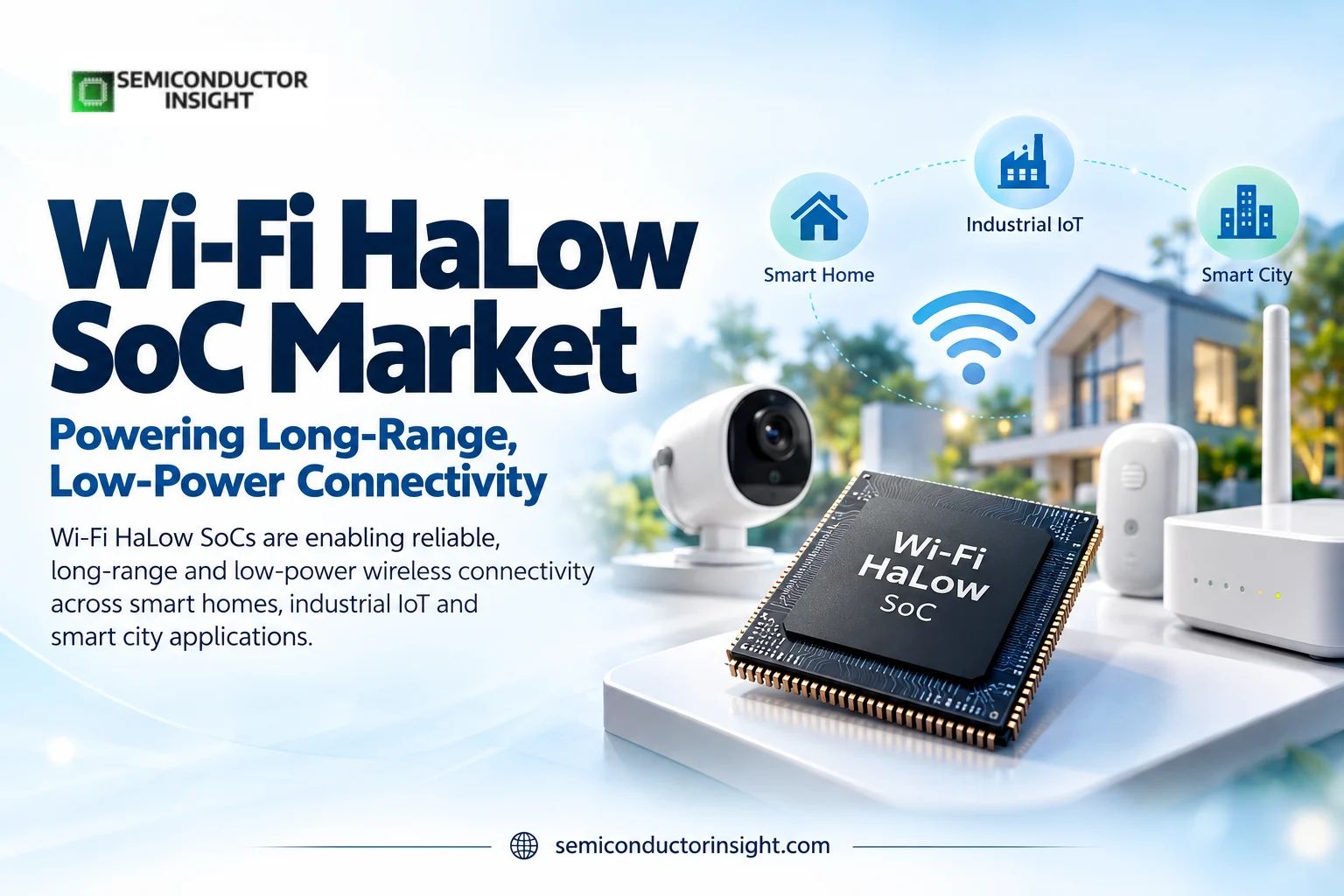
Wi-Fi HaLow SoC Market Trends 2026: Sub-GHz Connectivity, Edge AI and Long-Range IoT Reshape Embedded Silicon
Wi-Fi HaLow is becoming more than a long-range version of conventional Wi-Fi. Based on IEEE 802.11ah, the technology uses sub-GHz spectrum to connect devices that can sit far beyond conventional indoor Wi-Fi coverage. Its appeal is particularly strong where designers need IP connectivity, low power and meaningful data throughput without deploying a cellular modem or proprietary gateway architecture.
Silex describes Wi-Fi HaLow as a technology introduced to support long-range, low-power and secure IoT networking, while current silicon platforms are extending the technology into industrial and embedded applications. Silex Technology
The Silicon Numbers Are Getting More Interesting
The latest generation of dedicated HaLow SoCs illustrates how quickly the underlying semiconductor architecture is evolving. Morse Micro’s MM8108 reaches a peak PHY rate of 43.3 Mbps, uses a 5 × 5 mm FC-BGA package and integrates the power amplifier and low-noise amplifier. The chip supports 1, 2, 4 and 8 MHz channels as well as SPI, SDIO 2.0 and USB 2.0 host interfaces.
Its predecessor, the MM6108, supports up to 32.5 Mbps and uses a 6 × 6 mm QFN package. That progression matters because SoC integration directly affects board size, RF design complexity and the number of external components required in compact IoT equipment.
Why Sub-GHz Changes the Device Design?
- The defining feature of HaLow silicon is its operating frequency rather than simply its Wi-Fi branding.
- Sub-GHz signals can travel farther and penetrate walls and other obstacles more effectively than higher-frequency conventional Wi-Fi.
- Morse Micro specifies up to 10 times the range of conventional Wi-Fi and two-to-five-times stronger penetration through walls, floors and obstructions for its current silicon.
That characteristic creates a different design equation for connected products.
Sensor → HaLow SoC → Sub-GHz RF link → HaLow access point → IP network → Cloud / Edge application
- Instead of building a short-range sensor network around multiple access points, developers can use fewer connectivity points in some deployments, particularly where devices are dispersed through warehouses, campuses, agricultural fields or industrial facilities.
Edge AI Is Creating a New Role for HaLow
A significant 2026 development is the attempt to connect existing computing equipment to HaLow without redesigning the complete platform. In August 2026, Morse Micro announced two USB dongle reference designs based on the MM8108. The company says the designs can add Wi-Fi HaLow connectivity to devices through USB, with OpenWRT drivers available for compatible access-point and router applications.
This is important for edge computing because cameras, gateways and embedded processors increasingly need connectivity outside traditional Wi-Fi coverage. A 43.3 Mbps PHY-class link also creates considerably more headroom than ultra-low-data-rate wireless technologies for selected video, telemetry and firmware-update applications.
The Application Map Is Expanding
The commercial use cases are spreading well beyond basic sensors. Current Wi-Fi HaLow silicon platforms identify residential cameras and doorbells, building access control, occupancy sensing, industrial condition monitoring, inventory tracking, worker safety and agricultural monitoring among potential applications.
Agriculture is particularly relevant because farms can contain thousands of distributed sensing points separated by substantial distances. Soil monitoring, irrigation control, livestock tracking and environmental measurement can all benefit from connectivity that combines longer reach with battery-conscious operation.
Developer Support Is Becoming Part of the Chip Story
- Hardware specifications are only one part of semiconductor adoption. Software availability can determine how quickly an SoC moves from evaluation board to production equipment.
- In September 2026, Morse Micro announced that its Wi-Fi HaLow software would become accessible through the Zephyr Project, an open-source real-time operating system widely used for embedded devices.
- The company positioned the integration as a way to make its drivers and sample applications easier for developers to use across embedded platforms.
- This points toward an important change in connectivity silicon: the development ecosystem surrounding the chip is becoming almost as significant as the RF specification itself.
Security Remains Built Into the Connectivity Layer
Wi-Fi HaLow also inherits established Wi-Fi security architecture rather than requiring an entirely separate security framework. Current HaLow SoCs support WPA3, Protected Management Frames and Opportunistic Wireless Encryption, with AES and SHA-2 cryptographic functions handled in hardware on supported platforms.
For industrial and building deployments, that combination of native IP connectivity and Wi-Fi-grade security can simplify integration where devices need to communicate with existing network infrastructure.
For additional report info, feel free to view our most recent edition: https://semiconductorinsight.com/report/wi-fi-halow-soc-market/
The Emerging SoC Design Formula
The next phase of the Wi-Fi HaLow SoC market is being shaped by a clear engineering formula: smaller silicon + integrated RF + higher throughput + lower power + broader software support.
The movement from 32.5 Mbps-class first-generation silicon to 43.3 Mbps second-generation platforms, combined with 5 × 5 mm packaging and integrated RF front ends, demonstrates how the technology is progressing from an emerging wireless standard into a more complete semiconductor platform.
As industrial devices, smart buildings, agricultural equipment and edge systems become more geographically distributed, Wi-Fi HaLow SoCs are gaining a distinct position between conventional Wi-Fi and ultra-low-data-rate IoT radios. The defining opportunity is not simply longer wireless range; it is the ability to deliver IP-native, secure and increasingly capable connectivity in places where conventional Wi-Fi architecture becomes difficult to scale.

Comments (0)