
Why Smart Buildings Are Fuelling Smart Lock (Fingerprint and BLE) SoC Market Growth?
The global smart lock ecosystem is entering a completely different phase where semiconductor technology is becoming the real innovation engine behind modern security systems. Earlier smart locks focused mainly on remote access and digital keypads, but today’s advanced systems combine fingerprint authentication, Bluetooth Low Energy connectivity, AI processing, cloud synchronisation, and ultra-low-power semiconductor architectures into a single compact SoC design.
This transformation is happening as homes, offices, hotels, and rental properties increasingly shift toward connected infrastructure. Consumers no longer want traditional locks that only secure doors. They now expect intelligent access systems capable of recognising fingerprints within milliseconds, connecting seamlessly with smartphones, and operating for months without battery replacement.
At the centre of this evolution is the Smart Lock (Fingerprint and BLE) SoC market, where semiconductor manufacturers are building highly integrated chipsets designed specifically for intelligent entry systems.
Curious about the report? Dive into our newest updated version at no cost: https://semiconductorinsight.com/report/smart-lock-fingerprint-ble-soc-market/
Semiconductor Integration Is Shrinking Hardware Complexity
- One of the biggest shifts in smart lock technology is semiconductor consolidation. Earlier smart lock systems required separate processors for biometric sensing, wireless communication, memory management, and security encryption.
- Modern SoCs are now integrating all these functions into a single semiconductor platform.
- This integration is significantly reducing device size while improving battery efficiency and response speed.
- According to recent semiconductor design discussions across embedded electronics platforms, newer BLE 5.3 SoCs are enabling faster pairing, stronger encryption, and improved low-power performance for smart lock applications.
- The impact is especially visible in compact residential smart locks where space efficiency directly affects product design.
- Smaller semiconductor footprints are allowing manufacturers to create thinner fingerprint modules and sleeker lock mechanisms suitable for apartments, co-living spaces, and modern office interiors.
Ultra Low Power Chips Are Becoming the Core Selling Point
Battery performance has become one of the most important competitive factors in the smart lock semiconductor market. Consumers expect devices to remain active for long periods without frequent charging or battery replacement.
To address this demand, semiconductor firms are increasingly developing ultra-low-power BLE architectures that minimise energy consumption during standby mode while maintaining continuous biometric readiness.
At the Consumer Electronics Show 2026, several smart lock companies introduced systems featuring infrared wireless charging, solar-assisted power support, and kinetic energy harvesting technologies.
These advancements are heavily dependent on efficient semiconductor optimisation because every milliwatt directly impacts lock performance and battery lifespan. Some advanced BLE SoCs now support deep sleep modes that consume extremely low standby power while remaining ready for instant fingerprint recognition.
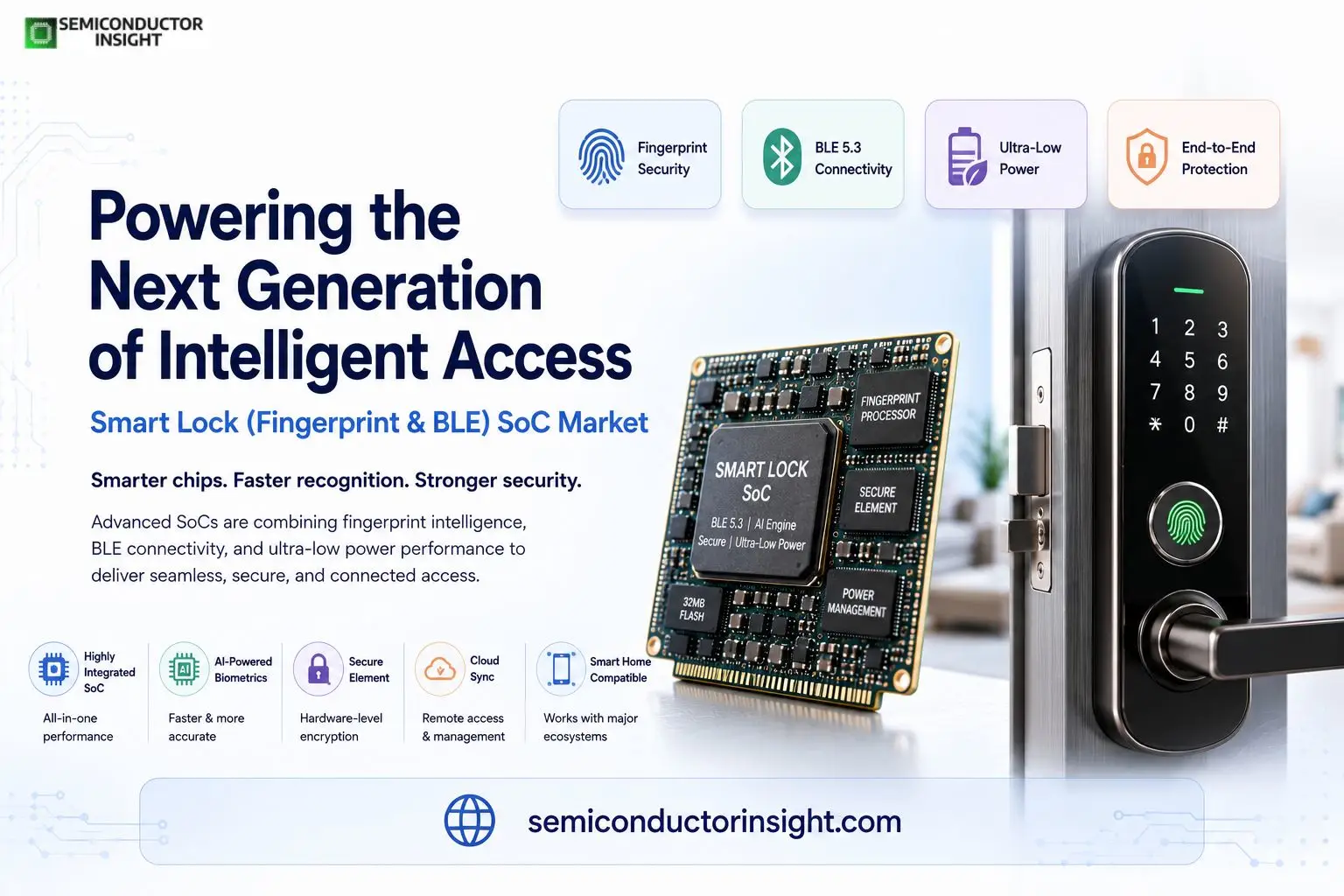
Semiconductor Functions inside Modern Smart Locks
- BLE SoC: Enables wireless smartphone pairing, app connectivity, and secure Bluetooth communication.
- Fingerprint Processor: Handles fast biometric scanning and accurate fingerprint authentication.
- Secure Element: Protects sensitive user data through hardware encryption and secure authentication.
- MCU Core: Manages lock operations, access permissions, and internal system control.
- Power Controller: Optimises battery usage and supports low-power performance for longer operation.
Fingerprint Recognition Is Becoming Faster and More Intelligent
Biometric authentication is rapidly moving beyond simple fingerprint matching. Semiconductor companies are now integrating AI-accelerated fingerprint processing directly into smart lock SoCs to improve recognition accuracy and reduce false rejections.
This matters because consumers expect immediate access without repeated scans. Delays of even a few seconds negatively affect user experience. Modern semiconductor architectures are solving this by enabling local biometric processing directly on the chip instead of depending entirely on cloud verification.
In countries like South Korea and China, premium smart lock systems already combine fingerprint scanning with palm vein recognition, facial authentication, and smartphone proximity detection.
This trend is pushing semiconductor manufacturers toward multi-authentication SoCs capable of handling several biometric inputs simultaneously without increasing hardware complexity.
Smart Home Ecosystems Are Expanding BLE Semiconductor Demand
- Another major factor shaping Smart Lock (Fingerprint and BLE) SoC market is ecosystem compatibility. Consumers increasingly expect smart locks to work with smartphones, voice assistants, home automation hubs, and connected surveillance systems.
- The launch of the new Connectivity Standards Alliance Aliro smart lock standard is expected to accelerate interoperability between devices across Android and iOS ecosystems.
- This is increasing demand for advanced BLE semiconductor platforms capable of supporting NFC communication, Matter compatibility, and ultra-wideband technologies alongside traditional Bluetooth connectivity.
Semiconductor manufacturers are therefore focusing on highly flexible SoCs that support firmware updates, encrypted credential storage, and multiple wireless communication standards within one architecture.

Comments (0)