
Why Semiconductor Technology Is the Backbone of the Modern Battery Market?
Battery market refers to the global industry involved in the research, manufacturing, distribution, and application of electrochemical energy storage devices that convert chemical energy into electrical energy. Batteries store electricity and release it when required to power a wide range of devices, vehicles, and systems.
The global battery ecosystem is undergoing a rapid transformation as semiconductor technologies increasingly integrate with advanced energy storage systems. Batteries are no longer standalone electrochemical devices; they are becoming intelligent systems powered by power electronics, battery management chips, sensors, and control circuits. This convergence is particularly visible in electric vehicles, renewable energy storage, and high-performance electronics.
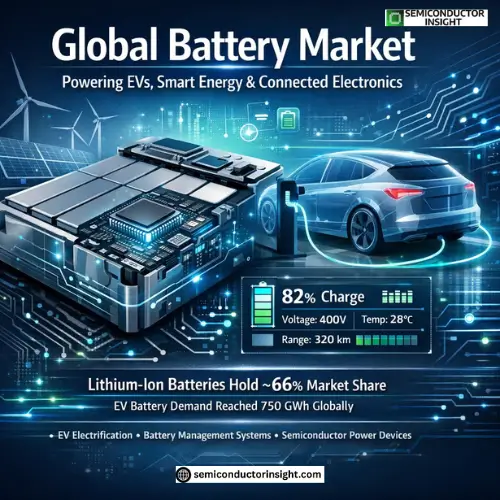
Lithium-ion batteries currently dominate the global battery landscape with approximately 66% market share, followed by lead-acid batteries with around 17% share and nickel-based chemistries with about 7%. Emerging technologies such as flow batteries and solid-state systems together account for roughly 5% of the market, signalling a shift toward new chemistries and architectures.
As electrification expands across industries, the relationship between batteries and semiconductor technologies is becoming one of the most critical drivers shaping the global energy transition.
In March 2026, Nordic Semiconductor, a global leader in low-power wireless connectivity solutions, announced at Embedded World 2026 Nordic Fuel Gauge v2.0, a significant update to its extremely accurate software-based fuel gauge solution for the award-winning nPM1300 and nPM1304 Power Management ICS. The update expands intelligent battery management to a variety of power-constrained IoT products by adding comprehensive State-of-Health estimation, adaptive battery modelling, and long-term fleet analytics capabilities.
Semiconductor Power Devices Driving Battery Efficiency
- Modern battery systems depend heavily on semiconductor power devices such as MOSFETs, IGBTs, and silicon carbide (SiC) components. These devices regulate energy conversion between batteries and electrical loads.
- Electric vehicles provide the clearest example of this integration. Global EV sales surpassed 14 million units in 2023, accounting for nearly 18% of total car sales worldwide.
- Each electric vehicle contains hundreds of semiconductor chips controlling battery operation, charging, and power distribution. Semiconductor-based battery management systems monitor parameters such as voltage balance, temperature gradients, and current flow in real time.
- In addition, silicon carbide power semiconductors improve power conversion efficiency, allowing batteries to operate with lower energy losses during high-current charging and discharging cycles.
- As EV adoption grows, semiconductor manufacturers are increasingly collaborating with battery producers to develop optimized integrated power systems.
Battery Demand Expansion across Key Industries
Battery deployment is accelerating across multiple sectors including electric mobility, consumer electronics, grid storage, and industrial automation.
The electric vehicle sector alone accounts for more than 60% of global battery demand measured in gigawatt-hours, making it the largest consumer of advanced battery systems.
Global EV battery demand reached approximately 750 GWh in 2023, highlighting the massive scale of energy storage required to support transportation electrification.
Meanwhile, stationary battery energy storage systems are emerging as another important market segment. Grid-scale batteries used for renewable integration represent more than 15% of lithium-ion battery deployment globally.
Don’t Forget to Surf Our Updated Report for More Detailed Analysis:
https://semiconductorinsight.com/report/battery-market/
Regional Manufacturing Landscape
The global battery manufacturing landscape is heavily concentrated in Asia-Pacific, which accounts for approximately 63% of total battery production capacity worldwide. Europe contributes around 21% of production, while North America represents about 14% of the global share.
China alone processes nearly 65% of the world’s lithium and around 80% of global cobalt, positioning the country as a critical hub in the battery supply chain.
In terms of battery cell manufacturing capacity, the world reached approximately 3.5 terawatt-hours of production capacity by the end of 2023, reflecting rapid expansion of gigafactories globally.
This massive scale of production requires extensive semiconductor infrastructure, including sensors, monitoring systems, and automated process control chips used in battery manufacturing lines.
Technology Innovation and Emerging Battery Architectures
The next generation of batteries is being developed through breakthroughs in both electrochemistry and semiconductor engineering.
Lithium-iron-phosphate (LFP) batteries now represent nearly 40% of global EV batteries, while nickel-manganese-cobalt (NMC) chemistries account for more than half of high-performance applications.
Meanwhile, semiconductor-controlled smart battery management systems are enabling improved energy density and safety performance.
Energy density in advanced lithium-ion cells has improved steadily, with high-performance NMC cells reaching around 300 Wh/kg, while emerging sodium-ion batteries deliver approximately 160 Wh/kg.
Recent experimental batteries are pushing boundaries even further. New semi-solid-state battery prototypes have demonstrated energy densities exceeding 500 Wh/kg, potentially enabling electric vehicles to travel over 1,000 km per charge.
Such technologies rely heavily on semiconductor-based monitoring and safety control systems to ensure stable operation.
Battery Supply Chain and Material Dependencies
The battery supply chain spans mining, chemical processing, cell manufacturing, and system integration. Semiconductor technologies are becoming essential at every stage of this value chain.
More than 70% of global cobalt production originates from the Democratic Republic of Congo, while China processes the majority of battery raw materials and rare earth elements.
Additionally, cathode materials account for roughly 40% of the total cost of a battery pack, making material optimization a key priority for manufacturers.
Battery recycling technologies are also improving rapidly, with hydrometallurgical processes capable of recovering up to 95% of lithium-ion battery components, enabling more sustainable supply chains.
Semiconductor-enabled monitoring systems help track battery degradation and optimize recycling processes.
Competitive Landscape and Industry Leaders
- The battery industry is dominated by a relatively small group of global manufacturers. The top ten battery companies collectively control about 64% of the global market.
- Among them, Contemporary Amperex Technology Co. Limited (CATL) remains the leading supplier with nearly 37% global EV battery market share, followed by BYD with around 16% share and LG Energy Solution with roughly 13%.
- Battery manufacturers are increasingly collaborating with semiconductor firms to develop integrated power modules and advanced battery management chips.
- Such partnerships are expected to accelerate the development of more efficient and intelligent energy storage systems.
The combination of semiconductor engineering and materials science will be crucial to the battery industry’s future.
Global battery deployment in 2025 is already estimated to be six times higher than in 2020, highlighting the unprecedented pace of energy storage adoption.
Advances in battery management systems, power semiconductors, and smart monitoring technologies will continue improving battery safety, charging speed, and lifecycle performance.

Comments (0)