
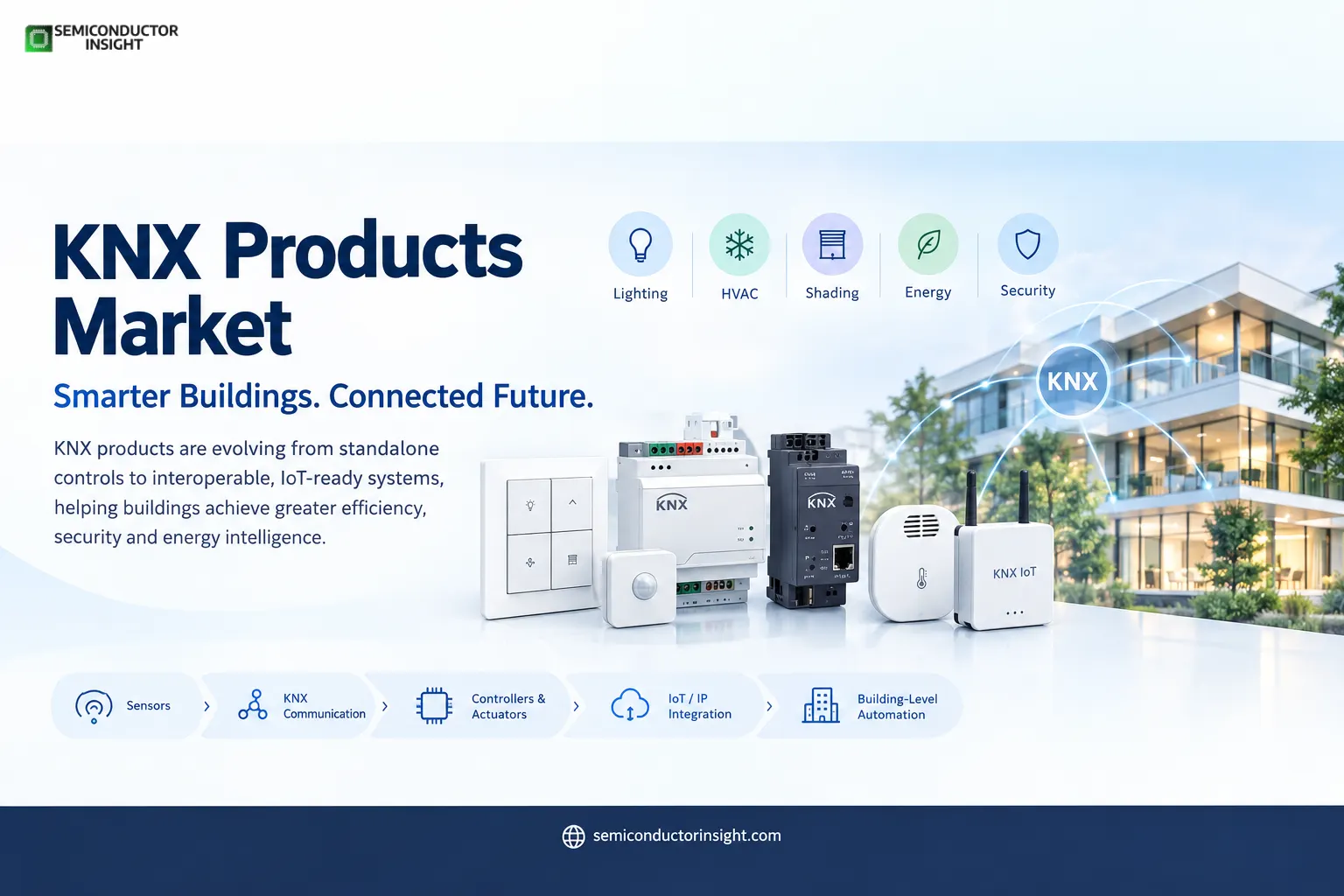
Why KNX Products Technology Is Becoming Central to the Modern Smart Building Stack?
KNX Products Market is becoming increasingly important as building automation shifts from isolated controls toward interoperable digital systems. KNX products span sensors, actuators, switches, interfaces, controllers, gateways and other devices used to coordinate lighting, HVAC, shading, energy management and security functions.
What makes the category distinctive is that the product is not evaluated only by its individual hardware capability. Its ability to communicate within a standardized ecosystem is equally important. KNX Association describes its standard as the reference framework defining system features, supported communication media and testing procedures for KNX devices. The latest Version 3.0.4, released in August 2025, added enhanced energy-management functions and expanded testing requirements.
The architecture is widening
The KNX ecosystem has traditionally supported several communication routes, including twisted pair, powerline, radio frequency and KNXnet/IP. The introduction of KNX IoT has widened that architecture further.
KNX Standard Version 3.0, released in 2022, introduced official specifications for the KNX IoT 3rd Party API and KNX IoT Point API. It also opened routes for KNX products using IPv6 networks such as Thread and for easier integration through RESTful web services.
That development changes the product conversation. A KNX device can increasingly act as part of a broader digital building environment instead of operating only inside a traditional automation installation.
The numbers tell a certification story
- Rather than measuring this category only through unit sales, certification activity provides an important indication of technological development. In November 2024, KNX Association announced the certification of its first KNX IoT devices and the commercial availability of its KNX IoT stack on Thread.
- KNX’s current development resources also distinguish between newly developed devices and OEM equipment, with separate certification routes available for different product-development scenarios. The association provides certified system-component listings and manufacturer-development resources through its ecosystem.
- This creates a product pipeline that increasingly includes conventional KNX hardware, secure devices, IoT products, gateways and OEM solutions.
From hardware control to energy intelligence
Energy management is becoming a more visible part of KNX product development. Version 3.0.4 specifically introduced new energy-management features while strengthening testing and interoperability.
The significance is practical. A modern building may contain lighting controls, heat pumps, photovoltaic systems, electric-vehicle charging, battery storage and occupancy sensors. The value of a KNX installation increasingly comes from coordinating these functions rather than controlling each one independently.
Sensors
↓
KNX Communication
↓
Controllers & Actuators
↓
Lighting | HVAC | Shading | Energy
↓
IoT / IP Integration
↓
Building-Level Automation
You Can Freely Surf Our Latest Updated Report Here: https://semiconductorinsight.com/report/knx-products-market/
Security is moving closer to the device
Cybersecurity has become another defining element of current KNX product development. KNX Secure separates security into KNX IP Secure and KNX Data Secure, enabling protection of communication over IP and at the data level. Secure devices use individual factory information and certificates as part of their security architecture.
The current KNX documentation also states that a secure device certificate combines a six-character serial number with a 16-character factory key, creating a 24-character identifier.
For building owners, this matters because automation networks increasingly connect to IP infrastructure and external digital services.
Why IoT is changing the product roadmap?
The arrival of KNX IoT does not simply replace established KNX technologies. Instead, it creates additional pathways for interoperability. Thread connectivity, IPv6 and APIs can make KNX-based systems easier to connect with broader IoT architectures.
This is particularly relevant for new commercial buildings where multiple digital systems need to exchange information. It also creates opportunities for manufacturers developing compact sensors, gateways and connected controllers that can operate within standardized environments.
The product mix is becoming more specialized
KNX Products Market is gradually moving from basic automation components toward a wider portfolio of purpose-built devices. Sensors can monitor presence, temperature, air quality and environmental conditions. Actuators can control lighting, blinds and HVAC equipment. Gateways connect KNX installations with IP and IoT environments, while secure interfaces address communication protection.
The result is a more layered ecosystem:
Field Devices
↓
KNX Bus / RF / IP
↓
Secure Interfaces
↓
IoT APIs & Gateways
↓
Energy + Building Platforms
What the 2026 product landscape reveals?
- The latest developments point toward a KNX product category defined by interoperability rather than hardware alone.
- The 2025 Standard 3.0.4 update, the first KNX IoT certifications, Thread support and continued development of KNX Secure all show how the ecosystem is adapting to connected buildings.
- For semiconductor and component suppliers, this evolution creates relevance at several layers, from communication interfaces and microcontrollers to security hardware, sensors and connectivity components.
- For device manufacturers, certification and interoperability remain central to product acceptance. For building integrators, the expanding architecture creates more ways to connect automation, energy and IoT functions within one standardized framework.
KNX Products Market is therefore becoming less about individual switches or controllers and more about how hardware, communications, security and software work together inside an intelligent building.

Comments (0)