
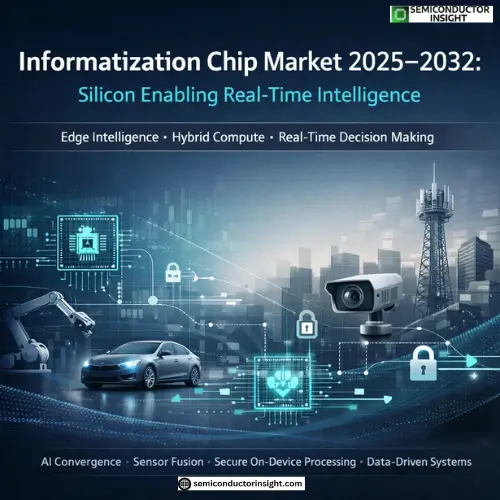
Why Informatization Chips Are Central to Future-Ready Semiconductor Ecosystems?
The semiconductor industry has historically been about pushing Moore’s Law increasing transistor count, driving clock speed, and scaling logic performance. Today, the tide has shifted. The transformative force reshaping the industry is informatization the ability of chips to ingest, interpret, and act on data in real time. This transition has elevated the informatization chip market from a niche segment to a fundamental enabler of intelligent devices, systems, and infrastructure across virtually every vertical.
In essence, an informatization chip is designed to support data-driven decision making within hardware platforms, frequently at the edge of the network, where latency, reliability, and contextual responsiveness matter. They are no longer just processors; they are embedded intelligence engines.
What Are Informatization Chips and Why They Matter?
Informatization chips extend beyond traditional CPUs and GPUs. They include specialized semiconductor architectures such as:
- Application-specific instruction set processors (ASIPs)
- Neural processing units (NPUs)
- Digital signal processors (DSPs) tuned for analytics loads
- Hybrid compute fabrics optimized for real-time data streams
These chips are integral to systems where real-time interpretation of sensory inputs, interaction with users, and autonomous responses are required. They bridge the gap between raw data and usable insight, enabling devices to go beyond fixed programming into contextual adaptability.
A Growing Market Powered by Data Proliferation
The last several years have seen exponential growth in data generation. With billions of connected devices contributing to the global data stream, silicon that merely stores or transmits that data is no longer sufficient. Informatization chips are designed to extract value from data where it lives whether that’s in an industrial controller, a self-driving vehicle, a smart camera, or a mobile device.
By some industry estimates, data created annually has increased by more than 400% in the past five years, feeding demand for local compute not just centralized processing in cloud data centres. This means more chips capable of decision support, inferencing, and sensor fusion all key functions of the informatization architecture.
Edge Compute Where Informatization Chips Excel
A key driver of this market is the ongoing shift toward edge computing. Data traffic and latency concerns are pushing complexity out of centralized server farms and onto distributed systems close to where data is generated.
Informatization chips perform a variety of functions at the edge:
- Filtering and pre-processing raw sensor data
- Running machine learning models locally
- Supporting real-time control loops
- Enabling secure and private data handling
Modern applications such as automated industrial lines, smart city monitoring, IoT gateways, and autonomous robotics increasingly depend on these capabilities.
Recent Market Developments and Technology Integrations
Several trends illustrate how the market is evolving:
- Hybrid Compute Platforms: Semiconductor manufacturers are combining general-purpose cores with domain-specific accelerators for AI, signal processing, and analytics within the same die. This heterogeneous integration is emerging as a key architectural trend.
- AI and Informatization Convergence: Many NPUs designed for AI inferencing are now being leveraged for broader informatics tasks, blurring the line between AI chips and pure informatization chips.
- Standards and Interoperability: Industry consortia are beginning to standardize frameworks for edge compute and data portability, making it easier for chips to operate across ecosystems.
- Security at the Silicon Level: Informatization chips increasingly include hardware-based security features, embedding encryption, root-of-trust, and secure boot mechanisms to protect data in motion and at rest.
Each of these advances reflects the market’s shift from raw performance to context-aware, secure, and responsive intelligence.
Regulatory Influences and Data Economy Policy Impact
Data governance policies and security regulations are having a notable impact on the design and deployment of informatization chips. As more decisions are made on-device, laws governing data privacy, cross-border data flows, and cyber security are influencing chip features and certification requirements.
For example, in markets with stringent data privacy requirements, edge devices must process sensitive information locally rather than transmitting it making on-board intelligence not just desirable but necessary for compliance.
To Know More about the Report, You Can Freely Browse Our Latest Updated Report:
https://semiconductorinsight.com/report/informatization-chip-market/
Market Forecasts Reflect Sustained Growth Trajectory
Market projections indicate persistent expansion, with growth driven by:
- The rapid proliferation of real-time applications
- Increased spending on edge compute capabilities
- Consumer demand for more intelligent devices
- Enterprise requirements for responsive automation
While forecast figures vary by analyst, most conclude that informatization chip adoption will outpace traditional compute segments in both unit shipments and revenue growth over the next several years.
The informatization chip market is less about raw horsepower and more about contextual capability. Chips must not only calculate they must interpret, decide, and respond in dynamic environments.
This shift elevates silicon from being a passive executor of instructions to an active partner in system intelligence. Whether powering autonomous machines, enhancing infrastructure operations, or enabling instantaneous insights at the edge, informatization chips are becoming a defining element of modern semiconductor architecture.

Comments (0)