
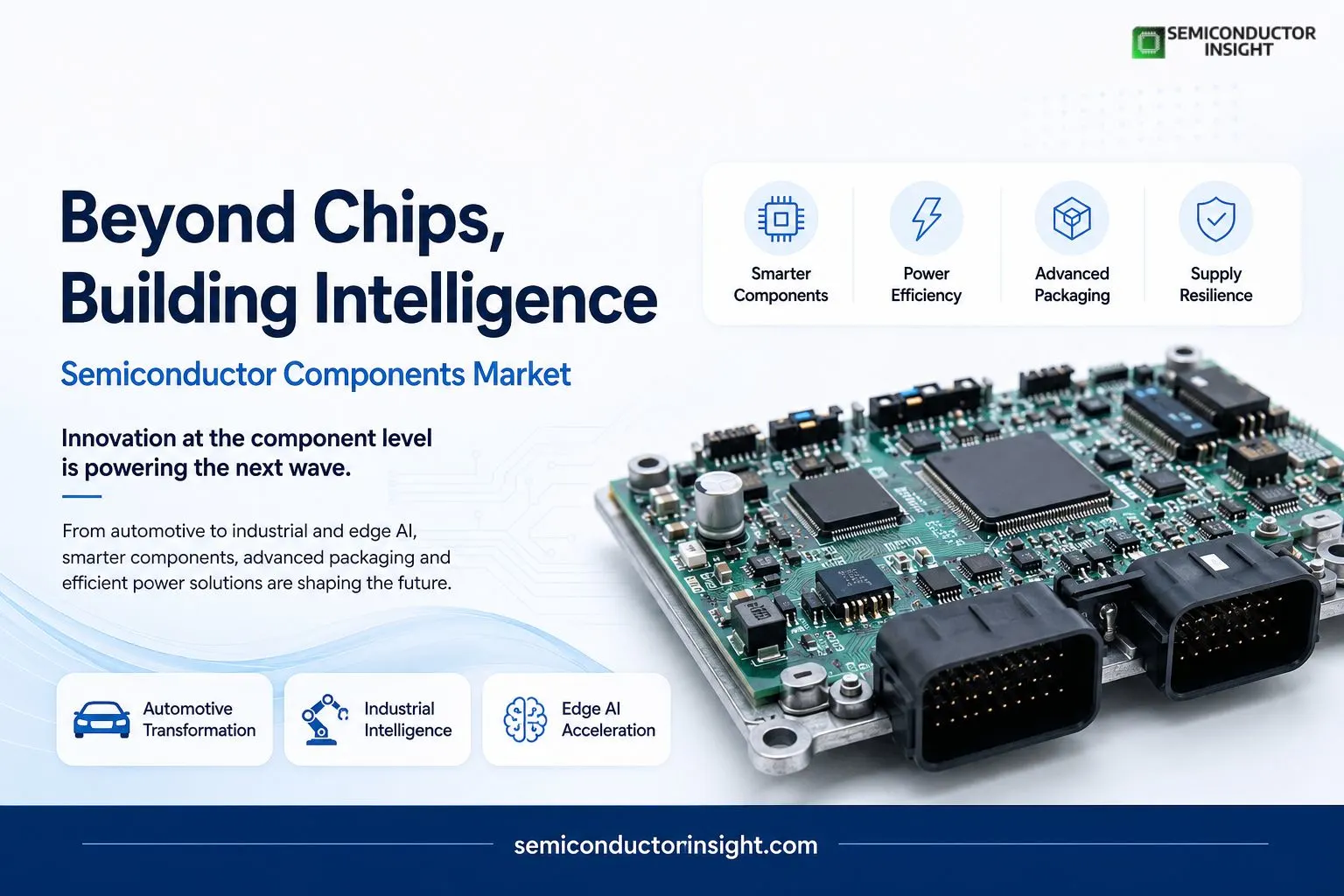
Why Are Semiconductor Components Becoming More Important for AI, Automotive and Industrial Electronics in 2026?
Semiconductor components market is becoming increasingly difficult to define as a simple collection of chips. Modern electronic systems combine processors, memory, power devices, sensors, connectivity components, analog ICs, microcontrollers and discrete semiconductors into tightly integrated architectures. From an automotive control unit to a smart factory sensor, the performance of the final product depends on how these individual components work together.
The change is particularly visible as computing moves toward the edge. Devices are expected to process more information locally, consume less power and communicate continuously. That is putting greater emphasis on component-level efficiency, thermal management, functional safety and compact packaging.
A Component Is No Longer Just a Component
The architecture of an electronic product increasingly determines which semiconductor building blocks are required. A connected industrial controller, for example, can combine a microcontroller, voltage regulators, memory, communication transceivers, analog interfaces and sensing elements within a single system.
A simplified architecture looks like this:
Sensing → Signal conditioning → Processing → Memory → Connectivity → Power management → Actuation
Each stage can require a different semiconductor technology. This is why component selection has become closely tied to the intended application rather than being driven solely by processor performance.
What Are the Best Semiconductor Components for Embedded Systems?
There is no single best component for every embedded design. The right combination depends on processing requirements, power budget, connectivity, memory capacity, operating temperature and safety requirements.
For mainstream embedded applications, microcontrollers (MCUs) remain central because they combine processing, memory and peripheral functions in compact packages. ARM reported that more than 30 billion Arm-based chips were shipped in 2024, illustrating the enormous scale of architectures used across embedded and edge applications.
A practical embedded system may therefore prioritize:
- MCUs for deterministic control and low-power processing
- MPUs or application processors where operating systems and heavier workloads are required
- NOR or NAND memory for program storage and larger data requirements
- PMICs and voltage regulators for efficient power distribution
- Sensors and analog ICs for physical-world measurements
- CAN, Ethernet, USB or wireless interface ICs for communications
- MOSFETs and other discrete devices for switching and power control
For safety-critical automotive systems, component selection becomes even more specialized because devices may need to support stringent reliability and functional-safety requirements.
You can freely browse our most recent updated related report to learn more about it before scrolling further: https://semiconductorinsight.com/report/semiconductor-components-cleaning-chemicals-market/
The Automotive ECU Is Becoming a Component-Dense Environment
- Vehicle electronics provide one of the clearest examples of increasing semiconductor content. Modern cars use semiconductors for engine and battery management, braking, steering, infotainment, radar, cameras, lighting and connectivity.
- The semiconductor challenge is also changing with software-defined vehicles. Instead of dozens of relatively independent electronic control units, manufacturers are moving toward zonal architectures and centralized computing platforms.
- That shift can increase the importance of high-performance processors, high-speed networking, power-management ICs and automotive-grade memory.
- The result is a component ecosystem increasingly influenced by vehicle architecture rather than by individual chips alone.
Edge AI Is Creating a New Layer of Component Demand
Artificial intelligence is moving beyond cloud data centers into cameras, robots, industrial equipment, vehicles and consumer devices. This creates demand for components that can execute inference locally while operating within tight thermal and power limits.
- NVIDIA’s Jetson platform illustrates this direction. Its Jetson Orin family can deliver up to 275 TOPS of AI performance, while Jetson Orin Nano systems are designed for edge AI applications with substantially lower power requirements.
For semiconductor component suppliers, edge AI therefore expands the importance of accelerators, high-speed memory, power-management devices and connectivity components alongside conventional processors.
The 2026 Design Question Is Increasingly About Power
Power efficiency has become a system-level concern. A processor cannot deliver useful performance if its surrounding power-management architecture creates excessive losses or thermal stress.
Wide-bandgap semiconductors such as silicon carbide (SiC) and gallium nitride (GaN) are gaining attention in applications requiring efficient power conversion. SiC is particularly relevant to high-voltage applications such as electric vehicles, charging infrastructure and industrial power systems, while GaN is increasingly used in compact high-frequency power conversion.
The U.S. Department of Energy identifies wide-bandgap semiconductor technologies as important for improving power-conversion efficiency and reducing energy losses in power electronics.
Packaging Is Becoming Part of Component Performance
- Shrinking transistor dimensions are only one part of semiconductor progress. Advanced packaging is becoming increasingly important for integrating multiple dies, improving bandwidth and controlling thermal behavior.
- Chiplet architectures are particularly significant because they allow complex systems to be assembled from multiple semiconductor dies rather than relying entirely on one large monolithic die.
- Standards such as UCIe are designed to support interoperability between chiplets from different sources, potentially changing how future semiconductor systems are assembled.
- This creates opportunities for component suppliers in advanced substrates, interconnects, memory integration and thermal solutions.
Supply Security Is Moving Into the Design Process
Recent semiconductor disruptions demonstrated that component availability can affect entire product lines. Governments are consequently investing in domestic semiconductor capabilities, while manufacturers are diversifying suppliers and redesigning products around more readily available components.
The U.S. CHIPS and Science Act authorized approximately $52.7 billion in semiconductor-related incentives and research programs, including manufacturing incentives and research funding.
For designers, this has created a new consideration: component selection increasingly involves lifecycle availability, second-source options and geographic supply resilience.
One Board Can Now Represent Several Semiconductor Trends
Consider a connected industrial motor controller. A single board can combine an MCU for control, an ADC for measurement, gate drivers and MOSFETs for switching, memory for firmware and data, an Ethernet interface for communication, temperature sensors for protection and a PMIC for regulated power.
Sensor → ADC → MCU → Memory → Communication IC → Gate Driver → Power Semiconductor → Motor
That chain demonstrates why semiconductor components market remains foundational even when attention is focused on headline technologies such as AI processors.
Where Component Innovation Is Heading Inside Real Devices
The strongest developments are increasingly happening at the intersection of technologies. Automotive electronics require computing plus sensing plus power management. Industrial robots require control plus vision plus connectivity. Edge AI requires processing plus memory plus thermal and power optimization.
This convergence is making component specifications more application-specific. Low-power consumption, automotive qualification, high-temperature operation, cybersecurity support, deterministic processing and compact packaging can be just as important as raw computing capability.

Comments (0)