
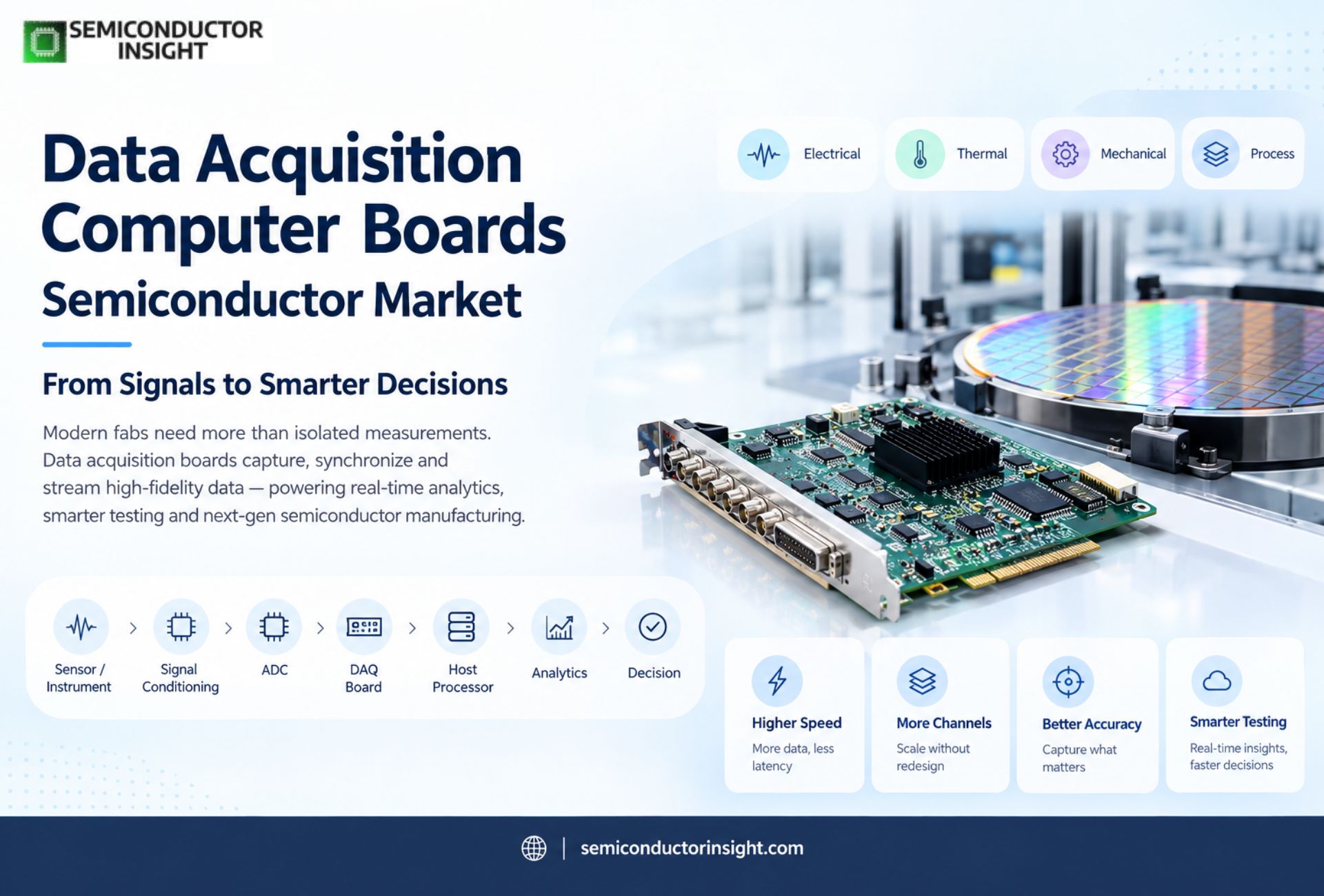
Why Are Data Acquisition Computer Boards Becoming Critical to Advanced Semiconductor Test Environments in 2026?
The semiconductor industry’s measurement problem is changing. Modern fabs and test facilities are no longer dealing with isolated measurements collected at the end of a process. Engineers increasingly need to capture electrical, thermal, mechanical and process signals while equipment is operating, preserve the timing relationship between those signals and move the resulting data into analysis systems with minimal delay.
That shift puts data acquisition computer boards in an important position between the physical measurement environment and the computing layer. In semiconductor applications, these boards can sit inside automated test equipment, wafer-level measurement systems, process-development platforms, and equipment diagnostics and laboratory characterization setups.
The board is becoming part of the measurement architecture
- A modern DAQ board is more than an ADC mounted on a computer interface.
- Its practical performance depends on several elements working together: input channels, ADC resolution, sampling architecture, synchronization, onboard memory, triggering, bus throughput and software support.
A useful way to view the architecture is:
Sensor or test instrument → signal conditioning → ADC → DAQ board → PCIe/PXIe fabric → host processor → analytics → manufacturing or test decision
- This architecture is becoming increasingly relevant because semiconductor engineers need measurement systems that can expand from a handful of signals to hundreds of synchronized channels without redesigning the entire test environment.
Sampling speed is becoming a competitive specification
Current commercial hardware illustrates how wide the performance range has become. NI’s PXI-6115, for example, supports 10 MS/s per channel, simultaneous sampling and 12-bit analog input resolution. Other PXI Express systems now extend substantially higher, with NI listing digitizer configurations reaching 5 GS/s and up to 1.5 GHz bandwidth in certain models.
At the other end of the spectrum, high-channel-count measurement can prioritize density over extreme speed. One recent PXI Express configuration supports 32 thermocouple channels, while another provides eight isolated analog channels at 250 kS/s per channel.
That means buyers increasingly select boards according to the measurement task rather than simply choosing the highest possible sampling rate.
Semiconductor factories are asking for more data than conventional control links provide
A significant 2026 development comes from SEMI. In August 2026, SEMI reported the creation of a Diagnostic Data Acquisition Task Force in China, specifically addressing the growing need for high-frequency and higher-fidelity equipment data in advanced-node manufacturing. SEMI notes that the move from 200 mm batch production toward 300 mm wafer-level processing created stronger requirements for real-time analytics and in-situ intervention.
The distinction is important. Traditional equipment-control communications are not necessarily designed to continuously expose every useful diagnostic signal. SEMI’s EDA framework instead focuses on structured, high-volume equipment data acquisition.
This creates an important opportunity for the underlying measurement hardware.
You can freely browse our most recent updated report to learn more about it before scrolling further: https://semiconductorinsight.com/report/data-acquisition-computer-boards-market/
PCIe bandwidth is changing what boards can realistically stream
- The computer interface has become just as important as the acquisition circuitry. PCI-SIG’s PCIe 6.0 specification supports 0 GT/s and up to 256 GB/s through an x16 configuration, twice the raw data rate of PCIe 5.0. It uses PAM4 signaling together with lightweight FEC and CRC to manage the higher signaling demands.
- For DAQ designers, higher bus capacity matters because large numbers of channels can generate enormous data streams.
- For example, an eight-channel DAQ operating at 14 MS/s with 32-bit data produces a theoretical stream of approximately 448 MB/s before additional software or protocol overhead.
- NI currently documents an eight-input PXIe-6396 configuration capable of approximately 336 MB/s calculated input data rate under its specified operating conditions.
- The implication is clear: acquisition speed without an efficient data path can create a bottleneck.
The semiconductor test floor is moving toward streaming data
The change is particularly visible in semiconductor test. SEMI’s work on Rich Interactive Test Database (RITdb) is aimed at supporting newer test-data models, including real-time or near-real-time queries, adaptive testing and streaming access. SEMI has also highlighted the need for more efficient data communication between automated test equipment, test-cell hosts and other systems.
That matters for DAQ hardware because test data is becoming an active input to manufacturing decisions rather than simply a historical record.
A simplified modern test loop looks like this:
Acquire → timestamp → classify → analyze → adapt test conditions → acquire again
The faster this loop becomes, the more important deterministic acquisition and synchronized channels become.
Advanced metrology is widening the opportunity
- Semiconductor measurement is also moving into extremely demanding frequency and accuracy ranges.
- NIST’s CalNet program, for example, is developing validated on-wafer calibration standards for measurements extending from 10 MHz to 110 GHz, addressing the need for traceable semiconductor measurement infrastructure.
- Although such systems are broader than conventional DAQ boards, they illustrate the direction of the industry: measurement hardware increasingly has to coexist with sophisticated calibration, instrumentation and computational analysis.
- NIST’s CHIPS Metrology Program has already funded more than $190 million across over 40 projects, covering measurement instruments, methods and measurement-informed models for advanced microelectronics.
Where the next specification battle is happening
For manufacturers and system integrators, the most important specifications are increasingly becoming:
- Simultaneous sampling for time-correlated signals
- Higher channel density without sacrificing synchronization
- Higher-resolution ADCs for small signal detection
- Low-latency PCIe/PXIe connectivity
- Large onboard buffers for transient events
- Deterministic triggering for automated test sequences
- Software-defined acquisition for changing measurement requirements
The result is a market increasingly shaped by data fidelity, timing and throughput, not simply by the number of analog inputs on a board. As semiconductor manufacturing moves toward more autonomous diagnostics and adaptive testing, data acquisition computer boards are becoming an increasingly important hardware layer connecting physical semiconductor processes with the software systems making sense of their signals.

Comments (0)