
When Pixels Decide: The Smart Vision Sensor Market’s Shift from Sight to Insight
The semiconductor industry is witnessing a fundamental transition where sensors are evolving from passive components that simply capture light into intelligent systems that interpret meaning. This shift is most evident in the smart vision sensor market, where the integration of edge AI and advanced processing capabilities is redefining what industrial automation, robotics, and consumer devices can achieve.
- The market for smart vision sensors has entered a phase of significant expansion, driven by the proliferation of automation across industries.
- This growth trajectory reflects the accelerating adoption of machine vision technologies in manufacturing, logistics, and quality control applications where traditional inspection methods are being replaced by intelligent sensing solutions.
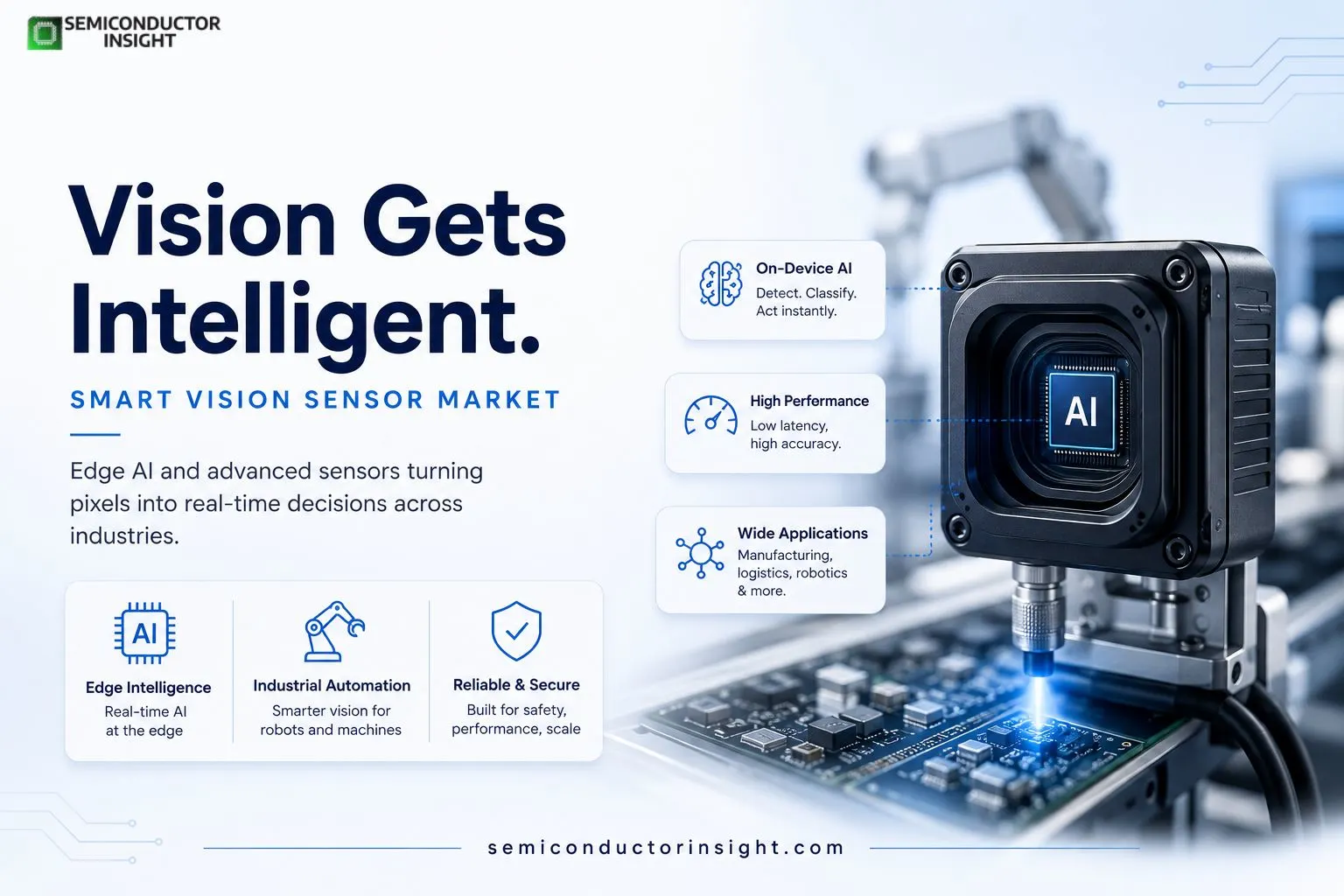
- The smart vision sensor represents a critical evolution in this space, functioning as a self-contained micro-miniature machine vision system that integrates image sensors, digital processors, and communication modules into a single compact unit.
- These smart sensors have inference capabilities at the edge which allows them to detect, classify, track and measure in real-time without the need to connect to the cloud, unlike traditional cameras which simply capture images to be processed elsewhere.
- Latency-sensitive applications that require real-time decision making are heavily impacted by this architectural change.
Edge AI Proliferation Reshapes Sensor Architecture
The migration of deep learning inference from centralized cloud infrastructure to the sensor’s edge processor represents perhaps the most transformative trend in the market. By performing artificial intelligence functions locally on the device, smart vision sensors can now solve previously intractable inspection tasks including defect classification, unstructured bin picking, and complex pattern recognition. This capability is particularly valuable in manufacturing environments where high-speed production lines require instantaneous quality assessment without the bandwidth constraints or latency issues associated with cloud-based processing.
The technology stack supporting these capabilities is becoming increasingly modular and interoperable. Sensor makers, semiconductor vendors, and software developers are converging around integrated solutions that combine imaging hardware, embedded AI accelerators, and optimized model pipelines. This convergence is reshaping procurement decisions, as buyers now select sensing-and-compute subsystems rather than individual components, with performance, power efficiency, cybersecurity, and lifecycle support becoming critical evaluation criteria.
Indian Semiconductor Startups Challenge Global Dominance
The competitive landscape of the smart vision chip market is witnessing notable shifts, with Indian fabless semiconductor startups establishing a presence in video surveillance and edge vision applications. Companies including Netrasemi, BigEndian Semiconductors, and Sensesemi Technologies are designing chips for different layers of the surveillance value chain, from camera subsystems to application-specific integrated circuits and ultra-low-power sensor intelligence. These startups are strategically positioning video surveillance as a proving ground for domestically designed edge-AI silicon, building a foundation for broader vision-led automation stacks.
Netrasemi, based in Thiruvananthapuram, designs AI and machine learning-capable system-on-chips for edge devices, supplying silicon, software development kits, and evaluation kits to camera and network video recorder manufacturers. Bengaluru-based BigEndian is developing an application-specific integrated circuit for IP cameras on a 28-nanometer node, fabricated at Taiwan’s United Microelectronics Corporation with original design manufacturer support from Zinwell Corporation. Sensesemi is extending its expertise in ultra-low-power sensing from health and wearables into vision and surveillance, emphasizing aggressive on-device filtering and summarization for power-constrained and bandwidth-limited environments.
Manufacturing Qualification and Supply Chain Complexity
- The path from chip design to production deployment in the smart vision sensor market is characterized by substantial barriers to entry, particularly the rigorous qualification processes required for industrial applications.
- Complex inspection tasks such as automated optical inspection for solder joints or surface defect classification require performance and reliability validation, with qualification cycles often lasting six to eighteen months.
- This lengthy qualification pathway creates significant switching costs once a supplier is selected, effectively locking in vendors for the lifecycle of production lines or machine models.
- Supply chain resilience has become increasingly critical as the industry navigates geopolitical tensions and component shortages.
- The market depends heavily on a narrow set of advanced components, particularly global shutter CMOS sensors and embedded AI processors, with supply concentration creating strategic leverage for vertically integrated suppliers.
- Ongoing semiconductor shortages and tariff impacts are forcing original equipment manufacturers to dual-source critical components or redesign systems to accommodate alternative suppliers, making supply chain security a key differentiator in customer selection criteria.
Sensor-to-Action Architecture and Industrial Integration
The emergence of sensor-to-action architectures is fundamentally reshaping how vision systems are designed and deployed. In these systems, perception is tightly coupled with control loops, enabling industrial robotics applications such as dynamic grasping, bin picking, and adaptive inspection without extensive fixturing. This integration extends to mobility and infrastructure applications, where real-time anomaly detection and situational awareness depend on seamless sensor-to-action workflows. The engineering focus is shifting toward end-to-end performance considerations including data quality, model drift management, over-the-air updates, and functional safety rather than isolated component specifications.
To Stay Tuned with More meaningful and In-Depth Insights, Do Visit here: https://semiconductorinsight.com/report/smart-vision-sensor-market/
- The buyer landscape reflects this shift, with original equipment manufacturers designing machines for sale seeking sensors that are reliable, cost-effective at volume, and easy to integrate into their platforms.
- In-house automation teams at large end-users prioritize total cost of ownership, ease of use for line operators, and vendor support for maintenance and troubleshooting.
- System integrators and distributors act as crucial intermediaries, valuing broad portfolios, strong technical support, and healthy margins.
- This complex ecosystem demands that sensor suppliers maintain comprehensive product portfolios covering core categories such as IPC SoC, ISP, and NVR or XVR to build complete technology chains from image acquisition and processing to storage and analysis.
The smart vision sensor market is evolving rapidly as semiconductor innovation enables new levels of intelligence at the edge. The integration of embedded AI, the growth of robotics, and the emergence of new market entrants are reshaping competitive dynamics and application possibilities. For semiconductor professionals, understanding these trends is essential to navigating a market where the sensor itself is becoming the decision-maker, and pixels are increasingly being processed into meaning at the point of capture.

Comments (0)