
What Role Does the Portable Energy Devices Market Play in the Era of Tiny Electronics?
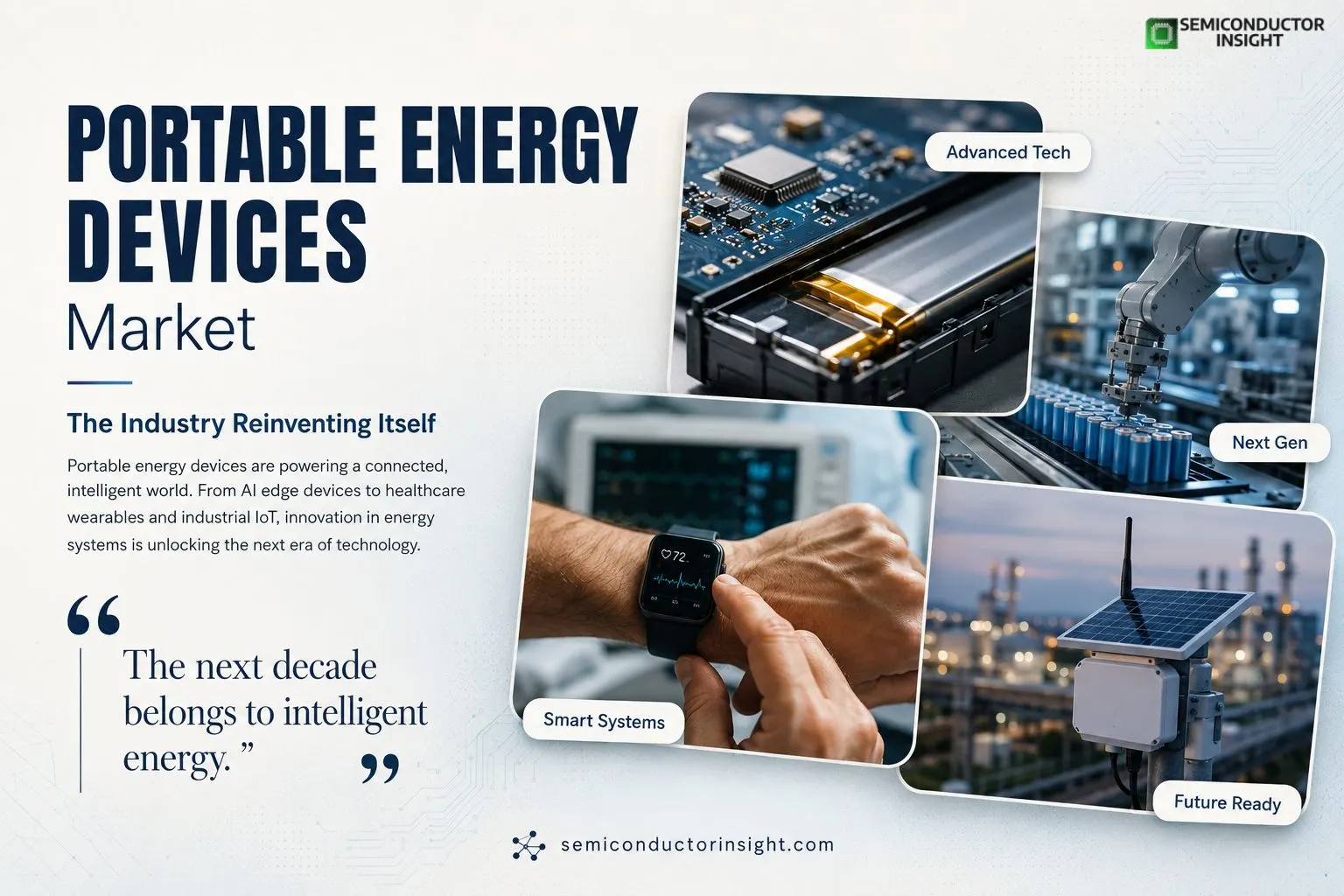
Portable energy devices have quietly become one of the most influential technologies behind modern electronics. From smartphones and medical wearables to industrial sensors and AI-enabled edge devices, portable power solutions now determine how long devices operate, how efficiently they process data, and how effectively they connect to digital ecosystems.
Within the semiconductor industry, the conversation is no longer limited to processing power. Energy availability has become equally important. Every new generation of chips, sensors, and wireless modules relies on compact, reliable, and increasingly intelligent portable energy systems to unlock its full potential.
The Shift from Batteries to Energy Platforms
- A decade ago, portable energy devices were viewed primarily as battery packs. Today, they function as integrated energy platforms that combine storage, power management, monitoring electronics, and semiconductor-based control systems.
- Modern portable energy solutions incorporate advanced battery management integrated circuits, microcontrollers, power semiconductors, and sensing technologies that continuously optimize charging and discharge cycles. This transformation has created a direct relationship between semiconductor innovation and portable power development.
- As devices become smaller and more capable, energy systems must deliver greater performance within the same physical footprint.
Unveiling the Reach of Technology in Daily Life
The scale of portable energy consumption is staggering. According to industry and government-backed technology sources, global smartphone shipments continue to exceed one billion units annually. Wearable device shipments are measured in hundreds of millions of units each year, while billions of Internet of Things endpoints remain active across industrial, commercial, and consumer environments.
Each of these devices depends on portable energy technologies supported by semiconductor components such as power management ICs, MOSFETs, sensors, and charging controllers.
At the same time, lithium-ion battery production worldwide now exceeds several terawatt-hours of annual manufacturing capacity, reflecting the growing demand for mobile and connected electronics.
Where Portable Energy Meets Artificial Intelligence
One of the most important developments in 2025 and 2026 is the growing presence of artificial intelligence at the device level.
AI-enabled cameras, smart glasses, industrial monitoring systems, and wearable health devices increasingly process data locally instead of relying entirely on cloud infrastructure. This trend places significant pressure on portable energy systems.
A device capable of running AI workloads continuously requires sophisticated energy management. Semiconductor companies are therefore developing ultra-low-power processors and advanced power regulation technologies designed to maximize operational time while maintaining performance.
Recent product launches across consumer electronics demonstrate how manufacturers are balancing AI functionality with battery efficiency to extend usage without increasing device size.
Energy Harvesting Enters the Mainstream Discussion
Portable energy is no longer limited to stored power. Energy harvesting technologies are gaining attention as complementary solutions.
Emerging devices can capture energy from:
- Indoor and outdoor light
- Body movement
- Mechanical vibration
- Temperature differences
- Radio frequency signals
These technologies are particularly attractive for industrial IoT deployments where replacing batteries across thousands of sensors can be expensive and operationally disruptive.
Semiconductor innovations in ultra-low-power circuitry are making energy harvesting increasingly practical for real-world applications.
Why Healthcare Is Becoming a Key Adoption Story?
Healthcare technology has become one of the most compelling use cases for portable energy devices.
Continuous glucose monitors, wearable cardiac monitors, smart hearing aids, and remote patient monitoring equipment all depend on compact and dependable energy systems.
The healthcare sector increasingly values longer device lifecycles because uninterrupted operation directly influences patient outcomes. As a result, semiconductor designers are prioritizing power efficiency alongside computational performance.
Recent deployments of connected healthcare devices across North America, Europe, and Asia highlight the growing importance of portable energy reliability in medical technology ecosystems.
The New Importance of Fast Charging Architectures
- Consumer expectations continue to reshape device engineering. Fast charging capabilities have evolved from a premium feature into a standard requirement.
- Behind these charging systems are advanced semiconductor components that regulate voltage, manage thermal performance, and protect batteries during high-speed energy transfer.
- Many flagship consumer devices now support charging systems capable of delivering significant battery capacity restoration within minutes rather than hours. This shift is accelerating investment in power semiconductor technologies and intelligent charging architectures.
Portable Energy and the Rise of Edge Infrastructure
Edge computing is creating another powerful growth avenue.
Factories, logistics facilities, agricultural operations, and smart cities increasingly deploy distributed devices that must function independently for extended periods. Portable energy systems provide the operational foundation for these installations.
Whether powering environmental sensors, asset trackers, or autonomous monitoring equipment, portable energy devices are enabling data collection closer to the point of activity, reducing latency and supporting real-time decision-making.
You can freely browse our most recent updated report to learn more about it before scrolling further: https://semiconductorinsight.com/report/portable-energy-devices-market/
Beyond Power Storage toward Intelligent Energy
The most significant evolution in portable energy devices is the move toward intelligence. Modern systems not only store energy but also analyze usage patterns, predict maintenance requirements, monitor health conditions, and optimize performance through embedded semiconductor technologies.
As electronic devices become more autonomous, connected, and computationally intensive, portable energy solutions are emerging as a strategic technology layer rather than a supporting component. Their growing influence across healthcare, artificial intelligence, industrial automation, and consumer electronics ensures they remain closely tied to the next phase of semiconductor innovation.

Comments (0)