Portable Energy Devices Market Insights
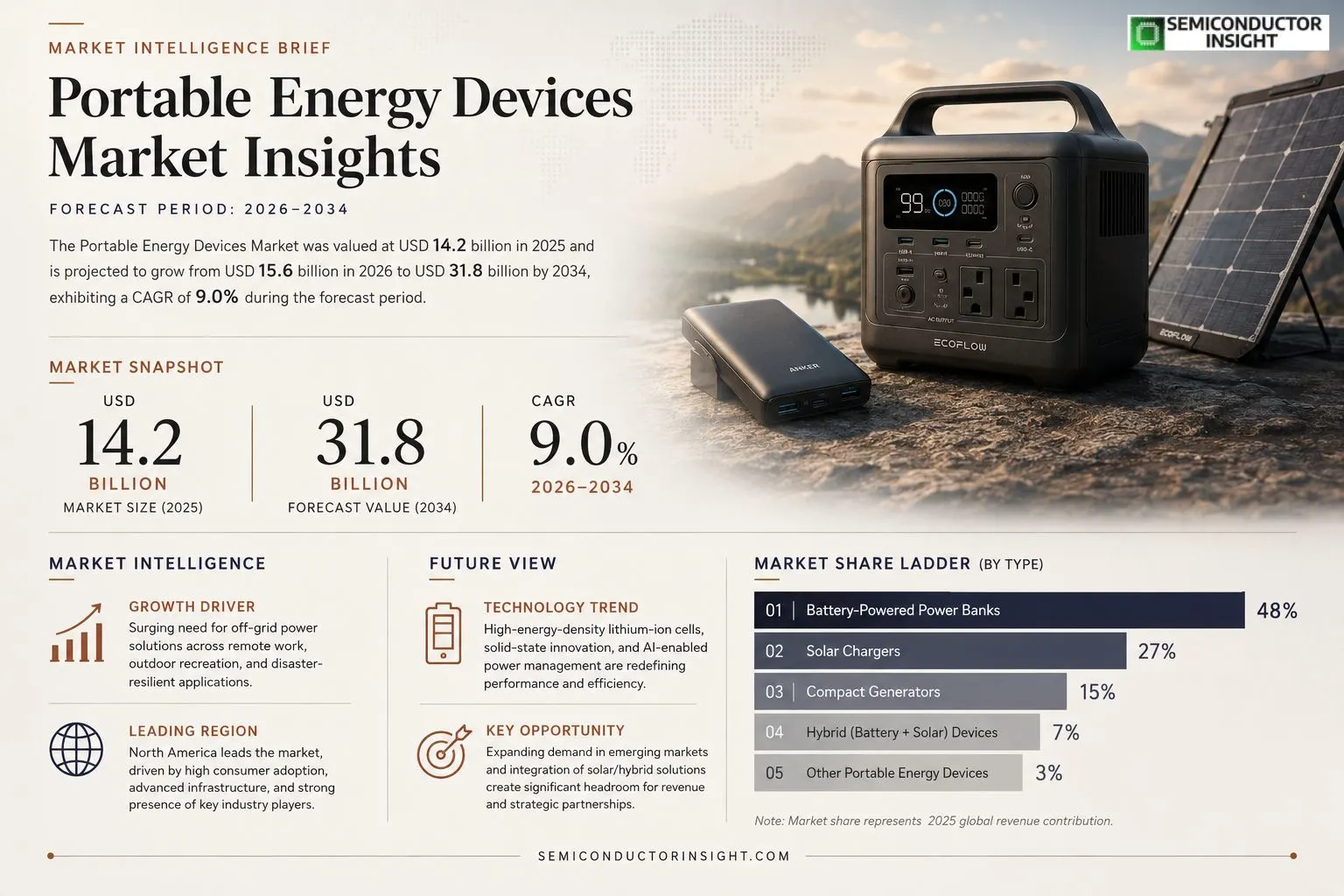
Portable energy devices market size was valued at USD 14.2 billion in 2025. The market is projected to grow from USD 15.6 billion in 2026 to USD 31.8 billion by 2034, exhibiting a CAGR of 9.0% during the forecast period.
Portable energy devices encompass battery‑powered power banks, solar chargers, and compact generators that provide on‑the‑go electricity for smartphones, laptops, medical equipment, and remote‑site tools. These solutions integrate lithium‑ion technology, advanced power management circuits, and often incorporate renewable charging options.The market is accelerating due to rising consumer reliance on mobile electronics, expanding remote work trends, and increasing demand for off‑grid power in disaster‑prone regions. Furthermore, advancements in high‑energy density cells and decreasing battery costs are driving adoption, while key players such as Anker Innovations, RavPower, Goal Zero, and EcoFlow continue to launch innovative products.
MARKET DRIVERS
Increasing Demand for Off‑Grid Power Solutions
The rise of remote work, outdoor recreation, and disaster‑resilient housing is driving a steady increase in purchases of portable power units. Consumers and enterprises alike value the ability to maintain critical operations without reliance on fixed grid infrastructure, prompting rapid adoption of Portable Energy Devices Market across urban and rural segments.
Advancements in Battery Technology
Recent breakthroughs in lithium‑ion chemistry and emerging solid‑state designs have lifted energy density while reducing weight and charging time. Manufacturers can now offer devices that deliver up to 30 % more runtime, enhancing the appeal of portable energy solutions for both professional and consumer users.
➤ “Enhanced battery performance is the single most influential factor accelerating Portable Energy Devices Market growth.”
Coupled with the expansion of renewable micro‑grids and the proliferation of IoT‑enabled charge management, these drivers create a robust foundation for sustained market expansion over the next decade.
MARKET CHALLENGES
Regulatory and Safety Concerns
Stringent certification requirements for transport, storage, and operation of high‑capacity batteries impose additional testing costs. Compliance with international standards such as UN 38.3 and IEC 62133 remains a critical hurdle for new entrants.
Other Challenges
Supply Chain Volatility
Global semiconductor shortages and raw‑material price fluctuations for lithium, cobalt, and nickel create lead‑time uncertainties that can delay product launches and affect profit margins.
MARKET RESTRAINTS
High Capital Costs
Advanced battery packs command premium pricing, which limits adoption among price‑sensitive segments such as small‑scale field contractors and casual outdoor users. Cost reductions through economies of scale are essential to broaden market reach.
MARKET OPPORTUNITIES
Emerging Markets in Southeast Asia
Rapid urbanization, inconsistent grid reliability, and growing middle‑class disposable income in countries like Indonesia, Vietnam, and the Philippines present a sizable, untapped demand for portable energy solutions. Strategic partnerships with regional distributors and localized product adaptations can unlock significant growth potential for Portable Energy Devices Market.
Portable Energy Devices Market Trends
Remote‑Work Expansion and Off‑Grid Resilience
Portable Energy Devices Market is being reshaped by a surge in remote‑work arrangements and a heightened focus on disaster‑prone regions. As professionals increasingly rely on laptops, smartphones, and IoT tools outside traditional office settings, the need for reliable, on‑the‑go power solutions has intensified. Simultaneously, communities subject to frequent power interruptions are turning to compact generators and solar‑charged batteries to sustain critical communications and medical equipment. These parallel dynamics create a robust demand pipeline that pushes manufacturers to expand capacity while maintaining portability and safety standards.
Other Trends
Technological Advances in Energy Density and Renewable Integration
Recent breakthroughs in lithium‑ion chemistry have lifted energy density by over 20 % compared with legacy cells, enabling slimmer power banks that still deliver multi‑day runtimes for high‑draw devices. Coupled with declining battery material costs, manufacturers can now embed solar panels and fast‑charge controllers without inflating retail prices. Smart power‑management circuits further optimize charge cycles, extending battery lifespan and reducing waste. These innovations are validated by product launches from leading firms such as Anker Innovations, RavPower, Goal Zero, and EcoFlow, which showcase hybrid devices capable of harvesting sunlight while delivering rapid USB‑C charging.
Strategic Positioning and Competitive Innovation
Competitive dynamics within Portable Energy Devices Market emphasize rapid product iteration and brand differentiation through ecosystem compatibility. Companies are integrating proprietary apps that monitor charge health, provide remote shutdown, and sync with renewable energy sources, thereby creating added value for tech‑savvy consumers. Partnerships with outdoor equipment manufacturers and telecom providers broaden distribution channels, especially in emerging markets where off‑grid power is essential for digital inclusion. As a result, the sector is witnessing a steady influx of feature‑rich, price‑competitive offerings that reinforce its role as a cornerstone of mobile energy infrastructure.
COMPETITIVE LANDSCAPEKey Industry Players
Portable Energy Devices Market Competitive Overview
The portable energy devices segment is anchored by a handful of globally recognized innovators that dominate both consumer and professional channels. Anker Innovations leads the market with a diversified portfolio that spans high‑capacity power banks, fast‑charging modules, and integrated solar solutions, leveraging its extensive distribution network and aggressive pricing strategy to capture a sizable share of the USD 31.8 billion projected market by 2034. Rival firms such as RavPower and EcoFlow complement the landscape by focusing on premium performance metrics, modular design, and rapid‑charge technologies, thereby intensifying competitive pressure on pricing and product differentiation. These leading players benefit from strong brand equity, robust R&D pipelines, and strategic alliances with electronics OEMs, which together shape a market structure characterized by oligopolistic dominance and high barriers to entry for newcomers.Beyond the headline brands, a vibrant cohort of niche manufacturers contributes depth and specialization to the ecosystem. Companies like Goal Zero concentrate on rugged, solar‑powered generators for outdoor and disaster‑relief applications, while Jackery emphasizes portable solar kits tailored to recreational users. Smaller but agile firms such as Suaoki, MaxOak, iMuto, Omnicharge, and PowerOak target specific segments including medical equipment backup and on‑site construction power. Asian players including Xiaomi, Samsung, Sony, Belkin, Mophie, and Aukey further expand the market, often leveraging cost‑effective supply chains to deliver competitively priced power banks that address mass‑market demand. Collectively, these diverse entrants foster innovation, expand product variety, and sustain healthy competition across price points and functional niches.
List of Key Portable Energy Devices Companies Profiled
- Anker Innovations
- RavPower
- Goal Zero
- EcoFlow
- Jackery
- Suaoki
- MaxOak
- iMuto
- Omnicharge
- PowerOak
- Xiaomi
- Samsung
- Sony
- Belkin
- Mophie
- Aukey
Segment Analysis:
| Segment Category | Sub-Segments | Key Insights |
| By Type |
|
Battery‑Powered Power Banks
|
| By Application |
|
Personal Electronics
|
| By End User |
|
Individual Consumers
|
| By Power Source |
|
Lithium‑Ion Batteries
|
| By Form Factor |
|
Compact (Pocket‑Size)
|
Regional Analysis: North America
United States
The consumer electronics sector is a primary driver of Portable Energy Devices Market in the US. Increasing smartphone adoption and the proliferation of other portable gadgets necessitate reliable charging solutions. This segment witnesses continuous innovation in compact and high-capacity power banks designed for on-the-go charging.
The growing popularity of outdoor activities such as camping, hiking, and RV travel is fueling demand for portable power stations and solar generators. These devices offer a convenient and sustainable way to power electronic devices in remote locations, aligning with the trend towards eco-conscious lifestyles.
Portable energy devices are increasingly being adopted in industrial and professional settings for powering tools, equipment, and communication devices in locations with limited access to traditional power outlets. This segment emphasizes durability, reliability, and high power output.
New applications for portable energy devices are continuously emerging, including powering electric vehicles, supporting emergency response systems, and enabling off-grid living solutions. This trend highlights the versatility and adaptability of portable power technology.
Europe
Europe presents a significant and evolving landscape for Portable Energy Devices Market. Driven by stringent environmental regulations and a strong focus on sustainable mobility, the region is witnessing a substantial increase in demand for eco-friendly power solutions. The electric vehicle (EV) sector is a key driver, with growing adoption necessitating portable charging options. Furthermore, the emphasis on renewable energy sources and the expansion of off-grid living initiatives are fueling demand for portable solar generators and energy storage systems. Business strategies in Europe often prioritize product innovation, emphasizing energy efficiency and compatibility with existing charging infrastructure. The competitive environment is characterized by a mix of established European manufacturers and international players. The European market strongly favors devices with a focus on design, sustainability, and compliance with safety standards.
Asia-Pacific
The Asia-Pacific region is poised to be the fastest-growing market for Portable Energy Devices. Rapid industrialization, increasing disposable incomes, and a burgeoning consumer electronics market are driving significant demand. China, in particular, is a dominant force, with substantial investments in electric vehicle manufacturing and a large consumer base for portable power solutions. The region’s focus on smart cities and the expansion of renewable energy infrastructure are further contributing to market growth. Business strategies in Asia-Pacific often emphasize competitive pricing, strong distribution networks, and adaptation to local consumer preferences. The competitive landscape is highly fragmented, with a mix of domestic and international players vying for market share. The demand for portable energy devices in Asia-Pacific is significantly influenced by the growth of e-commerce and the increasing adoption of mobile payment systems.
South America
South America represents a promising but relatively nascent market for Portable Energy Devices. Growing urbanization, increasing adoption of consumer electronics, and a rising awareness of environmental issues are driving demand. The region’s dispersed geography and limited access to reliable electricity in certain areas create significant opportunities for portable power solutions. Business strategies in South America often focus on affordability, durability, and ease of use. The competitive landscape is characterized by a mix of local and international suppliers catering to diverse consumer segments. The market is witnessing increasing interest in portable solar generators for residential and commercial applications.
Middle East & Africa
The Middle East & Africa region presents a unique and evolving landscape for Portable Energy Devices Market. Rapid economic growth, increasing urbanization, and government initiatives promoting sustainable development are driving demand. The region’s reliance on remote locations and the challenges in providing consistent electricity access create significant opportunities for portable power solutions. Business strategies in the region often prioritize robustness, reliability, and adaptability to harsh environmental conditions. The competitive landscape is characterized by a mix of international players and regional distributors. The demand for portable energy devices is particularly strong in the off-grid power segment, driven by the need for reliable power in remote communities and for outdoor activities.
Report Scope
This market research report provides a comprehensive analysis of the Portable Energy Devices Market , covering the forecast period 2026–2034. It offers detailed insights into market dynamics, technological advancements, competitive landscape, and key trends shaping the industry.
Key focus areas of the report include:
- Market Overview: The report begins with an overview outlining its current market scenario, key growth indicators, and industry transformation drivers. It discusses macroeconomic factors, demand–supply balance, regulatory landscape, and the strategic role of semiconductors in powering advancements across industries such as automotive, telecommunications, consumer electronics, and industrial automation.
- Market Size & Forecast: Historical data and future projections for revenue, unit shipments, and market value across major regions and segments.
- Segmentation Analysis: Detailed breakdown by product type, technology, application, and end-user industry to identify high-growth segments and investment opportunities.
- Regional Insights: Insights into market performance across North America, Europe, Asia-Pacific, Latin America, and the Middle East & Africa, including country-level analysis where relevant.
- Competitive Landscape: Profiles of leading market participants, including their product offerings, R&D focus, manufacturing capacity, pricing strategies, and recent developments such as mergers, acquisitions, and partnerships.
- Technology Trends & Innovation: Assessment of emerging technologies, integration of AI/IoT, semiconductor design trends, fabrication techniques, and evolving industry standards.
- Market Drivers & Restraints: Evaluation of factors driving market growth along with challenges, supply chain constraints, regulatory issues, and market-entry barriers.
- Stakeholder Insights: Insights for component suppliers, OEMs, system integrators, investors, and policymakers regarding the evolving ecosystem and strategic opportunities.
Primary and secondary research methods are employed, including interviews with industry experts, data from verified sources, and real-time market intelligence to ensure the accuracy and reliability of the insights presented.
FREQUENTLY ASKED QUESTIONS:
What is the current market size of Portable Energy Devices Market?
-> Portable Energy Devices Market was valued at USD 14.2 billion in 2025 and is expected to reach USD 31.8 billion by 2034.
Which key companies operate in Portable Energy Devices Market?
-> Key players include Anker Innovations, RavPower, Goal Zero, EcoFlow, among others.
What are the key growth drivers?
-> Key growth drivers include rising consumer reliance on mobile electronics, expanding remote‑work trends, increasing demand for off‑grid power, and decreasing battery costs.
Which region dominates the market?
-> Asia‑Pacific is the fastest‑growing region, while North America remains a dominant market.
What are the emerging trends?
-> Emerging trends include high‑energy‑density lithium‑ion cells, renewable charging options such as solar, and integration of AI‑enabled power management.

Get Sample Report PDF for Exclusive Insights
Report Sample Includes
- Table of Contents
- List of Tables & Figures
- Charts, Research Methodology, and more...
 Download Sample Report PDF