

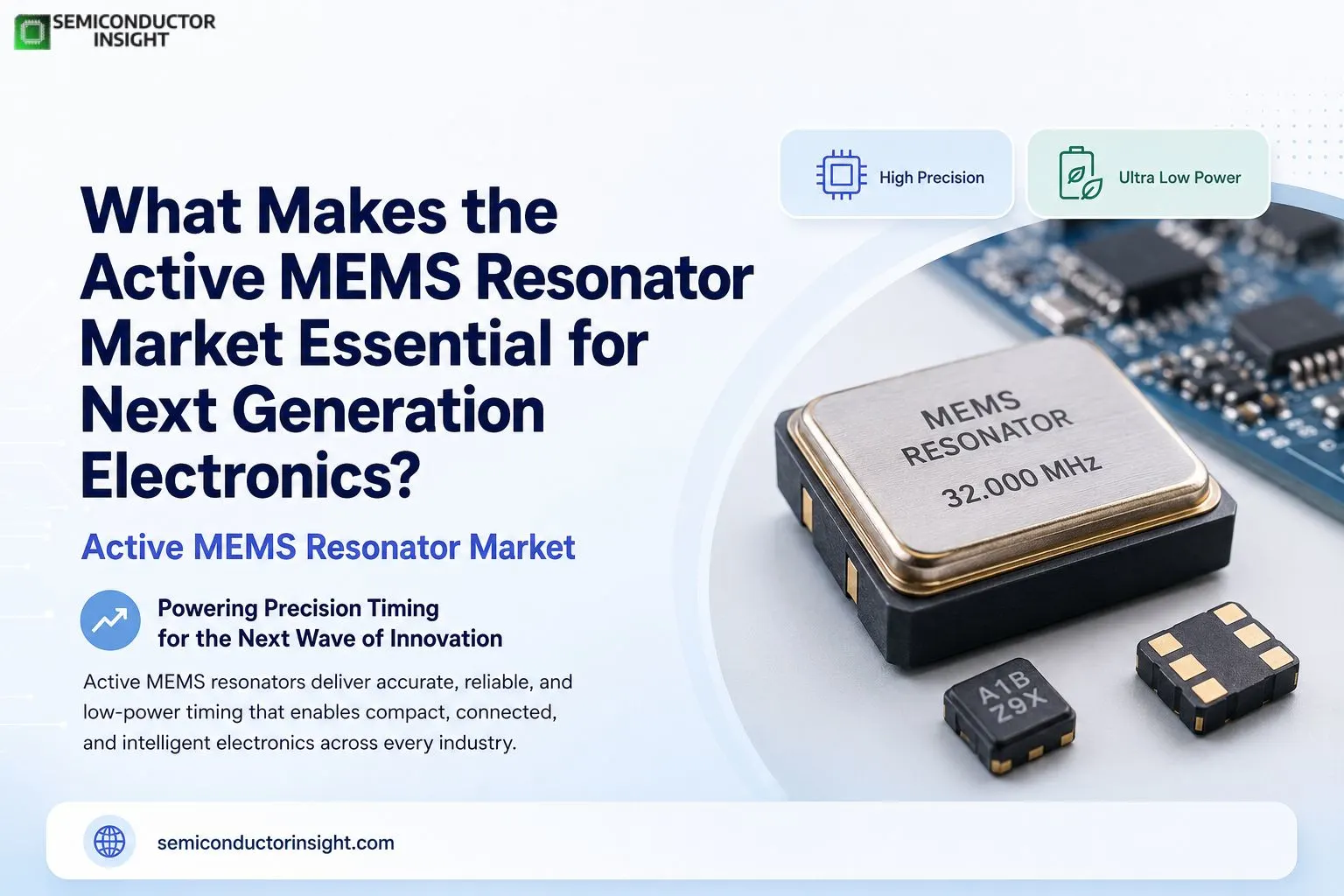
What Makes the Active MEMS Resonator Market Essential for Next Generation Electronics?
The semiconductor industry is undergoing a fundamental shift in timing technology. As electronic devices become smaller, more connected, and increasingly power-sensitive, traditional quartz timing components are facing growing competition from microelectromechanical systems (MEMS). This transition is placing the Active MEMS Resonator Market at the center of next-generation electronics design.
Active MEMS resonators integrate a vibrating silicon structure with signal conditioning circuitry to provide stable timing references for processors, communication modules, sensors, and wireless systems. Their compact footprint, resistance to environmental stress, and low power consumption are making them increasingly attractive across consumer, industrial, automotive, and networking applications.
The Timing Component Hidden Inside Modern Electronics
Every connected device requires a reliable clock source. Whether it is a smartwatch synchronizing wireless signals or a server processing AI workloads, accurate timing remains essential.
Digital Timing Ecosystem
MEMS Resonator
↓
Frequency Generation
↓
Clock Distribution
↓
Processor Synchronization
↓
Data Communication
↓
System Performance
MEMS devices are made utilising semiconductor manufacturing techniques, which allows for more integration and design flexibility than traditional quartz crystals.
Why Device Designers Are Moving Beyond Quartz?
As electronic products continue to become thinner and more compact, they are also expected to perform reliably in increasingly demanding environments.
Active MEMS resonators address these needs by offering strong resistance to shock and vibration, smaller package sizes, compatibility with semiconductor fabrication processes, improved reliability in harsh conditions, and ultra-low power consumption for battery-powered devices. As a result, MEMS timing components are now widely used in wearables, wireless sensors, smart meters, industrial IoT devices, and advanced automotive electronics.
Tiny Components Supporting Massive Semiconductor Volumes
The scale of modern electronics highlights the importance of timing devices.
AI Infrastructure Creates a New Timing Requirement;
One of the most significant developments influencing the Active MEMS Resonator Market is the expansion of AI infrastructure.
Modern AI servers require highly synchronized clocks for:
- High-speed interconnects
- Optical communication modules
- Accelerator processors
- Data center networking equipment
Recent timing component launches by semiconductor suppliers are increasingly targeting AI servers, edge computing systems, and advanced networking hardware where signal integrity and synchronization are critical.
What Are the Price Differences between SiTime Kyocera and Microchip Low Power MEMS Resonators for Precision Timing Applications?
Pricing for low-power timing devices depends on frequency, package size, stability requirements, and purchase volume, with distributor and manufacturer listings offering a helpful point of comparison.
SiTime’s SiT1532 NanoDrive MEMS oscillator is typically priced at around USD 1.16 to USD 1.77 per unit, while Microchip’s DSC1003 MEMS oscillator family is generally listed at about USD 1.11 to USD 1.46 per unit. Kyocera’s precision timing products are usually sold through application-specific distributor pricing rather than fixed public rates.
For bulk orders of several thousand units or more, pricing can often drop below USD 1 per device for select configurations. SiTime’s SiT1532 series is especially suited to wearable and battery-powered applications because of its very low current consumption of around 1.3 to 1.4 microamps, while Microchip’s DSC1003 family is positioned for similar low-power precision timing needs.
Don’t Forget to Surf Our Updated Report for More Detailed Analysis: https://semiconductorinsight.com/report/global-active-mems-resonator-market/
The Rise of Always-On Electronics
An emerging trend in semiconductor design is the growth of always-on functionality.
Examples include:
- Smartwatches monitoring health metrics continuously
- Asset tracking devices transmitting location data
- Environmental monitoring sensors
- Wireless industrial control systems
These products require timing solutions that remain active while consuming extremely small amounts of energy. MEMS resonators are increasingly selected because they support extended battery life without compromising timing accuracy.
Reliability Becomes a Design Metric
Electronics manufacturers are no longer evaluating timing devices solely on frequency performance. Mechanical durability has become equally important.
MEMS resonators demonstrate strong resistance to:
- Mechanical shock
- Manufacturing stress
- Board-level vibration
- Temperature fluctuations
This is particularly important for automotive electronics, industrial automation systems, and aerospace platforms where environmental conditions can significantly affect component reliability.
Precision Timing Evolves into a Semiconductor Differentiator
The Active MEMS Resonator Market is no longer limited to replacing quartz components. It is becoming a strategic technology layer supporting AI infrastructure, edge computing, advanced sensors, connected vehicles, and next-generation consumer electronics.
As electronic systems continue shrinking while processing greater volumes of data, active MEMS resonators are increasingly positioned as a foundational building block that enables synchronization, power efficiency, and long-term reliability across the modern semiconductor ecosystem.

Comments (0)