
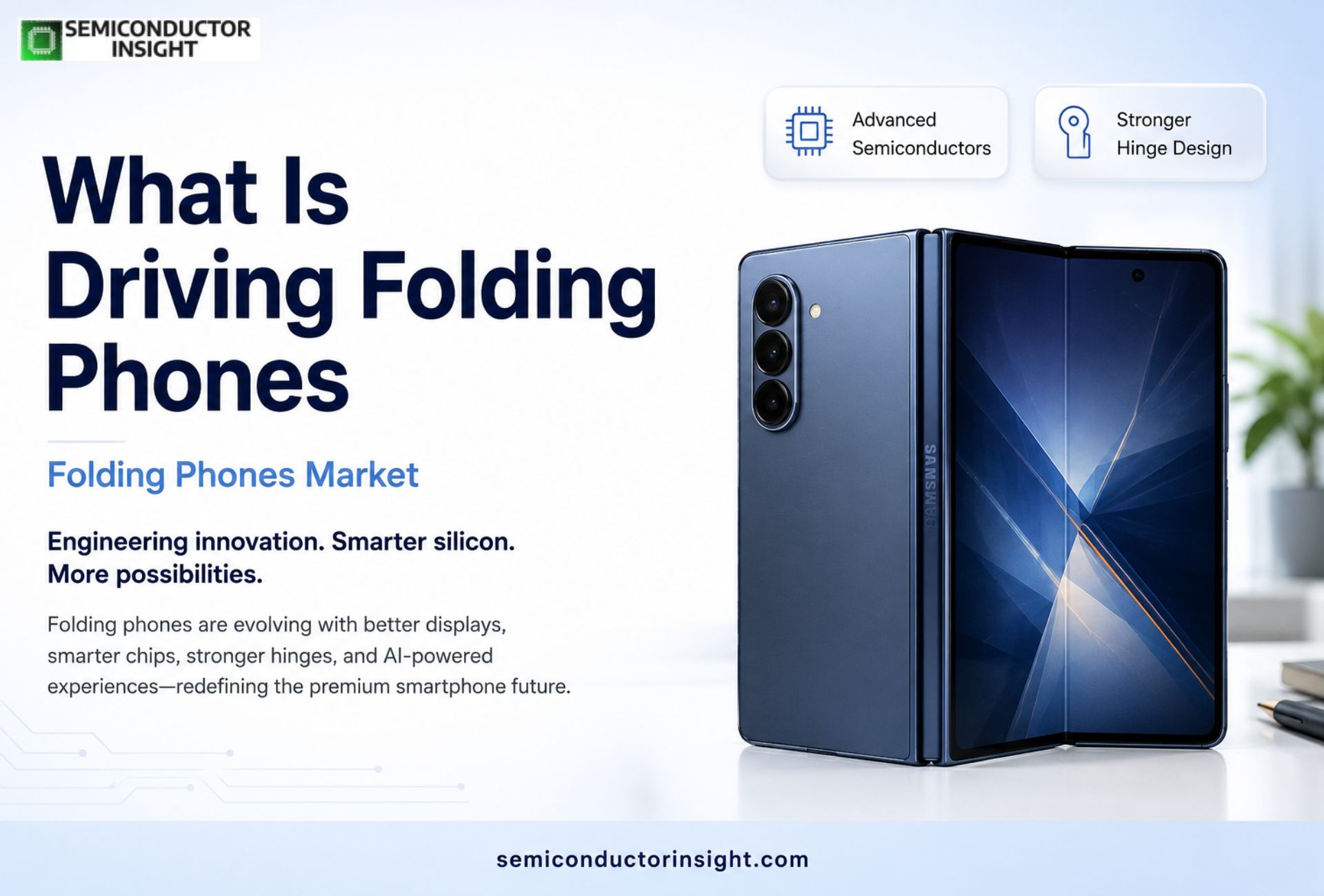
What Is Driving Folding Phones Market in 2026? A Complete Technology Breakdown
Folding phones have moved well beyond the experimental stage. In 2026, the category is increasingly being shaped by a combination of flexible displays, compact semiconductor packages, hinge engineering, high-density batteries, advanced camera processors and artificial-intelligence workloads. What makes Folding Phones Market particularly interesting for the semiconductor industry is that manufacturers are no longer simply trying to make a phone fold. They are trying to fit flagship-level computing into a device that changes physical geometry every time it opens and closes.
The latest generation illustrates that shift clearly. Samsung’s Galaxy Z Fold7 combines an 8-inch main display, 6.5-inch cover screen, up to 120 Hz refresh rate, a 200-megapixel main camera and a 4,400 mAh battery. Its Snapdragon platform is also designed to support AI processing, gaming and multitasking across the larger display.
From two screens to one flexible computing surface
The basic proposition of a foldable remains simple: carry a conventional smartphone-sized device and open it into something closer to a compact tablet. The engineering underneath is anything but simple.
A typical foldable architecture brings together:
Application processor → memory → display driver IC → flexible OLED → touch controller → hinge sensors → camera processors → power-management ICs → battery
Every additional component has to work within tight restrictions on thickness, heat generation and power consumption. Semiconductor designers therefore face an unusual packaging problem: more computing capability has to occupy less physical space while remaining reliable through repeated mechanical movement.
The numbers tell a different story about premium hardware
One of the clearest developments is the rapid compression of flagship hardware into slimmer bodies. Samsung’s Galaxy Z Fold7 opens to an 8-inch screen while retaining a 21:9 cover-screen ratio, bringing the external experience closer to a conventional premium smartphone. The device can also operate at up to 2,600 nits peak brightness and 120 Hz, putting significant demands on the display driver, graphics processor and power-management architecture.
This matters for semiconductor suppliers because a larger active display does not simply require more pixels. It requires efficient display processing, memory bandwidth, graphics acceleration and thermal management.
AI has changed what manufacturers expect from a foldable
- The foldable form factor is becoming particularly attractive for AI because its expanded screen gives users more room to interact with AI assistants, documents, images and multiple applications simultaneously.
- Samsung has positioned Galaxy Z Fold7 around multimodal AI and Gemini Live, while its processor architecture supports demanding AI, graphics and multitasking workloads.
- The semiconductor implication is significant: neural-processing capability, high-speed memory and efficient system-on-chip design increasingly influence the usefulness of the physical fold mechanism itself.
- A larger screen is valuable only when the processor can make practical use of it.
The hinge is quietly becoming an electronics problem
A folding phone can have an excellent processor and display and still fail commercially if the hinge, flexible panel or internal interconnects cannot withstand everyday use. Engineers therefore have to manage mechanical stress alongside electrical performance.
The architecture increasingly resembles a miniature electromechanical system in which the display, hinge, sensors and flexible interconnects must operate together.
Open → electrical and mechanical alignment → expanded display state → multitasking → close → sensor state changes → compact device
This cycle is repeated throughout the product’s life, making durability testing an important part of foldable-device engineering rather than a cosmetic design exercise.
Thinness is becoming the new specification race
The competition is also moving toward reducing the physical penalty of folding technology. HONOR’s Magic V5 became a prominent example in 2025, with its design focusing heavily on a thin and lightweight construction. Huawei has simultaneously continued developing its foldable portfolio, demonstrating how intensely manufacturers are competing around flexible-device engineering. Huawei currently operates across more than 170 countries and regions, giving its device business a broad international footprint.
The importance for semiconductors is straightforward: thinner phones leave less room for conventional component placement and thermal dissipation. Smaller packages, efficient processors and compact power-management solutions consequently become increasingly valuable.
Our most recent updated related study is available for free at this link: https://semiconductorinsight.com/report/folding-phones-market/
The camera processor has found a larger canvas
Foldables also create an unusual photography advantage. Their larger internal screens can provide more room for image review, editing and AI-assisted photography. Samsung’s Galaxy Z Fold7 incorporates a 200 MP wide-angle camera, with its ProVisual Engine using processor-based computational photography to improve image output.
This is another area where semiconductor capability directly affects the user experience. Image-signal processing, neural acceleration and memory performance determine how quickly the phone can process high-resolution images and AI-generated edits.
Why 2026 matters for Folding Phones Market?
- The category is increasingly becoming a test bed for semiconductor miniaturisation.
- A successful foldable must coordinate flexible OLED technology, high-performance application processors, memory, connectivity chips, power-management ICs, image processors and sensors inside a mechanically moving chassis.
- The most important shift is therefore not simply that smartphones can fold. It is that more computing is being compressed into a device that physically changes shape.
- That makes Folding Phones Market a useful indicator of where mobile semiconductor engineering is heading: higher AI capability, tighter packaging, greater power efficiency, more sophisticated display control and increasingly integrated hardware.
The next competitive advantage may not come from adding another camera or increasing screen size. It may come from making the entire semiconductor stack smaller, cooler and smarter while the phone keeps folding.

Comments (0)