
The Critical Role of Vacuum Sensing in Advanced Chip Manufacturing
Semiconductor manufacturing operates in environments where even a microscopic particle or pressure fluctuation can disrupt production. Vacuum sensors play a central role in maintaining ultra-clean and controlled conditions inside fabrication chambers used for processes like etching, deposition, and ion implantation.
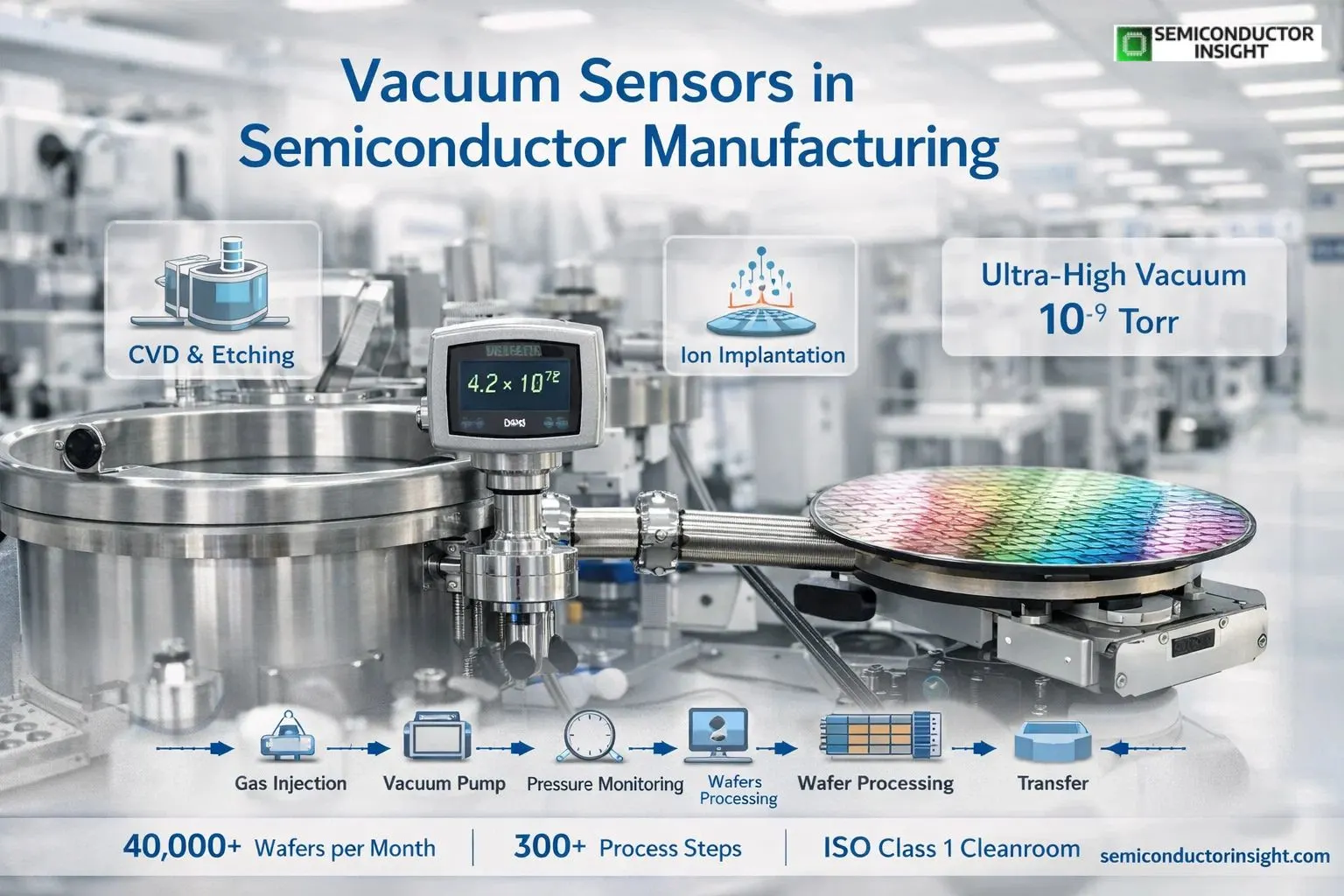
Modern semiconductor fabs rely on vacuum levels ranging from atmospheric pressure down to ultra-high vacuum (10⁻⁹ torr). These extreme conditions are necessary to ensure accurate layer deposition and defect-free wafer processing. Without precise vacuum measurement, maintaining process integrity across thousands of wafers becomes nearly impossible.
Inside the Fab: Where Vacuum Sensors Operate
Vacuum sensors are embedded across multiple semiconductor manufacturing stages, acting as real-time monitoring tools that ensure consistency and safety.
- Chemical Vapor Deposition (CVD) chambers
- Physical Vapor Deposition (PVD) systems
- Plasma etching units
- Lithography systems
- Ion implantation equipment
- Vacuum transfer chambers
In these environments, sensors must withstand aggressive gases, plasma exposure, and temperature fluctuations while maintaining high accuracy.
Technology Layer Breakdown: Types of Vacuum Sensors Used
Different vacuum levels demand specialized sensing technologies, each tailored to specific pressure ranges and operating conditions. Pirani gauges excel in low to medium vacuum environments, while capacitance manometers deliver high-precision measurements.
Ionization gauges handle ultra-high vacuum scenarios, thermocouple gauges serve general-purpose needs, and cold cathode gauges protect contamination-sensitive processes. Together, these solutions ensure fabs maintain stable conditions across intricate production lines.
Data Signals from the Semiconductor Ecosystem
The importance of vacuum sensors becomes clearer when viewed through broader semiconductor industry data:
- Global semiconductor fabs consume millions of cubic meters of process gases annually, requiring precise vacuum control
- A single advanced fab can process over 40,000 wafers per month, each requiring stable vacuum conditions
- Cleanroom environments operate at ISO Class 1-5 levels, allowing fewer than 10 particles per cubic meter in critical zones
- Semiconductor manufacturing involves over 300 sequential processing steps, many dependent on vacuum environments
- Equipment downtime due to pressure instability can reduce fab efficiency by up to several hours per incident, impacting output significantly
These figures highlight how vacuum sensing is deeply embedded in operational efficiency and yield optimization.
Top 10 Vacuum Sensor Products in Semiconductor Applications
- Inficon PSG550 Vacuum Gauge
- MKS Baratron Capacitance Manometer
- Pfeiffer Vacuum TPR 280 Pirani Gauge
- Edwards Active Strain Gauge Sensor
- Agilent FRG-700 Vacuum Gauge
- Leybold CERAVAC CTR Series
- ULVAC GP Series Vacuum Sensors
- Kurt J. Lesker KJL275 Ion Gauge
- Setra Systems Model 760 Vacuum Sensor
- Teledyne Hastings HPM Series Sensors
These products are widely used across semiconductor fabs for their reliability, accuracy, and compatibility with harsh process environments.
Semiconductor-Specific Performance Metrics
Vacuum sensors for semiconductor applications demand performance beyond standard industrial benchmarks. They require measurement accuracy up to ±0.15% of reading, millisecond response times for real-time process control, and exceptional contamination resistance with minimal outgassing or particle generation.
Covering pressure ranges from atmospheric to ultra-high vacuum levels, these sensors also deliver long-term stability with drift resistance. These stringent standards ensure process repeatability essential for high-volume chip manufacturing.
Vacuum Control in Semiconductor Processing
Gas Injection → Chamber Sealing → Vacuum Pump Activation → Pressure Monitoring via Sensors → Process Stabilization → Wafer Processing → Pressure Release & Transfer
Lastly, for more in-depth information, don’t forget to read our most recent exclusive report: https://semiconductorinsight.com/report/semiconductor-vacuum-sensors-market/
Vacuum sensors are not standalone components; they are integral to the semiconductor value chain. As chip architectures become more complex and manufacturing tolerances shrink, the demand for ultra-precise environmental control will only intensify.
Rather than being viewed as auxiliary equipment, vacuum sensors are now recognized as critical enablers of semiconductor innovation ensuring that every layer, every etch, and every deposition step meets exacting standards.

Comments (0)