
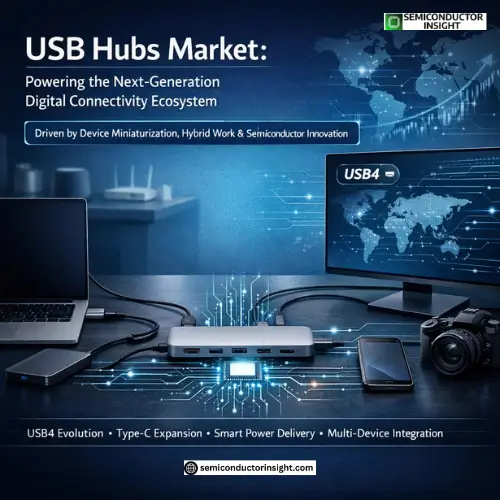
USB Hubs Market Insights Rises Speed, Power Delivery, and Device Integration Trends
In today’s hyper-connected world, the humble USB hub has evolved into a strategic enabler of digital ecosystems. What once served as a basic port multiplier is now an intelligent connectivity bridge supporting laptops, smartphones, gaming consoles, IoT systems, and industrial devices. USB Hubs Market is witnessing accelerated traction, fueled by device miniaturization, hybrid work trends, and the rapid expansion of semiconductor-enabled electronics.
As ultra-thin laptops reduce native port availability, consumers and enterprises increasingly rely on hubs to maintain seamless connectivity. This structural shift is transforming USB hubs into a mission-critical infrastructure component within the broader semiconductor industry.
Connectivity Expansion in a Multi-Device Era
- The global surge in remote work, digital classrooms, and content creation has significantly expanded multi-device usage.
- Users now demand simultaneous connectivity for displays, storage drives, keyboards, cameras, and charging systems. This rising complexity is driving demand for high-speed, multi-port USB hubs with integrated power delivery.
- Modern hubs are no longer passive hardware add-ons.
- They support USB 3.x, USB4, and Thunderbolt-compatible standards, enabling faster data transfer and improved power management.
- As bandwidth requirements rise, semiconductor manufacturers are integrating advanced controller chips to ensure high-speed data throughput without performance compromise.
- The shift toward USB Type-C interfaces is another transformative factor.
- Type-C’s reversible design and universal compatibility are reshaping product design strategies across consumer electronics and enterprise IT ecosystems.
Semiconductor Advancements Reshaping Hub Architecture
The USB hubs market operates at the intersection of connectivity hardware and semiconductor innovation. At the chip level, improved signal integrity, power efficiency, and thermal optimization are enabling smarter hub configurations.
With advancements in controller ICs and power management integrated circuits (PMICs), hubs now support features like smart charging allocation, display output via DisplayPort Alt Mode, and multi-monitor connectivity. Semiconductor players are optimizing silicon design to reduce latency while maintaining compact form factors.
Emerging integration trends include embedded firmware upgrades, enhanced cyber security layers, and support for AI-enabled edge devices. These developments position USB hubs as part of the broader next-generation semiconductor ecosystem, rather than standalone accessories.
Market Dynamics across Key End-Use Segments
- Consumer Electronics
Laptops, tablets, and gaming devices represent a dominant share of demand. With device portability increasing, USB hubs serve as expansion gateways, especially in ultrabooks and compact PCs.
- Enterprise & Corporate Infrastructure
Hybrid workplaces require flexible docking and connectivity solutions. USB hubs integrated with docking capabilities are increasingly deployed in corporate IT setups.
- Industrial & Embedded Systems
Industrial automation and embedded electronics require reliable multi-port data distribution. Ruggedized USB hubs designed for harsh environments are gaining steady traction.
- Automotive & Mobility Applications
Advanced infotainment systems and in-vehicle connectivity solutions are opening niche growth opportunities. As automotive electronics become more software-defined, USB hubs play a supporting role in passenger and backend data systems.
Across these segments, the key driver remains the universal need for scalable and seamless device integration.
Regional Landscape and Competitive Intensity
Asia-Pacific continues to dominate manufacturing and supply chain operations due to strong semiconductor fabrication capabilities and electronics production clusters. North America and Europe lead in innovation, premium product demand, and enterprise adoption.
The competitive landscape features global electronics brands, specialized connectivity solution providers, and semiconductor design firms. Companies are focusing on product differentiation through:
- Compact and modular designs
- Fast-charging capabilities
- Multi-display support
- Enhanced data security protocols
Strategic partnerships between semiconductor chip designers and peripheral manufacturers are strengthening product ecosystems and accelerating time-to-market.
At Last before Ending, Don’t Forget to Browse Our Recent Exclusive Report for Detailed Insights:
https://semiconductorinsight.com/report/usb-hubs-market/
Technology Trends Driving the Upcoming Expansion
- The transition toward USB4 and higher bandwidth standards is expected to redefine product capabilities. USB4 supports significantly higher transfer speeds and improved video output compatibility, opening new possibilities for creative professionals and enterprise users.
- Additionally, integration of GaN-based power components is improving charging efficiency within hubs. As sustainability becomes a strategic priority, manufacturers are exploring energy-efficient chip architectures and recyclable materials.
- The evolution of smart homes, IoT expansion, and edge computing devices further reinforces demand. USB hubs are gradually becoming intelligent connectivity controllers rather than simple splitters marking a shift toward intelligent port management systems.
USB Hubs Market is positioned for steady global expansion, supported by rising digitalization, semiconductor advancements, and evolving consumer workflows. While price competition remains a challenge in entry-level segments, premium and enterprise-grade hubs offer higher margin opportunities.
Looking ahead, growth will likely be shaped by:
- Faster universal standards adoption
- Cross-platform compatibility requirements
- AI-enabled device ecosystems
- Increasing data consumption per device
As connectivity complexity deepens, USB hubs will remain an indispensable link between hardware efficiency and user productivity.

Comments (0)