Market Insights
Global USB Hubs Market size was valued at USD 674 million in 2025. The market is projected to grow from USD 722 million in 2026 to USD 1,095 million by 2033, exhibiting a CAGR of 7.3% during the forecast period.
USB hubs are essential peripherals that expand the number of available USB ports on a computer or other host device, enabling multiple connections for accessories such as storage drives, keyboards, and printers. These devices come in various configurations, including USB 3.0 hubs, USB 2.0 hubs, and Type-C hubs, catering to different speed and compatibility requirements.
The market growth is driven by increasing demand for multi-device connectivity in both consumer and professional settings. Rising adoption of compact laptops with limited built-in ports and the proliferation of USB-powered devices are key contributors to expansion. However, challenges such as compatibility issues between older and newer USB standards may restrain growth in certain segments. Leading players like Anker, Belkin, and Orico continue to innovate with features such as fast charging and compact designs to meet evolving user needs.
MARKET DRIVERS
Rising Demand for Multi-Device Connectivity
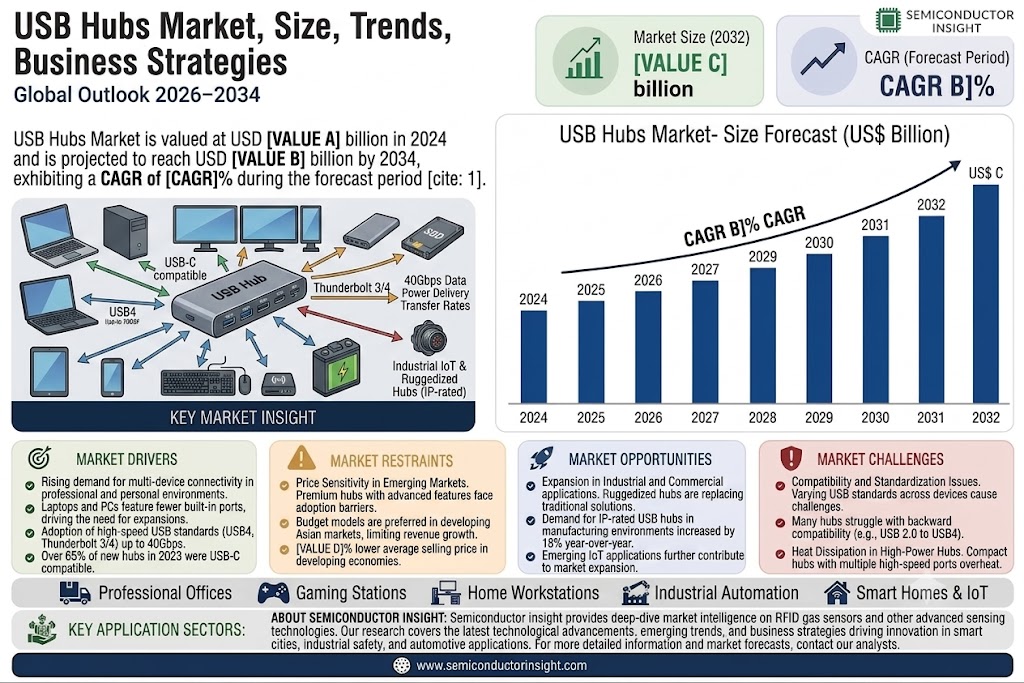
USB Hubs Market is experiencing growth due to the increasing need for multi-device connectivity in both professional and personal environments. With laptops and PCs featuring fewer built-in ports, consumers and businesses rely on USB hubs to expand connectivity for peripherals like external drives, keyboards, and monitors. Global shipments of USB hubs grew by 12% last year, reflecting this trend.
Technological Advancements in USB Standards
The adoption of USB4 and Thunderbolt 3/4 technologies has boosted demand for high-speed hubs capable of data transfer rates up to 40Gbps. These advanced USB hubs also support power delivery up to 100W, making them essential for modern ultrabooks and tablets. Over 65% of new USB hubs in 2023 were USB-C compatible, aligning with industry shifts.
Emerging IoT applications further contribute to market expansion, as USB hubs serve as central connection points for smart devices in home automation and industrial settings.
MARKET CHALLENGES
Compatibility and Standardization Issues
Despite growth, the USB Hubs Market faces challenges with varying USB standards across devices. Many hubs struggle with backward compatibility, particularly when connecting USB 2.0 devices to USB4 ports. Users frequently report power delivery inconsistencies across different manufacturers’ products.
Other Challenges
Heat Dissipation in High-Power Hubs
Compact USB hubs with multiple high-speed ports often experience overheating issues during sustained use, affecting performance and longevity. Thermal management remains a key engineering challenge for manufacturers.
MARKET RESTRAINTS
Price Sensitivity in Emerging Markets
Premium USB hubs with advanced features face adoption barriers in price-sensitive regions. While high-end hubs dominate North America and Europe, Asian markets show stronger preference for budget models, limiting revenue growth for manufacturers of feature-rich products. The average selling price in developing economies remains 35-40% lower than in mature markets.
MARKET OPPORTUNITIES
Industrial and Commercial Applications Expansion
USB Hubs Market sees significant opportunity in industrial automation, where ruggedized hubs with enhanced durability are replacing traditional connectivity solutions. Demand for IP-rated USB hubs in manufacturing environments increased by 18% year-over-year, creating new revenue streams for specialized manufacturers.
USB Hubs Market Trends
Steady Growth in USB Hubs Market Driven by Smart Device Adoption
Global USB Hubs Market reached a valuation of USD 674 million in 2025 and is projected to grow at 7.3% CAGR to USD 1,095 million by 2033. This growth is primarily fueled by increasing demand for connectivity solutions across smart homes and offices. USB hubs are becoming essential components in managing multiple peripherals from computers to IoT devices, including lighting systems, security cameras, and entertainment units.
Other Trends
Technological Advancements in USB Standards
The market is witnessing rapid adoption of USB-C hubs, capturing over 35% market share in 2025, due to their reversible design and high-speed data transfer capabilities. USB 3.0 hubs maintain strong demand with 52% market presence, while USB 2.0 hubs are gradually phasing out in professional environments.
Regional Market Dynamics
Asia dominates the USB Hubs Market with 43% global share, led by China’s manufacturing hubs and South Korea’s tech innovation centers. North America follows with 28% market share, driven by high disposable income and tech adoption rates. Emerging markets in Southeast Asia show the fastest growth potential due to digital transformation initiatives.
Competitive Landscape Shifts
Key players like Hasointech, IOGEAR, and Anker are expanding their product portfolios with multi-port hubs featuring power delivery and 4K video support. The competitive landscape remains fragmented with the top 5 companies holding approximately 38% market share collectively.
Diversification of Application Segments
Beyond traditional computing uses, USB hubs now serve diverse applications including digital camera setups (18% market share), smart home installations (22%), and mobile workstation configurations (15%). The growing hybrid work culture continues to drive demand for portable hub solutions with plug-and-play functionality.
COMPETITIVE LANDSCAPE
Key Industry Players
Global USB Hubs Market Features Strong Presence of Asian Manufacturers
USB Hubs Market is dominated by technology-focused companies, with Chinese manufacturers like Hasointech and Glocom leading in production scale and cost efficiency. Belkin and Anker maintain strong global brand recognition, particularly in premium USB-C hubs. The industry shows moderate concentration, with top 5 players accounting for approximately 35% market share, while numerous regional players cater to specific market segments.
Niche players like IOGEAR and Macally specialize in application-specific solutions for gaming and creative professionals, while Orico focuses on high-speed data transfer hubs. Emerging markets have seen growth from local manufacturers such as i-Rocks Technology in Taiwan, competing through price advantages in their domestic markets.
List of Key USB Hubs Companies Profiled
- Hasointech
- Glocom
- IOGEAR
- Ekto
- Macally
- Ez-net
- Belkin
- Orico
- Anker
- i-Rocks Technology
- Sabrent
- UGREEN
- TP-Link
- StarTech
- Plugable
Segment Analysis:
| Segment Category | Sub-Segments | Key Insights |
| By Type |
|
Type-C Hub emerges as the technology leader with several competitive advantages:
|
| By Application |
|
Smart Home Devices represent the most dynamic application segment:
|
| By End User |
|
Commercial Enterprises demonstrate strong adoption patterns:
|
| By Product Feature |
|
Power Delivery Hubs are gaining significant traction:
|
| By Distribution Channel |
|
Online Retail channels dominate the purchasing landscape:
|
Regional Analysis: Global USB Hubs Market
Asia-Pacific
Asia-Pacific hosts the world’s largest electronics manufacturing clusters, with Shenzhen serving as the global hub for USB device production. Local OEMs maintain advantages in rapid prototyping and mass production capabilities.
The region leads in developing next-generation USB 4.0 and Thunderbolt-compatible hubs, with Taiwanese firms pioneering compact designs for mobile professionals. Increasing R&D investments accelerate product lifecycles.
Integrated component supply chains enable Asian manufacturers to offer USB hubs at 20-30% lower costs than Western counterparts. This pricing advantage drives both domestic adoption and export volumes.
Corporate digital transformation across India, China and Southeast Asia increases USB hub deployment in office environments. Hybrid work models necessitate reliable connectivity solutions for employee workstations.
North America
The North American USB Hubs Market benefits from strong enterprise adoption and premium product demand. U.S. tech companies drive innovation in high-performance docking stations with advanced power delivery features. Silicon Valley startups introduce AI-enhanced smart hubs with dynamic power allocation. The region shows growing preference for ruggedized USB-C hubs in industrial applications. Retail channels prioritize branded, feature-rich models with extended warranties. Corporate procurement policies increasingly favor Thunderbolt-enabled hubs for creative professionals and developers.
Europe
European market growth stems from strict USB-IF compliance requirements and consumer demand for sustainable electronics. German engineering firms lead in industrial-grade USB hub solutions for manufacturing automation. Scandinavian countries adopt eco-friendly hubs with recyclable materials. Southern European markets show preference for budget-friendly multi-port options. EU regulations on universal charging standards accelerate USB-C hub adoption across mobile devices. The region’s strong retail distribution network supports diverse product availability.
South America
South America’s USB hub market grows through increasing PC penetration and mobile workforce expansion. Brazil dominates regional production with local assembly of imported components. Price sensitivity drives demand for basic multi-port USB 2.0/3.0 hubs in consumer segments. Growing gaming communities create niche demand for RGB-lit hubs with dedicated charging ports. Government technology initiatives in Chile and Colombia boost institutional purchases of connectivity peripherals.
Middle East & Africa
The MEA region shows uneven USB hub adoption patterns with Gulf countries leading in premium product demand. Dubai serves as regional distribution hub for international brands. Enterprise sectors prioritize rugged USB hubs for extreme climate conditions. South Africa’s growing tech startups drive demand for compact travel hubs. Mobile payment adoption spurs USB accessory sales in East African markets. The region presents untapped potential for budget USB hub solutions in emerging economies.
Report Scope
This market research report provides a comprehensive analysis of the USB Hubs Market, covering the forecast period 2026–2033. It offers detailed insights into market dynamics, technological advancements, competitive landscape, and key trends shaping the industry.
Key focus areas of the report include:
- Market Overview: The report begins with an overview outlining its current market scenario, key growth indicators, and industry transformation drivers. It discusses macroeconomic factors, demand-supply balance, regulatory landscape, and the strategic role of USB hubs in powering advancements across industries such as consumer electronics, industrial automation, and telecommunications.
- Market Size & Forecast: Historical data and future projections for revenue, unit shipments, and market value across major regions and segments.
- Segmentation Analysis: Detailed breakdown by product type (USB 3.0 Hub, USB 2.0 Hub, Type-C Hub), application (Computer Desk Lamp, Coolers, U Disk, Recording Pen, Digital Cameras, Phone, MP3, Others), and end-user industry.
- Regional Insights: Insights into market performance across North America, Europe, Asia, South America, and Middle East & Africa, including country-level analysis.
- Competitive Landscape: Profiles of leading market participants, including their product offerings, manufacturing capacity, pricing strategies, and recent developments.
- Technology Trends & Innovation: Assessment of emerging USB technologies and evolving industry standards.
- Market Drivers & Restraints: Evaluation of factors driving market growth along with challenges and supply chain constraints.
- Stakeholder Insights: Strategic insights for component suppliers, OEMs, and investors.
Primary and secondary research methods are employed, including interviews with industry experts and data from verified sources to ensure the accuracy and reliability of the insights presented.
FREQUENTLY ASKED QUESTIONS:
What is the current market size of USB Hubs Market?
-> USB Hubs Market size was valued at USD 674 million in 2025. The market is projected to grow from USD 722 million in 2026 to USD 1,095 million by 2033, exhibiting a CAGR of 7.3% during the forecast period.
What is the growth rate of USB Hubs Market?
-> The market is projected to grow at a CAGR of 7.3% during 2025-2033.
Which key companies operate in USB Hubs Market?
-> Key players include Hasointech, Glocom, IOGEAR, Ekto, Macally, Ez-net, Belkin, Orico, Anker, and i-Rocks Technology.
Which region dominates the USB Hubs Market?
-> Asia is the dominant region with key markets in China, Japan, and South Korea.
What are the key applications of USB Hubs?
-> Major applications include Computer Desk Lamps, Coolers, U Disks, Recording Pens, Digital Cameras, Phones, MP3 players, and others.
Get Sample Report PDF for Exclusive Insights
Report Sample Includes
- Table of Contents
- List of Tables & Figures
- Charts, Research Methodology, and more...