
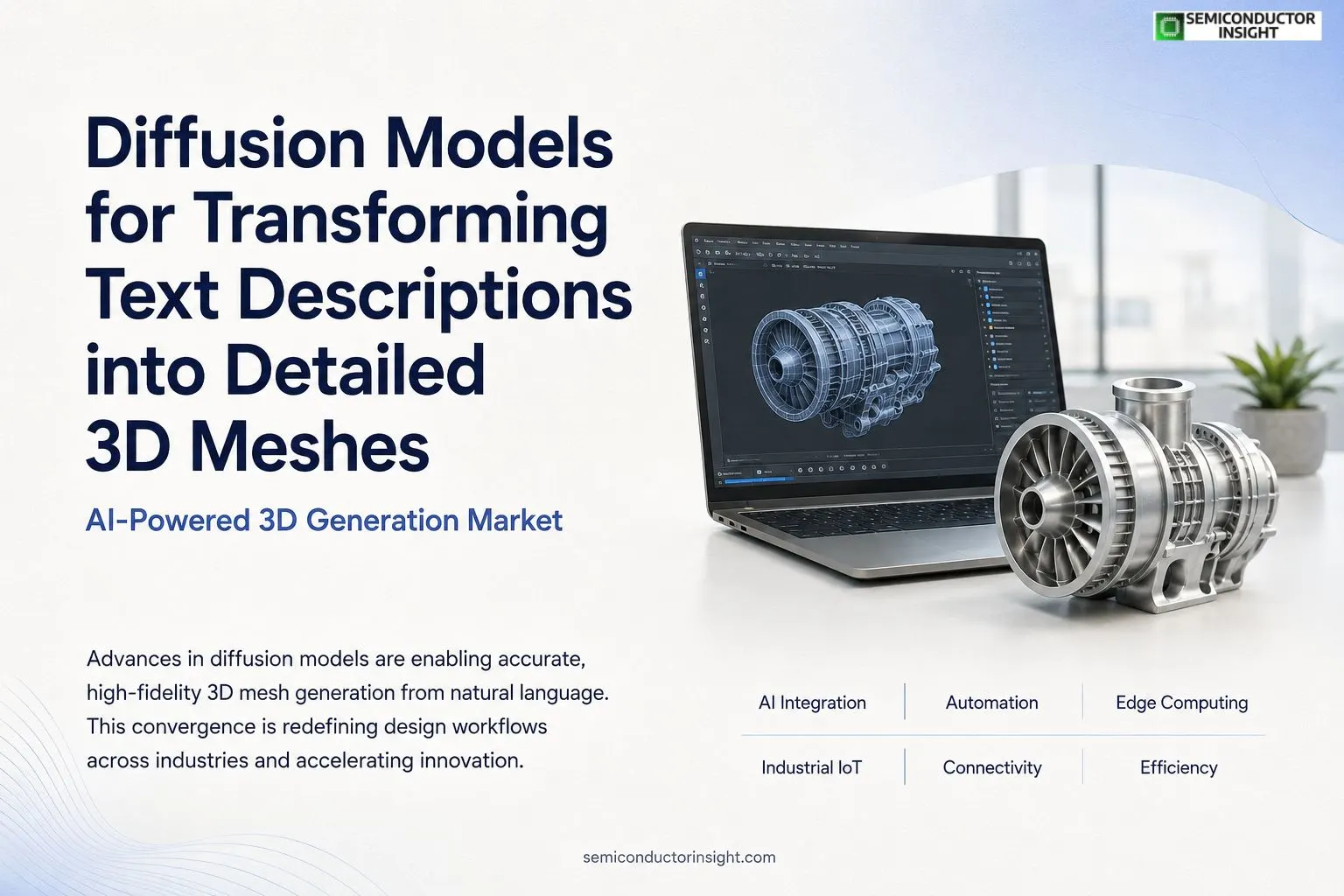
Unlocking Creative Worlds Text to 3D Mesh Generation Diffusion Models Powering Semiconductor Innovation
Diffusion models for transforming text descriptions into detailed 3D meshes represent a vibrant intersection of generative artificial intelligence and semiconductor hardware capabilities.
These systems start with random noise and iteratively refine it guided by text prompts to produce coherent three-dimensional structures complete with textures and geometries suitable for applications ranging from virtual prototyping to immersive environments.
NVIDIA’s Magic3D approach, for instance, demonstrated the ability to create high-quality meshes in roughly 40 minutes by optimizing a two-stage process that refines coarse models into higher resolution outputs.
For More Detailed Insights, You Can Surf Our Latest Report Here: https://semiconductorinsight.com/report/diffusion-model-for-text-to-3d-mesh-generation-market/
Hardware Acceleration Enabling Rapid 3D Synthesis
· Semiconductor advancements play a central role in making these computationally intensive processes practical.
· Graphics processing units optimized for parallel tensor operations handle the heavy lifting of denoising steps and score distillation sampling techniques that bridge 2D diffusion knowledge with 3D representations.
· Intel Labs developed LDM3D, which generates both images and depth maps from text, creating immersive 360-degree views that leverage specialized AI hardware for efficient inference.
· Such models rely on high-performance computing architectures to manage the memory bandwidth and floating-point operations required for real-time or near-real-time generation.
· Recent integrations in electronic design automation tools further accelerate workflows.
· Open-source initiatives and industry platforms now incorporate AI-assisted layout optimization for complex 3D integrated circuits that could one day host dedicated inference engines for mesh generation tasks.
· These semiconductor solutions support faster iteration cycles in design environments where engineers use text prompts to explore conceptual prototypes before committing to physical fabrication.
Industry Applications Reshaping Design Pipelines
In automotive and aerospace sectors, text-to-3D capabilities allow rapid visualization of component variations described in natural language. A designer might input streamlined electric vehicle chassis with integrated battery cooling and receive a mesh ready for simulation.
Semiconductor firms contribute through specialized processors that run these generative pipelines locally, reducing reliance on distant cloud resources and enhancing data security for proprietary projects. NVIDIA research has extended diffusion techniques to texture painting directly on 3D meshes, enabling artists and engineers to refine outputs interactively using reference images.
Educational and Research Breakthroughs Worldwide
Academic and government-supported projects explore diffusion-based 3D generation for scientific visualization. Initiatives draw on supercomputing resources built with advanced semiconductor nodes to train and deploy models that reconstruct molecular structures or architectural forms from descriptive text.
Case studies from university labs highlight how single-view image-to-mesh systems, enhanced by diffusion transformers, produce high-fidelity results in under 30 seconds on accessible GPU hardware. These developments democratize 3D content creation, allowing students and researchers without traditional modelling expertise to participate in cutting-edge work.
Integration of Accelerators in Generative AI Workflows
Which GPU architectures integrate best with text-to-3D mesh generation pipelines? High-end tensor core equipped processors from leading manufacturers excel due to their optimized support for mixed-precision computations and large model parallelism. Systems featuring ample high-bandwidth memory handle the simultaneous processing of multiview consistency checks and geometry optimization steps effectively.
Developers often pair these with software stacks that enable seamless scaling across multiple units for training custom diffusion variants tailored to industry-specific meshes, such as those used in semiconductor package design or consumer electronics prototyping. Real-world deployments in creative studios show reduced generation times and improved mesh quality when leveraging architectures designed for sustained high-throughput AI workloads.
Open Standards and Collaborative Ecosystems
Ø Open standards like those evolving for 3D IC design facilitate better interoperability between generative AI tools and traditional electronic design automation flows. Projects backed by collaborative efforts aim to standardize data formats that allow text-generated meshes to flow directly into simulation and verification environments running on specialized semiconductor hardware.
Ø This synergy supports faster innovation cycles where conceptual 3D ideas translate quickly into manufacturable designs. Government initiatives promoting domestic semiconductor capabilities also indirectly bolster these technologies by expanding access to powerful computing infrastructure.
Challenges in Scalability and Realism Addressed Through Silicon Advances
Achieving consistent multiview geometry and fine surface details requires substantial computational resources that semiconductor progress continues to unlock. Techniques like amortized optimization and 3D-aware priors help models generalize across diverse prompts while running efficiently on current hardware generations.
Ongoing work in research labs focuses on reducing memory footprints so that sophisticated text-to-3D pipelines can operate on edge devices powered by energy-efficient AI accelerators, expanding use cases to mobile design tools and augmented reality applications.
Creative and Entertainment Sector Transformations
Film and game development studios adopt these models to generate assets from script descriptions, streamlining pre-production.
A prompt describing a fantastical creature yields a textured mesh integrable into existing pipelines, with semiconductor-accelerated rendering ensuring quick previews.
This capability shortens timelines and encourages experimentation, as artists iterate rapidly without extensive manual sculpting.
Companies leveraging NVIDIA Omniverse and similar platforms report enhanced collaboration through shared 3D environments built from generative outputs.
Broader Societal and Industrial Implications
From architecture firms visualizing buildings described in client briefs to medical device developers conceptualizing implants, text-to-3D diffusion models powered by advanced semiconductors are expanding creative and technical possibilities globally.
The technology supports sustainable practices by enabling virtual prototyping that reduces material waste in early design stages. As hardware continues evolving with more efficient nodes and specialized cores, these generative tools become accessible to smaller teams and individual innovators worldwide.

Comments (0)