

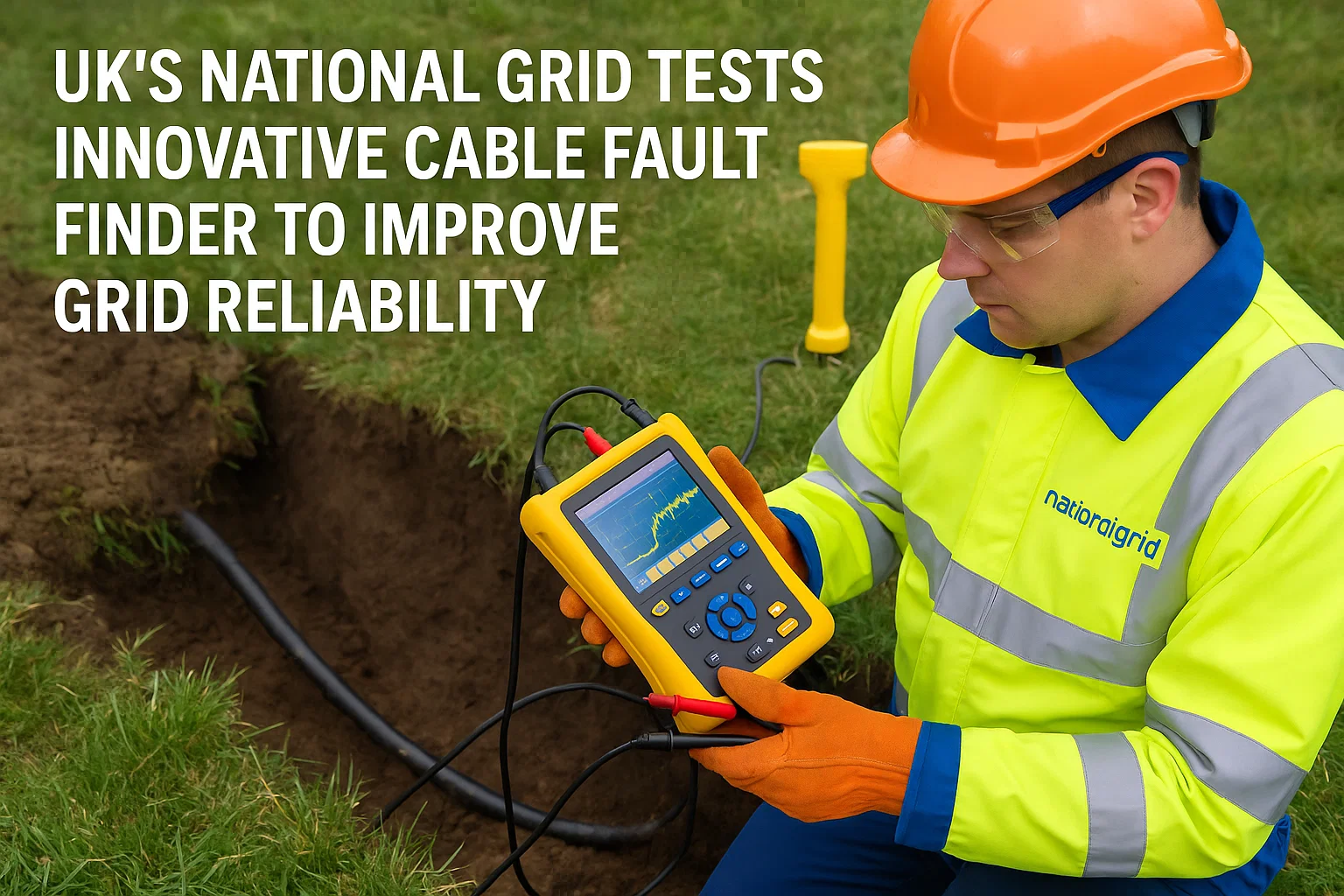
UK’s National Grid Tests Innovative Cable Fault Finder to Improve Grid Reliability
Electricity is the backbone of modern society, powering homes, industries, hospitals, transport systems, and digital infrastructure. Yet, behind the convenience of a simple light switch lies one of the most complex engineering challenges: maintaining reliable power distribution through vast networks of underground and overhead cables. When faults occur whether due to aging infrastructure, environmental factors, or sudden equipment failures the consequences can range from minor service interruptions to widespread blackouts.
For decades, utility companies have struggled with one fundamental problem: how to detect and locate faults in buried or hidden power cables quickly, accurately, and with minimal disruption. Traditional fault-finding techniques often involve trial-and-error excavation, consuming time, money, and public patience.
But change is on the horizon. In March 2025, National Grid unveiled a trial of a new low-voltage (LV) cable fault locator, marking a significant leap forward in the way utilities approach fault detection. This innovation is not just a technical milestone; it signals a broader transformation in the cable fault finder industry a market valued at US$ 795 million in 2024 and projected to soar to US$ 1661 million by 2032, expanding at a CAGR of 11.4%.
Access Your Free Sample Report- Cable Fault Finder Market
The Challenge of Cable Faults in Power Networks
Power cables, whether laid underground or strung overhead, form the arteries of modern power grids. In urban areas, underground cabling is often preferred due to aesthetics, safety, and space optimization. However, underground systems come with their own unique challenge: when a cable fails, the problem is hidden beneath roads, pavements, and landscapes.
Faults can occur for numerous reasons:
- Aging infrastructure – Many cities rely on cables laid decades ago.
- Water ingress and insulation breakdown – Moisture is a common enemy of underground cabling.
- Mechanical damage – Construction works, drilling, or roadworks frequently damage buried cables.
- Overloading and overheating – Demand surges put pressure on distribution systems.
When a fault arises, utilities need to act fast. Traditional methods often require isolating sections, performing insulation resistance tests, and sometimes digging multiple trial holes before the actual fault location is identified. This process is costly, time-consuming, and disruptive to communities.
National Grid’s Breakthrough: The New LV Fault Locator
In March 2025, National Grid, one of the UK’s leading utilities, announced a trial of a new low-voltage (phase-to-phase) cable fault locator. This system represents a leap forward in fault detection technology, especially for LV networks that power residential neighborhoods, commercial areas, and critical services.
Key Features of the New Fault Locator
- Non-intrusive diagnosis
- Instead of cutting into cables or digging multiple holes, engineers connect the fault locator at the substation end.
- Impedance-based detection
- By measuring impedance along the cable under load (with household appliances such as kettles or heaters switched on), the device calculates where the fault lies.
- Reduced excavations
- This dramatically reduces unnecessary digging, saving both costs and public disruption.
- Accuracy in live conditions
- Unlike traditional offline tests, this method works while the network is still carrying load, offering real-time insights.
- Ease of deployment
- Field engineers can carry the device and deploy it quickly without requiring extensive equipment.
Engineers Behind the Innovation
The development is credited to Gary Butler and Tom White, whose work demonstrates how engineering ingenuity can solve long-standing challenges in the power sector. By focusing on low-voltage networks often overlooked compared to high-voltage transmission lines the innovation directly improves reliability for everyday consumers.
Why This Innovation Matters
The implications of this breakthrough go far beyond operational efficiency. Here’s why it matters:
- Faster restoration of supply: Quicker fault identification means less downtime for homes and businesses.
- Cost savings: Reduced excavation and resource use directly lower maintenance expenses.
- Public satisfaction: Avoiding repeated roadworks and lengthy outages improves trust in utilities.
- Workforce efficiency: Field crews can cover more faults in less time, optimizing workforce utilization.
- Environmental benefits: Fewer excavations reduce carbon emissions associated with heavy machinery and material usage.
This development aligns with the broader push toward smart grid technologies, where data, automation, and advanced diagnostics create more resilient, sustainable power networks.
Download Sample Report PDF- Cable Fault Finder Market
The Cable Fault Finder Market: A Growing Industry
The innovation by National Grid reflects a broader global trend: increasing investment in fault detection and monitoring solutions.
Market Size and Forecast
- 2024 Market Value: US$ 795 million
- 2032 Projected Value: US$ 1661 million
- CAGR: 11.4% (2024–2032)
Such strong growth is driven by several factors:
- Rising electricity demand – Growing urban populations and electrification of transport/industry demand robust networks.
- Aging infrastructure – Many power grids worldwide are decades old, creating higher fault risks.
- Smart grid adoption – Integration of IoT sensors and advanced monitoring encourages adoption of modern fault finders.
- Cost efficiency – Utilities seek to minimize operational expenditures through precision tools.
- Resilience against climate change – Extreme weather events are increasing fault incidents, requiring quicker responses.
Types of Cable Fault Finders
To appreciate the new LV locator’s importance, it helps to understand the broader spectrum of fault finder technologies:
- Time Domain Reflectometer (TDR)
- Sends a pulse down the cable and measures reflections to locate faults.
- Bridge Methods (e.g., Murray and Varley Bridge)
- Classical methods using resistance measurement to pinpoint faults.
- Surge Generators (Thumpers)
- Apply high voltage surges to “burn” faults, making them audible for location.
- Impedance-based methods
- Like National Grid’s LV trial, these calculate fault distance based on impedance under load.
- Automated/Smart Systems
- Integrated IoT-enabled systems that continuously monitor cable health.
Regional Insights
- Europe
- Leading in smart grid adoption. National Grid’s trial fits into a larger European strategy for energy resilience.
- North America
- Significant investments in upgrading aging infrastructure, especially post-storm resilience.
- Asia-Pacific
- Rapid urbanization and electrification are fueling demand for efficient cable diagnostics.
- Middle East & Africa
- Expansion of power networks in developing economies creates demand for cost-effective fault finders.
Challenges and Barriers
While the industry is growing, some challenges remain:
- High initial investment: Advanced fault locators can be expensive for smaller utilities.
- Skilled workforce requirement: Operators need specialized training.
- Integration with legacy systems: Many older networks are not easily compatible with new tools.
- Regulatory hurdles: Adoption may require policy shifts in certain regions.
Click Here To Download Full Sample Report- Cable Fault Finder Market
The Future of Cable Fault Finders
Looking ahead, several trends are likely to shape the industry:
- AI and Machine Learning
- Predictive fault detection based on historical and real-time data.
- IoT Integration
- Sensors embedded in networks enabling real-time monitoring.
- Portable, Lightweight Devices
- Tools optimized for field deployment with user-friendly interfaces.
- Sustainability
- Eco-friendly systems that reduce excavation and emissions.
- Global Collaborations
- Partnerships between utilities, research institutions, and tech companies.
The trial of the new LV cable fault locator by National Grid marks a watershed moment in power infrastructure management. It directly addresses long-standing challenges in low-voltage networks, offering a more accurate, less disruptive, and cost-efficient solution.
Coupled with a rapidly growing global market expected to more than double from US$ 795 million in 2024 to US$ 1661 million by 2032 this innovation highlights the strategic importance of fault finders in building future-ready power systems.

Comments (0)