
UHF RAIN vs. HF RFID Reader IC Market 2026: Which Architecture Fits the Application?
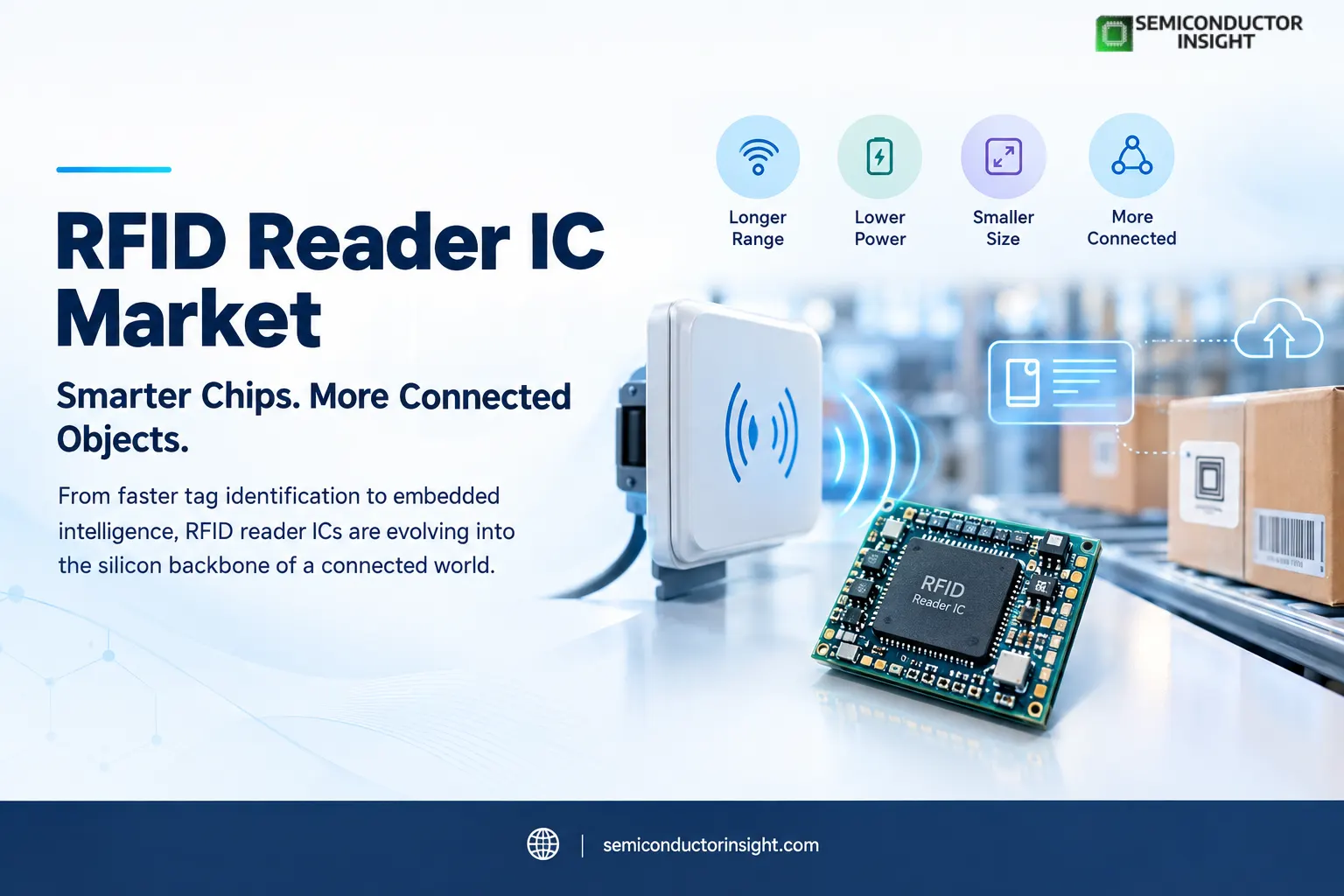
That single distinction is changing the role of the RFID reader IC from a supporting semiconductor component into an increasingly important piece of connected infrastructure. Modern reader chips are expected to identify large groups of objects, operate with limited power, cope with interference, fit inside compact devices and communicate with software platforms that turn radio signals into inventory, logistics, payment or asset information.
The most interesting change in 2026 is therefore happening at the silicon level.
From Radio Waves to an Item-Level Data Event
An RFID reader IC sits between the antenna and the digital system. It generates or manages the RF signal, receives the response from tags, performs analog signal processing and transfers decoded information to a host processor.
The simplified architecture now looks like this:
RFID Tag → Antenna → Reader IC → RF Processing → Protocol Handling → MCU/Processor → Cloud or Enterprise System
For RAIN RFID, GS1 identifies the UHF Gen2 air interface alongside EPC data standards and reader protocols such as LLRP. This standardization is important because the reader IC has to operate within an ecosystem rather than simply detect an arbitrary radio signal.
Our most recent updated related study is available for free at this link: https://semiconductorinsight.com/report/rfid-reader-ic-market/
The UHF Chip Is Becoming the Real Workhorse
- The strongest semiconductor activity is visible around UHF RAIN RFID, particularly where companies need to identify multiple objects without requiring line-of-sight.
- Impinj’s current E Family illustrates the segmentation.
- Its E910 is positioned for enterprise-grade readers such as portals, gateways and conveyors; E710 targets handheld and fixed readers; E510 addresses mobile, wearable and point-of-sale devices; while E310 focuses on printers, kiosks and access-control applications.
- This is an important architectural shift. Instead of designing one large reader for every application, manufacturers can select a reader IC according to read distance, processing requirements, power budget and physical size.
1,000 Tags per Second Is Becoming a Design Benchmark
Reader performance is increasingly measured by how quickly a system can process a population of tags rather than simply whether it can read one tag.
For example, an Impinj-based one-port reader module listed by Impinj specifies a 1,000-tags-per-second read rate, 27 dBm maximum RF output and a compact 21 mm × 21 mm module footprint.
That combination is significant for embedded applications. A reader designed for a warehouse portal can afford a larger RF section, whereas a wearable, handheld scanner or smart cabinet needs substantially tighter integration.
Impinj’s E710 also specifies up to 9 dB improved receive sensitivity compared with its cited previous-generation R2000 reference, while the E510 offers up to 14 dB improved sensitivity compared with the Indy R500 and up to 50% lower IC power consumption.
Miniaturization Is Moving RFID inside the Product
- The next stage of RFID is not necessarily another handheld reader.
- It is RFID embedded inside products and equipment.
- Reader IC suppliers are increasingly targeting point-of-sale equipment, smart shelves, connected appliances, wearables, printers, security systems and industrial devices. Impinj states that its newer reader chips can enable system designs up to 80% smaller than earlier implementations.
This creates a new design equation:
Smaller IC → Smaller RF Section → Lower Power → Easier Embedding → More Connected Objects
- System-in-package technology is pushing this even further. One Impinj partner example integrates a reader solution into an 11 mm × 11 mm SiP, demonstrating how RFID electronics can move into space-constrained equipment.
Gen2X Is Adding another Layer of Intelligence
The RAIN RFID ecosystem is also moving beyond basic tag identification. Impinj’s Gen2X solutions toolbox is designed to add capabilities around faster inventory, extended read range, interference management, authentication and other application-level improvements.
For semiconductor designers, this raises the importance of receiver sensitivity, interference rejection and signal-processing efficiency. The reader IC is no longer simply decoding a tag response; it increasingly determines how reliably the entire system can operate in dense RF environments.
HF RFID Still Has a Different Semiconductor Role
UHF is not replacing every RFID architecture.
HF RFID and NFC remain important for payment terminals, access systems, identification, consumer devices and short-range interactions. STMicroelectronics’ ST25R3916B, for example, operates at 13.56 MHz and supports ISO 14443A/B, ISO 15693, ISO 18092 and FeliCa-related modes. It supports NFC-A/B data rates up to 848 kbit/s and NFC-V up to 53 kbit/s.
The distinction is therefore becoming application-specific: UHF RAIN excels when the system needs longer-range identification and high tag populations, while HF/NFC reader ICs remain highly relevant for controlled short-range transactions.
The Automotive Connection Is Getting More Interesting
Reader IC development is also moving into automotive electronics. STMicroelectronics’ ST25R3914/3915 devices are AEC-Q100 Grade 1 qualified and support a -40°C to 125°C operating temperature range, illustrating the requirements imposed when RFID/NFC technology moves into vehicle environments.
That creates opportunities around vehicle access, digital keys, identification, service authentication and connected interior functions where reliable RF operation has to coexist with a demanding electronic environment.
What the Next RFID Reader Design Will Be Judged On?
- The specification sheet is changing. Engineers increasingly examine sensitivity, RF output, simultaneous tag handling, power consumption, package dimensions, antenna compatibility, protocol support and interference behavior together.
- A reader IC delivering high RF performance but requiring excessive board area may not fit a wearable. Conversely, an ultra-low-power chip may not be suitable for a warehouse portal handling dense populations of moving tags.
- That is why the current RFID Reader IC Market is becoming less about one universal chip and more about optimized silicon platforms for specific physical environments.
The Semiconductor Opportunity Is Moving Closer to the Edge
RFID is gradually becoming an edge-computing input rather than an isolated identification technology. A reader can capture an item’s identity, location or movement and immediately pass that information to an embedded processor, application or cloud platform.
GS1 describes RFID as a technology capable of improving supply-chain visibility and inventory accuracy, while modern reader IC architectures are making the RF function easier to embed into increasingly small devices.
The result is a broader semiconductor opportunity: RFID reader ICs are becoming the radio interface through which physical objects enter digital systems.
In 2026, the most important question is no longer simply how far an RFID reader can read. It is how much intelligence, RF performance and connectivity can be packed into the smallest possible piece of silicon.

Comments (0)