RFID Reader IC Market, Emerging Trends, Technological Advancements, and Business Strategies 2026-2034

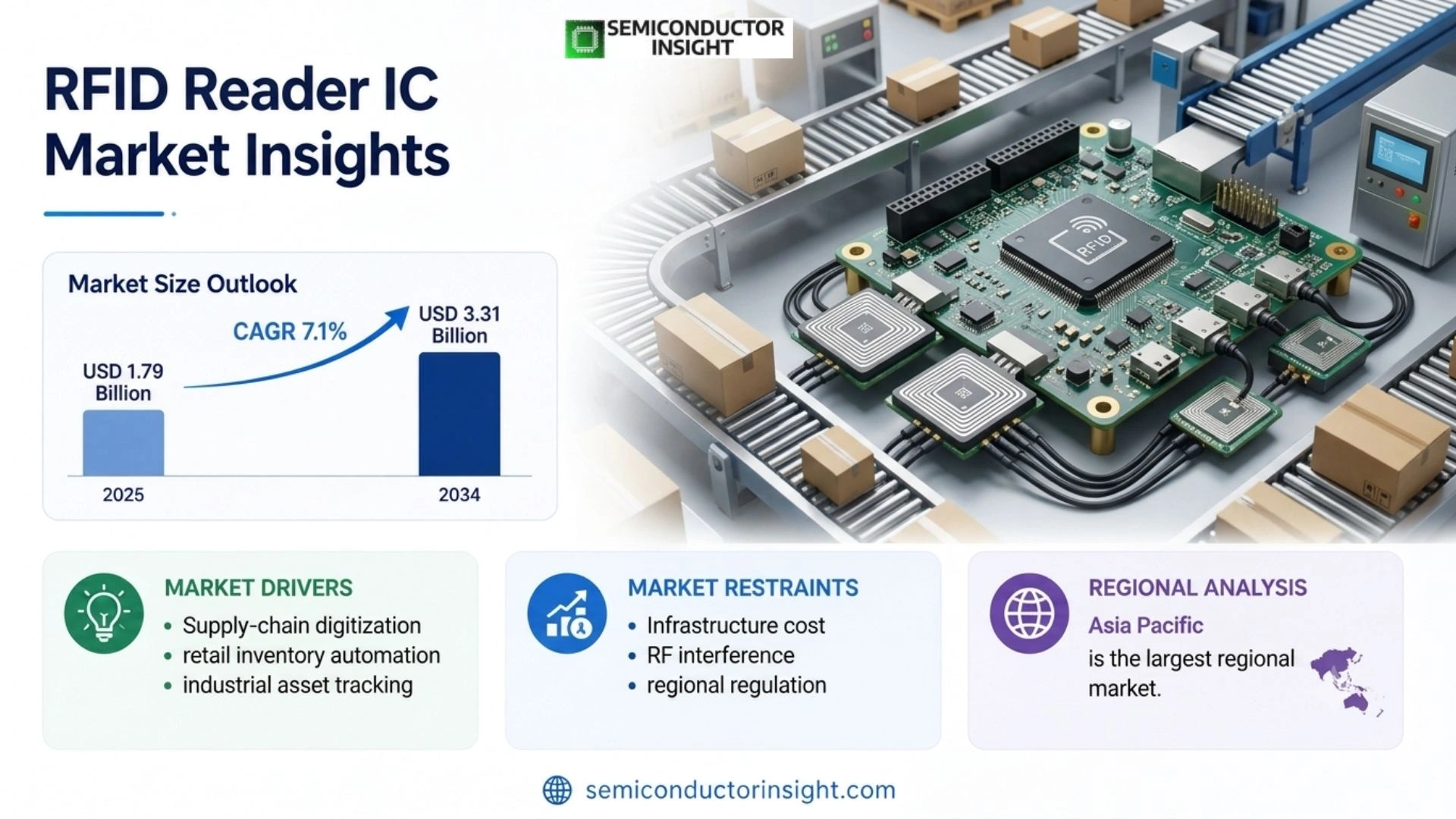
RFID reader IC market is represented at approximately USD 1.79 billion in 2025 and is projected to reach USD 3.31 billion by 2034, corresponding to a 7.1% CAGR for 2026–2034. Asia Pacific is the largest regional market in the market. Reader IC demand expands as RFID systems move from isolated identification points toward connected infrastructure across retail, logistics and industry.

PDF Icon Download Sample Report PDF
  • Quick Dispatch

    All Orders

  • Secure Payment

    100% Secure Payment

Price range: $1,500.00 through $4,250.00

Clear

Key Statistics

2025 Market Size
USD 1.79 billion
2034 Projected Size
USD 3.31 billion
CAGR (2026–2034)
7.1%
Largest Market in 2025
Asia Pacific (42% in 2024)

Key Takeaways

  • UHF RFID reader ICs lead because long-range RAIN RFID supports rapid identification across supply chains, warehouses and retail. The architecture rewards high sensitivity, multi-tag handling, interference management and efficient communication with the host system.
  • Supply Chain is the leading application because readers can be placed at receiving, storage, picking, shipping and returns points. A single logistics program can therefore require many reader endpoints, directly increasing semiconductor content as item-level visibility expands.
  • Asia Pacific is the largest region in the market, combining electronics manufacturing, retail and logistics demand. North America remains a major enterprise-technology market, while Europe emphasizes industrial, retail and automotive applications with strong interoperability requirements.
  • RF performance and integration are the principal competitive variables. Integrated reader ICs can reduce BOM complexity and development effort, but suppliers must still deliver reliable operation across antennas, metals, liquids, dense tags and differing regional radio requirements.
  • Embedded RFID and connected inventory create the largest expansion opportunity as RFID moves into handhelds, smart cabinets, industrial machinery and connected retail fixtures. Low-power operation and simple host interfaces can expand the number of products capable of adding RFID.

RFID Reader IC Market Overview

RFID reader IC market is represented at approximately USD 1.79 billion in 2025 and is projected to reach USD 3.31 billion by 2034, corresponding to a 7.1% CAGR for 2026–2034. Asia Pacific is the largest regional market in the market. Reader IC demand expands as RFID systems move from isolated identification points toward connected infrastructure across retail, logistics and industry.

Base year: 2025 · Forecast period: 2026–2034 · Historical context: 2020–2024 · Values in USD billion unless otherwise stated

RFID reader ICs are semiconductor devices that provide the RF and control functions required to interrogate RFID tags and communicate tag information to a host processor. The exact architecture varies by frequency, protocol and application, but the IC generally includes some combination of RF transmit and receive circuitry, signal processing, protocol framing, control logic and interfaces to the rest of the reader system. The supplied market structure covers LF, HF and UHF reader ICs and adds frequency and communication-interface dimensions.

The buying requirement originates from the completed reader rather than the chip alone. Fixed logistics readers can prioritize multi-antenna performance and read throughput, while handheld devices must balance RF capability with battery consumption and processing load. Embedded industrial readers can require very small footprints and straightforward interfaces. These different system requirements create demand for multiple device architectures and make evaluation boards, reference designs, firmware and developer support commercially valuable.

Impinj describes reader ICs as a channel sold through distribution to handheld- and fixed-reader OEMs and ODMs, while readers and gateways reach solution providers, VARs and systems integrators through distribution. This illustrates the commercial structure of the market: semiconductor suppliers influence design choices through both device performance and the quality of the development ecosystem available to the reader manufacturer.

The market is standards-driven but performance-differentiated. UHF systems typically operate in the 860–960 MHz range and depend on established RAIN RFID and EPC Class 1 Gen2 style interoperability, while HF systems at 13.56 MHz address short-range identification and NFC-related applications. Standards make multi-vendor sourcing possible, but sensitivity, interference rejection, antenna control, power consumption and host integration still differentiate reader ICs.

Recent company evidence shows the scale of the surrounding ecosystem. Impinj reported 52.8 billion endpoint ICs shipped in 2024 and more than 150 billion endpoint ICs sold cumulatively by the end of 2025. Endpoint ICs are not the same product as reader ICs, but the figures demonstrate the expanding population of RFID-tagged objects that reader infrastructure must identify. Impinj also highlighted Gen2X and continued platform development in its 2025 results.

Segment Analysis: By Type

The defined type segmentation is LF RFID Reader IC, HF RFID Reader IC and UHF RFID Reader IC. UHF is the largest type because it supports long-range and multi-tag identification used extensively in retail and logistics. HF is important in NFC and access-related systems, while LF remains established in proximity identification and selected tracking applications. The mix reflects both physical operating frequency and the application ecosystem surrounding each protocol family.

Type Technical role Market position
LF RFID Reader IC Supports low-frequency RFID architectures used for proximity identification, animal tracking and selected access-control systems where simplicity and established compatibility are important. A mature niche with stable replacement demand. Price and compatibility can outweigh advanced processing features because many installations are built around well-established low-frequency applications.
HF RFID Reader IC Supports 13.56 MHz RFID and NFC architectures used for contactless identification, access, payment-related functions and short-range interaction. An important application-led segment. Protocol breadth, low-power detection, certification support and compact integration are significant buying considerations in consumer and automotive systems.
UHF RFID Reader IC Supports long-range RAIN RFID operation in the 860–960 MHz region and enables high-throughput multi-tag identification in logistics, retail and industrial environments. Largest type. Strongest structural growth because one reader can interrogate many tagged objects rapidly, increasing the value of RF sensitivity, anti-interference performance and efficient edge processing.

Frequency and communication-interface economics

The source segmentation identifies 125–134 kHz, 13.56 MHz, 860–960 MHz and 2.45 GHz frequency ranges. It also includes communication interface as a market dimension. Frequency changes the antenna architecture, regulatory environment and achievable range, while the interface changes how the reader IC communicates with the host system. A platform intended for a handheld reader can therefore have different cost, power and software requirements from a fixed warehouse reader even when both ultimately perform RFID identification.

Segment Analysis: By Application

The defined application groups are Supermarket, Convenience Store, Supply Chain, Shopping Mall and Other. Supply Chain leads because reader infrastructure can be deployed at many physical control points and each additional checkpoint requires electronics capable of reliable tag interrogation. Supermarkets and shopping malls create retail demand, while convenience stores favor compact low-complexity deployments. Other includes industrial, healthcare, automotive and specialist identification systems that often have more application-specific requirements.

Application Demand characteristics
Supermarket Demand is driven by inventory visibility and automated replenishment. Customers value UHF architectures that support rapid reads in dense retail environments and can integrate into existing inventory software.
Convenience Store Smaller footprints favor compact and economical reader designs. The trigger is simplified automation, so integration effort, low power and straightforward host connections are commercially important.
Supply Chain The leading application because readers can be installed at docks, conveyors, storage zones, picking stations and shipping points. Throughput, read reliability and integration with warehouse software are the key purchasing drivers.
Shopping Mall Retail operators use RFID to improve inventory accuracy and item movement visibility. Reader designs must fit constrained store environments and connect effectively to enterprise retail systems.
Other Industrial assets, healthcare, libraries, automotive and specialist equipment create a broad demand pool. These systems can prioritize ruggedness, low power, security or custom antenna arrangements over maximum reader throughput.

RFID reader IC market Growth 2026

Regional Analysis

Asia Pacific is the largest regional market in the market, supported by electronics manufacturing, retail scale and logistics activity. North America is a major enterprise-technology center where RFID is widely integrated into inventory and supply-chain systems. Europe combines industrial, retail and automotive applications. South America and Middle East & Africa remain smaller but are expanding through logistics modernization, retail automation and project-based asset tracking.

How does regional demand differ across the RFID reader IC market?

Regional differences arise from deployment maturity, local electronics manufacturing and the role of system integrators. Asia Pacific combines the strongest supply base with large end-user demand. North America emphasizes enterprise software integration and scalable deployments. Europe focuses on industrial, retail and automotive interoperability. South America is more distributor- and project-led. Middle East & Africa concentrate demand in logistics hubs, large retailers, airports and industrial sites. These differences affect channel strategy and product requirements as much as overall market size.

Region Position Growth outlook Demand profile What decides supplier selection
Asia Pacific Largest Strong Manufacturing, retail and logistics RF performance, cost, local support and scalable supply
North America Second Strong enterprise adoption Supply chain and advanced retail System integration, software ecosystem and reader performance
Europe Third Steady Industrial, retail and automotive Standards compliance, reliability and lifecycle support
South America Fourth Moderate Retail and logistics modernization Landed cost, distributor coverage and deployment simplicity
Middle East & Africa Smallest Moderate to strong Logistics hubs, airports and industrial projects Integrator capability, supply reliability and ruggedization
Asia Pacific LARGEST

Why does Asia Pacific lead the RFID reader IC market?

Asia Pacific leads because it combines large electronics manufacturing capacity with major retail, logistics and industrial ecosystems. China, Japan and South Korea support significant reader-system and electronics production, while large distribution networks create demand for many reader endpoints. This dual supply-and-demand role makes the region structurally different from markets that mainly consume imported reader equipment.

Market positionLargest region
Growth outlookStrong
Demand profileManufacturing and logistics led
Market access gateLocal design support
Country Position in region What drives demand
China Largest Retail, logistics, electronics manufacturing and industrial automation create broad UHF reader demand.
Japan Mature Automotive, retail and industrial automation favor reliable high-integration RFID platforms.
South Korea Electronics-led Advanced electronics manufacturing and connected-factory applications support high-performance reader integration.

China provides the deepest volume opportunity because readers are deployed across retail, warehousing and manufacturing. Cost, RF sensitivity and supply assurance are important when many readers are installed across one site.

Japan emphasizes reliability and lifecycle continuity. Suppliers can defend relationships through long product availability, software support and stable device roadmaps that reduce redesign risk.

South Korea has concentrated demand in electronics and connected factories, where reader IC performance is evaluated as part of a complete RF system rather than as a stand-alone semiconductor.

Market instances

  • 2025: Impinj reported 52.8 billion endpoint ICs shipped in 2024 and continued developing the RAIN RFID ecosystem. The scale of the endpoint base supports continued investment in reader infrastructure that can interrogate large populations of tagged objects. Source: Impinj

None

North America SECOND LARGEST

Why is North America strategically important for RFID reader IC suppliers?

North America is strategically important because enterprise RFID deployments often connect reader infrastructure directly to inventory, warehouse and asset-management software. This raises the value of system integration, development tools and long product availability. Reader IC suppliers can win through reference designs and ecosystem relationships, not only through RF performance, because an enterprise deployment may standardize one reader platform across many facilities.

Market positionSecond largest
Growth outlookStrong enterprise adoption
Demand profileSupply-chain led
Market access gateSystem integration
Country Position in region What drives demand
United States Largest Enterprise retail, logistics, healthcare and industrial deployments drive fixed and handheld reader demand.
Canada Growing Retail, logistics and industrial identification support steady adoption through integrators.
Mexico Manufacturing and logistics Industrial production and cross-border logistics create asset and inventory tracking demand.

The United States has a mature enterprise ecosystem in which reader data is tied into software and operational workflows. This makes compatibility, support and long-term availability important alongside RF performance.

Canada has a diversified but smaller deployment base, making distributors and integrators important for reaching customers across retail, healthcare and industry.

Mexico is increasingly relevant as manufacturing and logistics expand. The strongest opportunities are typically tied to traceability and inventory control, where deployment simplicity and cost matter.

Market instances

  • 2026: Impinj continues to position RAIN RFID as an IoT platform linking physical items to business applications, reinforcing demand for reader infrastructure that can convert tag events into enterprise data. Source: Impinj Investor Relations

None

Europe THIRD

What supports European RFID reader IC demand?

Europe combines retail and logistics adoption with industrial and automotive applications where interoperability, product continuity and system reliability are important. Reader suppliers therefore compete on lifecycle support and integration as well as RF capability. The market favors platforms that can operate within established standards and remain available long enough to support long-lived industrial equipment.

Market positionThird
Growth outlookSteady
Demand profileIndustrial and retail
Market access gateStandards and lifecycle
Country Position in region What drives demand
Germany Industrial leader Automotive, manufacturing, warehouses and retail create broad RFID use.
France Retail and transport Enterprise retail and logistics support connected identification programs.
U.K. Advanced retail and logistics Retail, healthcare and logistics favor software-connected reader platforms.

Germany’s industrial customer base values traceability and reliability, so reader ICs that support stable long-term platforms can benefit from lower requalification risk.

France has meaningful retail and transport applications, making multi-tag read performance and software integration important selection criteria.

The U.K. has a mature RFID ecosystem where complete system economics matter. Low-power modes and long product availability can help suppliers win against otherwise similar devices.

Market instances

  • 2025–2026: STMicroelectronics continues to offer the ST25 reader portfolio, including the ST25RU3993 RAIN RFID single-chip reader and multiple HF/NFC reader devices. The breadth shows continued movement toward highly integrated reader architectures. Source: STMicroelectronics

None

South America FOURTH

Where are South American RFID reader IC opportunities concentrated?

South America is more project- and distributor-driven than the largest RFID regions. Brazil provides the broadest opportunity through retail, logistics and industrial tracking, while Argentina and Chile tend to be more selective. Suppliers can improve adoption by offering modular reference designs, predictable availability and local technical support, because the customer often needs a complete deployable reader solution rather than a semiconductor component alone.

Market positionFourth
Growth outlookModerate
Demand profileRetail and logistics led
Market access gateDistributor and integrator coverage
Country Position in region What drives demand
Brazil Largest Retail inventory, logistics and industrial tracking provide the broadest demand pool.
Argentina Project-led Retail and industrial customers adopt RFID where labor and visibility benefits justify investment.
Chile Industrial and logistics Ports, mining and distribution create focused asset-tracking demand.

Brazil’s scale supports many potential reader deployments, but local system integration and distributor access are important. Suppliers that simplify deployment can convert pilots into repeat orders.

Argentina requires a clear operating return before hardware is standardized, so modular platforms that can support several project types can help OEMs manage development cost.

Chile’s logistics and mining applications can require rugged continuous operation, making reader reliability and data connectivity important beyond basic tag-interrogation capability.

Market instances

  • 2026: STMicroelectronics continues to publish reader IC documentation and development resources that support industrial and consumer applications. Broad engineering support can lower the barrier for regional integrators adapting international reader IC platforms. Source: STMicroelectronics

None

Middle East & Africa SMALLEST

Where is RFID reader IC demand emerging in Middle East & Africa?

Demand is concentrated in logistics hubs, airports, large retailers, industrial facilities and specialist asset-tracking programs. The market is strongly influenced by system integrators because deployments are often project-based and multi-site. Suppliers gain advantage when they combine reliable availability with rugged operation, simple software integration and device roadmaps that can support long installation cycles.

Market positionSmallest
Growth outlookModerate to strong
Demand profileProject and logistics led
Market access gateIntegrator capability
Country Position in region What drives demand
United Arab Emirates Regional hub Airports, logistics zones, retail and smart-infrastructure projects create concentrated demand.
Saudi Arabia Project growth Industrial modernization and logistics programs support traceability and automation.
South Africa Regional technology base Retail, mining, transport and industrial asset tracking create recurring demand.

The UAE acts as a procurement and logistics hub, enabling system integrators to aggregate demand across several countries. Reader suppliers that maintain stable part numbers and good channel support fit this model well.

Saudi Arabia offers project-led opportunities where standardized equipment and reliable long-term supply can be important to multi-site deployments.

South Africa has a diverse industrial base, so reader demand ranges from retail to mining and transport. Ruggedness and connectivity can therefore matter alongside pure RF performance.

Market instances

  • 2025–2026: STMicroelectronics continues to position ST25 readers for industrial, consumer and automotive use, emphasizing low-power operation, noise robustness and multiprotocol support. Those characteristics are relevant to regional deployments operating in mixed and demanding RF environments. Source: STMicroelectronics

None

Competitive Landscape

The RFID reader IC market is competitive at the platform level. Vendors differentiate through frequency coverage, RF sensitivity, protocol support, power efficiency, host interfaces, reference designs and software tools. A device can have strong laboratory performance but still lose a design if it increases development effort or requires extensive external circuitry. For reader OEMs, the most valuable supplier is often the one that reduces total system engineering time while maintaining reliable supply.

Channel strategy is another differentiator. Impinj describes reader IC sales through distribution to handheld- and fixed-reader OEMs and ODMs and reader or gateway sales through distributors, VARs and system integrators. This highlights the importance of ecosystem reach. Broad channel coverage can accelerate adoption because smaller OEMs need evaluation support, software and predictable access to devices before they can standardize on a reader platform.

Key Industry Players

  • NXP Semiconductors
  • Impinj, Inc.
  • Texas Instruments
  • STMicroelectronics
  • Microchip Technology
  • EM Microelectronic
  • Giantec Semiconductor

Competitive capability map

Competitive tier Typical strengths Commercial implication
RFID platform leaders Reader ICs, tags, software, reference designs and ecosystem relationships Can influence complete system architecture and shorten OEM development.
Broad semiconductor suppliers Mixed-signal expertise, high-volume manufacturing and global channels Strong in embedded and cost-sensitive designs where RFID is one function among many.
Specialist or regional suppliers Targeted frequency or application expertise Can address niche requirements with optimized pricing or custom functions.

Production Capacity Analysis

Reader IC capacity depends on mixed-signal semiconductor fabrication, RF process capability, packaging and specialized test. RF performance is sensitive to process variation, so simply adding assembly capacity does not create equivalent qualified output. Mature nodes can also remain economically important because many reader designs do not require leading-edge lithography. Suppliers therefore balance wafer capacity, test throughput and long product lifecycles rather than pursuing only the newest process technologies.

Integration can improve economics but adds validation complexity. A highly integrated IC can remove external RF and control components, yet each added function increases analog, digital and protocol verification requirements. RF test can become the bottleneck when new devices are introduced or when a product requires specialized characterization. Platform reuse is therefore important because it allows manufacturers to spread development and test investment across multiple reader form factors.

Market Dynamics

RFID reader IC demand grows as organizations convert physical movement into machine-readable data. The market expands when manual identification is replaced by continuous or semi-automated visibility, but deployment speed is constrained by total infrastructure cost, RF complexity and local regulatory requirements. The commercial result is a preference for integrated reader platforms that can reduce bill-of-material cost and engineering work while maintaining reliable performance in real-world environments.

Market Drivers

Supply-chain digitization, retail inventory automation, industrial asset tracking and connected IoT infrastructure are the principal demand drivers. Each driver increases the number of physical objects or process steps that require reliable identification. Reader IC suppliers benefit most when one silicon platform can serve multiple reader form factors, because that increases addressable unit volume without requiring a completely separate device for every deployment.

Driver Directional impact* Commercial mechanism
Supply-chain visibility High More receiving, storage, conveyor and shipping checkpoints create additional reader endpoints.
Retail inventory automation High Item-level tagging drives fixed and handheld reader deployments across stores and distribution centers.
Industrial asset tracking Medium Factories extend RFID into work-in-process, tooling and equipment monitoring.
Embedded connected equipment Medium Compact reader ICs allow RFID capability to move into machines, cabinets and smart fixtures.

Supply-chain visibility multiplies reader endpoints

Once RFID is used beyond a single receiving gate, additional readers can be placed at conveyors, storage areas, picking zones, shipping and returns. This multiplies semiconductor demand because each endpoint needs a complete RF and control architecture. Suppliers can benefit when a common platform can be reused across many reader locations without extensive redesign.

Retail automation increases demand for compact UHF architectures

Retail RFID is valuable because many items must be identified quickly without individual scans. That requires readers capable of handling dense tag populations and variable antenna conditions. Suppliers that combine good read performance with compact designs and low system BOM can win high-volume store and distribution-center deployments.

Industrial tracking broadens the market beyond retail

Factories use RFID to identify work-in-process, tools, pallets and equipment as they move through production. These applications can prioritize deterministic operation and ruggedness over extreme range. Reader ICs with flexible interfaces, diagnostics and efficient power management can therefore expand the addressable embedded market.

Connected readers turn identification into continuous data

As readers connect directly to enterprise software and analytics systems, the device becomes a networked sensing endpoint. That increases the commercial value of efficient processing, low-power behavior and easy software integration. Suppliers with development tools and reference software can influence the architecture earlier and reduce the customer’s integration burden.

Market Restraints

Infrastructure cost, RF interference, regional regulation and redesign risk are the principal restraints. These factors can slow the transition from pilots to standardized deployment because customers must evaluate the complete reader system, not just the semiconductor. Suppliers can mitigate the barriers through integration, robust reference designs, flexible regional configurations and strong technical support.

Restraint Directional impact* Commercial mechanism
Infrastructure and installation cost Medium negative Antennas, cabling, networking and software can dominate total project cost.
RF interference and read variability High negative Metal, liquids and dense tags create real-world performance challenges.
Regional frequency rules Medium negative Reader products must support different operating requirements across geographies.
Reader redesign and qualification Medium negative Changing an IC can require antenna retuning, firmware work and RF validation.

Infrastructure cost can delay otherwise attractive deployments

The reader IC is only one component of the installed system. Antennas, cabling, networking and installation labor can materially change project economics, especially when readers are installed at many locations. Suppliers can improve the business case by integrating more functions and simplifying reference designs so that OEMs reduce surrounding component count and development time.

RF interference makes application performance variable

A reader that performs well in an open test environment may behave differently near metal racks, liquids or dense tags. This makes complete-system evaluation necessary and increases engineering cost. Devices that provide strong antenna control, diagnostics and noise management can reduce the risk of deployment problems and strengthen supplier differentiation.

Regulatory differences fragment product requirements

UHF RFID operating conditions vary by geography, so a globally sold reader architecture must support the appropriate local settings. Flexible silicon and software can reduce the need for separate hardware variants. Suppliers that support multiple regional configurations from a common platform can reduce development and inventory cost for OEMs.

Changing reader silicon can trigger full-system redesign

RF matching networks, firmware and antenna behavior are often closely tied to the chosen IC. Replacing the device can therefore create switching costs far above the semiconductor price difference. New suppliers must provide a credible migration path, evaluation hardware and enough performance or cost improvement to justify requalification.

Market Opportunities

Embedded UHF reader modules

Smart cabinets, conveyors, industrial machines and retail fixtures can incorporate RFID directly rather than relying on an external reader. This creates a new unit-demand pool. IC suppliers can capture value by providing low-power devices, compact packages and host interfaces that let OEMs add RFID without rebuilding the entire electronics architecture.

Handheld and mobile readers

Handheld devices need high RF performance within tight battery and size constraints. Low-power detection, efficient processing and simple host connections can help OEMs build lighter devices with longer operating time. This creates opportunities for semiconductor suppliers that optimize the whole reader platform rather than only peak RF sensitivity.

Protocol evolution and Gen2X

Impinj’s Gen2X launch demonstrates continued development of the RAIN RFID ecosystem. New protocol capabilities can create replacement demand when installed reader platforms need higher performance or new features. Suppliers can maximize this opportunity when new silicon remains compatible with established reader architectures and development workflows.

Integrated HF and UHF platforms

Some connected products need both short-range NFC functions and longer-range RFID identification. Broad reader portfolios can reduce vendor count and simplify system development. STMicroelectronics illustrates the opportunity through a portfolio that spans HF/NFC reader devices and a RAIN RFID single-chip reader, showing how integration across frequency domains can support broader OEM relationships.

Supply Chain Analysis

1. RF semiconductor design and wafer fabricationReader ICs begin with mixed-signal and RF design followed by semiconductor fabrication. Value capture depends on RF IP, analog performance and process control. Mature-node availability can be strategically important because long-lived reader platforms may remain in production for many years.
2. Packaging and RF testAfter fabrication, wafers are diced, packaged and tested for electrical and RF characteristics. RF characterization is critical because sensitivity and noise behavior can determine reader range. Specialized test capacity can become a bottleneck during new product ramps or when many variants require separate validation.
3. Reader module and OEM integrationThe IC is combined with antennas, host processors or interfaces, power management and firmware. This stage captures value through reference designs, software and application engineering. Antenna environment and regional radio rules make system tuning a key constraint.
4. Distribution, integration and deploymentFinished readers move through distributors, OEMs, VARs and system integrators into warehouses, retail sites, factories and other end markets. Channel support affects deployment speed because installations often require configuration and software integration. Availability can become more important than chip price once a rollout schedule is committed.

Reader ICs begin with mixed-signal and RF design followed by semiconductor fabrication. Value capture depends on RF IP, analog performance and process control. Mature-node availability can be strategically important because long-lived reader platforms may remain in production for many years.

After fabrication, wafers are diced, packaged and tested for electrical and RF characteristics. RF characterization is critical because sensitivity and noise behavior can determine reader range. Specialized test capacity can become a bottleneck during new product ramps or when many variants require separate validation.

The IC is combined with antennas, host processors or interfaces, power management and firmware. This stage captures value through reference designs, software and application engineering. Antenna environment and regional radio rules make system tuning a key constraint.

Finished readers move through distributors, OEMs, VARs and system integrators into warehouses, retail sites, factories and other end markets. Channel support affects deployment speed because installations often require configuration and software integration. Availability can become more important than chip price once a rollout schedule is committed.

Recent Developments

February 2026

Impinj reported full-year 2025 revenue of USD 346.4 million, said endpoint IC volumes grew year over year, and highlighted the launch of Gen2X. The development supports continued expansion of the RAIN RFID ecosystem and the need for reader platforms that can support evolving protocol capabilities. Source: Impinj

April 2025

STMicroelectronics introduced the ST25R500 and ST25R501 automotive NFC readers, highlighting up to 70% greater low-power card-detection range and CCC digital-key support. The development reflects the broader trend toward highly integrated reader ICs that combine RF capability, power management and protocol functions in compact devices. Source: STMicroelectronics

Report Scope & Segmentation

Attribute Scope
Market Global RFID Reader IC Market
Target window 2025 base year; 2026–2034 forecast; historical context 2020–2024.
By Type LF RFID Reader IC; HF RFID Reader IC; UHF RFID Reader IC.
By Application Supermarket; Convenience Store; Supply Chain; Shopping Mall; Other.
By Frequency 125–134 kHz; 13.56 MHz; 860–960 MHz; 2.45 GHz.
By Communication Interface Communication Interface segmentation as defined in the source report.
Regions North America; Europe; Asia; South America; Middle East & Africa.
Key Industry Players NXP Semiconductors; Impinj, Inc.; Texas Instruments; STMicroelectronics; Microchip Technology; EM Microelectronic; Giantec Semiconductor.

Frequently Asked Questions

What is the 2025 RFID reader IC market size?

The 2025 market size is approximately USD 1.79 billion. It is the baseline for the 2025–2034 target window and is used consistently with the 2034 endpoint and 7.1% CAGR. Asia Pacific is the largest regional market in the market, supported by both electronics production and RFID deployment.

What is the projected 2034 market size?

The 2034 market size is approximately USD 3.31 billion. The endpoint reflects the same growth trajectory used for the 2025 baseline. Growth is supported by expanded reader infrastructure in supply chains, retail and connected industrial applications.

What is the CAGR for 2026–2034?

The computed CAGR is 7.1% for 2026–2034. It represents the annual growth of the market-value trajectory derived from the source-page market-size anchors. Segment and regional growth can diverge from the headline rate because RFID adoption is not uniform across use cases.

Which region dominates the market?

Asia Pacific is the largest region in the market, with approximately 42% share in 2024. The region combines large electronics manufacturing capacity with retail and logistics demand. North America remains a major enterprise-technology market for advanced RFID deployments.

Which reader IC type leads?

UHF RFID reader ICs lead because long-range and multi-tag identification are central to supply-chain and retail applications. The segment benefits from demand for high read throughput, reliable RF performance and efficient operation in challenging environments.

Which application leads?

Supply Chain is the leading application in the defined segmentation. Readers can be placed at receiving, storage, picking, shipping and returns points, so large deployments create multiple reader endpoints. The economic trigger is improved inventory visibility and reduced manual identification.

What frequency bands are covered?

The source segmentation includes 125–134 kHz, 13.56 MHz, 860–960 MHz and 2.45 GHz. Frequency affects range, antenna design, regulatory requirements and application suitability. The 13.56 MHz and 860–960 MHz regions are particularly important to mainstream HF/NFC and UHF/RAIN RFID architectures.

Why are integrated reader ICs important?

Integration can reduce external RF, analog and control components, lowering BOM complexity and development effort. It is especially valuable in compact readers and embedded applications where board space and power are constrained. Integrated devices can also provide protocol, diagnostics and antenna-management functions that reduce system engineering effort.

What are the main market restraints?

The main restraints are infrastructure cost, RF interference, regional regulatory variation and the cost of qualifying a new reader architecture. A reader IC is only part of the installed system, and changing it can trigger antenna tuning, firmware work and RF validation.

Who are the key industry players?

The defined company universe includes NXP Semiconductors, Impinj, Texas Instruments, STMicroelectronics, Microchip Technology, EM Microelectronic and Giantec Semiconductor. They compete through different combinations of UHF or HF/NFC capability, mixed-signal expertise, software support, integration and distribution.

RFID Reader IC Market, Emerging Trends, Technological Advancements, and Business Strategies 2026-2034

Get Sample Report PDF for Exclusive Insights

Report Sample Includes

  • Table of Contents
  • List of Tables & Figures
  • Charts, Research Methodology, and more...

PDF Icon Download Sample Report PDF

Download Sample Report

Table of Content

1 Introduction to Research & Analysis Reports
1.1 RFID Reader IC Market Definition
1.2 Market Segments
1.2.1 Segment by Type
1.2.2 Segment by Application
1.3 Global RFID Reader IC Market Overview
1.4 Features & Benefits of This Report
1.5 Methodology & Sources of Information
1.5.1 Research Methodology
1.5.2 Research Process
1.5.3 Base Year
1.5.4 Report Assumptions & Caveats
2 Global RFID Reader IC Overall Market Size
2.1 Global RFID Reader IC Market Size: 2024 VS 2032
2.2 Global RFID Reader IC Market Size, Prospects & Forecasts: 2020-2032
2.3 Global RFID Reader IC Sales: 2020-2032
3 Company Landscape
3.1 Top RFID Reader IC Players in Global Market
3.2 Top Global RFID Reader IC Companies Ranked by Revenue
3.3 Global RFID Reader IC Revenue by Companies
3.4 Global RFID Reader IC Sales by Companies
3.5 Global RFID Reader IC Price by Manufacturer (2020-2025)
3.6 Top 3 and Top 5 RFID Reader IC Companies in Global Market, by Revenue in 2024
3.7 Global Manufacturers RFID Reader IC Product Type
3.8 Tier 1, Tier 2, and Tier 3 RFID Reader IC Players in Global Market
3.8.1 List of Global Tier 1 RFID Reader IC Companies
3.8.2 List of Global Tier 2 and Tier 3 RFID Reader IC Companies
4 Sights by Product
4.1 Overview
4.1.1 Segment by Type – Global RFID Reader IC Market Size Markets, 2024 & 2032
4.1.2 LF RFID Reader IC
4.1.3 HF RFID Reader IC
4.1.4 UHF RFID Reader IC
4.2 Segment by Type – Global RFID Reader IC Revenue & Forecasts
4.2.1 Segment by Type – Global RFID Reader IC Revenue, 2020-2025
4.2.2 Segment by Type – Global RFID Reader IC Revenue, 2026-2032
4.2.3 Segment by Type – Global RFID Reader IC Revenue Market Share, 2020-2032
4.3 Segment by Type – Global RFID Reader IC Sales & Forecasts
4.3.1 Segment by Type – Global RFID Reader IC Sales, 2020-2025
4.3.2 Segment by Type – Global RFID Reader IC Sales, 2026-2032
4.3.3 Segment by Type – Global RFID Reader IC Sales Market Share, 2020-2032
4.4 Segment by Type – Global RFID Reader IC Price (Manufacturers Selling Prices), 2020-2032
5 Sights by Application
5.1 Overview
5.1.1 Segment by Application – Global RFID Reader IC Market Size, 2024 & 2032
5.1.2 Supermarket
5.1.3 Convenience Store
5.1.4 Supply Chain
5.1.5 Shopping Mall
5.1.6 Other
5.2 Segment by Application – Global RFID Reader IC Revenue & Forecasts
5.2.1 Segment by Application – Global RFID Reader IC Revenue, 2020-2025
5.2.2 Segment by Application – Global RFID Reader IC Revenue, 2026-2032
5.2.3 Segment by Application – Global RFID Reader IC Revenue Market Share, 2020-2032
5.3 Segment by Application – Global RFID Reader IC Sales & Forecasts
5.3.1 Segment by Application – Global RFID Reader IC Sales, 2020-2025
5.3.2 Segment by Application – Global RFID Reader IC Sales, 2026-2032
5.3.3 Segment by Application – Global RFID Reader IC Sales Market Share, 2020-2032
5.4 Segment by Application – Global RFID Reader IC Price (Manufacturers Selling Prices), 2020-2032
6 Sights by Region
6.1 By Region – Global RFID Reader IC Market Size, 2024 & 2032
6.2 By Region – Global RFID Reader IC Revenue & Forecasts
6.2.1 By Region – Global RFID Reader IC Revenue, 2020-2025
6.2.2 By Region – Global RFID Reader IC Revenue, 2026-2032
6.2.3 By Region – Global RFID Reader IC Revenue Market Share, 2020-2032
6.3 By Region – Global RFID Reader IC Sales & Forecasts
6.3.1 By Region – Global RFID Reader IC Sales, 2020-2025
6.3.2 By Region – Global RFID Reader IC Sales, 2026-2032
6.3.3 By Region – Global RFID Reader IC Sales Market Share, 2020-2032
6.4 North America
6.4.1 By Country – North America RFID Reader IC Revenue, 2020-2032
6.4.2 By Country – North America RFID Reader IC Sales, 2020-2032
6.4.3 United States RFID Reader IC Market Size, 2020-2032
6.4.4 Canada RFID Reader IC Market Size, 2020-2032
6.4.5 Mexico RFID Reader IC Market Size, 2020-2032
6.5 Europe
6.5.1 By Country – Europe RFID Reader IC Revenue, 2020-2032
6.5.2 By Country – Europe RFID Reader IC Sales, 2020-2032
6.5.3 Germany RFID Reader IC Market Size, 2020-2032
6.5.4 France RFID Reader IC Market Size, 2020-2032
6.5.5 U.K. RFID Reader IC Market Size, 2020-2032
6.5.6 Italy RFID Reader IC Market Size, 2020-2032
6.5.7 Russia RFID Reader IC Market Size, 2020-2032
6.5.8 Nordic Countries RFID Reader IC Market Size, 2020-2032
6.5.9 Benelux RFID Reader IC Market Size, 2020-2032
6.6 Asia
6.6.1 By Region – Asia RFID Reader IC Revenue, 2020-2032
6.6.2 By Region – Asia RFID Reader IC Sales, 2020-2032
6.6.3 China RFID Reader IC Market Size, 2020-2032
6.6.4 Japan RFID Reader IC Market Size, 2020-2032
6.6.5 South Korea RFID Reader IC Market Size, 2020-2032
6.6.6 Southeast Asia RFID Reader IC Market Size, 2020-2032
6.6.7 India RFID Reader IC Market Size, 2020-2032
6.7 South America
6.7.1 By Country – South America RFID Reader IC Revenue, 2020-2032
6.7.2 By Country – South America RFID Reader IC Sales, 2020-2032
6.7.3 Brazil RFID Reader IC Market Size, 2020-2032
6.7.4 Argentina RFID Reader IC Market Size, 2020-2032
6.8 Middle East & Africa
6.8.1 By Country – Middle East & Africa RFID Reader IC Revenue, 2020-2032
6.8.2 By Country – Middle East & Africa RFID Reader IC Sales, 2020-2032
6.8.3 Turkey RFID Reader IC Market Size, 2020-2032
6.8.4 Israel RFID Reader IC Market Size, 2020-2032
6.8.5 Saudi Arabia RFID Reader IC Market Size, 2020-2032
6.8.6 UAE RFID Reader IC Market Size, 2020-2032
7 Manufacturers & Brands Profiles
7.1 NXP
7.1.1 NXP Company Summary
7.1.2 NXP Business Overview
7.1.3 NXP RFID Reader IC Major Product Offerings
7.1.4 NXP RFID Reader IC Sales and Revenue in Global (2020-2025)
7.1.5 NXP Key News & Latest Developments
7.2 Impinj
7.2.1 Impinj Company Summary
7.2.2 Impinj Business Overview
7.2.3 Impinj RFID Reader IC Major Product Offerings
7.2.4 Impinj RFID Reader IC Sales and Revenue in Global (2020-2025)
7.2.5 Impinj Key News & Latest Developments
7.3 Texas Instruments
7.3.1 Texas Instruments Company Summary
7.3.2 Texas Instruments Business Overview
7.3.3 Texas Instruments RFID Reader IC Major Product Offerings
7.3.4 Texas Instruments RFID Reader IC Sales and Revenue in Global (2020-2025)
7.3.5 Texas Instruments Key News & Latest Developments
7.4 STMicroelectronics
7.4.1 STMicroelectronics Company Summary
7.4.2 STMicroelectronics Business Overview
7.4.3 STMicroelectronics RFID Reader IC Major Product Offerings
7.4.4 STMicroelectronics RFID Reader IC Sales and Revenue in Global (2020-2025)
7.4.5 STMicroelectronics Key News & Latest Developments
7.5 Microchip Technology
7.5.1 Microchip Technology Company Summary
7.5.2 Microchip Technology Business Overview
7.5.3 Microchip Technology RFID Reader IC Major Product Offerings
7.5.4 Microchip Technology RFID Reader IC Sales and Revenue in Global (2020-2025)
7.5.5 Microchip Technology Key News & Latest Developments
7.6 EM Microelectronic
7.6.1 EM Microelectronic Company Summary
7.6.2 EM Microelectronic Business Overview
7.6.3 EM Microelectronic RFID Reader IC Major Product Offerings
7.6.4 EM Microelectronic RFID Reader IC Sales and Revenue in Global (2020-2025)
7.6.5 EM Microelectronic Key News & Latest Developments
7.7 Fudan Microelectronics Group
7.7.1 Fudan Microelectronics Group Company Summary
7.7.2 Fudan Microelectronics Group Business Overview
7.7.3 Fudan Microelectronics Group RFID Reader IC Major Product Offerings
7.7.4 Fudan Microelectronics Group RFID Reader IC Sales and Revenue in Global (2020-2025)
7.7.5 Fudan Microelectronics Group Key News & Latest Developments
7.8 Invengo Information Technology
7.8.1 Invengo Information Technology Company Summary
7.8.2 Invengo Information Technology Business Overview
7.8.3 Invengo Information Technology RFID Reader IC Major Product Offerings
7.8.4 Invengo Information Technology RFID Reader IC Sales and Revenue in Global (2020-2025)
7.8.5 Invengo Information Technology Key News & Latest Developments
7.9 Kiloway
7.9.1 Kiloway Company Summary
7.9.2 Kiloway Business Overview
7.9.3 Kiloway RFID Reader IC Major Product Offerings
7.9.4 Kiloway RFID Reader IC Sales and Revenue in Global (2020-2025)
7.9.5 Kiloway Key News & Latest Developments
7.10 Shanghai Quanray Electronics
7.10.1 Shanghai Quanray Electronics Company Summary
7.10.2 Shanghai Quanray Electronics Business Overview
7.10.3 Shanghai Quanray Electronics RFID Reader IC Major Product Offerings
7.10.4 Shanghai Quanray Electronics RFID Reader IC Sales and Revenue in Global (2020-2025)
7.10.5 Shanghai Quanray Electronics Key News & Latest Developments
7.11 Giantec Semiconductor
7.11.1 Giantec Semiconductor Company Summary
7.11.2 Giantec Semiconductor Business Overview
7.11.3 Giantec Semiconductor RFID Reader IC Major Product Offerings
7.11.4 Giantec Semiconductor RFID Reader IC Sales and Revenue in Global (2020-2025)
7.11.5 Giantec Semiconductor Key News & Latest Developments
8 Global RFID Reader IC Production Capacity, Analysis
8.1 Global RFID Reader IC Production Capacity, 2020-2032
8.2 RFID Reader IC Production Capacity of Key Manufacturers in Global Market
8.3 Global RFID Reader IC Production by Region
9 Key Market Trends, Opportunity, Drivers and Restraints
9.1 Market Opportunities & Trends
9.2 Market Drivers
9.3 Market Restraints
10 RFID Reader IC Supply Chain Analysis
10.1 RFID Reader IC Industry Value Chain
10.2 RFID Reader IC Upstream Market
10.3 RFID Reader IC Downstream and Clients
10.4 Marketing Channels Analysis
10.4.1 Marketing Channels
10.4.2 RFID Reader IC Distributors and Sales Agents in Global
11 Conclusion
12 Appendix
12.1 Note
12.2 Examples of Clients
12.3 DisclaimerList of Tables
Table 1. Key Players of RFID Reader IC in Global Market
Table 2. Top RFID Reader IC Players in Global Market, Ranking by Revenue (2024)
Table 3. Global RFID Reader IC Revenue by Companies, (US$, Mn), 2020-2025
Table 4. Global RFID Reader IC Revenue Share by Companies, 2020-2025
Table 5. Global RFID Reader IC Sales by Companies, (M Pcs), 2020-2025
Table 6. Global RFID Reader IC Sales Share by Companies, 2020-2025
Table 7. Key Manufacturers RFID Reader IC Price (2020-2025) & (US$/K Pcs)
Table 8. Global Manufacturers RFID Reader IC Product Type
Table 9. List of Global Tier 1 RFID Reader IC Companies, Revenue (US$, Mn) in 2024 and Market Share
Table 10. List of Global Tier 2 and Tier 3 RFID Reader IC Companies, Revenue (US$, Mn) in 2024 and Market Share
Table 11. Segment by Type – Global RFID Reader IC Revenue, (US$, Mn), 2024 & 2032
Table 12. Segment by Type – Global RFID Reader IC Revenue (US$, Mn), 2020-2025
Table 13. Segment by Type – Global RFID Reader IC Revenue (US$, Mn), 2026-2032
Table 14. Segment by Type – Global RFID Reader IC Sales (M Pcs), 2020-2025
Table 15. Segment by Type – Global RFID Reader IC Sales (M Pcs), 2026-2032
Table 16. Segment by Application – Global RFID Reader IC Revenue, (US$, Mn), 2024 & 2032
Table 17. Segment by Application – Global RFID Reader IC Revenue, (US$, Mn), 2020-2025
Table 18. Segment by Application – Global RFID Reader IC Revenue, (US$, Mn), 2026-2032
Table 19. Segment by Application – Global RFID Reader IC Sales, (M Pcs), 2020-2025
Table 20. Segment by Application – Global RFID Reader IC Sales, (M Pcs), 2026-2032
Table 21. By Region – Global RFID Reader IC Revenue, (US$, Mn), 2025-2032
Table 22. By Region – Global RFID Reader IC Revenue, (US$, Mn), 2020-2025
Table 23. By Region – Global RFID Reader IC Revenue, (US$, Mn), 2026-2032
Table 24. By Region – Global RFID Reader IC Sales, (M Pcs), 2020-2025
Table 25. By Region – Global RFID Reader IC Sales, (M Pcs), 2026-2032
Table 26. By Country – North America RFID Reader IC Revenue, (US$, Mn), 2020-2025
Table 27. By Country – North America RFID Reader IC Revenue, (US$, Mn), 2026-2032
Table 28. By Country – North America RFID Reader IC Sales, (M Pcs), 2020-2025
Table 29. By Country – North America RFID Reader IC Sales, (M Pcs), 2026-2032
Table 30. By Country – Europe RFID Reader IC Revenue, (US$, Mn), 2020-2025
Table 31. By Country – Europe RFID Reader IC Revenue, (US$, Mn), 2026-2032
Table 32. By Country – Europe RFID Reader IC Sales, (M Pcs), 2020-2025
Table 33. By Country – Europe RFID Reader IC Sales, (M Pcs), 2026-2032
Table 34. By Region – Asia RFID Reader IC Revenue, (US$, Mn), 2020-2025
Table 35. By Region – Asia RFID Reader IC Revenue, (US$, Mn), 2026-2032
Table 36. By Region – Asia RFID Reader IC Sales, (M Pcs), 2020-2025
Table 37. By Region – Asia RFID Reader IC Sales, (M Pcs), 2026-2032
Table 38. By Country – South America RFID Reader IC Revenue, (US$, Mn), 2020-2025
Table 39. By Country – South America RFID Reader IC Revenue, (US$, Mn), 2026-2032
Table 40. By Country – South America RFID Reader IC Sales, (M Pcs), 2020-2025
Table 41. By Country – South America RFID Reader IC Sales, (M Pcs), 2026-2032
Table 42. By Country – Middle East & Africa RFID Reader IC Revenue, (US$, Mn), 2020-2025
Table 43. By Country – Middle East & Africa RFID Reader IC Revenue, (US$, Mn), 2026-2032
Table 44. By Country – Middle East & Africa RFID Reader IC Sales, (M Pcs), 2020-2025
Table 45. By Country – Middle East & Africa RFID Reader IC Sales, (M Pcs), 2026-2032
Table 46. NXP Company Summary
Table 47. NXP RFID Reader IC Product Offerings
Table 48. NXP RFID Reader IC Sales (M Pcs), Revenue (US$, Mn) and Average Price (US$/K Pcs) & (2020-2025)
Table 49. NXP Key News & Latest Developments
Table 50. Impinj Company Summary
Table 51. Impinj RFID Reader IC Product Offerings
Table 52. Impinj RFID Reader IC Sales (M Pcs), Revenue (US$, Mn) and Average Price (US$/K Pcs) & (2020-2025)
Table 53. Impinj Key News & Latest Developments
Table 54. Texas Instruments Company Summary
Table 55. Texas Instruments RFID Reader IC Product Offerings
Table 56. Texas Instruments RFID Reader IC Sales (M Pcs), Revenue (US$, Mn) and Average Price (US$/K Pcs) & (2020-2025)
Table 57. Texas Instruments Key News & Latest Developments
Table 58. STMicroelectronics Company Summary
Table 59. STMicroelectronics RFID Reader IC Product Offerings
Table 60. STMicroelectronics RFID Reader IC Sales (M Pcs), Revenue (US$, Mn) and Average Price (US$/K Pcs) & (2020-2025)
Table 61. STMicroelectronics Key News & Latest Developments
Table 62. Microchip Technology Company Summary
Table 63. Microchip Technology RFID Reader IC Product Offerings
Table 64. Microchip Technology RFID Reader IC Sales (M Pcs), Revenue (US$, Mn) and Average Price (US$/K Pcs) & (2020-2025)
Table 65. Microchip Technology Key News & Latest Developments
Table 66. EM Microelectronic Company Summary
Table 67. EM Microelectronic RFID Reader IC Product Offerings
Table 68. EM Microelectronic RFID Reader IC Sales (M Pcs), Revenue (US$, Mn) and Average Price (US$/K Pcs) & (2020-2025)
Table 69. EM Microelectronic Key News & Latest Developments
Table 70. Fudan Microelectronics Group Company Summary
Table 71. Fudan Microelectronics Group RFID Reader IC Product Offerings
Table 72. Fudan Microelectronics Group RFID Reader IC Sales (M Pcs), Revenue (US$, Mn) and Average Price (US$/K Pcs) & (2020-2025)
Table 73. Fudan Microelectronics Group Key News & Latest Developments
Table 74. Invengo Information Technology Company Summary
Table 75. Invengo Information Technology RFID Reader IC Product Offerings
Table 76. Invengo Information Technology RFID Reader IC Sales (M Pcs), Revenue (US$, Mn) and Average Price (US$/K Pcs) & (2020-2025)
Table 77. Invengo Information Technology Key News & Latest Developments
Table 78. Kiloway Company Summary
Table 79. Kiloway RFID Reader IC Product Offerings
Table 80. Kiloway RFID Reader IC Sales (M Pcs), Revenue (US$, Mn) and Average Price (US$/K Pcs) & (2020-2025)
Table 81. Kiloway Key News & Latest Developments
Table 82. Shanghai Quanray Electronics Company Summary
Table 83. Shanghai Quanray Electronics RFID Reader IC Product Offerings
Table 84. Shanghai Quanray Electronics RFID Reader IC Sales (M Pcs), Revenue (US$, Mn) and Average Price (US$/K Pcs) & (2020-2025)
Table 85. Shanghai Quanray Electronics Key News & Latest Developments
Table 86. Giantec Semiconductor Company Summary
Table 87. Giantec Semiconductor RFID Reader IC Product Offerings
Table 88. Giantec Semiconductor RFID Reader IC Sales (M Pcs), Revenue (US$, Mn) and Average Price (US$/K Pcs) & (2020-2025)
Table 89. Giantec Semiconductor Key News & Latest Developments
Table 90. RFID Reader IC Capacity of Key Manufacturers in Global Market, 2023-2025 (M Pcs)
Table 91. Global RFID Reader IC Capacity Market Share of Key Manufacturers, 2023-2025
Table 92. Global RFID Reader IC Production by Region, 2020-2025 (M Pcs)
Table 93. Global RFID Reader IC Production by Region, 2026-2032 (M Pcs)
Table 94. RFID Reader IC Market Opportunities & Trends in Global Market
Table 95. RFID Reader IC Market Drivers in Global Market
Table 96. RFID Reader IC Market Restraints in Global Market
Table 97. RFID Reader IC Raw Materials
Table 98. RFID Reader IC Raw Materials Suppliers in Global Market
Table 99. Typical RFID Reader IC Downstream
Table 100. RFID Reader IC Downstream Clients in Global Market
Table 101. RFID Reader IC Distributors and Sales Agents in Global Market

List of Figures
Figure 1. RFID Reader IC Product Picture
Figure 2. RFID Reader IC Segment by Type in 2024
Figure 3. RFID Reader IC Segment by Application in 2024
Figure 4. Global RFID Reader IC Market Overview: 2024
Figure 5. Key Caveats
Figure 6. Global RFID Reader IC Market Size: 2024 VS 2032 (US$, Mn)
Figure 7. Global RFID Reader IC Revenue: 2020-2032 (US$, Mn)
Figure 8. RFID Reader IC Sales in Global Market: 2020-2032 (M Pcs)
Figure 9. The Top 3 and 5 Players Market Share by RFID Reader IC Revenue in 2024
Figure 10. Segment by Type – Global RFID Reader IC Revenue, (US$, Mn), 2024 & 2032
Figure 11. Segment by Type – Global RFID Reader IC Revenue Market Share, 2020-2032
Figure 12. Segment by Type – Global RFID Reader IC Sales Market Share, 2020-2032
Figure 13. Segment by Type – Global RFID Reader IC Price (US$/K Pcs), 2020-2032
Figure 14. Segment by Application – Global RFID Reader IC Revenue, (US$, Mn), 2024 & 2032
Figure 15. Segment by Application – Global RFID Reader IC Revenue Market Share, 2020-2032
Figure 16. Segment by Application – Global RFID Reader IC Sales Market Share, 2020-2032
Figure 17. Segment by Application -Global RFID Reader IC Price (US$/K Pcs), 2020-2032
Figure 18. By Region – Global RFID Reader IC Revenue, (US$, Mn), 2025 & 2032
Figure 19. By Region – Global RFID Reader IC Revenue Market Share, 2020 VS 2024 VS 2032
Figure 20. By Region – Global RFID Reader IC Revenue Market Share, 2020-2032
Figure 21. By Region – Global RFID Reader IC Sales Market Share, 2020-2032
Figure 22. By Country – North America RFID Reader IC Revenue Market Share, 2020-2032
Figure 23. By Country – North America RFID Reader IC Sales Market Share, 2020-2032
Figure 24. United States RFID Reader IC Revenue, (US$, Mn), 2020-2032
Figure 25. Canada RFID Reader IC Revenue, (US$, Mn), 2020-2032
Figure 26. Mexico RFID Reader IC Revenue, (US$, Mn), 2020-2032
Figure 27. By Country – Europe RFID Reader IC Revenue Market Share, 2020-2032
Figure 28. By Country – Europe RFID Reader IC Sales Market Share, 2020-2032
Figure 29. Germany RFID Reader IC Revenue, (US$, Mn), 2020-2032
Figure 30. France RFID Reader IC Revenue, (US$, Mn), 2020-2032
Figure 31. U.K. RFID Reader IC Revenue, (US$, Mn), 2020-2032
Figure 32. Italy RFID Reader IC Revenue, (US$, Mn), 2020-2032
Figure 33. Russia RFID Reader IC Revenue, (US$, Mn), 2020-2032
Figure 34. Nordic Countries RFID Reader IC Revenue, (US$, Mn), 2020-2032
Figure 35. Benelux RFID Reader IC Revenue, (US$, Mn), 2020-2032
Figure 36. By Region – Asia RFID Reader IC Revenue Market Share, 2020-2032
Figure 37. By Region – Asia RFID Reader IC Sales Market Share, 2020-2032
Figure 38. China RFID Reader IC Revenue, (US$, Mn), 2020-2032
Figure 39. Japan RFID Reader IC Revenue, (US$, Mn), 2020-2032
Figure 40. South Korea RFID Reader IC Revenue, (US$, Mn), 2020-2032
Figure 41. Southeast Asia RFID Reader IC Revenue, (US$, Mn), 2020-2032
Figure 42. India RFID Reader IC Revenue, (US$, Mn), 2020-2032
Figure 43. By Country – South America RFID Reader IC Revenue Market Share, 2020-2032
Figure 44. By Country – South America RFID Reader IC Sales, Market Share, 2020-2032
Figure 45. Brazil RFID Reader IC Revenue, (US$, Mn), 2020-2032
Figure 46. Argentina RFID Reader IC Revenue, (US$, Mn), 2020-2032
Figure 47. By Country – Middle East & Africa RFID Reader IC Revenue, Market Share, 2020-2032
Figure 48. By Country – Middle East & Africa RFID Reader IC Sales, Market Share, 2020-2032
Figure 49. Turkey RFID Reader IC Revenue, (US$, Mn), 2020-2032
Figure 50. Israel RFID Reader IC Revenue, (US$, Mn), 2020-2032
Figure 51. Saudi Arabia RFID Reader IC Revenue, (US$, Mn), 2020-2032
Figure 52. UAE RFID Reader IC Revenue, (US$, Mn), 2020-2032
Figure 53. Global RFID Reader IC Production Capacity (M Pcs), 2020-2032
Figure 54. The Percentage of Production RFID Reader IC by Region, 2024 VS 2032
Figure 55. RFID Reader IC Industry Value Chain
Figure 56. Marketing Channels