

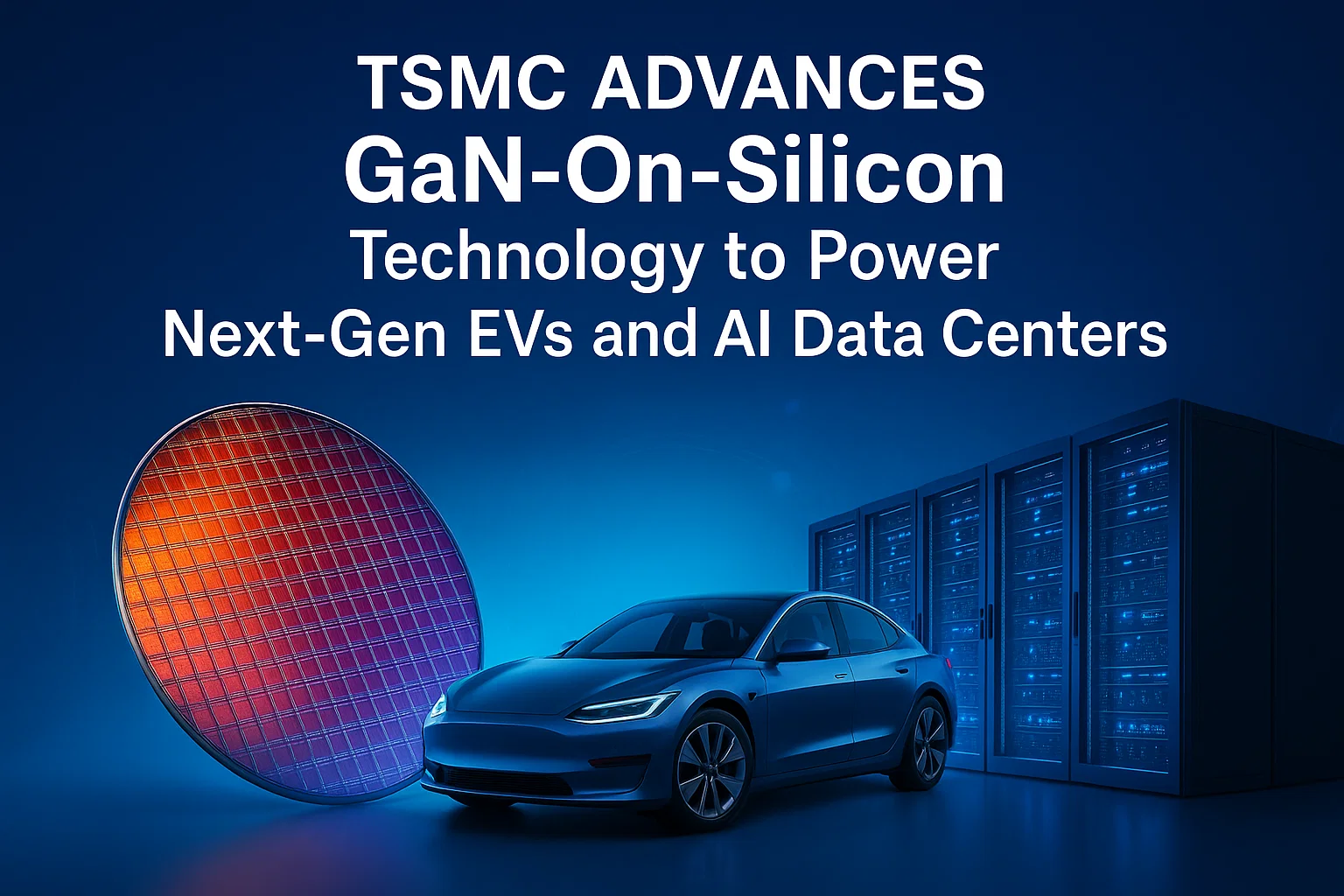
TSMC Advances GaN-on-Silicon Technology to Power Next-Gen EVs and AI Data Centers
The world of power electronics is undergoing a once-in-a-generation transformation. For decades, silicon has been the dominant semiconductor material powering everything from laptops to electric vehicles. But in recent years, new materials like Gallium Nitride (GaN) have burst onto the scene, promising faster switching, higher efficiency, and dramatically smaller footprints.
GaN is no longer just a buzzword. It has quickly become the backbone of cutting-edge devices, enabling ultra-fast phone chargers, compact laptop adapters, and increasingly, high-performance modules in data centers, electric vehicles (EVs), and renewable energy systems. And the momentum is only accelerating.
In 2024, the GaN Power Modules market was valued at just US$0.1 million. Yet, it is projected to skyrocket to US$2.6 million by 2032, expanding at a stunning CAGR of 38.8%. This explosive growth underscores how vital GaN has become to the future of global energy efficiency.
Access Your Free Sample Report- GaN Power Modules Market
Why GaN Matters: A Quick Primer
Before diving into the latest news, let’s step back and understand why GaN is making waves.
- High Efficiency: GaN has a wider bandgap than silicon, which means it can handle higher voltages and currents with less heat and fewer losses.
- Smaller Size: Devices built on GaN can be smaller and lighter while delivering more power think pocket-sized 65W or even 120W chargers.
- High-Speed Switching: GaN transistors switch faster than silicon, making them ideal for high-frequency applications like 5G base stations, servers, and EV drivetrains.
- Scalability: Beyond consumer electronics, GaN’s ability to scale into kilowatt-level modules makes it a candidate for grid-scale renewable energy, EV fast chargers, and AI-driven data centers.
With those fundamentals in mind, let’s explore the recent breakthroughs shaping the GaN power module landscape.
TSMC’s GaN-on-Silicon: Laying the Foundational Blocks
One of the most significant developments comes from Taiwan Semiconductor Manufacturing Company (TSMC), the world’s largest contract chipmaker.
At its 2024 OIP Forum, TSMC highlighted progress in GaN-on-silicon (GaN-on-Si) processes. By building GaN devices on standard silicon wafers, TSMC aims to bring down costs while scaling production for mass adoption. This is critical, because while GaN performance is impressive, cost has historically been a barrier to adoption in high-volume applications like EVs and industrial systems.
Applications in focus:
- AI Data Centers: With power-hungry GPUs driving data centers, GaN modules offer superior efficiency compared to traditional silicon MOSFETs.
- EV Powertrains: By enabling compact onboard chargers and high-voltage inverters, GaN helps extend driving range and cut charging times.
- Renewable Energy: GaN-on-Si could power high-efficiency solar inverters and wind turbines.
TSMC’s entry into GaN is more than a technical milestone it signals that GaN is becoming mainstream. When the world’s largest foundry invests in a material, the industry listens.
Infineon: Expanding the CoolGaN™ Portfolio
German semiconductor giant Infineon Technologies has been equally aggressive in GaN innovation. In 2024, Infineon unveiled new CoolGaN™ power modules targeting EV charging stations, solar inverters, and industrial drives.
What sets Infineon apart is its ability to package GaN into multi-level topologies for example, half-bridge and full-bridge modules. These designs are critical for high-power systems where switching losses need to be minimized.
Why this matters:
- EV Fast Charging: High-voltage GaN modules can reduce energy loss during AC-to-DC conversion, enabling ultra-fast 350kW chargers.
- Solar Power: GaN modules allow compact, lightweight solar inverters with greater energy yield.
- Industrial Motors: Lower switching losses translate to better efficiency in robotics and factory automation.
Infineon’s CoolGaN lineup is part of its broader push into wide-bandgap (WBG) semiconductors, alongside silicon carbide (SiC). While SiC dominates high-voltage EV inverters today, GaN is carving out a complementary role, particularly in lower to mid-voltage systems where efficiency and size matter most.
Download Sample Report PDF- GaN Power Modules Market
Navitas: The Startup that Won Big
If one company embodies GaN’s rise, it’s Navitas Semiconductor. Founded in 2014, Navitas has gone from startup to industry disruptor in under a decade.
In 2024–2025, Navitas announced volume shipments of GaNFast™ power ICs, not only for smartphone and laptop chargers but also for EV onboard chargers and solar inverters.
Rumors in trade media suggest Navitas is also working closely with Tesla’s supply chain to deliver GaN-based solutions for EV applications. While unconfirmed, this highlights how GaN is moving from consumer electronics into automotive-grade power systems.
Navitas differentiators:
- Integration: Unlike discrete GaN devices, Navitas integrates drivers, protection circuits, and GaN FETs into a single package, simplifying design.
- Sustainability: Navitas claims its GaNFast ICs cut energy losses by up to 40%, reducing carbon emissions over product lifetimes.
Their aggressive expansion into automotive and renewable energy marks a turning point GaN is no longer just about phone chargers; it’s about transforming how we power entire ecosystems.
STMicroelectronics & GlobalFoundries: A European Manufacturing Push
Europe is determined not to fall behind in the WBG semiconductor race. In 2024, STMicroelectronics (ST) and GlobalFoundries (GF) announced an expansion of their joint GaN fab in Crolles, France.
This move is strategically vital for two reasons:
- Supply Chain Security: With most GaN production concentrated in Asia, Europe wants domestic capacity to support its EV, industrial, and renewable energy sectors.
- Mass Production: The expanded fab will begin volume shipments in 2025, positioning ST and GF as key players in the global GaN supply chain.
For European automakers like Renault, Volkswagen, and BMW, having a local GaN supply chain could accelerate EV innovation while reducing dependence on Asian foundries.
Texas Instruments: Targeting Hyperscale Data Centers
In 2024, Texas Instruments (TI) unveiled GaN-based modules designed specifically for hyperscale data centers.
Why is this important? AI workloads, powered by GPUs and accelerators, consume enormous amounts of electricity. Data centers are under pressure to cut energy use while expanding capacity a perfect match for GaN.
Benefits in data centers:
- Higher switching speeds → more compact power supplies.
- Lower losses → reduced cooling costs.
- Better efficiency → fewer carbon emissions.
With TI’s long-standing relationships in the server and networking industries, its GaN modules could become a key enabler for sustainable AI and cloud computing.
Industry Applications Beyond Consumer Electronics
While early adoption of GaN happened in consumer chargers, the real growth lies in industrial-scale applications:
- Electric Vehicles (EVs):
- Onboard chargers and DC-DC converters are shifting toward GaN for higher efficiency and lighter weight.
- Automakers like Hyundai and Kia have already signaled interest in GaN-powered systems.
- Renewable Energy:
- GaN enables smaller, more efficient inverters, boosting solar energy yields and reducing costs.
- Industrial Automation:
- From robotics to motor drives, GaN reduces energy losses, cutting operational costs for factories.
- 5G & Telecom:
- GaN’s high-frequency capabilities make it ideal for 5G base stations, reducing power consumption at the network edge.
Click Here To Download Full Sample Report- GaN Power Modules Market
Market Outlook: GaN’s Road to 2032
With the market projected to grow from US$0.1 million in 2024 to US$2.6 million by 2032, GaN is still in the early innings of adoption. Several factors will drive this explosive growth:
- Falling Costs: As fabs like TSMC and ST/GF scale production, economies of scale will bring prices down.
- Government Policy: Europe, the U.S., and Asia are all investing in semiconductor sovereignty, fueling GaN R&D.
- Sustainability Demands: With global climate targets, energy-efficient technologies like GaN are not optional but essential.
- Competition with SiC: While SiC dominates in ultra-high-voltage EV inverters, GaN is carving out niches in mid-voltage, high-frequency domains.
By 2032, GaN is expected to be everywhere from the wall socket that charges your laptop to the inverter powering your EV, the server running your AI model, and even the grid balancing renewable energy.

Comments (0)