
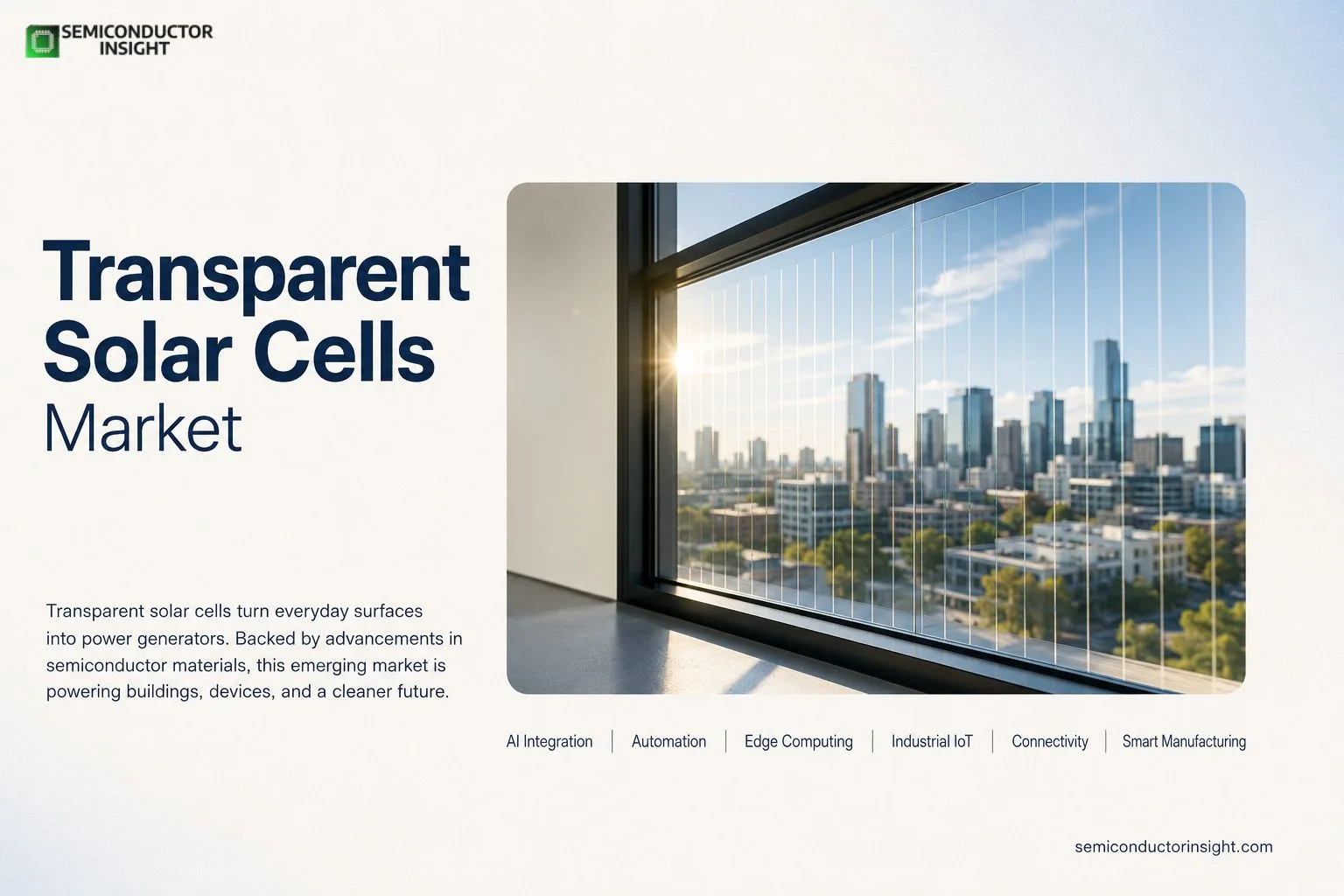
Transparent Solar Cells Market 2026: The USD 310 Million Semiconductor Bet That Wants Every Window to Pay Its Way
A window is a passive thing. It lets in light, keeps out weather, and offers a view. It has been doing essentially the same job since Roman glassmakers first blew panes two thousand years ago. But in 2026, a growing coalition of semiconductor engineers, building designers, and climate-conscious property developers is trying to turn the humble window into something altogether more ambitious: a power station. Transparent solar cells, which harvest energy from sunlight while still letting visible light pass through, are finally moving out of university laboratories and into the real world, and the semiconductor materials inside them are as much a part of the story as the glass itself.
The market numbers are still modest by the standards of the global energy industry. Transparent solar cells were valued at roughly USD 310 million in 2025, and the expectation is that they will reach around USD 950 million by 2034, a compound annual growth rate of 13.7 percent. That growth path is not being driven by a single breakthrough but by a slow, steady accumulation of improvements in the thin-film semiconductor layers that do the actual work of converting photons into electrons while staying, to the human eye at least, mostly invisible.
How a material becomes transparent and productive
The physics behind transparent photovoltaics is both elegant and stubborn. In a conventional solar panel, the semiconductor layer absorbs as much sunlight as possible, including all the visible wavelengths that make up the colours we see. That absorption is what generates current, but it also makes the panel opaque. A transparent solar cell must let visible light pass through while still harvesting energy from the parts of the solar spectrum that we cannot perceive-principally ultraviolet and near-infrared light. Achieving that requires semiconductor materials with carefully tuned bandgaps, the electronic property that determines which photons get absorbed and which sail right through.
The material palette that makes this possible reads like a who’s-who of advanced semiconductor research. Organic photovoltaics, built from carbon-based polymers and small molecules, can be deposited as ultra-thin films that are nearly colourless. Perovskite solar cells, the darlings of the photovoltaic research world, can be engineered with bandgaps that absorb in the near-infrared while transmitting visible light, and they can be fabricated using low-temperature processes compatible with glass manufacturing. Transparent conductive oxides like indium tin oxide, already familiar from touchscreen displays, provide the invisible electrodes that collect current without blocking the view. The transparent solar cell is, in essence, a semiconductor sandwich where every layer has been engineered for optical neutrality.
The manufacturing convergence with display technology
What makes the transparent solar cell market particularly intriguing from a semiconductor industry perspective is how closely its manufacturing process mirrors that of flat-panel displays. The same vacuum deposition chambers that coat glass with thin-film transistors for LCD panels can be adapted to deposit photovoltaic layers. The laser scribing tools that pattern electrodes in OLED screens can define the cell interconnections in a transparent solar module. This is not a coincidence; it is a deliberate strategy by equipment makers and glass manufacturers who see transparent photovoltaics as a way to fill capacity in existing factories.
In early 2026, a major South Korean display equipment manufacturer announced it had adapted its sputtering tools to deposit transparent conductive oxide and perovskite layers on architectural glass substrates up to two metres wide. The company, better known for supplying the OLED fabs that produce smartphone screens, described the move as a diversification into building-integrated photovoltaics. The announcement, covered by a Korean semiconductor trade publication, is a concrete signal that the manufacturing infrastructure for transparent solar cells is piggybacking on the trillion-dollar display industry, which dramatically lowers the capital barriers that usually strangle new photovoltaic technologies.
Where the first real deployments are happening
For all the laboratory excitement, the transparent solar cell market in 2026 is still concentrated in a handful of application areas where the value proposition is clearest. Building-integrated photovoltaics-windows, skylights, and curtain walls that generate power-is the largest and most visible segment. A commercial office tower clad in transparent solar glass can offset a meaningful fraction of its energy consumption, particularly when combined with energy-efficient lighting and HVAC systems. Several completed pilot buildings in Europe and the United States have demonstrated that photovoltaic glass can generate between 30 and 50 watts per square metre while maintaining a transparency of 40 to 60 percent, enough to serve as functional windows.
Greenhouses represent a second, equally logical application. Plants need light to grow, but they do not use all the solar spectrum; much of the ultraviolet and infrared radiation is wasted or even harmful. Transparent solar panels on a greenhouse roof can capture those unused wavelengths and generate electricity for pumps, fans, and supplemental lighting, all while letting through the photosynthetically active radiation that crops require. A consortium of Dutch horticultural companies, working with a thin-film solar startup, commissioned a 5,000-square-metre trial in March 2026 that integrates perovskite-based transparent cells into a tomato greenhouse. Early performance data, shared with an agricultural technology journal, showed electricity generation sufficient to power the facility’s climate control systems for several hours a day.
The consumer electronics segment, while smaller, is where transparent solar cells might become most visible to ordinary people. A smartphone screen that trickle-charges the battery using ambient light, a smartwatch that never needs plugging in, an e-reader that sips power from the sun-these are concept products that several major device makers are exploring in prototype form. The semiconductor content is particularly high here because the transparent cell must be integrated into a display stack that already contains touch sensors, OLED pixels, and cover glass, without adding thickness or degrading image quality. The challenge is materials science at its most demanding, and it is being worked on in the R&D labs of both established display manufacturers and venture-funded startups.
The bigger picture
Transparent solar cells will not replace the vast fields of opaque silicon panels that are driving the global shift to renewable electricity. Their role is different. They are about harvesting energy from surfaces that already exist-the glass facades of cities, the roofs of agricultural greenhouses, the screens of the devices we carry everywhere. In a world that is urbanising rapidly and building taller, the total area of glass in the built environment is enormous, and even a modest power output per square metre adds up to something consequential. The semiconductor industry, which has spent fifty years learning how to deposit, pattern, and integrate thin films on glass and silicon, is the essential enabler of that vision. In 2026, the transparent solar cell market is a small but remarkably well-connected piece of the energy transition, a piece that happens to be almost invisible, which is exactly the point.
Learn More in the Full Market Report: https://semiconductorinsight.com/report/transparent-solar-cells-market/

Comments (0)