Transparent Solar Cells Market Insights
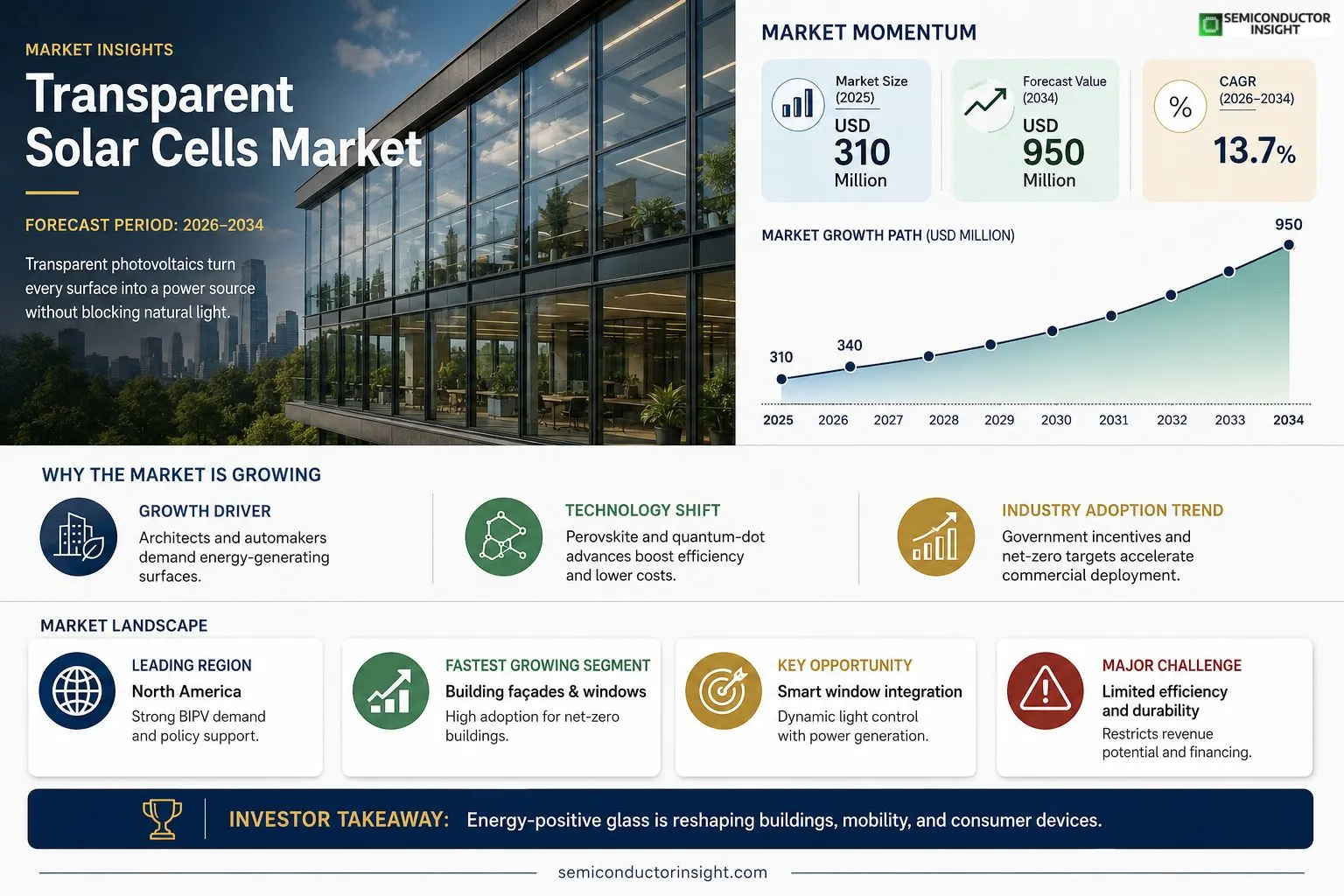
transparent solar cells market size was valued at USD 310 million in 2025. The market is projected to grow from USD 340 million in 2026 to USD 950 million by 2034, exhibiting a CAGR of 13.7% during the forecast period.
Transparent solar cells are photovoltaic devices that convert sunlight into electricity while allowing visible light to pass through, typically achieving light‑transmission rates between 30% and 80%. These technologies employ thin‑film materials such as organic photovoltaics, perovskite layers or quantum dots integrated onto glass or flexible substrates, enabling applications on building façades, windows and automotive glazing.The market is experiencing rapid growth because architects and automakers are seeking energy‑generating surfaces, while government incentives for net‑zero buildings boost adoption rates.
Furthermore, advances in durability and scaling reduce production costs, attracting major manufacturers such as Ubiquitous Energy, Heliatek and PPG Industries.
For instance, in March 2024 Ubiquitous Energy announced a partnership with Samsung Display to embed transparent photovoltaics into next‑generation smartphone screens, illustrating how strategic collaborations are accelerating commercialization.
MARKET DRIVERS
Building‑Integrated Photovoltaics (BIPV) Adoption
Transparent Solar Cells Market is being propelled by the rapid integration of photovoltaics into architectural glazing. Developers are specifying energy‑generating windows to meet green‑building certifications, creating a dual‑function asset that supplies electricity while preserving daylight.
Advances in Transparent Conductive Materials
Recent breakthroughs in silver nanowire networks and perovskite‑based layers have lifted average power conversion efficiencies into the 7‑12% range. These material innovations reduce manufacturing steps and lower the cost per watt, encouraging broader commercial rollout.
➤ “Transparent solar technology is shifting from niche demonstrations to mainstream construction projects, driven by regulatory mandates for net‑zero buildings.”
Combined, these trends forecast a compound annual growth rate exceeding 20% through 2035, as architects, OEMs, and utilities align around the promise of energy‑positive glass.
MARKET CHALLENGES
Manufacturing Scale‑Up Constraints
Large‑area deposition of uniform transparent layers remains technically demanding. Variability in film thickness leads to optical haze, which can compromise both energy yield and aesthetic standards, limiting early‑stage adoption.
Other Challenges
Cost Competitiveness
Current unit costs for transparent modules are 2‑3 times higher than conventional silicon panels. Without economies of scale, price‑sensitive developers may postpone investment until cost parity improves.
MARKET RESTRAINTS
Limited Conversion Efficiency
Even with recent material gains, transparent cells typically convert only 5‑12% of incident solar energy, far below opaque silicon modules. This efficiency ceiling restricts the revenue potential of projects that rely on high energy return.
Durability and Environmental Stability
Exposure to UV radiation, temperature cycling, and moisture can degrade organic and perovskite layers, shortening product lifespans to less than 15 years in harsh climates. Uncertainty around long‑term performance hampers financing decisions.
Regulatory and Certification Barriers
Building codes often require proven fire‑rating and structural certifications. The lack of standardized testing protocols for transparent photovoltaic glazing adds time‑to‑market for manufacturers seeking approval.
MARKET OPPORTUNITIES
Smart Window Integration
Embedding transparent solar cells with electrochromic coatings enables dynamic light control while generating power. This synergy supports the growth of smart‑building ecosystems, where windows act as both sensors and energy harvesters.
Automotive and Aerospace Applications
Automakers are exploring panoramic roofs and sunroofs that maintain cabin illumination and supply auxiliary power to onboard electronics. Similarly, aircraft manufacturers view lightweight transparent panels as a pathway to fuel‑efficiency gains.
Public‑Sector Funding and Incentives
Governments worldwide are allocating grants and tax credits to projects that demonstrate net‑zero energy outcomes. Pilot installations of transparent solar façades in civic buildings are attracting sizable public‑private investment, accelerating market entry.
Transparent Solar Cells Market Trends
Architectural Integration and Energy‑Generating Facades
Transparent Solar Cells Market is being reshaped by the rapid adoption of photovoltaic glazing on commercial and residential buildings. Architects are specifying glass panels that transmit 30‑80 % of visible light while simultaneously converting solar irradiance into electricity. This dual functionality supports net‑zero building targets and reduces reliance on conventional grid power. Recent product launches demonstrate improved thin‑film stability, enabling installations that maintain performance over a decade without significant efficiency loss. The trend is reinforced by municipal incentives that reward energy‑positive structures, prompting developers to embed transparent photovoltaic layers during construction rather than retrofit later.
Other Trends
Automotive Glazing and Mobility Solutions
Automakers are exploring transparent solar cells as a means to power auxiliary systems and reduce battery drain in electric vehicles. By applying photovoltaic coatings to windshields and roof panels, manufacturers can harvest daylight energy to operate climate control, infotainment, and sensor suites. The technology’s lightweight nature aligns with vehicle efficiency goals, while durability advances address the vibration and temperature extremes typical of automotive environments. Collaborative projects between photovoltaic suppliers and major OEMs illustrate a shift from experimental prototypes to production‑ready modules slated for upcoming model years.
Strategic Partnerships and Scaling of Production
Strategic collaborations are accelerating commercialization across Transparent Solar Cells Market. A notable example is the partnership formed in early 2024 between a leading transparent‑photovoltaic developer and a major display manufacturer to embed solar functionality into next‑generation smartphone screens. This alliance showcases how supply‑chain integration can lower unit costs and expand application scopes beyond building and automotive sectors. Concurrently, manufacturers are scaling roll‑to‑roll processes that deposit thin‑film layers on flexible substrates, reducing material waste and enabling high‑volume production. These operational efficiencies are expected to drive broader market penetration as price points approach those of conventional glazing solutions.
COMPETITIVE LANDSCAPEKey Industry Players
Emerging leaders drive innovation in transparent photovoltaics
Transparent Solar Cells Market is currently led by a handful of technologically advanced firms that control most of the high‑performance coating and integration capabilities. Ubiquitous Energy has secured a dominant position through strategic alliances with Samsung Display and its proprietary Powerglass™ technology, enabling large‑scale glazing solutions for commercial façades. Heliatek, with its organic‑based CIGS‑type films, commands a strong share in European building projects, while PPG Industries leverages its historic coatings expertise to supply durable transparent photovoltaic layers to automotive OEMs. These three companies together shape the market hierarchy, setting price benchmarks and driving standard‑setting R&D investments that newer entrants must match to compete effectively.Beyond the primary tier, a diverse cohort of niche innovators expands the competitive landscape. Oxford Photovoltaics focuses on perovskite‑silicon tandem cells that promise higher efficiencies, whereas Solaria and 3M apply thin‑film technologies to retrofit existing windows. Sharp’s transparent optoelectronic panels target the Asian residential sector, and SunPartner Technologies pursues flexible substrate solutions for automotive glass. Hanergy, Lumicell, SolarWindow Technologies, and Polysolar contribute specialty quantum‑dot and polymer‑based modules, each carving out specialized applications such as curved architectural elements, smart‑tinting glass, and low‑cost mass production. Collectively, these firms enrich the market with differentiated portfolios, intensifying competition on performance, cost, and integration speed.
List of Key Transparent Solar Cells Companies Profiled
- Ubiquitous Energy
- Heliatek
- PPG Industries
- Oxford Photovoltaics
- Solaria
- 3M
- Sharp
- SunPartner Technologies
- Hanergy
- Lumicell
- SolarWindow Technologies
- Polysolar
- Energy Harvesting Solutions
- Envision Solar
- InvisiSolar
Segment Analysis:
| Segment Category | Sub-Segments | Key Insights |
| By Type |
|
Perovskite‑based films
|
| By Application |
|
Building façades and windows
|
| By End User |
|
Architects & developers
|
| By Technology |
|
Integrated glass manufacturing
|
| By Market Driver |
|
Strategic collaborations
|
Regional Analysis: North America
North America
The integration of transparent solar cells into building facades, windows, and skylights is gaining considerable traction. This trend aligns with the growing demand for aesthetically pleasing and energy-efficient building materials.
Transparent solar cells are finding increasing applications in electric vehicles (EVs) and other automotive components, contributing to enhanced energy efficiency and extended driving ranges.
North America boasts a robust ecosystem of research institutions and technology companies actively engaged in advancing transparent solar cell technology, leading to innovations in efficiency and cost reduction.
Supportive government policies and financial incentives are accelerating the adoption of transparent solar cell technologies across various sectors in North America.
Europe
Europe is witnessing steady growth in Transparent Solar Cells Market, driven by stringent renewable energy targets and a strong focus on sustainable solutions. The region’s commitment to energy independence and its well-established industrial base are key factors propelling market expansion. Applications in architectural integration and specialty glazing are prominent.
Asia-Pacific
Asia-Pacific represents a dynamic and rapidly growing market for transparent solar cells, primarily fueled by increasing urbanization and rising energy demands. Countries like Japan, South Korea, and China are leading this growth, investing heavily in renewable energy infrastructure and innovative technologies. The automotive segment in this region is also a significant driver.
South America
Transparent Solar Cells Market in South America is emerging, with potential for growth driven by increasing awareness of renewable energy and supportive government initiatives. Pilot projects in building integration and agricultural applications are contributing to market development.
Middle East & Africa
The Middle East and Africa offer significant long-term potential for Transparent Solar Cells Market. With abundant solar resources and growing investments in renewable energy projects, the region is poised for substantial expansion in the coming years. Focus areas include BIPV for residential and commercial buildings.
Report Scope
This market research report provides a comprehensive analysis of the Transparent Solar Cells Market , covering the forecast period 2026–2034. It offers detailed insights into market dynamics, technological advancements, competitive landscape, and key trends shaping the industry.
Key focus areas of the report include:
- Market Overview: ✅ The report begins with an overview outlining its current market scenario, key growth indicators, and industry transformation drivers. It discusses macroeconomic factors, demand–supply balance, regulatory landscape, and the strategic role of semiconductors in powering advancements across industries such as automotive, telecommunications, consumer electronics, and industrial automation.
- ✅ Market Size & Forecast: Historical data and future projections for revenue, unit shipments, and market value across major regions and segments.
- ✅ Segmentation Analysis: Detailed breakdown by product type, technology, application, and end-user industry to identify high-growth segments and investment opportunities.
- ✅ Regional Insights: Insights into market performance across North America, Europe, Asia-Pacific, Latin America, and the Middle East & Africa, including country-level analysis where relevant.
- ✅ Competitive Landscape: Profiles of leading market participants, including their product offerings, R&D focus, manufacturing capacity, pricing strategies, and recent developments such as mergers, acquisitions, and partnerships.
- ✅ Technology Trends & Innovation: Assessment of emerging technologies, integration of AI/IoT, semiconductor design trends, fabrication techniques, and evolving industry standards.
- ✅ Market Drivers & Restraints: Evaluation of factors driving market growth along with challenges, supply chain constraints, regulatory issues, and market-entry barriers.
- ✅ Stakeholder Insights: Insights for component suppliers, OEMs, system integrators, investors, and policymakers regarding the evolving ecosystem and strategic opportunities.
Primary and secondary research methods are employed, including interviews with industry experts, data from verified sources, and real-time market intelligence to ensure the accuracy and reliability of the insights presented.
FREQUENTLY ASKED QUESTIONS:
What is the current market size of Transparent Solar Cells Market?
-> Transparent Solar Cells Market was valued at USD 310 million in 2025 and is expected to reach USD 950 million by 2034, reflecting a CAGR of 13.7% over the forecast period.
Which key companies operate in Transparent Solar Cells Market?
-> Key players include Ubiquitous Energy, Heliatek, and PPG Industries, among others.
What are the key growth drivers?
-> Key growth drivers include architect and automaker demand for energy‑generating surfaces, government incentives for net‑zero buildings, and advances in durability and scaling that lower production costs.
Which region dominates the market?
-> The reference does not specify a single dominant region, indicating a ly distributed market with significant adoption across North America, Europe, and Asia‑Pacific.
What are the emerging trends?
-> Emerging trends include strategic collaborations such as the partnership between Ubiquitous Energy and Samsung Display to embed transparent photovoltaics into smartphone screens, and ongoing material innovations in perovskite and quantum‑dot technologies.

Get Sample Report PDF for Exclusive Insights
Report Sample Includes
- Table of Contents
- List of Tables & Figures
- Charts, Research Methodology, and more...