
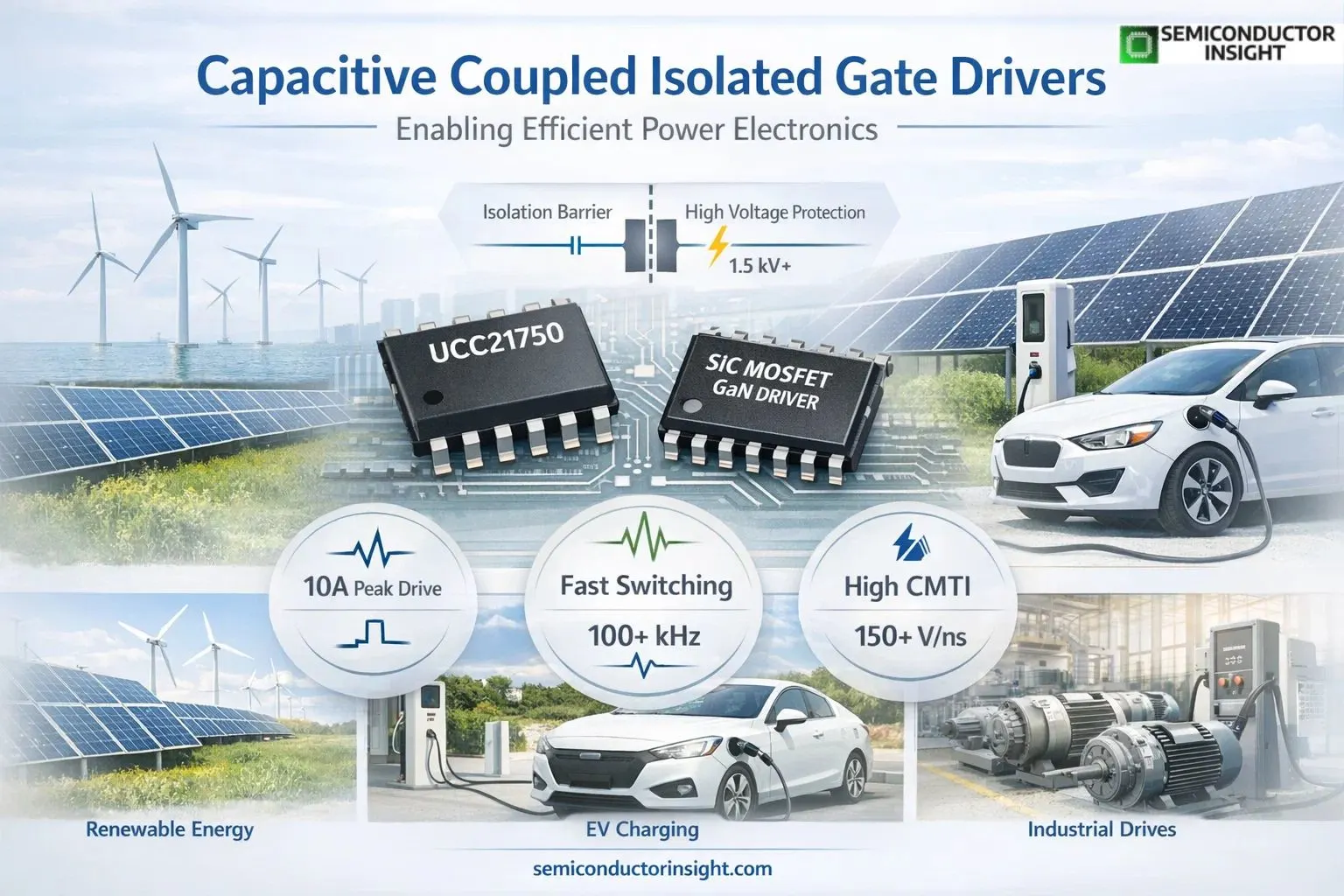
Transformation of Grid-Scale Power Systems and Capacitive Coupled Isolated Grid Driver Market
Fast switching semiconductor devices like MOSFETs and IGBTs, silicon carbide (SiC), and gallium nitride (GaN) transistors are essential to modern power electronics. To charge and discharge the transistor gate capacitance during switching cycles, these devices need specialised gate drivers. Every switching event in a MOSFET involves charging and discharging electrical energy across the gate structure, which functions like a capacitor.
In high-power converters, isolation between the control circuit and the switching device is critical. Capacitive coupled isolation technology has emerged as an efficient architecture because it transmits control signals through tiny capacitors instead of magnetic transformers. This approach enables faster switching speeds, smaller chip footprints, and improved integration into power semiconductor modules.
Power conversion infrastructure has grown rapidly alongside electrification trends. Electrical motors alone consume nearly 65% of global electricity, highlighting the massive scale of power electronic systems used in industrial drives, renewable energy plants, and electric mobility platforms.
Within these systems, capacitive isolation technologies play a key role in enabling safe signal transmission across high-voltage barriers while maintaining switching performance.
What are Real Device Specifications?
The TI UCC21710 and UCC21750 series are flagship capacitive-coupled isolated gate drivers for SiC/IGBT. Key published performance numbers:
- The UCC21710 uses SiO₂ capacitive isolation technology with:
- ±10 A peak source and sink current
- 5 kV RMS working voltage
- 8 kV PK surge immunity
- >150 V/ns CMTI (Common Mode Transient Immunity)
- >40-year isolation barrier lifetime
- Designed to drive devices up to 1,700 V (SiC MOSFETs and IGBTs)
The UCC21750 extends the architecture to support SiC MOSFETs and IGBTs up to 2,121 V DC operating voltage, maintaining the same 1.5 kV RMS working isolation voltage and 12.8 kV PK surge immunity with the same >150 V/ns CMTI specification.
- The UCC53x0 series is consistent with:
- Isolation voltages of 3 kV RMS (SOIC-8 D package) and 5 kV RMS (SOIC-8 DWV package)
- Drives MOSFETs, IGBTs, SiC MOSFETs, and GaN FETs
- Offers lower propagation delay and higher CMTI compared to optocouplers
- Higher operating temperature ceiling than optocouplers
High-Frequency Switching Performance in Grid Drivers
One of the defining characteristics of capacitive coupled isolated drivers is their ability to support extremely high switching frequencies. Traditional insulated gate bipolar transistor (IGBT) systems typically operate below 10 kHz, while silicon carbide devices can operate near 100 kHz, and gallium nitride power switches can reach switching frequencies in the megahertz range.
Higher switching frequencies allow engineers to shrink power converter components such as transformers, inductors, and filters. As a result, grid driver modules used in solar inverters, EV charging infrastructure, and industrial automation systems are becoming significantly smaller and more energy efficient.
Recent semiconductor research prototypes demonstrate significant advances in isolated driver performance. A modern capacitive-coupled gate driver prototype designed for SiC MOSFET applications achieved 220 V/ns common-mode transient immunity, 20 ns propagation delay, and 5 A output current capability while operating with output voltages between 15 V and 30 V.
Further, these performance metrics illustrate how capacitive coupling architectures support fast and stable switching in high-voltage grid systems.
Isolation Reliability and Signal Integrity in High-Voltage Systems
- In large grid converters and power electronics platforms, isolation barriers must protect control electronics from extremely high voltage differences. However, fast switching events generate high-slew-rate voltage transients that can propagate across isolation boundaries.
- One important parameter in isolated grid driver design is common-mode transient immunity (CMTI), which measures how well a driver rejects voltage spikes between input and output circuits. High-performance drivers used in modern power converters can withstand transient events exceeding 160 kV/µs, while maintaining signal integrity across the isolation interface.
- Such resilience is essential for applications like renewable power inverters, where grid voltage levels can exceed 1,200 V and switching noise can compromise system reliability if isolation is not properly engineered.
- Additionally, capacitive coupling acts as a natural high-pass filter, enabling AC signals to pass while blocking DC currents across the isolation barrier. This property allows designers to maintain electrical isolation without sacrificing communication speed between control and power stages.
To Know More about the Report, You Can Freely Browse Our Latest Updated Report: https://semiconductorinsight.com/report/capacitive-coupled-isolated-grid-driver-market/
Power Electronics Integration across Energy Infrastructure
The rise of renewable energy and electrified transportation is reshaping semiconductor requirements across the global power infrastructure. Grid-connected solar inverters, battery energy storage systems, and EV fast-charging stations rely heavily on high-efficiency switching architectures.
For example, modern electric vehicle power converters increasingly deploy SiC and GaN devices capable of handling 600 V to 1,700 V operating voltages while maintaining high temperature tolerance of up to 225 °C in certain wide-bandgap devices.
These high-performance semiconductors demand gate drivers capable of precise timing control, low propagation delay, and robust isolation. Capacitive coupled isolated grid drivers are well suited to this environment because they deliver fast digital signal transmission while occupying minimal silicon area.
In industrial motor control systems, the scale of electrification is particularly significant. With electric motors responsible for over half of global electricity usage, even incremental improvements in switching efficiency can translate into substantial energy savings across manufacturing, transportation, and infrastructure sectors.
This dynamic is encouraging semiconductor manufacturers to integrate capacitive isolation directly into driver ICs used in power modules and intelligent power stages.
Semiconductor Innovation and Advanced Driver Architectures
- Another key trend shaping the Capacitive Coupled Isolated Grid Driver Market is the integration of protection and sensing capabilities within driver chips. Modern designs include features such as active Miller clamp circuits, desaturation detection, and adaptive threshold control to prevent unintended switching events in high-power systems.
- High-frequency switching can create parasitic coupling effects within MOSFET structures, particularly through the Miller capacitance between gate and drain. Advanced driver circuits mitigate this effect by actively controlling gate voltage and preventing unwanted conduction during rapid switching transitions.
- Integration is also improving data transmission speeds across isolation barriers. New digital isolation architectures fabricated in advanced CMOS processes can reach data rates of 230 Mbps, while maintaining isolation breakdown voltages near 14 kV and propagation delays as low as 6 ns.
- These advancements highlight how semiconductor design innovation continues to strengthen the capabilities of capacitive coupling architectures in grid-scale power electronics.
Later, as electrification, renewable power deployment, and high-efficiency industrial systems continue expanding worldwide, the Capacitive Coupled Isolated Grid Driver Market is increasingly positioned at the intersection of semiconductor innovation and modern energy infrastructure.

Comments (0)