

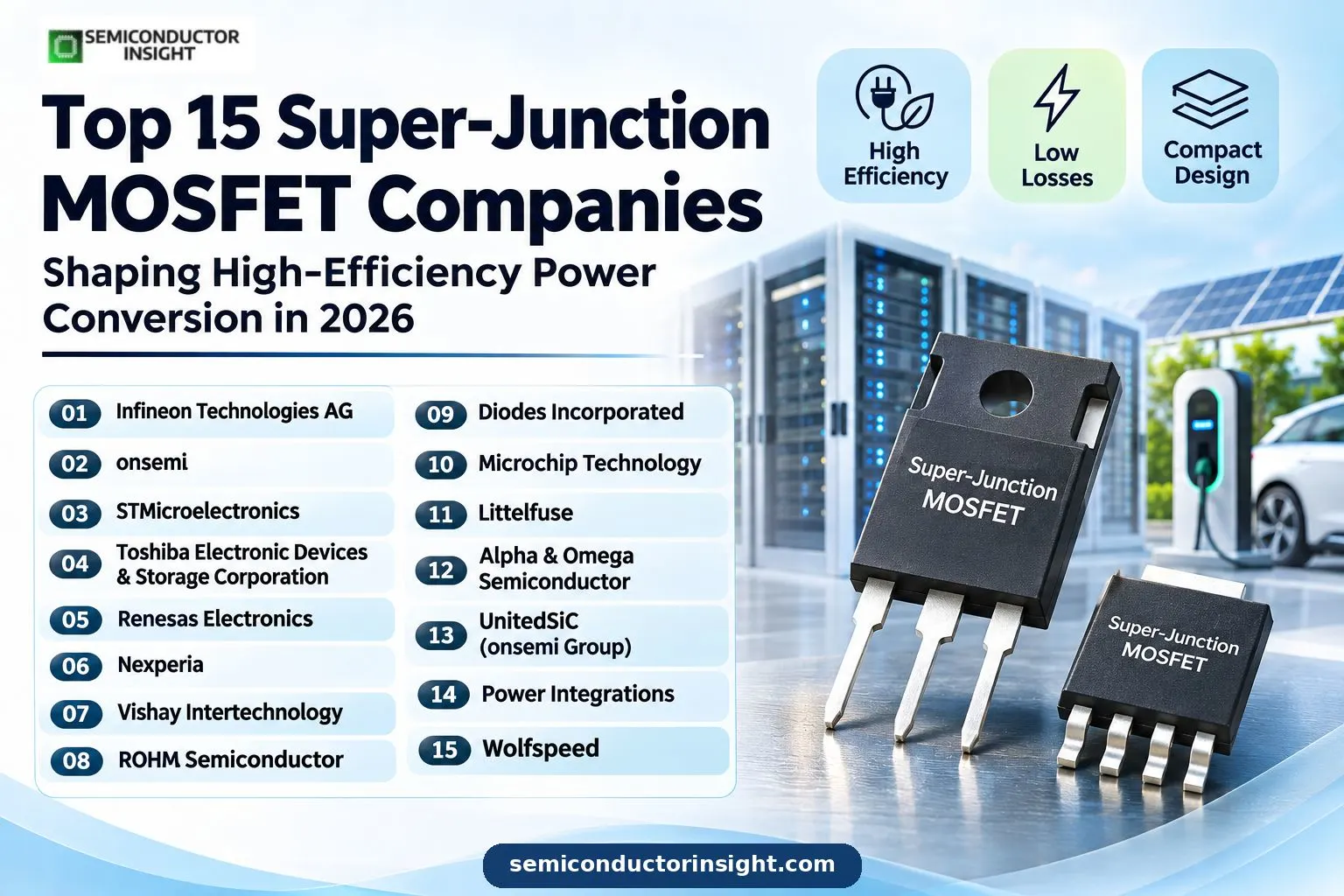
Top 15 Super-Junction MOSFET Companies Shaping High-Efficiency Power Conversion in 2026
The Super-Junction MOSFET Market is built around a specialised silicon power-device architecture that enables high-voltage switching with lower on-state resistance than conventional planar MOSFET structures. By using alternating p-type and n-type regions in the drift layer to balance electric charge, super-junction technology helps reduce conduction losses while maintaining high breakdown voltage. This makes it particularly important in power-factor-correction circuits, switched-mode power supplies, server power units, industrial inverters, solar conversion systems, EV chargers and uninterruptible power supplies.
In 2026, the technology is gaining renewed attention as AI data centres increase power-conversion requirements and equipment manufacturers seek greater efficiency within smaller thermal and mechanical footprints. The latest product activity is revealing three important directions: more compact surface-mount packages, improved body-diode recovery and lower switching losses. Manufacturers are also differentiating their portfolios through device generations, current ratings, package choices and suitability for hard- and soft-switching topologies.
Ranking approach: The following is an editorial ranking based on demonstrated super-junction product portfolios, device-generation development, application coverage, technical specifications and recent product activity. It is not a verified ranking by revenue or market share. The additional companies are included because they have identifiable super-junction products or platforms—not simply because they manufacture conventional power MOSFETs.
Infineon Technologies AG – CoolMOS Innovation Sets the Benchmark for High-Voltage Switching
Infineon remains one of the most influential suppliers in the super-junction MOSFET segment through its CoolMOS technology. Its 600 V CoolMOS 8 family is designed for both hard- and soft-switching applications, including server power supplies, telecom infrastructure, EV charging stations, industrial switched-mode power supplies and photovoltaic systems. The platform includes an integrated fast body diode and top-side-cooling package options, addressing two important design priorities: switching efficiency and thermal management. Infineon reports a reduction of up to 20% in gate charge and 15% in turn-off losses compared with the preceding CFD7 generation. Its portfolio also reaches single-digit on-resistance territory, with products specified down to 7 mΩ.
The strategic advantage is the breadth of applications supported by one technology family. A power designer can evaluate CoolMOS for compact adapters, high-power server supplies, solid-state circuit breakers and charging infrastructure without moving immediately to a wide-bandgap device. This positions Infineon strongly where silicon remains a cost-effective option for high-voltage power conversion.
onsemi – SUPERFET Technology Connects High-Voltage Switching with Power-System Reliability
onsemi’s SUPERFET portfolio, which carries forward technology heritage associated with Fairchild Semiconductor, is a major name in high-voltage super-junction MOSFETs. The company has developed several generations, including SUPERFET II, SUPERFET III and SUPERFET V, with product variants aimed at different switching requirements. Its 600 V SUPERFET V devices are designed for server power supplies, cloud infrastructure, telecommunications, UPS equipment, EV chargers and industrial power systems. Product choices include FAST and Easy Drive versions, allowing designers to balance switching speed, efficiency and circuit manageability.
The technical distinction is not limited to low on-resistance. onsemi’s published SUPERFET V specifications include a 120 V/ns drain-source voltage slew-rate capability and devices with typical on-resistance figures such as 32.8 mΩ and 79.2 mΩ, depending on the selected part. This gives designers options for different power levels and switching strategies. Its Fairchild legacy is best understood as technology heritage within onsemi, not as a separate current competitor.
STMicroelectronics – MDmesh and STMESH Cover Different Switching Architectures
STMicroelectronics has developed a broad super-junction portfolio under its MDmesh and STMESH technology families. Its high-voltage MOSFET range spans approximately 250 V to 650 V, with selected 650 V MDmesh products reaching 12 mΩ on-resistance in a MAX-247 package. The newer MDmesh DM6 series focuses on fast-recovery body-diode behaviour for full-bridge phase-shifted zero-voltage-switching circuits. ST reports up to 15% lower on-resistance than the preceding generation and a 100 V/ns dV/dt ruggedness rating.
This portfolio is particularly relevant to industrial power supplies, telecom conversion, server systems and high-power-density equipment. Rather than offering a single device design for every topology, ST differentiates product families according to capacitance behaviour, recovery performance and switching conditions. That application-specific approach is valuable where designers need to manage electromagnetic interference, switching losses and thermal stress together.
Toshiba Electronic Devices & Storage Corporation – DTMOSVI Targets Compact, High-Current Power Stages
Toshiba’s DTMOSVI technology has become increasingly relevant to compact high-efficiency power supplies. In March 2026, the company expanded its 600 V super-junction range with seven high-speed-diode products available in TO-247, TOLL and DFN8×8 packages. One highlighted device, TK058V60Z5, offers typical on-resistance of 50 mΩ in a DFN8×8 package. The wider range is intended for data-centre server supplies, UPS systems and photovoltaic power conditioners.
The important development is the combination of reverse-recovery performance and package miniaturisation. Toshiba’s high-speed-diode devices use lifetime-control technology to improve body-diode recovery, a relevant feature in bridge and inverter circuits. The company’s November 2025 launch of the TK057V60Z in a DFN8×8 package also demonstrated a 600 V device rated for up to 40 A, showing how DTMOSVI is being adapted to higher power density and surface-mount designs.
Take a Quick Glance at Our In-Depth Analysis Report: https://semiconductorinsight.com/report/global-super-junction-mosfet-market/
Vishay Intertechnology – 650 V Super-Junction Modules Move into Higher-Current Industrial Designs
Vishay’s E Series provides a substantial base of high-voltage super-junction MOSFET products, while its 2026 module launches demonstrate a move towards higher-current power-conversion assemblies. On October 1, 2026, Vishay introduced four SOT-227 modules using 650 V super-junction MOSFET technology. Three single-switch configurations carry nominal current ratings of 50 A, 100 A and 150 A; a fourth 50 A low-side chopper version integrates a 650 V silicon-carbide diode.
The application coverage is unusually broad for this product announcement: solar inverters, hydrogen-generation and fuel-cell systems, HVDC auxiliary electronics, charging stations, welding equipment, UPS systems, rail power supplies and medical imaging equipment. The modules operate across a stated temperature range of −55°C to +150°C. Their SOT-227 package is also intended to support drop-in replacement in existing designs, reducing the need for a complete PCB redesign. This gives Vishay a distinctive position between discrete MOSFET supply and more integrated power-module solutions.
ROHM Semiconductor – A 32-Model Expansion Addresses AI Server and Industrial Power Supplies
ROHM made one of the clearest super-junction product announcements of 2026. Its July launch introduced the R60xxXNx high-speed-switching series with 21 models and the R60xxWNx PrestoMOS series with 11 models, creating a combined 32-model addition. The new devices include DFN8080-5L packages measuring 8.0 × 8.0 × 0.85 mm and TOLL packages measuring 11.68 × 9.9 × 2.3 mm. Sequential mass production began in June 2026.
This development directly addresses the power-density requirements of AI servers and industrial equipment. ROHM has also focused on maintaining compatibility with commonly used gate-drive conditions, specifying a 3 V to 5 V gate-threshold range. Its PrestoMOS products are designed around fast reverse recovery for applications such as LLC and PFC circuits, motor drives, air conditioners and refrigerators. ROHM has indicated plans to extend the portfolio towards 650 V products, making the 2026 launch an important step in its high-voltage silicon MOSFET roadmap.
Alpha and Omega Semiconductor – αMOS E2 Brings Top-Side Cooling to 600 V Devices
Alpha and Omega Semiconductor (AOS) has strengthened its position with the αMOS E2 600 V super-junction platform. The company unveiled the platform in January 2026, with AOTL037V60DE2 as its first announced product. On September 8, AOS followed with two top-side-cooled devices, AOGT037V60DE2 and AOGT060V60DE2. The package and thermal approach are intended to improve heat removal and support higher power density in systems where board space and cooling design are constrained.
AOS identifies servers, workstations, telecom rectifiers, solar inverters, motor drives and industrial power systems as target applications. The important point is the platform’s focus on electrical and thermal design together. As power supplies move towards higher output within tighter enclosures, top-side cooling can give designers more flexibility in heatsink placement and system construction. The two 2026 product announcements make AOS one of the more active entrants in this technology segment.
Magnachip Semiconductor – Sixth-Generation 600 V Devices Target AI Infrastructure
Magnachip has moved its super-junction development towards higher-efficiency power systems with its sixth-generation 600 V MOSFETs. In June 2026, it announced two new devices with on-resistance specifications of 36 mΩ and 37 mΩ. Both integrate a Zener diode between the gate and source terminals to improve protection against electrostatic discharge. Magnachip also highlighted a reduction in chip size compared with its previous generation, which can help improve integration and design flexibility.
The targeted applications include AI server power supplies, EV charging equipment and industrial power systems. This is an important positioning shift because the power architecture supporting AI infrastructure requires efficient conversion at several stages, from incoming AC power to regulated DC distribution. Magnachip’s combination of lower conduction resistance, fast body-diode recovery and integrated gate protection is intended to address reliability as well as efficiency.
Microchip Technology – Advanced Power Technology Extends Super-Junction MOSFETs into High-Current Modules
Microchip’s super-junction portfolio includes discrete devices and power modules inherited from its Advanced Power Technology product range. Its APT100N60BC7 is a 600 V super-junction MOSFET in a TO-247 package, with a published maximum on-resistance of 18 mΩ and a listed continuous drain-current capability of up to 120 A under the manufacturer’s specified conditions. The portfolio also includes the APT40N60BC7, a 600 V device with a 55 mΩ maximum on-resistance and a 40 A current rating.
The module range makes Microchip particularly relevant to designers developing higher-power conversion stages. For example, its APTC60DDAM24T3G is a 600 V dual-boost-chopper module using super-junction silicon MOSFETs, with a typical on-resistance of 24 mΩ and a 70 A current rating at a case temperature of 80°C. The interleaved-PFC module APTC60VDAM24T3G carries the same published 600 V and 70 A ratings. These configurations are useful in applications where designers want to reduce the number of discrete power components and simplify high-current assembly.
Fuji Electric – Super J-MOS Serves Established 600 V Power Conversion Designs
Fuji Electric’s Super J-MOS series is a dedicated super-junction technology platform, primarily focused on 600 V devices. Its published product information includes several current classes, including 6.5 A, 8 A and 10 A options, with package choices such as TO-220AB, TO-220F, TO-3P, TO-247-P2 and D2-Pack. This variety allows engineers to select devices for different thermal, mounting and board-layout requirements rather than relying on a single package configuration.
Fuji’s relevance comes from its established presence in industrial power electronics, where high-voltage MOSFETs are used in switched-mode power supplies, motor-control equipment and energy-conversion systems. Although the public product material does not establish a new 2026 Super J-MOS launch, the current catalogue confirms a defined super-junction offering. Its portfolio is therefore best positioned as a supplier of established 600 V silicon solutions rather than one of the most visible 2026 launch leaders.
PANJIT International – Multi-Epitaxial Design Supports PSU and PFC Applications
PANJIT entered the super-junction segment with a 600 V and 650 V product family aimed at power-supply applications. Its published portfolio uses multi-epitaxial-layer technology and includes TO-220AB-F, TO-220AB-L and TO-252AA package options. The company’s application material specifically identifies power-factor-correction circuits and primary-side switching in AC/DC and DC/DC converters. It also highlights body-diode ruggedness and switching behaviour as important design characteristics for reducing EMI-related issues.
One useful technical reference is PANJIT’s published 600 W continuous-conduction-mode PFC evaluation, conducted with a 110 V AC input, 400 V output and 65 kHz switching frequency. This gives engineers a practical operating context beyond a simple product-rating claim. The devices are relevant to communication equipment, computing power supplies, USB power-delivery chargers, household appliances and game-console power units. PANJIT’s strength is its focus on standardised high-voltage PSU designs where ease of implementation and reliability matter alongside switching efficiency.
Jilin Sino-Microelectronics – A Full 600 V to 700 V Platform Adds a Domestic Supply Option
Jilin Sino-Microelectronics is a notable Chinese power-device manufacturer with a specifically identified super-junction MOSFET platform. Its publicly available 2024 annual-report material states that the company completed development and mass production of a full 600 V to 700 V super-junction MOS product platform. The report identifies power supplies and industrial applications as areas where the products have entered batch use. This is a more meaningful indicator of manufacturing capability than simply listing a device under development.
The company’s product catalogue separately identifies super-junction MOSFETs alongside conventional MOSFET, SiC MOSFET and IGBT categories. This broader power-device structure matters because industrial customers often evaluate suppliers across several voltage and switching requirements. Jilin’s relevance to the market is its domestic manufacturing and product-platform development, particularly for applications where a qualified alternative source can help reduce dependence on a narrow group of international suppliers.
Changzhou Galaxy Century Microelectronics – Multi-Voltage SJ Devices Address Power Supply Design Variety
Changzhou Galaxy Century Microelectronics lists super-junction MOSFETs across 600 V, 650 V, 700 V, 800 V and 900 V product classes. This spread is useful because power designers do not select a device solely by its nominal voltage: they must account for switching transients, circuit topology, current demand and the required safety margin. The company’s published product information identifies applications such as power adapters, DC/DC converters and chargers, where low on-resistance and reduced gate charge can support more compact and efficient designs.
Its portfolio also illustrates the importance of having multiple voltage options within one supplier’s catalogue. A designer working on a standard adapter, a higher-voltage industrial supply or a specialised conversion circuit can evaluate different super-junction ratings without treating every project as an entirely new sourcing exercise. The company is a relevant additional supplier to track, although its public information provides less evidence of 2026 product-launch activity than the larger international manufacturers.
Power Master Semiconductor – eMOS E7 Focuses on Hard- and Soft-Switching Flexibility
Power Master Semiconductor’s eMOS E7 is a high-voltage super-junction MOSFET platform designed for 600 V to 650 V applications. The company’s product information highlights low switching and conduction losses, device ruggedness and compatibility with both hard- and soft-switching circuit designs. It identifies power-factor correction, AC/DC conversion and DC/DC conversion as the core application areas. This gives the company a focused role in the power-supply segment rather than a broad, undifferentiated MOSFET offering.
The ability to address both switching approaches is important for manufacturers developing different generations of power supplies. Hard-switching designs remain relevant across many established industrial systems, while resonant and soft-switching topologies are used where designers are seeking improved efficiency and reduced switching stress. Power Master’s positioning is therefore centred on the practical requirements of power-conversion engineers, although its publicly visible 2026 launch record is more limited than that of Infineon, ROHM, Toshiba or Vishay.
Micro Commercial Components – 650 V Devices Target Cost-Conscious Power Electronics
Micro Commercial Components (MCC) offers high-voltage super-junction MOSFETs designed for primary-side power applications. Its published product information includes devices rated up to 650 V, with current options reaching 20 A and packages such as TO-247, TO-220, TO-220F, DFN and DPAK. The range is aimed at switched-mode power supplies, chargers, PFC circuits, PWM controls and LED lighting systems. These are high-volume application categories where component cost, availability and ease of integration can be as important as headline electrical performance.
MCC’s product range is especially relevant to manufacturers designing adapters, lighting supplies and industrial power units that do not require the highest-current module formats. Its portfolio demonstrates how super-junction technology is used across different product tiers: from high-performance server power conversion to more conventional chargers and lighting electronics. The company’s published specifications also give buyers multiple package and current choices for matching devices to thermal and assembly constraints.

Comments (0)