

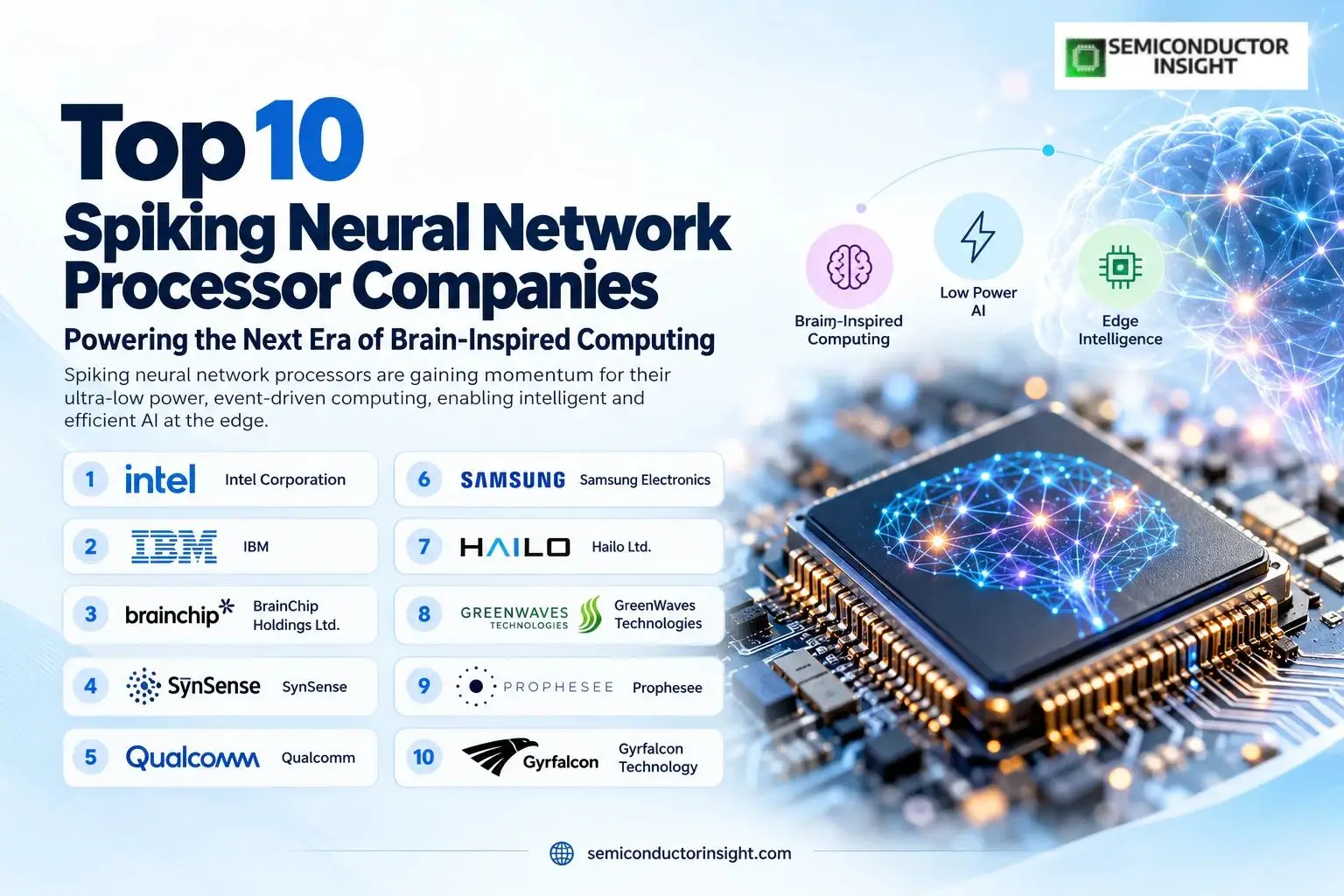
Top 10 Spiking Neural Network Processor Companies Driving Neuromorphic Computing Innovation
Spiking Neural Network (SNN) Processor Market is gaining attention as semiconductor manufacturers and computing technology developers explore energy-efficient alternatives to conventional artificial intelligence hardware. Inspired by the way biological neurons communicate through discrete electrical spikes, spiking neural network processors are designed to support event-driven computation, potentially reducing unnecessary processing and power consumption in suitable workloads.
The global Spiking Neural Network Processor market was valued at USD 0.85 billion in 2025 and is projected to reach USD 3.12 billion by 2034, growing at a compound annual growth rate (CAGR) of 15.0% during the forecast period. Increasing interest in edge AI, autonomous systems, robotics, intelligent sensors, and low-power computing is creating opportunities for companies developing neuromorphic processors and related technologies.
As the industry develops, competition involves more than dedicated chip manufacturers. Established semiconductor companies, specialized neuromorphic startups, AI accelerator developers, semiconductor foundries, and electronic design automation providers all contribute to the broader ecosystem.
Spiking Neural Network Processor Market Overview
Spiking neural network processors are specialized computing architectures that process information using spike-based signals rather than relying exclusively on the continuous numerical operations commonly used in conventional artificial neural networks. Their event-driven design can help reduce computational activity when inputs are sparse, making them relevant to applications that require rapid responses and constrained power consumption.
Unlike traditional processors, neuromorphic systems seek to combine computation and, in some architectures, memory in ways that resemble aspects of biological neural networks. This approach can support real-time processing of changing sensory information, including visual, auditory, and motion-related data.
Demand for SNN processors is being encouraged by the growing deployment of AI at the edge, where devices must analyse data locally rather than continuously transferring it to cloud infrastructure. Robotics, industrial monitoring, wearable electronics, smart cameras, and autonomous platforms are potential application areas.
However, adoption remains dependent on software availability, developer familiarity, model-training methods, benchmarking standards, and compatibility with existing AI systems. Performance advantages also vary according to the workload, hardware architecture, and application requirements.
Key Factors Driving the Spiking Neural Network Processor Market
Growing Demand for Energy-Efficient AI
Power consumption is an important consideration as AI workloads expand across embedded devices, industrial equipment, and connected sensors. Neuromorphic processors can use event-driven computation to avoid performing unnecessary operations when little new information is received. This characteristic makes them attractive for selected low-power and always-on applications.
Expansion of Edge Computing
Edge devices increasingly need to interpret information locally with limited latency, bandwidth, and energy resources. SNN processors may support applications such as anomaly detection, motion recognition, and sensor-based decision-making, particularly where inputs arrive as asynchronous events.
Advancements in Robotics and Intelligent Sensors
Robots and autonomous systems must respond to changing environments in real time. Event-based sensing and spiking computation can offer a promising combination for certain vision, navigation, and perception tasks. Continued progress in hardware-software integration could expand their practical use.
Research into Brain-Inspired Computing
Academic institutions, semiconductor developers, and technology companies continue to investigate brain-inspired computing architectures. Progress in neuromorphic hardware, learning algorithms, and development tools is important for determining which SNN applications can achieve measurable benefits over conventional computing approaches.
Top 14 Spiking Neural Network Processor Companies
The following companies operate across different parts of the neuromorphic and semiconductor ecosystem. Their roles are not identical: some develop neuromorphic or AI processing hardware, while others provide research platforms, sensing technologies, manufacturing services, or chip-design tools.
- Intel Corporation
Intel Corporation is a major semiconductor company with experience in processors, AI computing, and neuromorphic research. Its Loihi research processors have contributed to the development of event-driven, brain-inspired computing architectures. Intel’s neuromorphic research ecosystem has supported experimentation in areas such as robotics, adaptive systems, and optimization. Its broader semiconductor and software capabilities also provide relevant context for the evolution of specialized AI hardware.
- IBM
IBM has a long history of research into brain-inspired computing and neuromorphic architectures. Its TrueNorth research chip demonstrated an approach to large-scale neural computation designed around low-power operation. IBM’s research contributes to the broader understanding of event-driven processing, neural hardware, and alternative computing architectures. Its role in this market is primarily associated with research and neuromorphic innovation rather than being assumed to represent a dedicated commercial SNN processor business.
- BrainChip Holdings Ltd.
BrainChip develops neuromorphic computing technology, including its Akida processor architecture. The platform is designed to support event-based processing and low-power AI inference for edge applications. Potential use cases include smart sensors, industrial systems, security devices, and connected products that need local intelligence. BrainChip is a specialist participant in the neuromorphic computing ecosystem, with its technology focused on bringing brain-inspired processing into practical embedded applications.
- SynSense
SynSense specializes in neuromorphic sensing and computing technologies designed for efficient, real-time processing. Its work includes systems that combine event-based sensing with neuromorphic processing approaches. Such technologies are relevant to applications that need to interpret visual or other sensory information with limited power consumption. SynSense’s focus on integrating sensing and computation positions it within the specialist segment of the neuromorphic hardware industry.
- Qualcomm
Qualcomm develops semiconductor platforms for mobile devices, connected products, automotive applications, and edge computing. Its expertise in power-efficient processing and on-device AI is relevant to the broader market for specialized intelligent hardware. Qualcomm should be distinguished from companies whose main commercial focus is dedicated SNN processors; its inclusion reflects its wider role in efficient AI computing and semiconductor development.
- Samsung Electronics
Samsung Electronics operates across memory, logic semiconductors, consumer electronics, and advanced semiconductor technologies. Its research and manufacturing capabilities are relevant to the development of future AI and neuromorphic hardware. The company’s broad semiconductor expertise gives it a potential role in enabling advanced computing architectures, although individual SNN processor products and commercial deployments should be assessed separately.
- Hailo Ltd.
Hailo develops AI processors designed to accelerate neural-network workloads, particularly in edge devices. Its hardware targets applications that require efficient AI inference, including intelligent cameras, automotive systems, and industrial equipment. While conventional neural-network acceleration is distinct from dedicated spiking neural network processing, Hailo operates in the adjacent low-power AI accelerator market and competes for some of the same edge-computing opportunities.
- GreenWaves Technologies
GreenWaves Technologies focuses on ultra-low-power processing for embedded AI and edge applications. Its processor platforms are designed for devices operating under strict energy, memory, and cost constraints. These capabilities are relevant to the broader demand for efficient intelligent systems. GreenWaves is best understood as an adjacent embedded-AI processor developer rather than automatically classified as a dedicated SNN chip manufacturer.
- Prophesee
Prophesee develops event-based vision technology that captures changes in a scene rather than recording every image in a conventional frame-based manner. Event-based sensors can produce sparse, time-sensitive data suitable for low-latency perception. This technology can complement neuromorphic computing systems, including architectures that process events using spike-based representations. Prophesee’s contribution is primarily associated with sensing technology rather than being treated as a standalone SNN processor supplier.
- Gyrfalcon Technology
Gyrfalcon Technology is associated with AI accelerator hardware designed for efficient neural-network processing. Low-power acceleration is relevant to edge AI applications, where computational performance must be balanced against energy use and hardware costs. Its position in the broader AI hardware ecosystem makes it relevant to the competitive landscape, although its products should not be assumed to use dedicated spiking neural network architectures without product-specific evidence.
Competitive Landscape and Industry Trends
Competition in the Spiking Neural Network Processor market is shaped by power efficiency, processing latency, adaptability, software support, and compatibility with real-world applications. Specialist developers are working to establish differentiated neuromorphic architectures, while established semiconductor companies bring experience in chip engineering, fabrication, and AI infrastructure.
Another important trend is the combination of event-based sensors with processors capable of handling asynchronous data. This approach may reduce redundant computation in selected perception tasks. At the same time, conventional AI accelerators remain highly competitive because they benefit from mature software ecosystems and widespread deployment.
The market’s development will depend on demonstrating measurable advantages through application-specific benchmarks. Better programming tools, accessible development kits, interoperability, and clearer comparisons with conventional processors could help reduce barriers to adoption.
Future Outlook for the Spiking Neural Network Processor Market
With the market projected to rise from USD 0.85 billion in 2025 to USD 3.12 billion by 2034, neuromorphic computing represents a growing area of interest within specialized semiconductor technology. The projected 15% CAGR reflects the supplied market estimate and should be interpreted alongside the continuing technical and commercial challenges facing SNN adoption.
Edge AI, robotics, intelligent sensing, and low-power embedded systems are potential areas of opportunity. However, long-term growth will depend on whether SNN processors can deliver practical improvements in energy efficiency, latency, or adaptability for specific workloads, supported by reliable development tools and viable commercial applications.
Spiking Neural Network Processor market brings together specialist neuromorphic developers, established semiconductor companies, event-based sensing providers, foundries, and chip-design technology suppliers. Intel, IBM, BrainChip, and SynSense are particularly relevant to neuromorphic research and development, while companies such as Prophesee, TSMC, and Synopsys contribute complementary capabilities across sensing, manufacturing, and design.
As the market evolves, success will depend on more than hardware innovation alone. Software maturity, measurable performance advantages, application-specific integration, and commercial adoption will determine how quickly spiking neural network processors move from research environments into wider deployment.
See our latest report for fresh insights: https://semiconductorinsight.com/report/spiking-neural-network-processor-market/

Comments (0)