Spiking Neural Network Processor Market Insights
Global Spiking Neural Network Processor market size was valued at USD 0.85 billion in 2025. The market is projected to grow from USD 0.85 billion in 2025 to USD 3.12 billion by 2034, exhibiting a CAGR of 15 % during the forecast period.
Spiking Neural Network Processors are hardware accelerators designed to emulate biologically‑inspired neuronal spikes, enabling event‑driven computation with ultra‑low power consumption.
These processors translate discrete spike events into weighted synaptic operations, offering latency‑sensitive inference for edge AI, robotics, and sensory processing.
The market is gaining momentum because research funding for neuromorphic computing has risen sharply and enterprises are seeking energy‑efficient AI solutions for autonomous systems.
Key innovators such as Intel (Loihi), IBM (TrueNorth), BrainChip (Akida) and SynSense (DynapSE) have launched commercial chips or development kits, reinforcing adoption across automotive, industrial IoT and defense sectors.
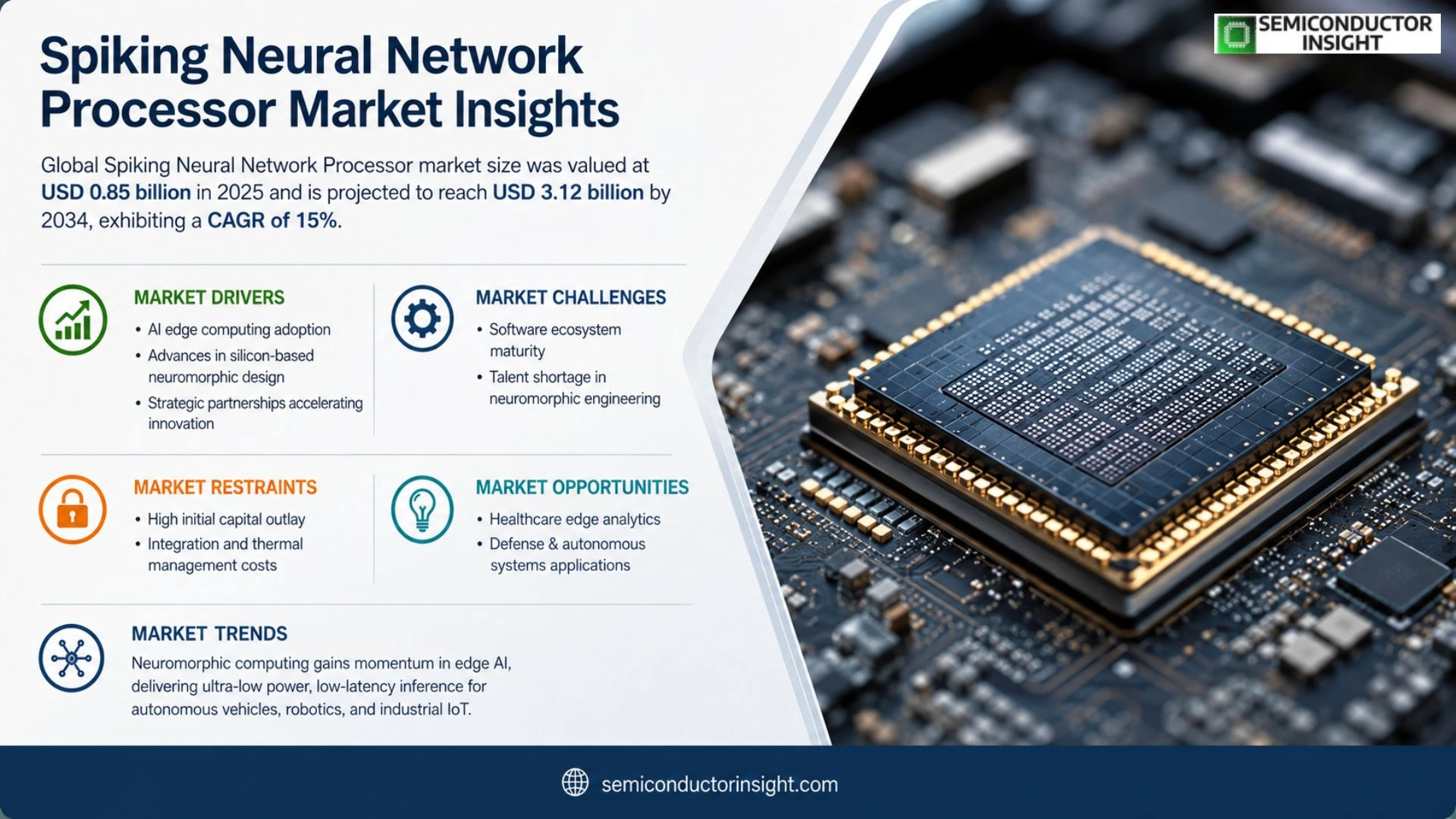
MARKET DRIVERS
AI Edge Computing Adoption
The surge in edge‑AI deployments is compelling manufacturers to seek processors that can handle event‑driven workloads with minimal power consumption. Spiking Neural Network Processor Market participants are capitalising on the ability of neuromorphic chips to process sparse signals directly at the sensor, eliminating the need for bulk data transmission. This shift reduces latency and operating costs, making neuromorphic solutions attractive for autonomous vehicles and industrial IoT.
Advances in Silicon‑Based Neuromorphic Design
Recent breakthroughs in mixed‑signal CMOS and emerging memristive technologies have lowered fabrication barriers, allowing a broader set of vendors to enter the field. As design tools mature, developers can now map complex spiking models onto hardware with greater fidelity, driving confidence among system integrators. The resulting ecosystem expansion fuels vendor investment and accelerates product roll‑outs.
➤ Strategic partnerships between chip makers and research institutions are shortening development cycles and creating ready‑to‑market reference designs.
These collaborations translate technical risk into commercial opportunity, prompting enterprises to allocate budget toward neuromorphic platforms. As firms recognise the competitive advantage of ultra‑low‑latency inference, they are more willing to pilot pilot projects, seeding early revenue streams for Spiking Neural Network Processor Market.
MARKET CHALLENGES
Software Ecosystem Maturity
Despite hardware progress, developers still grapple with limited tooling for spiking model translation and debugging. The scarcity of standardized programming frameworks hampers rapid application development, deterring firms that lack deep neuromorphic expertise.
Other Challenges
Talent Shortage
The specialised knowledge required to design, program, and optimise spiking networks is concentrated in a few academic labs, creating a bottleneck for scaling commercial projects.
MARKET RESTRAINTS
High Initial Capital Outlay
Early‑stage neuromorphic processors command premium pricing due to low production volumes and specialised packaging. Companies evaluating total cost of ownership often find conventional GPUs more economical for short‑term pilots, delaying wider adoption.
In addition, the need for bespoke board‑level integration and thermal management solutions introduces additional engineering expenses that can outweigh perceived performance benefits.
Regulatory uncertainties surrounding safety‑critical applications, such as autonomous driving, further constrain investment decisions until industry standards are firmly established.
MARKET OPPORTUNITIES
Healthcare Edge Analytics
The requirement for real‑time bio‑signal interpretation,e.g., EEG and retinal imaging,creates a niche where low‑power spiking processors excel. By performing on‑device inference, these chips can enable continuous monitoring without draining wearable battery life, opening a lucrative segment for early adopters.
Moreover, defence agencies are funding projects that leverage event‑driven perception for autonomous drones, presenting a high‑value contract pipeline for firms that can certify neuromorphic hardware under stringent reliability criteria.
Spiking Neural Network Processor Market Trends
Neuromorphic Computing Gains Traction in Edge AI
The rise of event‑driven architectures has reshaped how manufacturers address latency‑critical workloads at the edge. By translating discrete spikes into weighted synaptic operations, Spiking Neural Network processors deliver inference cycles measured in microseconds while consuming only a fraction of the power required by conventional GPUs. This efficiency is not merely a technical curiosity; it directly lowers the total cost of ownership for autonomous vehicles, robotic manipulators, and sensor‑rich industrial nodes, where thermal budgets and battery life are decisive constraints.
Other Trends
Funding Momentum Fuels Ecosystem Expansion
Government programs and venture capital streams targeting neuromorphic research have surged over the past three years, creating a pipeline of academic spin‑outs and joint industry‑university labs. The infusion of capital accelerates silicon‑design cycles, shortens time‑to‑market for development kits, and encourages standards‑building initiatives that lower integration risk for system integrators. As a result, enterprises that once viewed spiking processors as experimental now regard them as viable components for production‑grade solutions.
Strategic Positioning of Key Innovators
Major chip designers have translated research prototypes into commercial offerings, each emphasizing a distinct value proposition. Intel’s Loihi focuses on programmable plasticity for on‑device learning, while IBM’s TrueNorth prioritizes massive parallelism through fixed‑function cores. BrainChip’s Akida differentiates itself with a configurable architecture that bridges the gap between low‑power inference and limited on‑chip training. SynSense’s DynapSE adds a mixed‑signal front‑end that excels in ultra‑low voltage operation for tactile and acoustic sensing. The competitive diversity forces downstream manufacturers to evaluate trade‑offs between programmability, power envelope, and ecosystem support, driving a more nuanced adoption curve across automotive, industrial IoT, and defense verticals.
Collectively, these dynamics suggest that Spiking Neural Network Processor Market is moving from niche research demonstrations toward broader commercial relevance. Companies that align product roadmaps with the emerging demand for ultra‑efficient, latency‑aware AI will capture the upside of a supply chain that is rapidly maturing. Early adopters stand to gain not only performance benefits but also a strategic edge in markets where energy constraints dictate competitive viability.
COMPETITIVE LANDSCAPE
Key Industry Players
Spiking Neural Network Processors: Shaping Edge AI and Neuromorphic Compute
The segment is anchored by a handful of technology powerhouses whose silicon offerings have moved beyond research prototypes into production‑grade kits. Intel’s Loihi family, with its third‑generation architecture, continues to dominate early‑adopter deployments in autonomous robotics, leveraging an ecosystem built around open‑source toolchains. IBM’s TrueNorth remains a reference point for massively parallel spike‑based inference, particularly in defense simulations that demand deterministic latency. BrainChip’s Akida platform differentiates itself through an on‑device learning capability that appeals to manufacturers of edge sensors seeking to reduce cloud dependency. Meanwhile, Swiss‑based SynSense (DynapSE) attracts industrial IoT players by coupling event‑driven processing with ultra‑low power footprints, enabling battery‑operated vision systems in harsh environments. These four firms collectively dictate design standards, control key IP patents, and shape the supply chain dynamics that smaller innovators must navigate.
Beyond the marquee names, a diverse cohort of niche specialists is expanding the market’s functional breadth. Qualcomm has begun integrating spike‑aware accelerators into its Snapdragon portfolio, targeting smartphones that require on‑device neuromorphic inference for privacy‑preserving applications. Samsung Electronics introduced a neuromorphic research chip that emphasizes high‑density synaptic arrays, a move likely aimed at future heterogeneous SoCs. Hailo’s AI processors now support event‑driven kernels, positioning the company for robotics OEMs that value a unified compute fabric. GreenWaves Technologies focuses on ultra‑low‑power vision cores for wearables, while Prophesee supplies event‑camera‑optimized ASICs that pair naturally with spiking processors. Emerging startups such as Gyrfalcon, Aspinity, and Aeon are betting on customized spike‑learning algorithms for niche markets like adaptive hearing aids and precision agriculture. The proliferation of these players suggests a market that rewards both architectural uniqueness and the ability to integrate seamlessly with existing edge ecosystems.
List of Key Spiking Neural Network Processor Companies Profiled
- Intel Corporation
- IBM
- BrainChip Holdings Ltd.
- SynSense
- Qualcomm
- Samsung Electronics
- Hailo Ltd.
- GreenWaves Technologies
- Prophesee
- Gyrfalcon
- Aspinity
- Aeon Labs
- TSMC (foundry services for neuromorphic chips)
- Synopsys (EDA for spiking designs)
Segment Analysis:
| Segment Category | Sub-Segments | Key Insights |
| By Type |
|
Event‑driven spike processors
|
| By Application |
|
Edge AI inference
|
| By End User |
|
Automotive
|
| By Technology |
|
Digital spike processors
|
| By Market Driver |
|
Energy‑efficiency demand
|
Regional Analysis: Spiking Neural Network Processor Market
Boston’s concentration of neuromorphic research groups, backed by biotech investors, fuels cross‑disciplinary prototypes that integrate spiking processors with bio‑signal interfaces. In Austin, a blend of semiconductor fabs and AI incubators creates a pipeline where chip designers can test low‑latency architectures on real‑world datasets, shortening the proof‑of‑concept cycle dramatically.
While global wafer shortages pressure many sectors, North America’s diversified fab network,from mature 200 mm lines to advanced 5 nm nodes,offers fallback capacity for low‑volume neuromorphic runs. This redundancy safeguards project timelines, allowing companies to renegotiate design milestones without compromising innovation velocity.
The region benefits from a steady flow of graduates trained in both computational neuroscience and VLSI design, thanks to joint programs between engineering schools and neuroscience departments. Companies tap this pool through internship pipelines, ensuring that design teams possess the hybrid expertise required to translate spiking models into silicon.
U.S. federal agencies have begun issuing guidance on safety and reliability for event‑driven processors deployed in medical and automotive contexts. This early regulatory clarity reduces uncertainty for manufacturers, encouraging investment in certification processes that will later become global benchmarks.
Europe
Europe’s approach to Spiking Neural Network Processor Market leans heavily on collaborative consortia that link academia, industry, and public research funds. The EU’s Horizon initiatives prioritize energy‑efficient AI, positioning spiking hardware as a cornerstone for sustainable edge computing. German precision engineering firms are integrating event‑driven chips into industrial automation, while French research labs explore cognitive robotics using low‑power processors. However, fragmented standards across member states sometimes slow cross‑border product rollout, prompting calls for a unified framework that could accelerate market penetration. Moreover, the region’s stringent data‑privacy regulations influence how spiking processors handle real‑time sensor streams, driving designers to embed privacy‑preserving mechanisms at the silicon level.
Asia‑Pacific
Asia‑Pacific emerges as a fast‑adopting arena, propelled by large‑scale smart‑city projects and aggressive consumer‑electronics roadmaps. South Korean chip manufacturers repurpose their expertise in high‑density memory to develop neuromorphic arrays optimized for mobile AI, while Japanese firms pair spiking processors with advanced robotics platforms. In China, state‑led research hubs receive extensive subsidies to accelerate prototype fabrication, creating a competitive edge in low‑power inference. Cultural emphasis on rapid product cycles forces vendors to prioritize manufacturability, which in turn spurs the development of design‑for‑test methodologies tailored to event‑driven architectures. The confluence of governmental backing and market demand compresses development timelines, compelling firms to iterate hardware generations within a few years.
South America
South America’s participation in Spiking Neural Network Processor Market is shaped by localized use‑cases such as low‑cost agricultural drones and distributed environmental sensors. Brazil’s emerging semiconductor clusters, supported by public‑private partnerships, are experimenting with event‑driven chips that can process hyperspectral imagery on‑board, reducing reliance on cloud connectivity. Meanwhile, Argentina’s academic community contributes algorithms that emulate cortical bursting patterns, offering a software foundation for hardware developers. Despite limited fab capacity, the region leverages import‑assembly strategies to integrate foreign silicon into domestic products, fostering a niche ecosystem that emphasizes ruggedness and energy autonomy for off‑grid deployments.
Middle East & Africa
The Middle East & Africa region views spiking processors through the lens of security and energy resilience. In the United Arab Emirates, defense contractors are piloting neuromorphic processors for real‑time threat detection in unmanned aerial systems, capitalizing on the processors’ low latency. South Africa’s telemetry projects for remote mining sites adopt event‑driven chips to extend battery life of sensor networks, aligning with broader sustainability goals. While the local semiconductor manufacturing footprint remains modest, strategic partnerships with European and Asian firms bring design know‑how into the market. These collaborations enable the region to bespoke‑tailor solutions for harsh climates, positioning spiking technology as a differentiator in critical infrastructure.
Report Scope
This market research report provides a comprehensive analysis of the Spiking Neural Network Processor Market , covering the forecast period 2026–2034. It offers detailed insights into market dynamics, technological advancements, competitive landscape, and key trends shaping the industry.
Key focus areas of the report include:
- Market Overview: The report begins with an overview outlining its current market scenario, key growth indicators, and industry transformation drivers. It discusses macroeconomic factors, demand–supply balance, regulatory landscape, and the strategic role of semiconductors in powering advancements across industries such as automotive, telecommunications, consumer electronics, and industrial automation.
- Market Size & Forecast: Historical data and future projections for revenue, unit shipments, and market value across major regions and segments.
- Segmentation Analysis: Detailed breakdown by product type, technology, application, and end-user industry to identify high-growth segments and investment opportunities.
- Regional Insights: Insights into market performance across North America, Europe, Asia-Pacific, Latin America, and the Middle East & Africa, including country-level analysis where relevant.
- Competitive Landscape: Profiles of leading market participants, including their product offerings, R&D focus, manufacturing capacity, pricing strategies, and recent developments such as mergers, acquisitions, and partnerships.
- Technology Trends & Innovation: Assessment of emerging technologies, integration of AI/IoT, semiconductor design trends, fabrication techniques, and evolving industry standards.
- Market Drivers & Restraints: Evaluation of factors driving market growth along with challenges, supply chain constraints, regulatory issues, and market-entry barriers.
- Stakeholder Insights: Insights for component suppliers, OEMs, system integrators, investors, and policymakers regarding the evolving ecosystem and strategic opportunities.
Primary and secondary research methods are employed, including interviews with industry experts, data from verified sources, and real-time market intelligence to ensure the accuracy and reliability of the insights presented.
FREQUENTLY ASKED QUESTIONS:
What is the current market size of Spiking Neural Network Processor Market?
-> Spiking Neural Network Processor Market was valued at USD 0.85 billion in 2025 and is expected to reach USD 3.12 billion by 2034.
Which key companies operate in Spiking Neural Network Processor Market?
-> Key players include Intel (Loihi), IBM (TrueNorth), BrainChip (Akida) and SynSense (DynapSE).
What are the key growth drivers?
-> Key growth drivers include increased research funding for neuromorphic computing and the demand for energy‑efficient AI solutions in autonomous systems such as edge AI, robotics, and sensory processing.
Which region dominates the market?
-> The reference does not specify a single dominant region for Spiking Neural Network Processor market.
What are the emerging trends?
-> Emerging trends include event‑driven, ultra‑low‑power inference for edge AI, integration with robotics and industrial IoT, and the development of dedicated development kits and commercial chips.
Get Sample Report PDF for Exclusive Insights
Report Sample Includes
- Table of Contents
- List of Tables & Figures
- Charts, Research Methodology, and more...
 Download Sample Report PDF