

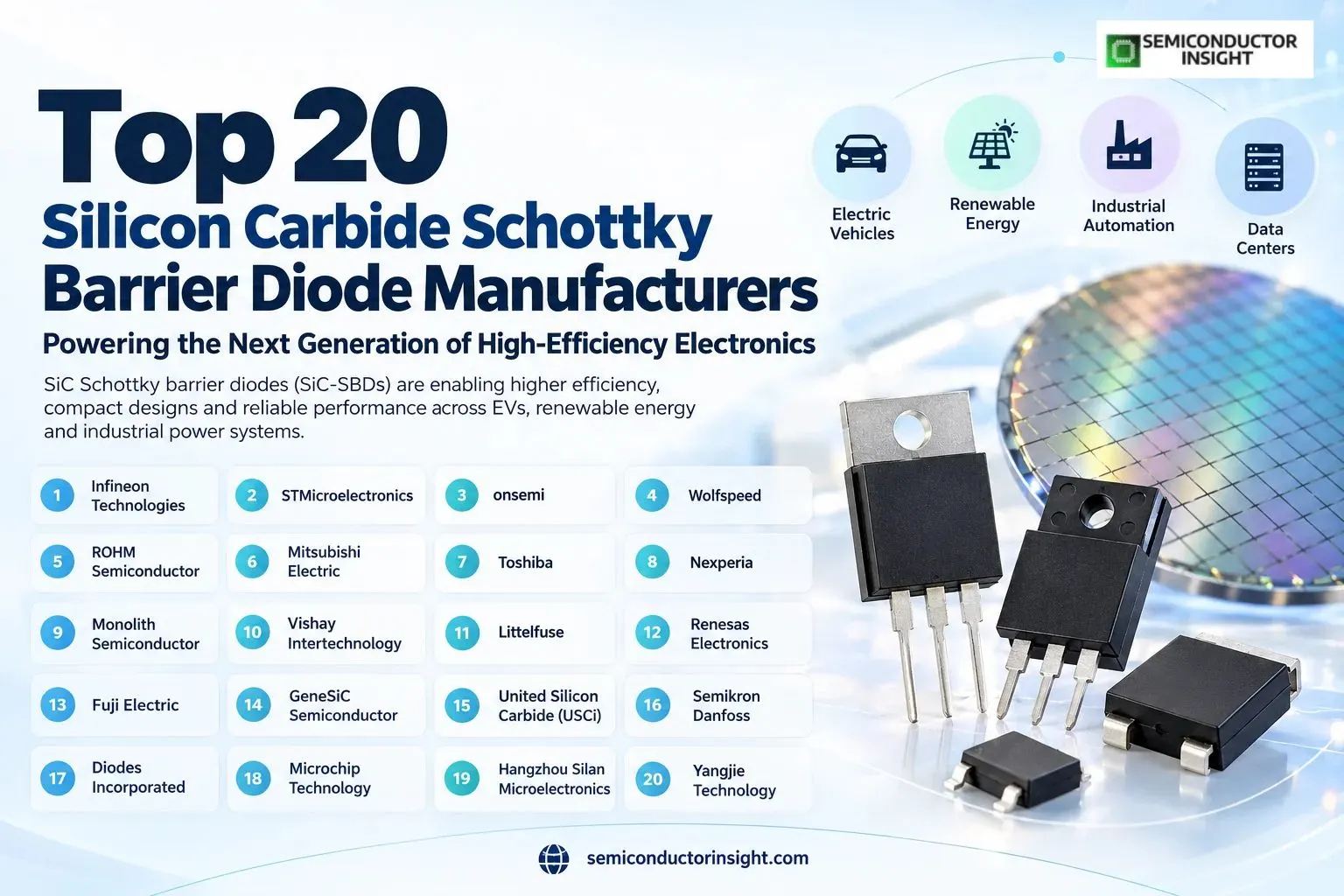
Top 20 Silicon Carbide Schottky Barrier Diode Manufacturers Powering the Transition to Sustainable and Efficient Energy Systems
Silicon Carbide Schottky Barrier Diode (SiC-SBD) market occupies an increasingly important position in the development of high-efficiency power electronics. Unlike conventional silicon-based Schottky diodes, SiC-SBDs use a wide-bandgap semiconductor material that offers high breakdown voltage, low reverse-recovery losses and improved performance at elevated operating temperatures.
- These characteristics make them particularly suitable for applications where switching efficiency, thermal management and power density directly influence equipment performance.
Infineon Technologies: Extending SiC Rectification across Industrial and High-Density Power Conversion
Positioning: Broad product portfolio and established SiC device ecosystem
Infineon Technologies holds a strong position in the SiC-SBD segment through its CoolSiC Schottky diode portfolio, which addresses applications where reverse-recovery behaviour and switching losses directly affect converter efficiency. Its product range covers 600 V, 650 V and 1,200 V devices, allowing engineers to select components for different power conversion architectures. The company’s technical differentiation lies in negligible reverse-recovery charge, capacitive switching behaviour and junction-temperature capability of up to 175°C. These characteristics are relevant to photovoltaic inverters, server power supplies, telecommunications equipment, motor drives and online UPS systems.
An important development in 2026 is Infineon’s expansion of its CoolSiC JFET portfolio for AI data centres and industrial power distribution. Its June 2 announcement included 750 V and 1,200 V devices and additional packaging configurations. These are JFET developments rather than new SBD launches, but they demonstrate the company’s wider investment in SiC power conversion as data-centre electricity requirements increase. Its advantage in the SBD market comes from combining discrete diodes with a broader ecosystem of power switches, gate drivers and system-level design resources.
STMicroelectronics: Building a Strong Position in High-Surge 650 V SiC Diodes
Positioning: Discrete diode variety and automotive-oriented configurations
STMicroelectronics has developed a substantial SiC power Schottky diode portfolio under its STPSC product family. Its product catalogue includes multiple 650 V devices, with forward-current configurations ranging from smaller 4 A and 6 A components to 30 A and 40 A products. The availability of dual-diode and tandem configurations is particularly relevant for designers working on compact power conversion circuits. For example, the STPSC40065C-Y is a 650 V, 40 A dual SiC power Schottky diode, while its high-surge products address applications exposed to demanding current transients.
ST’s positioning is strengthened by the relationship between its discrete semiconductor business and its automotive power electronics activities. Its SiC diode products can be used in power factor correction circuits, onboard charging architectures, industrial power supplies and solar conversion equipment. Rather than competing only on maximum current ratings, the company offers engineers different configurations for optimising circuit layout, surge handling and thermal performance. Its broad product documentation and design resources also support component evaluation during power-stage development.
onsemi: Connecting EliteSiC Diodes with Automotive and Renewable Energy Platforms
Positioning: Automotive-qualified devices and system-level power solutions
onsemi has established its EliteSiC portfolio around high-efficiency power conversion, with discrete SiC Schottky diodes available across 650 V, 1,200 V and 1,700 V voltage classes. Its published portfolio includes automotive-qualified and PPAP-capable options, making the devices relevant to applications where component qualification and long-term operating reliability are important. Specific products such as the NDSH20120C and NDSH50120C provide 1,200 V ratings at 20 A and 50 A respectively. The company’s product offering also includes diode configurations suitable for solar inverters, switching power supplies and UPS equipment.
A particularly important 2026 development is onsemi’s October 14 collaboration with Sungrow, which adopted its SiC hybrid power module technology for the PowerTitan 3.0 utility-scale battery energy storage platform. This is a module-level development, not a standalone SBD launch, but it demonstrates the relevance of SiC-based power conversion in large-scale energy storage. The company’s ability to connect discrete diode technology with hybrid modules and automotive power systems gives it a broader application presence than a component-only supplier.
Wolfspeed: Advancing MPS Diode Architecture and High-Voltage Rectification
Positioning: SiC materials expertise and specialised high-voltage diode technology
Wolfspeed remains an important technology participant in SiC-SBDs through its discrete Schottky diode and merged PiN Schottky (MPS) offerings. Its 1,200 V product family includes 14 listed products, with current ratings spanning 2 A, 5 A, 10 A, 20 A, 30 A and 40 A configurations. Several package options, including TO-220, TO-247 and TO-252 formats, allow designers to accommodate different board layouts and thermal requirements. The MPS structure combines Schottky and PiN characteristics to improve device ruggedness while retaining the fast-switching advantages associated with SiC rectification.
Its January 13, 2026 announcement of a single-crystal 300 mm SiC wafer breakthrough is another notable development. Wolfspeed reported more than 2,300 issued and pending patents worldwide in connection with its technology platform. Although the 300 mm milestone is not a commercial SBD product launch, it illustrates the company’s continued focus on advancing SiC material manufacturing. This materials capability is strategically relevant because wafer quality, defect density and production consistency influence the performance and economics of future power-device generations.
ROHM Semiconductor: Improving Insulation and Packaging for Automotive SiC Diodes
Positioning: Automotive-oriented packaging and specialised bare-die technology
ROHM Semiconductor differentiates its SiC-SBD offering through device engineering, bare-die products and automotive-oriented surface-mount packaging. Its published third-generation S6604 is a 1,200 V, 20 A SiC Schottky diode, while the S6307 provides a 1,200 V, 30 A configuration. Both are specified for junction temperatures up to 175°C. These product characteristics make ROHM relevant to applications requiring high-voltage switching, compact power stages and controlled thermal behaviour.
An important product development came in November 2024, when ROHM introduced an automotive-oriented surface-mount SiC SBD lineup comprising eight initial SCS2xxxNHR models. The company highlighted an approximately 1.3-times increase in creepage distance compared with standard products, addressing insulation requirements in high-voltage xEV systems. The planned industrial SCS2xxxN lineup was intended for factory automation equipment and photovoltaic inverters. In 2026, ROHM’s SiC-related developments also include automotive powertrain engagement with BMW’s Neue Klasse architecture, announced in September. This is broader SiC ecosystem activity rather than a new diode announcement.
Toshiba Electronic Devices & Storage: Bringing JBS Architecture into Lower-Loss Rectifier Designs
Positioning: JBS diode engineering and low-forward-voltage optimisation
Toshiba Electronic Devices & Storage has developed a differentiated SiC Schottky diode portfolio around junction barrier Schottky (JBS) structures. Its product range includes both 650 V and 1,200 V devices, with single and dual circuit configurations. This allows designers to address switching power supplies, server power systems and solar power conditioners using different device combinations. Toshiba’s emphasis on forward voltage, reverse leakage and surge-current performance is especially relevant in high-frequency rectification, where small device-level improvements can influence the overall converter thermal design.
Its third-generation SiC-SBD technology is a notable engineering development. Toshiba describes a lineup comprising seven TO-220-2L models and five DFN8×8 models. The generation uses a revised Schottky metal and an optimised JBS structure, achieving a typical forward voltage of 1.2 V in its highlighted comparison, approximately 17% below the earlier generation’s 1.45 V. The combination of traditional through-hole packages and smaller surface-mount formats gives Toshiba a useful position in both established industrial power supplies and more compact designs.
Fuji Electric: Expanding the 2G SiC-SBD Portfolio with Better Surge Capability
Positioning: Product-generation improvements and industrial power applications
Fuji Electric has developed a clearly differentiated SiC-SBD portfolio through its second-generation diode family. The manufacturer’s parametric catalogue lists 37 SiC-SBD product entries, spanning single and dual configurations, different package types and multiple voltage and current combinations. Its second-generation range includes 650 V and 1,200 V products, with selected devices designed for switching power supplies, UPS equipment and solar power systems.
The engineering improvements are particularly noteworthy. Fuji Electric reports approximately 15% lower forward voltage compared with its conventional first-generation 650 V products, along with approximately 60% higher surge-current capability. Its FDC2AT10S65, for instance, is a 650 V, 10 A device with an 82 A surge-current rating and a typical maximum junction temperature of 175°C. The availability of similar 6 A and 8 A configurations gives circuit designers additional flexibility when balancing current capacity, thermal margins and component cost.
Vishay: Targeting High-Current SiC Rectification for Demanding Power Stages
Positioning: High-current devices and dual-diode packaging
Vishay has built an important position in SiC-SBDs through high-current discrete devices and SOT-227-based configurations. Its product portfolio includes 1,200 V Schottky diode devices with 40 A, 120 A and 160 A ratings. The higher-current options are particularly relevant to industrial power supplies, high-frequency converters and applications requiring substantial rectification capacity. The company’s thin-wafer technology also focuses on improving forward-voltage characteristics and overall conversion efficiency.
A significant product expansion was announced in January 2025, when Vishay introduced 16 new 650 V and 1,200 V SiC Schottky diodes in the SOT-227 package. The lineup included dual-diode configurations with forward-current ratings from 40 A to 240 A, as well as single-phase bridge configurations rated at 50 A and 90 A. The products also featured forward-voltage drops as low as 1.36 V and total capacitive charge down to 56 nC. This is particularly relevant to photovoltaic systems, charging stations, industrial UPS equipment and telecommunications power supplies.
Explore the full report details in our recently refreshed edition anytime: https://semiconductorinsight.com/report/global-sic-sbd-market/
Mitsubishi Electric: Integrating SiC Diode Technology into High-Power Module Architectures
Positioning: High-current SiC modules and industrial integration
Mitsubishi Electric is best assessed in this market through its integrated SiC power module capabilities rather than as a leading standalone discrete SBD supplier. Its full-SiC and hybrid SiC modules incorporate SiC device technology for applications including motion control, renewable energy conversion and uninterruptible power supplies. The company has documented full-SiC module configurations at 1,200 V, with current ratings reaching 400 A in selected products. Its wider power module portfolio also includes 1,700 V and higher-voltage configurations.
The technical importance of Mitsubishi Electric lies in how it incorporates SiC Schottky diode characteristics into high-power assemblies. Its industrial full-SiC application documentation explains the positive temperature characteristics of SiC-SBDs and their ability to suppress current imbalance during parallel operation. The resulting architecture is relevant to high-current conversion systems where thermal stability, switching behaviour and internal chip layout must be managed together. The company therefore represents an important module-integrated competitor, although its discrete SBD range should not be treated as equivalent to manufacturers offering extensive standalone diode catalogues.
Microchip Technology: Taking mSiC Diodes into High-Current Module Applications
Positioning: Bare-die flexibility and high-current SiC diode modules
Microchip Technology has a particularly relevant position through its mSiC Schottky barrier diode portfolio, inherited in part from the Microsemi power semiconductor business. Its offering covers discrete devices, bare die and power modules, allowing engineers to select components for different levels of converter integration. A notable product is the MSC2X51SDA120J, a 1,200 V, 50 A dual SiC diode in an SOT-227 package. The availability of bare-die variants is useful for customers developing customised high-density power assemblies.
Its high-current module capability is another differentiator. The MSCDC200A120D1PAG is a 1,200 V, 200 A phase-leg SiC diode module specified for a maximum junction temperature of 175°C. Its product specifications include a typical forward voltage of 1.5 V and low-stray-inductance construction. Such configurations are relevant to high-power industrial converters and demanding energy conversion systems, where standalone discrete devices may not provide the required current-handling capability.
Qorvo (United Silicon Carbide): Strengthening MPS Diode Performance for Industrial Switching
Positioning: Third-generation MPS devices and high-voltage rectification
Qorvo entered the SiC-SBD competitive landscape through its United Silicon Carbide portfolio, which includes third-generation merged PiN Schottky diodes. Its product selector documents 650 V, 1,200 V and 1,700 V device categories, with several current configurations and TO-220 and TO-247 packaging options. The 1,200 V portfolio includes devices rated from 2 A through 50 A, while its 1,700 V offering includes a 25 A configuration. This breadth makes the portfolio relevant to industrial motor drives, power factor correction circuits, switching power supplies and high-voltage power conversion.
The MPS structure is particularly important because it combines the low forward-voltage behaviour of Schottky devices with the improved surge-handling characteristics of PiN structures. Qorvo’s third-generation products also include automotive-qualified options, supporting applications where electrical stress and temperature variation must be considered during component selection. Its positioning is therefore linked to device ruggedness and high-voltage engineering rather than simply the number of discrete diode models available.
GeneSiC (Navitas Semiconductor): Applying Fifth-Generation MPS Technology to High-Frequency Power Conversion
Positioning: MPS architecture, low forward voltage and application-specific diode engineering
Navitas Semiconductor has strengthened its SiC power semiconductor offering through the GeneSiC product platform. Its fifth-generation 650 V MPS diodes use a combined PiN-Schottky structure designed to deliver lower forward voltage, high surge-current capability and improved thermal behaviour. The portfolio covers multiple current ratings and package formats, including DO-214, PQFN, DPAK, D2PAK, TO-220, TO-247 and SOT-227. Bare-die options also give manufacturers additional flexibility when developing customised power assemblies.
A key differentiator is GeneSiC’s low-built-in-voltage biasing approach, intended to improve efficiency across different load conditions. The products target server and telecommunications power factor correction, industrial motor drives, solar inverters, boost converters and higher-power applications. The breadth of packaging is commercially significant because it allows the same underlying diode technology to serve compact board-level circuits as well as larger industrial power stages. Navitas’ 2025 technical product documentation provides the clearest published evidence for this positioning; a separate 2026 fifth-generation SBD launch should not be assumed without a new product announcement.
BASiC Semiconductor: Building a Bare-Die SiC Supply Platform for Custom Power Assemblies
Positioning: SiC wafer integration, bare-die supply and automotive power modules
BASiC Semiconductor has a particularly relevant position because its SiC-SBD activities extend beyond packaged discrete devices into bare-die and wafer supply. Its published portfolio includes 650 V and 1,200 V Schottky diode products, providing customers with multiple current options for different power conversion designs. The company’s published selection information identifies five 650 V current configurations, from 4 A to 30 A, and seven 1,200 V configurations, from 3 A to 50 A. This range is useful for customers developing custom power modules and high-density semiconductor assemblies.
Its wider product ecosystem includes SiC MOSFETs, industrial full-SiC power modules, automotive full-SiC modules, hybrid SiC discrete devices and gate-driver ICs. The important commercial distinction is the combination of device manufacturing and die-level supply. Customers can evaluate bare dies for their own package designs rather than depending exclusively on standard discrete packages. BASiC’s 2026 second-quarter product selection guide also provides a current reference point for its SiC portfolio, making the company particularly relevant to the developing Asian SiC component supply chain.
Yangzhou Yangjie Electronic Technology: Bringing Self-Developed SiC Rectifiers into Renewable Energy Systems
Positioning: Self-developed discrete SiC diodes and domestic power-device manufacturing
Yangjie Electronic Technology has developed its SiC-SBD business around rectification requirements in photovoltaic inverters, energy storage equipment and power supplies. Its published SiC diode family includes products such as YJD106530BYG4, YJD112015FYG5, YJD112080NCTYG4 and YJD117010PYG5. The company describes these as independently developed and manufactured SiC Schottky diodes, with technical emphasis on high-temperature resistance, low switching losses and strong surge-current handling.
A significant technical characteristic of its products is their ability to operate at junction temperatures of up to 175°C. Positive forward-voltage temperature characteristics also support current sharing when devices are connected in parallel. These characteristics are particularly relevant to solar inverters and charging equipment, where power conversion components must operate under changing loads and thermal conditions. Yangjie’s 2026 product announcements include developments in automotive MOSFETs, energy-storage MOSFETs and IGBT modules, indicating continued investment in adjacent power semiconductor technologies. The SiC-SBD family remains an important part of its broader discrete-device offering.
Global Power Technology: Addressing Multiple Voltage Classes with SiC Schottky Rectifiers
Positioning: Broad voltage coverage and high-voltage discrete rectification
Global Power Technology is relevant to the SiC-SBD market through its range of silicon carbide Schottky rectifiers, particularly devices targeting high-voltage industrial applications. Publicly documented product information identifies 600 V, 1,200 V, 1,700 V and 3,300 V diode families. Reported current configurations extend from low-current rectification devices to higher-current products, with the 1,200 V family covering several ratings between 2 A and 50 A. These specifications make the portfolio relevant to industrial power supplies, renewable energy conversion and motor-control systems.
Its product-level presence can also be seen through devices such as the G3S12003A, a 1,200 V SiC Schottky diode, and G5S12030BM, a 1,200 V, 30 A device in a TO-247 package. These products demonstrate the company’s focus on standard discrete rectifier formats used in industrial power-stage designs. Its wider voltage range is an important distinction because 1,700 V and 3,300 V components address specialised applications beyond conventional 650 V and 1,200 V circuits. However, detailed current manufacturing capacity and independently verified 2026 production volumes are not publicly established in the sources reviewed.
InventChip Technology: Offering High-Current 1,200 V SiC Diodes for Inverter and Charging Applications
Positioning: Discrete diode configurations and high-current industrial applications
InventChip Technology has established a product presence in the SiC-SBD segment through its IV1D family of Schottky diodes. Its portfolio includes 650 V and 1,200 V products in TO-220 and TO-247 packages, with several current configurations available. For example, the IV1D12010O2 is a 1,200 V device rated at 28 A, while the IV1D12030U3 is a 1,200 V diode array rated at 44 A per diode. These configurations are relevant to solar inverters, EV charging equipment, power factor correction circuits and industrial switching power supplies.
The technical relevance of this portfolio lies in its combination of zero reverse-recovery behaviour, high-temperature operation and package flexibility. The published IV1D12040U2 datasheet specifies a 1,200 V rating, a 40 A continuous forward current at a case temperature of 145°C and a 216 A non-repetitive surge-current rating under the stated test conditions. Such specifications matter in applications where transient current handling and thermal design influence device selection. Its product range provides an alternative to established international diode brands, particularly for designers evaluating multiple suppliers for high-voltage converter platforms.
Micro Commercial Components (MCC): Accelerating SiC Diode Generations for High-Efficiency Rectification
Positioning: Recent product introductions and package-level flexibility
Micro Commercial Components deserves inclusion among the additional major competitors because of its particularly active SiC diode introduction schedule in 2026. The company has expanded its fourth-generation SiC Schottky diode family across 650 V and 1,200 V configurations, with products available in DPAK, D2PAK, TO-220AC, TO-247AB and TO-247AD packages. Its March 25, 2026 introduction included devices covering 10 A to 40 A, providing a useful selection for different rectification requirements. The SICW30120DG4J, for example, is a 1,200 V, 30 A device with a specified forward-voltage drop of 1.45 V under its stated test conditions.
MCC’s March 6, 2026 Gen5 introduction adds another dimension through 650 V MPS diodes in D2-PAK packaging. The SICB2065XG5MQ is rated at 20 A, carries an AEC-Q101 qualification option and has a specified forward-voltage drop of 1.3 V. The series also supports operation at junction temperatures up to 175°C. This combination of automotive-grade qualification, higher current capability and standardised package formats strengthens MCC’s relevance to power factor correction, renewable energy inverters and industrial power supplies. Its successive Gen4 and Gen5 releases are particularly useful indicators of current product-level competition.
Diodes Incorporated: Expanding Discrete SiC Rectification Across Standard Voltage Ratings
Positioning: Wide discrete product selection and standardised component formats
Diodes Incorporated has developed its SiC-SBD business around discrete components for AC-DC, DC-DC and DC-AC power conversion. Its initial January 2023 product introduction included 11 devices in the 650 V DSCxxA065 family and eight products in the 1,200 V DSCxx120 family. These products covered multiple current ratings, including 4 A, 6 A, 8 A and 10 A configurations in the 650 V category and 2 A, 5 A and 10 A options in the 1,200 V category.
Its current official product selector lists 44 SiC diode results, with single and dual configurations, automotive qualification filters and multiple package options. This is significant for design engineers because the availability of different current ratings and package formats can simplify component substitution during converter development. The company targets applications including photovoltaic inverters, UPS systems, industrial motor drives and switching power supplies. Its competitive relevance comes from the breadth of its discrete semiconductor distribution and component selection ecosystem rather than a claim of a new 2026 SiC-SBD generation.
SemiQ: Developing High-Power SiC Schottky Diode Modules for Energy Conversion
Positioning: High-current diode modules and bare-die solutions
SemiQ is an important addition because it focuses specifically on silicon carbide power semiconductors rather than treating SiC diodes as a small part of a wider discrete-component catalogue. Its portfolio includes 650 V, 1,200 V and 1,700 V SiC Schottky diodes, as well as diode modules and known-good-die products. This three-voltage-class structure gives the company exposure to both conventional industrial power conversion and more demanding high-voltage applications.
Its module portfolio includes 1,200 V products with current ratings such as 15 A, 45 A, 60 A, 300 A and 400 A configurations. SemiQ has also documented 1,200 V bare-die diode products at 10 A, 15 A, 20 A, 30 A and 50 A. These options are relevant to solar inverters, EV charging equipment, fuel-cell power generation, industrial power supplies and energy storage systems. The company’s emphasis on standardised and customised modules, together with a redundant sourcing strategy covering substrates, epitaxial wafers, fabrication and assembly, adds a supply-chain dimension to its market positioning. Its 2026 product catalogue provides a current reference for this portfolio.
RIR Power Electronics: Establishing an Indian SiC Diode Manufacturing Presence
Positioning: Emerging Indian SiC supply and MPS diode development
RIR Power Electronics is an increasingly relevant participant in the SiC-SBD market, particularly because of its efforts to develop an Indian supply base for high-voltage power semiconductor devices. In June 2025, the company announced expanded production and shipment of 1,200 V SiC Schottky diodes through its manufacturing collaboration with Pro Asia Semiconductor Corporation in Taiwan. Its published product range covered 2 A to 60 A configurations, providing multiple current options for industrial and energy conversion applications.
A more recent development came on February 5, 2026, when RIR announced its SiC MPS diode family for EVs, renewable energy systems, data centres, industrial drives, aerospace and green hydrogen applications. The MPS architecture is important because it seeks to combine fast Schottky switching with improved surge and blocking characteristics. RIR’s March 2026 announcement of additional SiC MOSFET products further demonstrates its intention to build a wider SiC device portfolio. Its proposed Odisha manufacturing campus and existing Taiwan manufacturing collaboration make domestic supply-chain development a major part of its competitive strategy.

Comments (0)