

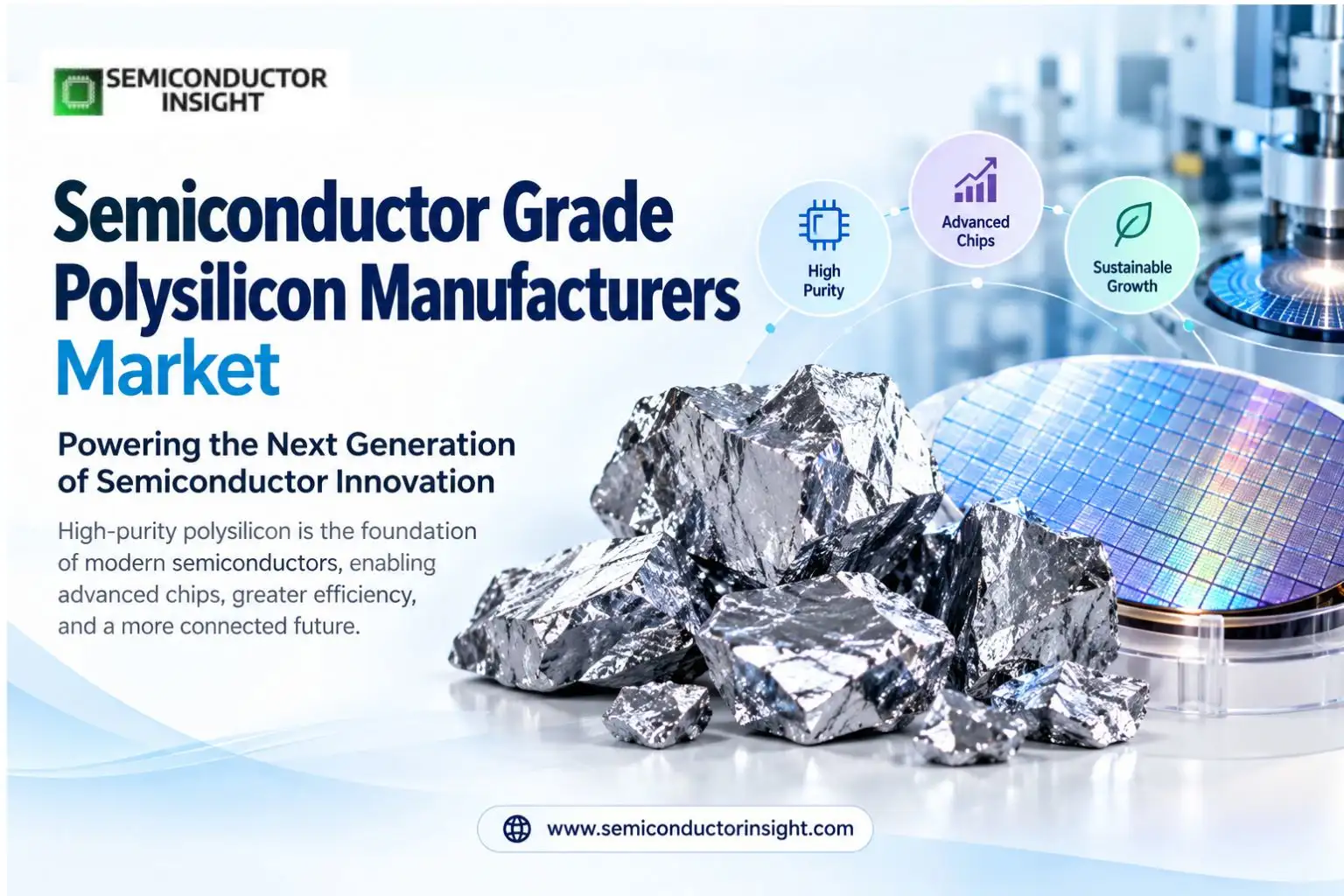
Top 10 Semiconductor Grade Polysilicon Manufacturers Driving High-Purity Innovation for Advanced Semiconductor and Solar Applications
Semiconductor Grade Polysilicon (also called electronic-grade polysilicon or EG-Si) is ultra-high-purity polycrystalline silicon produced specifically as the feedstock for manufacturing single-crystal silicon ingots and wafers used in semiconductor devices.
The dominant commercial route is the Siemens process (or modified Siemens process). Metallurgical-grade silicon is converted into trichlorosilane (or related chlorosilanes), purified through fractional distillation, and then thermally decomposed via chemical vapor deposition onto heated high-purity silicon rods inside specialized reactors.
The entire process occurs under tightly controlled clean conditions to prevent contamination. Alternative methods such as fluidized-bed reactors exist but are less common for the highest electronic grades.
WACKER Chemie
The manufacture of hyperpure semiconductor-grade polysilicon, which supports cutting-edge microelectronics and AI-driven chips, is still being led by WACKER. The company’s largest single project in ten years, Etching Line Next, was put into service at the Burghausen facility in July 2025, costing over €300 million. With crucial impurities in the parts-per-trillion range, the fully automated acid-etching and cleanroom process increases capacity for the highest semiconductor-grade material by more than 50% and produces polysilicon with purity above 99.9%.
- First consignments reached semiconductor customers shortly after start-up.
- By the first half of 2026 semiconductor-grade volumes had already risen roughly 10%, and nearly half of the world’s computer chips now incorporate WACKER hyperpure polysilicon.
- The expansion directly supports the escalating purity and volume needs of high-bandwidth memory, logic devices and power semiconductors while reinforcing supply reliability for global wafer makers.
Hemlock Semiconductor
Hemlock remains a cornerstone of U.S. and global supply for the ultra-high-purity polysilicon required by leading-edge semiconductor nodes. In 2025 the company completed its Next-Generation Finishing facility, introducing modern finishing technology that expands available semiconductor-grade output and improves surface quality for 300 mm wafer customers. Parallel CHIPS Act support of up to $325 million is funding a new dedicated manufacturing facility on the existing Michigan campus, with production targeted for 2028.
The project is expected to add approximately 180 manufacturing positions once fully operational. Hemlock’s material meets the stringent purity thresholds demanded by advanced logic, memory and power devices; nearly every electronic device worldwide contains some of its polysilicon. Recent leadership appointments in manufacturing and operations underscore the focus on safe, high-yield output amid rising demand from AI and high-performance computing applications.
Tokuyama
Tokuyama is actively reshaping the geographic footprint of semiconductor-grade polysilicon supply to reduce single-site risk. In August 2026 the company inaugurated a new processing plant in Vietnam’s Phu My 3 Industrial Park with an eventual annual capacity of roughly 4,000 to 4,955 metric tons focused on crushing, cleaning and analysis of high-purity material; commercial production is scheduled for 2027.
Simultaneously, the 50-50 joint venture OTSM with OCI is advancing an 8,000-metric-ton semiconductor-grade plant in Sarawak, Malaysia, backed by approximately $435 million and powered by an 80-megawatt renewable energy agreement. Once both sites reach full operation, Tokuyama’s total capacity is projected to rise about 50% to around 12,500 metric tons per year. The material achieves impurity levels as low as one part per billion, supporting wafer producers in Japan, Korea and Taiwan and addressing the forecast demand surge linked to AI and advanced packaging.
OCI
OCI is extending its semiconductor-grade polysilicon footprint both domestically and through strategic partnership. Its Gunsan facility currently produces approximately 4,700 metric tons of semiconductor-grade material annually, feeding wafer etching and related processes for major Korean chipmakers. The OTSM joint venture with Tokuyama in Malaysia is designed to add another 8,000 metric tons of 11N-purity polysilicon starting in 2029, with product already attracting interest from customers in Korea, Japan and Taiwan.
The Malaysian site will operate under a long-term renewable power agreement, positioning the output as low-carbon high-purity feedstock. These moves coincide with broader expansion of complementary semiconductor materials such as phosphoric acid, whose capacity is being raised toward 30,000 metric tons, reinforcing OCI’s role in the upstream supply chain for logic, memory and power devices.
A Brief Look at Our Detailed Analysis Related Report: https://semiconductorinsight.com/report/semiconductor-grade-polysilicon-market/
Mitsubishi Materials
Mitsubishi Materials’ high-purity polycrystalline silicon continues to serve demanding semiconductor applications through its “Eleven 9s” (99.999999999%) grade material offered in both chunk and cut-rod forms. The product line supports consistent quality for wafer manufacturing and related high-temperature equipment components. Following the transfer of the semiconductor polysilicon business into a dedicated entity later acquired by SUMCO, the material remains integrated into the vertical supply of electronic-grade feedstock.
Columnar-crystal variants provide mechanical strength suited to device manufacturing environments. Ongoing quality methods developed over decades keep the polysilicon aligned with the tightening impurity specifications required by advanced node processes and specialized silicon parts used in plasma etching, CVD and annealing tools.
OSAKA Titanium Technologies
Although OSAKA Titanium exited large-scale semiconductor polysilicon production several years ago after determining that its smaller, older facilities could no longer meet escalating purity and cost requirements, residual high-purity silicon expertise continues to inform specialized titanium and electronic materials offerings.
The earlier capacity of roughly 3,250 metric tons had been underutilized as quality thresholds for electronic-grade material rose. The company’s decision to concentrate on its core titanium portfolio left the semiconductor polysilicon segment to larger dedicated producers, yet the historical contribution to Japanese wafer supply chains remains part of the industry’s knowledge base for ultra-clean material handling and process control.
REC Silicon
REC Silicon’s recent trajectory illustrates the high qualification barriers that separate solar-grade from true semiconductor-grade polysilicon. The Moses Lake facility, once positioned for ultra-high-purity output, faced repeated manufacturing challenges and failed customer qualification tests for the most demanding applications. In 2026 the company moved to shutter the Washington plant after its primary customer cancelled the supply contract, resulting in the elimination of 224 positions.
Parallel wind-down activity at the Montana silane operations further reduced the company’s polysilicon footprint. The episode underscores how even established fluidized-bed technology can struggle to achieve the surface metals, carbon and bulk purity levels required by leading-edge wafer makers, leaving the highest-purity segment dominated by Siemens-process specialists.
GCL-related suppliers
GCL Technology and affiliated entities such as Jiangsu Xinhua Semiconductor are advancing high-purity granular polysilicon that increasingly meets electronic-grade thresholds. By mid-2026 the proportion of product with five metallic impurities at or below 0.3 ppbw had climbed above 99%, while the stricter 18-element standard at ≤1 ppbw reached 99.56%.
Annual granular capacity stands near 480,000 metric tons overall, with a growing share directed toward higher-purity applications. Carbon-footprint certification at 14.2756 kg CO₂e per kilogram positions the material favorably for customers seeking lower-emission feedstock. These quality gains support both domestic Chinese wafer demand and efforts to qualify granular silicon for selected semiconductor processes beyond traditional solar use.
Huanghe Hydropower
Huanghe Hydropower has steadily expanded its electronic-grade polysilicon capability to help reduce reliance on imported high-purity material for China’s integrated-circuit industry. Capacity for electronic-grade output reached 3,300 metric tons per year after the addition of an 800-ton production line that delivered its first batch of product.
The material is positioned to support national strategic needs for domestic wafer and chip manufacturing raw materials. Continued process refinement aims at meeting the multi-nines purity levels required by advanced semiconductor applications while leveraging the region’s energy resources for stable production.
Yichang CSG
Yichang CSG contributes to the emerging Chinese base of semiconductor-grade polysilicon producers, supplying high-purity material that appears in industry assessments of electronic-grade capacity and shipments. Its output supports the broader effort to localize upstream feedstock for wafer fabrication and to meet rising domestic demand estimated in the tens of thousands of metric tons annually for semiconductor applications.
Process improvements and capacity utilization focus on achieving the impurity control necessary for qualification by wafer and device manufacturers, complementing the larger established Western and Japanese suppliers in a diversifying global supply landscape.

Comments (0)