

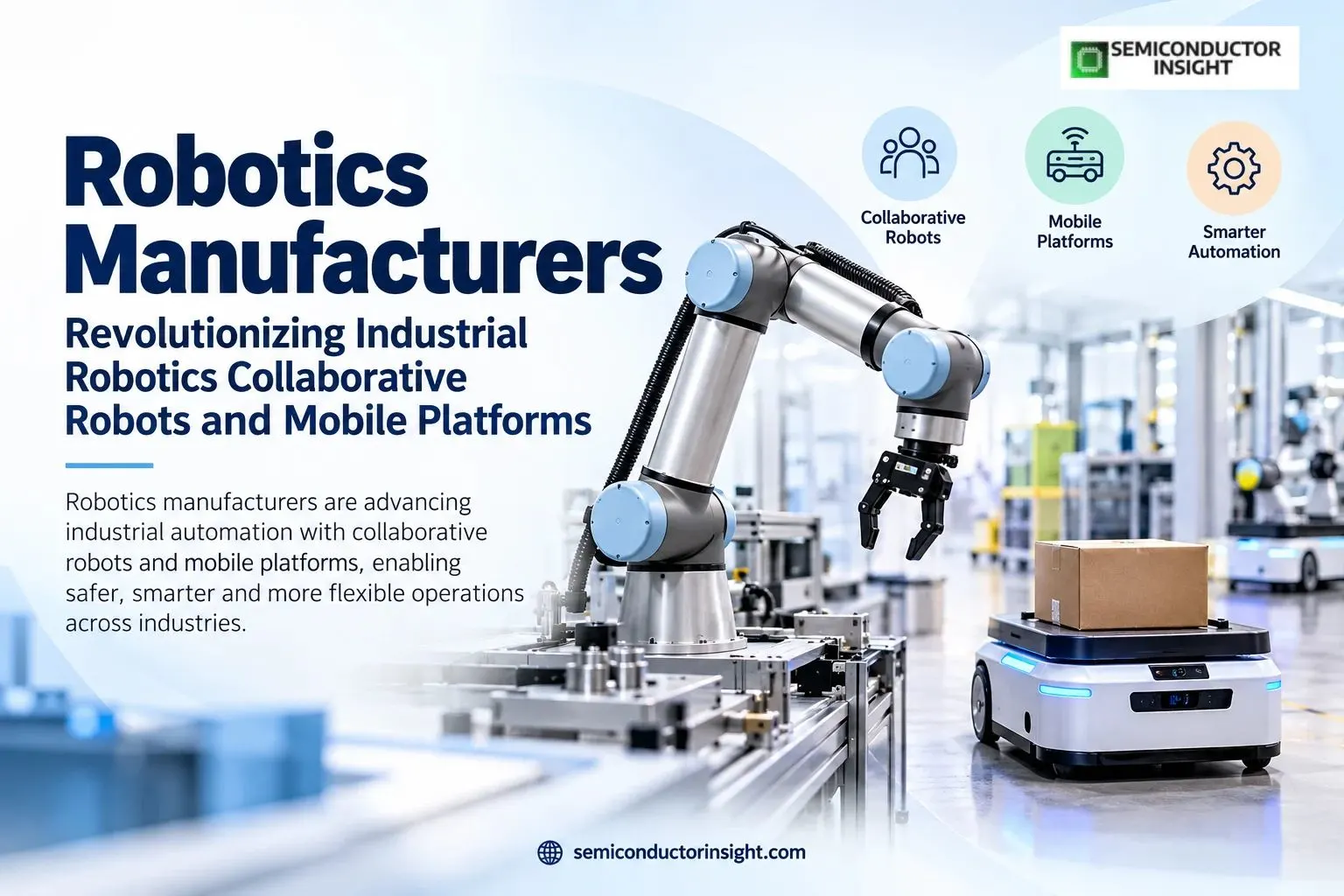
Top 10 Robotics Manufacturers Revolutionizing Industrial Robotics Collaborative Robots and Mobile Platforms
Factories installed roughly 603,000 industrial robots in 2025, lifting the worldwide operational stock past 5 million units. Demand is accelerating from physical AI integration, data-center and semiconductor build-outs, electric-vehicle lines, and persistent labor gaps.
The companies shaping this expansion are not merely shipping arms they are embedding simulation, real-time learning, and human-robot collaboration into production at scale. Here is a close look at the organizations currently defining capability, deployment volume, and technology direction.
FANUC
FANUC continues to set the benchmark for high-volume, high-reliability industrial arms that run continuous shifts in automotive, electronics, and metal-working plants.
- More than one million of its robots operate worldwide, and the company is expanding U.S. manufacturing capacity with a $90 million, 840,000-square-foot facility in Michigan scheduled for completion in late 2027.
- The new site adds production-ready space specifically for AI-enabled robots and digital-twin workflows.
- FANUC is integrating NVIDIA Isaac and Omniverse tools so customers can commission entire lines virtually before metal ever moves.
- In semiconductor and new-energy vehicle component machining, the yellow arms handle precision tasks that previously required multiple specialized stations, while recent capacity investments address earlier delivery bottlenecks that emerged when physical-AI demand surged.
ABB Robotics
ABB is pushing collaborative and small-payload performance into heavier and more precise territory. Its latest GoFa collaborative series reaches payloads that open material-handling and assembly jobs once reserved for traditional caged robots, while the refreshed IRB 1200 family delivers path accuracy of 0.6 mm and pose repeatability down to 0.011 mm at speeds up to 1,600 mm/s.
A new 15,000-square-meter technology and operations center under construction in Sabadell, Spain, will centralize Iberian engineering, vision systems, mobile-robot development, and customer training when it opens in 2028. Half the floor space is reserved for robot assembly and testing. ABB’s RobotStudio HyperReality, powered by NVIDIA Omniverse libraries, achieves 99% correlation between simulation and real behavior, cutting deployment time and physical prototyping cycles for electronics and automotive customers such as Foxconn.
Yaskawa Motoman
Yaskawa’s Motoman lineup now exceeds 600,000 installed units globally, with particular strength in arc welding where the company ships tens of thousands of welding robots each year. The 2025 Motoman NEXT platform and NEX series introduce physical-AI capabilities, including sim-to-real transfer and AI-driven task learning through the YNX1000 controller and offline simulator.
These tools allow factories to validate complex welding and handling sequences digitally before installation. Yaskawa continues to expand U.S. output in response to rising North American demand for automation in automotive and general industry, keeping its blue arms central to high-cycle, high-reliability cells that must operate around the clock.
For additional report info, feel free to view our most recent edition: https://semiconductorinsight.com/report/robotics-suite-market/
KUKA
KUKA is moving beyond individual robot cells into plant-wide orchestration. Its Automation Management Platform went live at the Toledo Production Operations facility, a 335,000-square-foot plant that builds more than 300 vehicle bodies per day using 285 robots and over 60,000 connected devices. The same site has produced more than two million Jeep Wrangler and Gladiator bodies.
KUKA is applying the platform’s AI-driven decision layer to coordinate existing automation with new mobile and fixed assets, turning isolated production data into continuous improvement loops. Parallel projects, such as fully automated 2D-panel factories that finish a panel every ten minutes, show the company’s reach into construction and modular manufacturing.
Universal Robots
Universal Robots remains the reference for collaborative arms that share space with people. More than 100,000 cobots have been deployed across electronics, food handling, machine tending, and packaging. The 2026 Gen 7 platform introduces new g-Series arms (including models with 10 kg, 17 kg, and 18 kg payloads) featuring an AI-ready tool flange that routes power, data, and safety signals directly to cameras and sensors.
The CB7 controller delivers 40% more compute in a 30% smaller footprint. This redesign reduces cabling and integration time so vision and physical-AI applications can move from concept to production in hours rather than weeks. The ecosystem of more than 500 certified accessories further lowers the barrier for small and mid-sized manufacturers.
Boston Dynamics
Boston Dynamics is translating mobility expertise into industrial humanoid and mobile systems. More than 1,500 Spot quadrupeds are already in customer hands for inspection and data collection across energy, manufacturing, and infrastructure sites. Stretch handles warehouse case unloading. Atlas entered early commercial production in 2026 and is now training at the Robotics Metaplant Application Center inside Hyundai’s Georgia electric-vehicle plant.
Hyundai plans an initial rollout of 25,000 Atlas units across its global plants, backed by a U.S. factory targeting 30,000 robots per year. Training currently focuses on logistics sequencing and heavy-object handling, with component assembly targeted later in the decade. Existing Spot and Stretch customers in aerospace, semiconductors, and logistics are already in discussions to expand Atlas use cases.
Kawasaki Robotics
Kawasaki is extending its traditional strength in welding and handling into high-speed, space-constrained packaging and physical-AI applications. The new CP110L palletizing robot carries a 110 kg payload, reaches 2,505 mm, and can handle up to 2,200 cases per hour while occupying minimal floor space and ceiling height. An 8-degree-of-freedom RL030N platform designed specifically for physical-AI tasks debuted for dynamic and confined environments.
Live demonstrations pair Kawasaki arms with closed-loop adhesive dispensing that adjusts beads 400 times per second and with modular case-packing cells, showing how the company is adapting to flexible, high-mix production lines common in consumer goods and automotive supply chains.
NVIDIA
NVIDIA has become the computational backbone for physical AI across the robotics industry. Its Isaac simulation frameworks, Omniverse libraries, and GR00T models are being integrated by FANUC, ABB, Yaskawa, KUKA, Universal Robots, and others into virtual commissioning and training pipelines. Manufacturers with a combined installed base exceeding two million robots now use these tools to generate synthetic data, close the sim-to-real gap, and validate entire production lines before hardware arrives.
- The approach shortens training cycles from years to months and enables robots to operate in unstructured environments. NVIDIA’s partnerships effectively turn every major industrial robot vendor into a node in a shared physical-AI development network.
Agility Robotics
Agility is commercializing bipedal humanoids for warehouse and light-industrial material handling. Earlier Digit models have logged more than 65,000 operating hours at sites including GXO, Amazon, Toyota Canada, and Schaeffler. Digit 5 raises payload to 50 pounds, extends reach to 7.2 feet, and introduces autonomous safety behaviors stopping, steering around people, or squatting when humans approach so the robots can work without traditional cages.
- Conditional multi-year orders for Digit 5 already exceed $300 million. The company’s RoboFab is designed for annual output of up to 10,000 units, positioning Agility as one of the first humanoid suppliers moving from pilot fleets into sustained commercial volume.
Mitsubishi Electric
Mitsubishi Electric brings specialized cleanroom and compact vertical-articulated robots into semiconductor and electronics manufacturing, where wafer sizes and FOUP handling demand both higher payloads and tighter footprints. Its RV-20FRL series delivers 20 kg capacity within a reach comparable to earlier 13 kg models, allowing existing cells to upgrade without layout changes.
Cumulative clean-robot shipments have surpassed 10,000 units. These systems address the simultaneous pressures of larger wafers, narrower inter-process corridors, and the need for ISO Class 3 particle control requirements that intensify as data-center and AI-chip production expands worldwide.

Comments (0)