

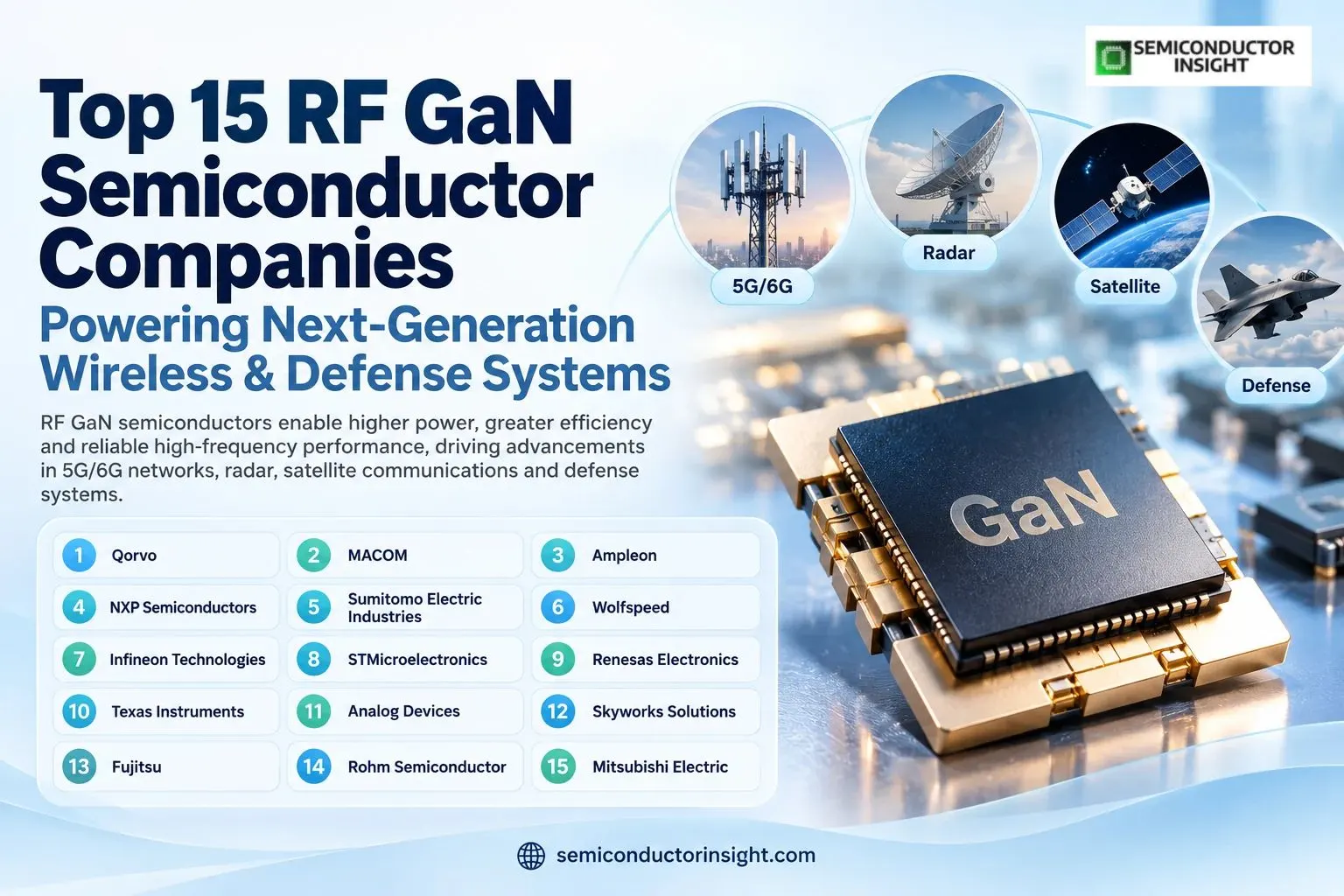
Top 15 RF GaN Semiconductor Companies Powering Next-Generation Wireless & Defense Systems
Radio-frequency gallium nitride (RF GaN) semiconductors are high-power, high-frequency devices made using gallium nitride, a wide-bandgap semiconductor material. Their combination of high power density, strong breakdown-field performance and efficiency at elevated frequencies makes them valuable in applications where conventional silicon or gallium arsenide technologies may face power-handling or thermal constraints.
The technology is particularly important for 5G and emerging 6G infrastructure, active electronically scanned radar, electronic warfare, satellite communications, aerospace, defence and industrial RF systems. In these applications, RF GaN power amplifiers can help deliver more output power from compact hardware, while reducing the number of amplification stages required in some designs. Actual benefits depend on operating frequency, circuit architecture, thermal management and the end application.
Qorvo – Raising the Power Ceiling for Radar and Electronic Warfare
Qorvo deserves a leading position because its RF GaN portfolio spans high-power discrete transistors and integrated components used in demanding radar and defence architectures. Its engineering advantage is especially visible in systems that must transmit powerful pulses while maintaining receiver sensitivity, frequency agility and compact packaging. This makes the company relevant to active electronically scanned array (AESA) radar, military communications, electronic warfare and test instrumentation.
Qorvo’s 2026 product activity provides several concrete indicators. Its QPD1426L is a 220 W GaN-on-SiC transistor designed for the 1.2-1.4 GHz L-band, with typical drain efficiency of 70%. Its QPD2562L family addresses the 2.5-3.5 GHz range with devices delivering up to 200-300 W, depending on operating band. On 22 September 2026, Qorvo also announced a milestone under DARPA’s THREADS programme, reporting more than a 400% increase in X-band RF power density through its research work. The result is a research milestone, not a claim that every commercial product has achieved the same improvement.
MACOM – Building a Bridge between High-Power GaN Devices and Integrated MMICs
MACOM has a broad RF GaN presence across communications infrastructure, radar, satellite communications and microwave systems. It supplies both discrete GaN-on-SiC high-electron-mobility transistors (HEMTs) and GaN monolithic microwave integrated circuits (MMICs). This range enables customers to choose between a component-level design and a more integrated amplifier architecture, depending on output power, bandwidth, thermal limits and system complexity.
The company’s published portfolio includes a 610 W GaN-on-SiC HEMT for 2.62-2.69 GHz cellular infrastructure, as well as a 440 W device covering 1.805-1.88 GHz. For higher-frequency systems, MACOM lists GaN MMIC power amplifiers operating across bands such as 4-8 GHz, 6-18 GHz, 7.9-11 GHz and 27-31 GHz. This combination is important because radar and satellite designers need different output-power levels at different frequencies, not one universal device. MACOM’s published portfolio also spans power levels up to 1,000 W for selected communications-infrastructure products, although product-specific operating conditions must be checked before comparing ratings.
Ampleon – Expanding GaN into Both Cellular Infrastructure and Industrial RF Energy
Ampleon is particularly important in RF power amplification because it develops devices for two different kinds of demand: wireless infrastructure, where linearity and efficiency are essential, and industrial RF systems, where high continuous-wave output can matter more than cellular signal characteristics. This diversity gives the company a role beyond conventional mobile-network base stations.
In 2026, Ampleon expanded its GaN portfolio with several application-specific devices. On 13 August, it announced an 800 W GaN-on-SiC HEMT for the 902-928 MHz industrial, scientific and medical (ISM) band, reporting drain efficiency above 80% for the specified operating conditions. The device is intended for applications including industrial RF heating, plasma generation and particle-accelerator systems. In cellular infrastructure, the company introduced a 70 W GaN Doherty power amplifier module for 3.4-4.0 GHz in May and a fully integrated 70 W GaN module for 5G massive MIMO in June. It also announced a 55 W GaN Doherty transistor for 4.8-5.0 GHz in June 2026.
NXP Semiconductors – Optimising GaN for High-Capacity 5G Radio Units
NXP’s RF GaN business is closely tied to cellular infrastructure, where the power amplifier must deliver strong output while preserving signal quality across wide bandwidths. In massive MIMO and multi-antenna radio systems, the challenge is not simply to generate power: the amplifier must operate efficiently under modulated signals, support linearisation and maintain performance as traffic demand changes.
An important 2026 product indicator is the Airfast A5G26H606W19N, an 85 W average-output GaN amplifier designed for 2.496-2.690 GHz cellular base-station applications. Its datasheet was revised on 13 February 2026, documenting a high-performance in-package Doherty architecture. The device supports a 194 MHz frequency span within the specified band. NXP’s wider macro-GaN portfolio has also been designed around 40-80 W radio units for configurations such as 4T4R and 8T8R, where multiple transmit and receive paths improve coverage and capacity. Buyers should check lifecycle status carefully: NXP’s product pages flag some earlier 85 W variants as end-of-life, so not every historic device listing represents an actively available part.
Sumitomo Electric Industries – Combining RF Power Density with In-House Device Engineering
Sumitomo Electric is a major specialist in compound-semiconductor technology, and its RF GaN capabilities cover wireless communications, radar, satellite communications and industrial heating. The company emphasises control across the device chain, from wafer technology through packaging. This is significant for high-power RF products, where thermal resistance, package geometry and reliability can be just as important as the transistor’s electrical characteristics.
Its published RF GaN specifications include typical output power of up to 750 W, efficiency reaching 80% in selected devices, operation at frequencies as high as 86 GHz, and broadband capability up to 5 GHz. The company’s application table gives distinct examples: a 5.85-6.75 GHz radio-link device, a 9.3-9.5 GHz SATCOM device and a 2.4-2.5 GHz heating application. Sumitomo also reports more than 300 million GaN power-amplifier units shipped across its product business. That shipment figure reflects the company’s wider GaN power-amplifier activity and should not be interpreted as a count of high-power radar devices alone.
Microchip Technology – Covering the Space between Microwave Frequencies and System-Level Constraints
Microchip’s RF portfolio is relevant to designers who must balance output power, frequency range, size, weight and power consumption (SWaP). This is particularly important in satellite payloads, aerospace platforms, radar equipment and military communications, where a small reduction in amplifier size or power demand can affect the design of the complete system.
Microchip’s published RF power-amplifier portfolio covers frequencies up to 31 GHz, with GaN and GaAs products across S-band, X-band and Ka-band applications. Its aerospace and defence range includes devices in the 3-70 W class across 1-31 GHz. For example, its ICP2840 GaN-on-SiC amplifier operates at 27.5-31 GHz and provides 9 W continuous-wave output or 10 W pulsed output, while the ICP1543 operates in the 12-18 GHz Ku-band and generates 20 W continuous-wave output. The company also offers products in bare-die and packaged forms, giving system designers flexibility when integrating amplifiers into specialised RF assemblies. These specifications are published product capabilities, rather than evidence of a single new launch in 2026.
Analog Devices – Broadening GaN Amplification for Radar, Test and Microwave Systems
Analog Devices (ADI) occupies an important position in RF GaN because it supplies amplifiers across a broad frequency range, including devices intended for pulsed radar, electronic warfare, communications and test equipment. Its product range allows designers to select from compact surface-mount amplifiers, packaged devices and bare-die solutions, depending on the power level and the integration requirements of the system.
A timely development appeared on 26 October 2026, when ADI published the datasheet for its ADPA9005 GaN power amplifier, covering 1-28 GHz with a typical output level of 37.5 dBm, approximately 5.6 W. The wide frequency coverage is particularly useful in broadband RF architectures that must operate across several bands. ADI also offers the ADPA1107, a 35 W GaN amplifier for 4.8-6.0 GHz, and the ADPA1105, a 40 W device for 0.9-1.6 GHz. The latter is intended for applications including weather radar, marine radar and military radar.
STMicroelectronics – Advancing a Silicon-Based Manufacturing Route for RF GaN
STMicroelectronics is notable for its work on RF GaN-on-silicon, a technology route intended to use larger silicon wafers and manufacturing infrastructure to improve the economics of RF GaN production. Traditional high-power RF GaN devices frequently use silicon carbide substrates because of their thermal performance, while GaN-on-silicon has potential for manufacturing scale and cost reduction if electrical and thermal requirements can be met.
A key milestone was announced on 13 May 2022, when STMicroelectronics and MACOM reported successful production of RF GaN-on-silicon prototypes that met their stated cost and performance targets and moved into qualification. The work was directed toward resilient volume manufacturing for 5G and future 6G infrastructure. This remains an important technical distinction: the announcement documented prototype and qualification progress, not proof that every related device has become a high-volume commercial product by 2026.
Infineon Technologies – Applying RF GaN-on-Silicon to High-Volume Wireless Infrastructure
Infineon’s RF GaN strategy differs from the GaN-on-SiC approach commonly used for the highest-power radar applications. The company has described RF GaN-on-silicon technology intended for high-frequency amplification in wireless infrastructure. By using a silicon substrate and a manufacturing approach designed for scalability, this technology seeks to reduce cost barriers for radio-frequency power amplifiers while retaining the performance needed for modern cellular signals.
Infineon’s technical material distinguishes its RF GaN-on-silicon technology from its CoolGaN power-switching products. RF devices are designed to amplify complex signals at gigahertz frequencies, while power-conversion GaN transistors are optimised for switching electrical energy. That distinction is important because the two types of devices are not interchangeable. Infineon’s wider RF portfolio also includes products covering frequencies up to 12 GHz, including more than 50 low-noise RF transistor products across relevant categories, although these should not all be counted as RF GaN devices.
Renesas Electronics – A Wider GaN Semiconductor Strategy with a More Limited Public RF GaN Footprint
Renesas belongs in the broader gallium-nitride semiconductor discussion because it has expanded its wide-bandgap semiconductor position, particularly in power conversion. Its acquisition of Transphorm in 2024 strengthened its GaN technology capabilities for power-management applications. However, power GaN and RF GaN serve different functions: power devices switch electrical energy in converters, whereas RF GaN transistors amplify high-frequency radio signals.
For a rigorous RF GaN market profile, Renesas should therefore be treated as an adjacent strategic participant rather than a clearly established front-rank supplier of RF GaN radar or cellular power transistors. The company’s broad semiconductor expertise, power-device development and system-design capabilities may be relevant to future integration opportunities, but these should not be mistaken for evidence of an active RF GaN product portfolio comparable with Qorvo, MACOM or Ampleon. The distinction matters to procurement teams and market analysts assessing the number of actual RF GaN manufacturers.
Mitsubishi Electric – Linking GaN HEMTs with Satellite and Base-Station RF Systems
Mitsubishi Electric has a directly relevant high-frequency semiconductor portfolio, including GaN HEMTs for mobile-communications base transceiver stations and GaN HEMTs and MMICs for satellite-communications earth stations. This gives the company a more direct RF GaN connection than manufacturers whose public GaN activities focus mainly on power conversion.
Its published product structure separates base-station GaN HEMTs from satellite-oriented devices, reflecting different engineering priorities. Cellular infrastructure requires efficient amplification of modulated signals across assigned bands, while satellite earth stations require high RF output, thermal stability and reliable transmission over long communication links. Mitsubishi’s satellite RF documentation also describes a C-band GaN solid-state power amplifier with output power up to 70 W and a design intended to reduce mass and footprint relative to a travelling-wave-tube amplifier. That document is historical product information, not a new 2026 launch.
Aethercomm – Engineering High-Power GaN Amplifiers for Defence and Space
Aethercomm stands apart from companies focused mainly on semiconductor components because its speciality is designing and manufacturing complete solid-state RF power-amplifier modules. Its products use GaN technology for demanding military, aerospace and satellite applications, where output power, broadband operation, shock resistance and rapid switching can be decisive system requirements.
Its published product specifications show the scale of this capability. The SSPA 7.5-10.0-1000 is a space-qualified GaN amplifier covering 7.5-10 GHz and rated at 1,000 W minimum output power. Another model, the SSPA 0.020-6.000-70, covers a remarkably broad 20 MHz-6 GHz range with 70 W typical output. Aethercomm also offers a Ka-band amplifier operating at 27-31 GHz with 20 W typical output and a stated minimum gain of 43 dB. These examples illustrate how GaN can support both broad-frequency military systems and specialised high-frequency satellite equipment.
Toshiba – A Legacy RF Semiconductor Supplier with a Different Technology Emphasis
Toshiba’s relevance to the RF semiconductor ecosystem comes from its established RF transistor and microwave-device portfolio. Its published product documentation describes RF MOSFETs, microwave transistors and other high-frequency components for communications equipment. These devices can support RF amplification and related signal functions, but they should not automatically be classified as GaN products.
Toshiba’s own RF product documentation distinguishes its microwave-transistor and RF-MOSFET product families by package, operating-frequency band and power capability. For example, the company’s RF-MOSFET naming convention includes devices designed for UHF and 700-950 MHz applications. This illustrates its historic participation in RF amplification, especially at lower frequencies. However, Toshiba’s publicly accessible material does not establish a current RF GaN portfolio comparable in breadth to Qorvo’s radar devices or MACOM’s GaN-on-SiC products.
Panasonic Industry – A Peripheral RF Components Player Rather Than a Verified RF GaN Leader
Panasonic Industry operates in the wider electronic-components ecosystem, supplying components and engineering resources used in industrial, automotive and communications-related electronics. For RF systems, component-level performance can affect signal integrity, thermal management, reliability and manufacturability. Nevertheless, participation in the electronics supply chain does not by itself establish leadership in RF GaN semiconductor production.
Panasonic Industry’s public product catalogue and technical-download portal provide product documentation across multiple component categories, but the public information reviewed for this article did not establish a current, clearly identifiable RF GaN HEMT or GaN MMIC portfolio with comparable published output-power and frequency specifications. Its relevance should therefore be treated as adjacent rather than equivalent to the specialist GaN manufacturers in this list.
United Monolithic Semiconductors (UMS) – Extending GaN MMIC Design Into Higher Microwave and Millimetre-Wave Bands
United Monolithic Semiconductors (UMS) is a strong addition to the list because it develops RF and microwave semiconductors for defence, aerospace, telecommunications and space applications. Its combination of GaN HEMT process technology and packaged or bare-die MMIC products makes it relevant to companies designing radar front ends, high-frequency satellite links and specialised microwave equipment.
A major development was the qualification and production opening of its GH10-10 GaN technology, announced on 3 December 2025. The process uses a 0.1-micrometre gate length and is designed for high-frequency RF and millimetre-wave applications. UMS showcased further portfolio developments at IMS 2026, while its product catalogue includes GaN power amplifiers across several bands. Examples include a 20 W X-band amplifier operating at 7.7-8.6 GHz and a 25 W amplifier covering 8.5-11.5 GHz. UMS also offers GaN products in higher-frequency ranges, including amplifiers operating above 20 GHz.
How the RF GaN Competitive Landscape Is Evolving in 2026
The latest product announcements point to several changes in how companies compete in RF GaN semiconductors.
- Higher output power at application-specific frequencies: Qorvo’s 220 W L-band device and Ampleon’s 800 W industrial GaN-on-SiC transistor show how manufacturers are tailoring output power to radar, cellular and industrial applications rather than pursuing one universal design.
- Broader frequency coverage and greater integration: MACOM’s MMIC range and Analog Devices’ 1-28 GHz ADPA9005 illustrate demand for devices that can support wide operating bands or simplify multi-stage RF architectures. Such products can reduce design complexity, although system-level efficiency still depends on matching, cooling and operating conditions.
- Manufacturing economics are becoming a strategic differentiator: STMicroelectronics and MACOM’s RF GaN-on-silicon work, alongside Infineon’s RF GaN-on-silicon technology, highlights the industry’s interest in manufacturing routes that could broaden adoption in wireless infrastructure. These approaches should not be treated as direct substitutes for every GaN-on-SiC application, particularly where very high power density and thermal performance are critical.
- The supplier ecosystem is wider than the device market alone: UMS provides specialist process technology and foundry services, while Aethercomm delivers complete amplifier modules. Their roles differ from manufacturers selling discrete GaN transistors, so market comparisons should separate semiconductor fabrication, component sales and finished RF assemblies.

Comments (0)