

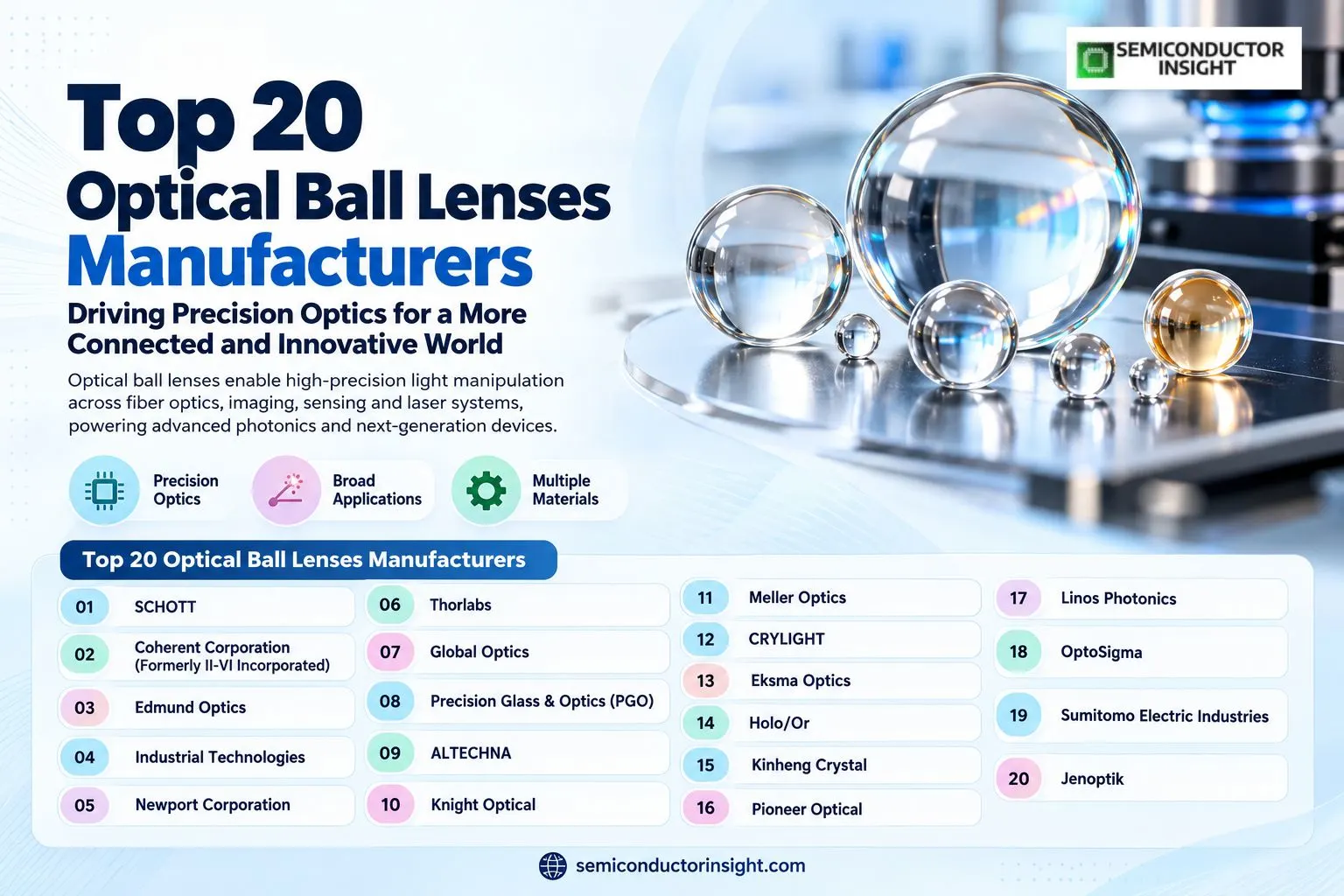
Top 20 Optical Ball Lenses Manufacturers Powering Next-Generation Laser Systems, Endoscopy & High-Precision Optical Solutions
Optical ball lenses are compact spherical optical components that collect, focus or collimate light within tightly constrained optical systems. Unlike conventional lenses with separate curved surfaces and a defined orientation, a ball lens can direct light through its spherical geometry, making it particularly useful where space is limited and optical alignment is critical.
Their applications extend across fibre-optic communications, laser diode coupling, medical endoscopy, barcode scanning, miniature sensors, spectroscopy and industrial inspection. The choice of material, refractive index, diameter, surface quality and sphericity determines whether a lens can meet the optical requirements of a particular system.
The market is increasingly shaped by the need for smaller photonic components, higher-quality optical interfaces and reliable integration into complex assemblies. For example, SCHOTT’s optical-glass portfolio includes ball-lens formats ranging from 0.8 mm to 320 mm in diameter, while specialist suppliers such as Industrial Technologies offer miniature precision balls starting at 0.25 mm. These different product scales illustrate how manufacturers serve both compact optical devices and specialised industrial applications.
How the Companies Are Ranked
The following ranking is an editorial assessment of relevance to optical ball lenses, considering documented product availability, technical specifications, material options, manufacturing capabilities and application fit. It is not a verified ranking by market share or revenue because comparable company-level sales data for optical ball lenses are not publicly available.
The company-specific developments reported for 2026 are distinguished from existing catalogue specifications. Where a recent announcement could not be verified, the discussion focuses on documented capabilities rather than presenting an older product as a new launch.
SCHOTT: Precision Glass Engineering for High-Performance Ball Lens Applications
SCHOTT holds a strong position in precision optical materials, particularly where the performance of the finished ball lens depends on tightly controlled glass properties. Its published optical-glass information includes ball lenses and a broad range of specialised glass compositions, supporting applications that require predictable refractive behaviour and reliable optical transmission. The company’s technical documentation also discusses ball-lens caps made from glasses with refractive indices between 1.5 and 2.0, including N-BK7, N-LaSF44, LaSFN9 and LaSF35. A typical sphericity specification below 0.5 µm illustrates the level of geometric control available for demanding designs.
Its wider photonics activities are also relevant to the market’s direction. In March 2026, SCHOTT announced hermetic optical MEMS lids with optical windows up to 100 cm² for optical circuit switching and sensing. Although these lids are not ball lenses, the development demonstrates the company’s continuing engagement with high-performance optical infrastructure, where precision components and reliable packaging must work together.
Coherent Corporation (Formerly II-VI Incorporated): Optical Coupling for Next-Generation Communications
Coherent is an important company to consider under the II-VI Incorporated name supplied in the original list. Its current optical portfolio includes precision ball and half-ball lenses for fibre communications, endoscopy, microscopy and laser measurement. Published specifications include typical lens diameters of 1 mm, 2 mm, 2.5 mm, 3 mm and 5 mm, a dimensional tolerance of ±0.002 mm, and sphericity of 0.6 µm. These details make the portfolio relevant to optical assemblies where small geometric deviations can affect alignment and coupling performance.
The most significant verified 2026 development is its broader photonics integration strategy. On 21 September 2026, Coherent announced PhotonLink, an integrated optics platform designed for AI data centres, co-packaged optics and near-packaged optics. The announcement concerns an integrated optical platform rather than a new ball-lens product. Nevertheless, it highlights the increasingly demanding environment in which precision lenses, fibres, lasers and detectors must operate as coordinated subsystems.
Edmund Optics: A Broad Ball Lens Portfolio for Fibre and Medical Devices
Edmund Optics is a notable supplier because its documented catalogue directly addresses several established ball-lens applications. Its offerings include N-BK7 ball lenses, half-ball lenses, fused-silica options, high-index lenses and sapphire and ruby variants. This material diversity helps engineers select a component based on wavelength transmission, mechanical durability, refractive index and mounting requirements rather than relying on a single general-purpose glass.
For fibre-optic systems, the short back focal length of a ball lens can reduce the distance between the lens and an optical fibre. Half-ball designs can also simplify integration where a full sphere is difficult to secure. The company’s product documentation identifies wavelength suitability from 350 nm to 2,200 nm for its N-BK7 ball lenses, making them relevant to applications across visible and near-infrared systems. This combination of standard products and custom-manufacturing options supports prototype development as well as OEM integration.
Industrial Technologies: Miniature Precision Balls Across Multiple Materials
Industrial Technologies is particularly relevant to manufacturers that need small optical balls in different substrate materials. Its published product range covers glass ball lenses, ruby balls, sapphire balls, cubic zirconia, spinel, half-balls, ceramic balls and antireflection-coated ball lenses. The stated diameter range for most of these products is 0.25 mm to 8 mm, while coated ball lenses start at 0.30 mm.
That breadth matters because optical performance and operating conditions can vary considerably between applications. Glass may suit general light-coupling tasks, while sapphire and other hard materials can be attractive where durability is important. Industrial Technologies also identifies exports to the United States, Europe, Japan and China as part of its business, with international shipments accounting for more than 95% of sales according to its published company information. Its multi-material approach gives buyers an option for applications where size, surface finish and substrate choice must be considered together.
Explore the full report details in our recently refreshed edition anytime: https://semiconductorinsight.com/report/global-optical-ball-lenses-market/
Knight Optical: Ready-to-Ship Ball Lenses for Fast System Development
Knight Optical stands out for its combination of stocked products and custom optical specifications. Its published ball-lens range includes quartz, sapphire, UV fused silica, cubic zirconia and several optical glasses, covering applications from ultraviolet through visible and near-infrared wavelengths. The company identifies fibre coupling, laser collimation, endoscopy and barcode scanning among the intended uses.
The catalogue provides useful dimensional detail for system designers. Listed ball lenses include diameters of 0.6 mm, 1 mm, 1.5 mm, 2.5 mm and 4 mm, while the company states a standard ball sphericity tolerance of 0.625 µm for its stock range. Individual quality testing and custom options for dimensions, materials and grades are also described. This makes Knight Optical relevant to engineering teams that need to move from optical design to physical testing without waiting for every component to be manufactured from scratch.
Doric Lenses: Ball Microlenses for Compact Optical Interfaces
Doric Lenses is relevant to specialised optical assemblies in which a ball microlens must work within a carefully controlled interface. Its dedicated ball-microlens product page publishes a ball-diameter tolerance of ±0.005 mm and a ball-roundness deviation below 0.003 mm. It also specifies an antireflection-coating reflectance below 0.5% for an angle of incidence between 0° and 30°. These figures provide a practical basis for evaluating the product against the needs of a compact optical design.
The value of this type of offering lies in more than the lens alone. Coating performance, mounting geometry and the optical interface can influence how much light reaches a detector or enters a fibre. Doric’s published ball-microlens specifications are therefore relevant when an engineer must balance optical throughput with the physical limitations of a miniature assembly. A new company-specific ball-lens launch for 2026 could not be independently verified, so the documented product specifications provide the soundest basis for assessing its position.
Swiss Jewel Company: Sapphire and Ruby Solutions for Demanding Environments
Swiss Jewel Company differentiates its offering through precision components made from hard optical and engineering materials. Its product information includes mechanical and optical ball lenses and hemispheres made from sapphire, ruby, ceramic, glass and fused silica. The company lists ball components starting at 0.15 mm in diameter, making its range relevant to compact optical designs that require very small components.
Sapphire and ruby are particularly useful where hardness, chemical stability and resistance to wear matter alongside optical function. The selection of a material still depends on wavelength transmission, refractive behaviour and the operating environment, so the hardest option is not automatically the best optical choice. Swiss Jewel’s combination of stock availability and custom fabrication makes it relevant to instrument makers, specialised optical assemblies and applications where miniature dimensions must be paired with specific material properties.
Z-Optics: Fine Diameter Control and High-Index Glass Options
Z-Optics offers ball lenses across a broad diameter range and several optical-glass types, including fused silica and calcium fluoride. Its published catalogue includes diameters beginning at 0.5 mm and continuing through 1 mm, 1.5 mm, 2 mm, 2.5 mm, 3 mm, 4 mm, 5 mm, 8 mm and larger sizes. This range gives engineers options for both miniature coupling designs and larger optical arrangements.
The company’s published specifications distinguish between low-cost, imaging, telecommunications and higher-precision requirements. For ball lenses below 4 mm, the stated diameter tolerances range from ±0.004 mm in its low-cost category to ±0.0005 mm in its highest-precision category. Corresponding sphericity specifications range from 1 µm to 0.2 µm. These differences are important because a component suitable for a cost-sensitive system may not meet the alignment and optical-performance requirements of a telecommunications assembly.
Shanghai Optics: Ball Lenses Designed Around Optical Coupling Efficiency
Shanghai Optics approaches ball lenses as functional elements within complete optical systems. Its technical material explains how the components can couple a laser to a fibre, connect two fibres using a pair of lenses, or improve light transfer between emitters and detectors. It also identifies applications in endoscopy, optical sensors and barcode scanning.
Its published factory-standard specifications include diameters from 2 mm to 50 mm, a diameter tolerance of ±0.05 mm and surface-quality options described as 20-10 scratch-and-dig. The company also explains the role of numerical aperture, effective focal length and back focal length in choosing a ball lens for fibre coupling. For instance, a design using a fibre with a numerical aperture of 0.22 requires an appropriate match between the lens and the fibre’s acceptance angle. This engineering-led guidance is useful when evaluating not just component availability, but whether a lens is suited to a particular optical interface.
Fuzhou Alpha Optics: Custom Ball Lenses for Laser and Fibre Assemblies
Fuzhou Alpha Optics has a dedicated ball-lens product category that identifies laser alignment, laser-to-fibre coupling, fibre-to-fibre coupling and light-sensor coupling as core applications. Its published manufacturing range covers ball lenses from 1 mm to 50 mm in diameter, with a stated diameter tolerance of ±0.005 mm. The company also lists ellipticity tolerance of ±0.005 mm, clear aperture above 80% and surface quality of 60-40 scratch-and-dig.
Antireflection coatings are available in single-layer and multilayer forms, allowing a design to be adapted to its intended wavelength and optical configuration. Alpha Optics also lists equipment for interferometry, spectrometry and automated focus and centring measurements in its manufacturing information. Those capabilities matter when producing lenses for repeatable optical assemblies, since dimensional inspection alone cannot establish all aspects of optical performance. Its combination of custom sizes, coatings and measurement capability makes it a relevant supplier for specialised fibre, laser and medical optics projects.
Changchun Sunday Optics: Ball Lenses Within a Broader Precision Optics Portfolio
Changchun Sunday Optics is relevant to buyers seeking ball lenses alongside other precision optical elements. Its published product portfolio includes ball lenses, spherical and aspherical lenses, cylindrical lenses, prisms, filters, mirrors, windows and laser optics. The company also describes capabilities in optical glass processing, coatings, optical assembly and optical design. This broader offering can be useful when a ball lens must be integrated into a larger optical assembly rather than purchased as an isolated component.
For optical system developers, access to several component categories through one supplier can simplify design coordination, particularly when the system requires multiple optical surfaces or a custom assembly. The company’s public product information supports its relevance to the ball-lens supply chain, although a separately verified 2026 ball-lens launch or production-volume figure was not available. Its position is therefore best assessed through its documented component range and integration capabilities, rather than unconfirmed claims about market share.
Tecnottica Consonni: Custom Optical Geometry for Specialist Applications
Tecnottica Consonni has a directly documented ball-lens manufacturing capability and positions these components for fibre coupling, endoscopy, scanning systems and sensor applications. Its technical explanation highlights the relationship between a sphere’s radius and refractive index when calculating focal length. This is particularly useful when selecting a lens for a specific emitter, detector or fibre arrangement.
The company’s broader manufacturing approach includes spherical and aspherical lenses, optical filters, prisms, mirrors and complete optical systems. Its production information describes CNC processing, optical metrology and custom manufacturing based on customer specifications. A verified 2026 development relevant to its wider optical activities is its participation as a Silver Sponsor in an EPIC Technology Meeting on Photonics for Augmented Reality, scheduled for 13–14 October 2026 in Milan. The announcement concerns the wider photonics industry rather than a ball-lens launch, but it demonstrates continuing engagement with emerging optical-system applications.
UNI Optics: Custom Optical Components for Integrated System Design
UNI Optics, now presented through the UNI Vision identity, is relevant to buyers looking for optical components that can be developed alongside other system elements. Its current product categories include spherical lenses, aspherical lenses, imaging lenses, optical filters, prisms and cylindrical lenses. The company’s website also identifies ball lenses among its supplier-related product search terms, although the publicly surfaced information does not provide a detailed ball-lens specification sheet.
That distinction matters when comparing suppliers. A broad optical portfolio may be advantageous when a project involves several component types, but engineers should request ball-specific data covering diameter tolerance, sphericity, material, surface quality, coating and wavelength range before finalising a design. UNI Optics is therefore a relevant candidate for custom optical sourcing, with its final ranking in a particular procurement exercise depending on verified specifications and sample performance rather than catalogue breadth alone.
Union Optic Inc.: A Custom Manufacturing Route for Optical Assemblies
Union Optic Inc. documents a portfolio covering optical lenses, windows, prisms, filters, mirrors, waveplates and beamsplitters. The company describes both customised production and selected standard products, making it relevant to projects where a ball lens may need to be procured as part of a wider optical component package.
Its potential value for ball-lens applications lies in the coordination of multiple optical components for a single system. For example, a compact laser or sensing assembly may require a focusing element together with a filter, window or beam-directing component. However, the public information reviewed does not establish a detailed ball-lens diameter range or a verified 2026 product announcement. Buyers should therefore confirm whether the required ball lens is manufactured directly, sourced through a partner or supplied as part of a custom order. That verification is essential before describing the company as a leading ball-lens producer for a particular application.
ILLUCO: Optical Components for Medical and Measurement Equipment
ILLUCO is a relevant company to assess where optical components must fit within medical devices, measurement equipment or other precision systems. Its published lens portfolio includes cylindrical, achromatic and optical ball lenses. The company also describes optical materials such as N-BK7, UV fused silica and calcium fluoride for its broader lens products, alongside custom manufacturing specifications.
The connection to ball lenses is important because compact optical elements can support light focusing and coupling in devices with limited internal space. Yet the exact performance requirements vary by application. A medical imaging system, for example, may require different transmission characteristics and dimensional tolerances from a laser measurement instrument. The available product information establishes ILLUCO’s relevance to optical components, but does not provide enough evidence to claim a specific 2026 ball-lens capacity increase or newly launched product. Its technical fit should be evaluated through application-specific drawings and component specifications.
Chengdu Yasi Optoelectronics: Material Flexibility for Specialised Ball Lenses
Chengdu Yasi Optoelectronics is listed as a supplier of ball lenses alongside optical glass components, prisms and infrared optical elements. Its published product information references a range of glass types, including crown, flint and lanthanum glasses, as well as materials such as zinc selenide, calcium fluoride, germanium, silicon, zinc sulfide, barium fluoride, sapphire, quartz and YAG. This material breadth is relevant when the optical system operates outside ordinary visible-light conditions or requires a specialised refractive response.
The company also lists optical-processing equipment and ball-forming machinery within its capabilities. Such process knowledge may be useful when customers need more than standard catalogue components. A verified company-specific 2026 ball-lens launch was not found, so the defensible insight is its documented combination of ball-lens supply, multiple optical materials and processing expertise. Buyers working on infrared sensing, laser equipment or customised optics should request material-specific transmission data and measured sphericity before qualification.
Tower Optical Corporation: Custom Optics for Demanding End-Use Systems
Tower Optical Corporation is relevant to specialist projects where the optical component must be engineered for a particular instrument or operating environment. Its published manufacturing portfolio includes lenses, mirrors, prisms, filters, optical windows and waveplates, serving areas such as aerospace, defence, medical technology and telecommunications. The company identifies ISO 9001:2015 certification and SAE AS9100 compliance within its quality framework.
For ball-lens procurement, the distinction is between general optical manufacturing expertise and a confirmed, directly available ball-lens range. The company’s publicly available material reviewed here does not establish a current ball-lens catalogue with specific diameter or sphericity data. Tower is therefore best considered a potential custom optical manufacturing partner where project requirements extend beyond a standard stocked component. Its relevance should be confirmed against the drawing, material, tolerance and traceability requirements of the specific application, rather than inferred solely from its broader optical portfolio.
West Coast Tech Limited: Prototype Flexibility Across UV, Visible and Infrared Optics
West Coast Tech Limited provides optical elements for ultraviolet, visible and infrared applications, including spherical lenses, prisms, windows, domes, mirrors, filters and waveplates. Its company information states that it supports work from prototypes through production and can provide testing data, interferograms, coating curves and material certificates on request. The company also reports supplying customers across more than 30 countries.
This breadth is relevant to optical ball-lens projects that require additional components or specialised coatings. For example, a customer developing an infrared optical assembly may need a ball lens alongside an infrared window and other custom optics. However, a detailed ball-lens product specification or verified 2026 launch was not established in the reviewed sources. Its position should therefore be treated as an adjacent precision-optics capability until the supplier confirms the ball-lens geometry, available materials, tolerances and production route for the intended application.
UltiTech Sapphire: Material-Specific Potential for Hard Optical Components
UltiTech Sapphire is included in the supplied company list as a potential specialist for sapphire-related optical components. Sapphire is an important material to consider in ball-lens selection because its mechanical hardness and chemical stability can be useful in demanding environments. Its optical suitability, however, depends on the intended wavelength, refractive properties and system design.
A material-specific assessment is particularly important for sapphire ball lenses used in compact optical instruments, sensor interfaces or environments where ordinary glass may be less suitable. The available sources reviewed for this article did not establish a sufficiently detailed, independently verifiable UltiTech Sapphire ball-lens catalogue or a specific 2026 company announcement. It would therefore be inappropriate to assign the company unverified diameter ranges, manufacturing tolerances or product launches. For procurement and competitive benchmarking, the decisive evidence would be a current technical datasheet, coating options, measured optical quality and confirmation of whether the company manufactures the ball lens itself.
Newport: Ball Microlenses for Laser-to-Fibre and Fibre-to-Detector Coupling
Newport earns a place among the additional companies because it offers a clearly documented range of spherical ball microlenses for optical coupling. Its published catalogue includes four standard diameters: 1 mm, 2 mm, 3 mm and 5 mm. These products are designed for laser collimation and focusing, laser-to-fibre coupling, fibre-to-fibre coupling and fibre-to-detector interfaces.
The technical specifications provide useful comparison points for system designers. Newport’s 3 mm ball microlens has an effective focal length of 1.65 mm, a working distance of 0.15 mm and a clear aperture of 2.4 mm. The published diameter tolerance is ±0.001 mm, and the specified wavelength range is 600–1550 nm. Newport also explains that using two lenses can support coupling between fibres or between a fibre and a detector. These concrete specifications make the company particularly relevant for compact telecommunications and laser systems where alignment and working distance are critical.
Thorlabs: Optical Integration and Mounting for Fibre-Coupling Systems
Thorlabs completes the additional shortlist as an established supplier of optical components and fibre-coupling equipment. Its published catalogue includes dedicated ball-lens holders for 2 mm, 3 mm and 5 mm lenses. The holders use clamping rings to secure the spherical component and feature RMS-compatible external threads, helping integrate the lens into an optical mounting arrangement.
This system-level approach matters because selecting a suitable ball lens is only one part of building a reliable optical interface. The lens must also be held securely and aligned with the fibre, laser or detector. Thorlabs’ fibre-launch guidance explains how wavelength, beam diameter, focal length and fibre mode-field diameter affect coupling performance. Although the available sources do not establish a new 2026 ball-lens launch, its documented mounting and fibre-coupling products make it relevant to laboratories, photonics developers and OEM engineers building or testing optical systems.

Comments (0)