

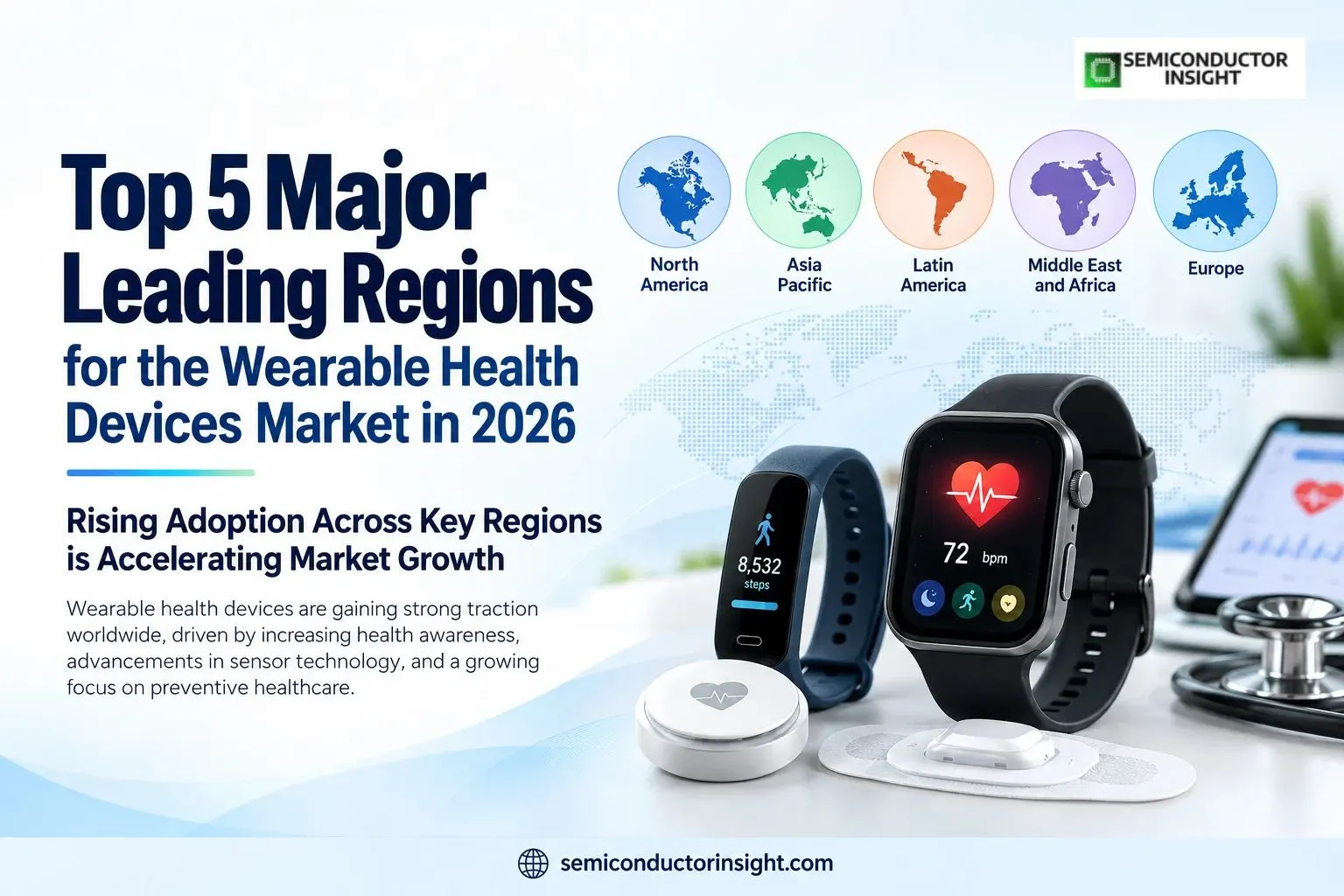
Top 5 Major Leading Regions for the Wearable Health Devices Market in 2026 as Digital Healthcare Expands
Wearable health devices market is moving beyond step counting and fitness tracking towards continuous health monitoring, early risk detection and digitally connected care.
Smartwatches, medical patches, continuous glucose monitors and wearable cardiac sensors can capture physiological information outside hospitals, helping clinicians and users observe health patterns over time. The World Health Organization extended its Global Strategy on Digital Health through 2027, reporting that 129 countries had established national digital health strategies by May 2025.
North America Connects Wearable Sensors with Clinical Decision-Making
North America remains an important centre for medically oriented wearable technology, supported by digital-health development, clinical research and established regulatory pathways. The US Food and Drug Administration maintains a dedicated list of authorised sensor-based digital health devices, covering wearables such as watches, rings, patches and bands designed for continuous or periodic monitoring.
The market opportunity extends from heart-rhythm monitoring to glucose management and sleep-related assessment. In 2026, the FDA’s published device records include updated authorisations for products such as Dexcom glucose-monitoring systems and wearable neurological monitoring technologies. This illustrates a shift towards devices designed around specific health needs rather than general wellness alone.
Europe Builds a Connected Framework for Digital Health
- Europe’s distinctive advantage lies in linking digital devices with broader healthcare information systems.
- The European Health Data Space Regulation establishes a framework for secure health-data access and exchange, supporting care delivery, research and innovation across EU member states.
- The European Commission identifies improved interoperability and cross-border data sharing as central objectives.
- For wearable manufacturers, compatibility with clinical workflows is increasingly important.
- A heart-rate reading or sleep measurement becomes more useful when it can be interpreted alongside medical records and reviewed by a healthcare professional.
- European opportunities therefore include cardiac monitoring, rehabilitation, remote observation of chronic conditions and medical-grade wearable sensors.
Asia Pacific Combines High-Volume Electronics with Expanding Digital Care
Asia Pacific benefits from electronics manufacturing expertise, large consumer markets and growing investment in digital healthcare. China’s wearable-device ecosystem includes smartwatches and fitness bands, while Japan and South Korea contribute strengths in compact sensors, miniaturised electronics and connected medical technologies. India offers a different opportunity through digital public-health infrastructure and mobile-based healthcare services.
- The Indian government’s Ayushman Bharat Digital Mission is intended to connect digital health records and healthcare services through interoperable systems.
- Its relevance to wearable devices is the potential to connect measurements captured outside clinics with wider care pathways, subject to consent, technical compatibility and clinical usefulness.
Latin America Extends Monitoring Beyond Hospital Walls
Across Latin America, remote monitoring could help healthcare providers follow patients who face long journeys to specialist facilities or need regular observation between appointments. Wearable blood-pressure monitors, glucose sensors and cardiac patches are relevant where services can integrate their readings into telehealth consultations.
The opportunity depends on more than device availability. Reliable connectivity, reimbursement arrangements, clinician training and affordable replacement supplies all influence whether monitoring programmes can be maintained. The region’s strongest applications are likely to emerge where wearables solve a defined care-delivery problem instead of functioning as standalone consumer gadgets.
You Can Go Through Our Latest Updated Insights Here: https://semiconductorinsight.com/report/wearable-health-devices-market/
Middle East and Africa Explore Accessible, Mobile-First Monitoring
In the Middle East and Africa, wearable health devices offer potential for remote patient observation, workplace health programmes and management of long-term conditions. Mobile-first services may be particularly useful where specialist care is concentrated in major urban centres, although infrastructure and affordability differ considerably between countries.
The WHO’s global digital-health programme emphasises accessible and sustainable technologies, including solutions for countries with limited digital resources. For manufacturers, this favours durable devices, efficient battery use, clear interfaces and data systems that can operate across different levels of connectivity.
Wearable Technology Moves from Wellness to Medical Use
- The most important distinction in 2026 is the growing separation between general wellness trackers and devices intended for medical monitoring.
- The WHO estimates that 1.28 billion adults aged 30-79 worldwide live with hypertension, and around 46% are unaware of their condition.
- This creates a substantial public-health need for accessible screening and monitoring, although not every wearable can accurately measure blood pressure or diagnose hypertension.
Wearable devices capture a range of health information for different care needs. Smartwatches track heart rate and activity to support wellness and selected monitoring, while continuous glucose monitors record glucose trends for diabetes management. ECG-enabled wearables capture the heart’s electrical signals for rhythm assessment, and medical patches collect selected physiological signals for remote patient monitoring. Sleep-monitoring devices measure sleep-related parameters to support sleep assessment.
How a Wearable Becomes Part of a Care Pathway?
Body sensor → Signal processing → Mobile application or gateway → Secure data sharing → Clinical review when appropriate
This sequence explains why sensor accuracy, battery life, privacy and interoperability matter as much as device design. Wearables can support ongoing observation, but they do not automatically replace diagnostic tests or professional medical advice.

Comments (0)