

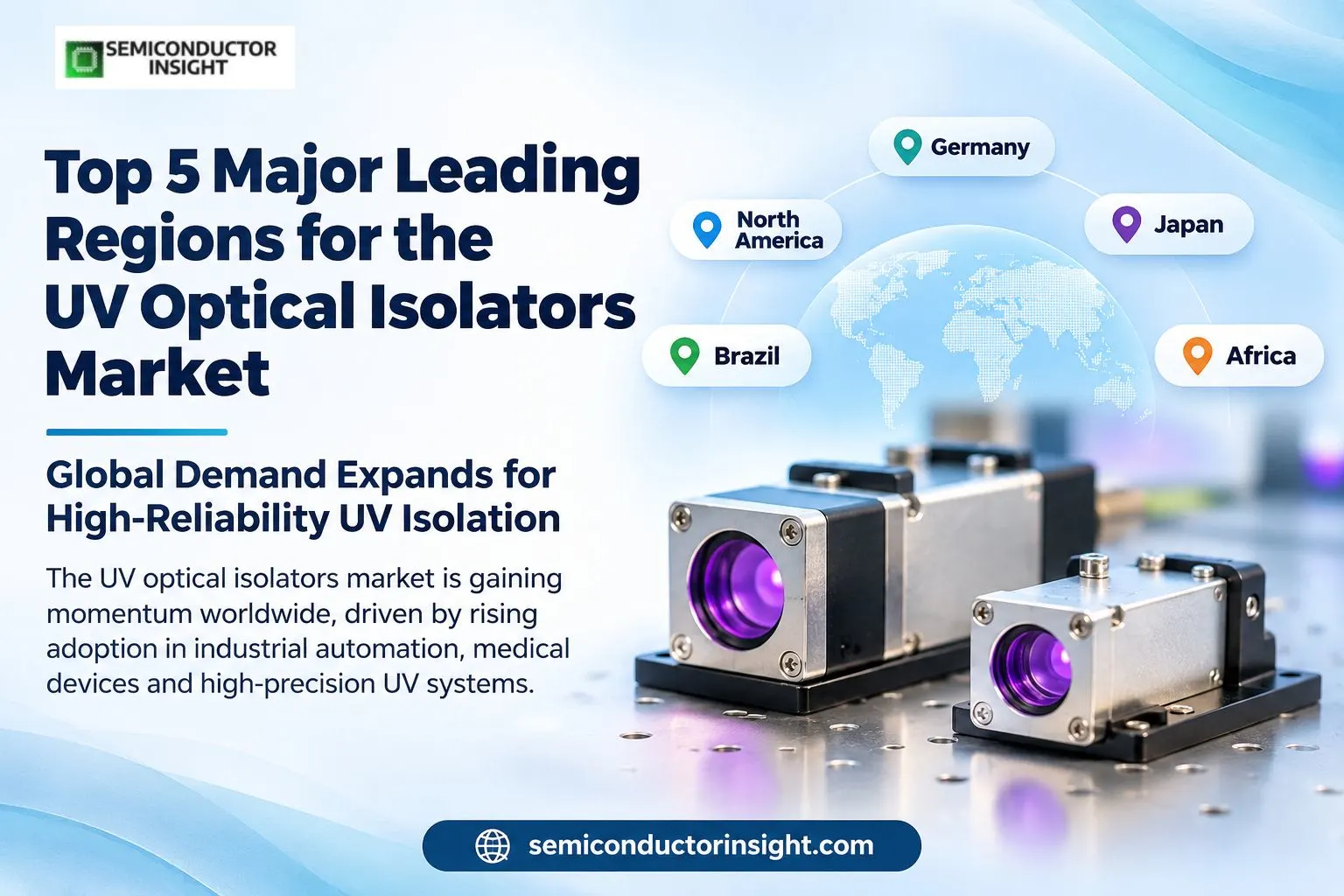
Top 5 Major Leading Regions for the UV Optical Isolators Market Driven by Advanced UV Lasers and Photonics Innovation
The increasing use of ultraviolet laser systems in semiconductor processing, medical instrumentation, scientific research and industrial micromachining is bringing specialised optical components into greater focus.
UV optical isolators play an important role in protecting laser sources and amplifiers from unwanted reflected light, helping maintain beam stability and reliable system operation.
- These devices use Faraday rotation and polarisation-based optical arrangements to allow light transmission in one direction while restricting reverse propagation.
- They are designed for specialised wavelengths, including 248 nm, 266 nm, 349 nm, 351 nm, 355 nm, 375 nm and 395 nm.
- As photonics applications become more precise, regional demand opportunities are increasingly connected to the availability of advanced laser manufacturing, optical research and semiconductor infrastructure.
North America Advances through Semiconductor Research and High-Precision Laser Development
North America remains an important centre for specialised optical components because of its established semiconductor, aerospace, defence and scientific research industries. The United States has a particularly strong ecosystem of laser manufacturers, photonics laboratories and advanced instrumentation developers.
According to the Semiconductor Industry Association, US-headquartered semiconductor companies generated approximately USD 425 billion in sales during 2025, representing 53.4% of worldwide semiconductor industry sales. The industry also invested USD 76.8 billion in research and development. These activities support an extensive ecosystem for precision optical equipment and UV laser applications.
Demand opportunities are associated with semiconductor inspection, laser-based material processing, fluorescence instrumentation and advanced research laboratories, where controlling optical feedback is essential.
Europe Builds Its Position through Photonics Engineering and Optical Manufacturing
Europe has an established position in precision optics, photonics components and industrial laser systems. Germany, France, the Netherlands and the United Kingdom have particularly important manufacturing and research capabilities.
Germany’s photonics industry generated approximately EUR 50 billion in sales during 2024, supported by around 1,000 manufacturers and 188,000 employees. Its export share reached approximately 76%, demonstrating the international reach of its optical technology supply chain.
The presence of advanced semiconductor equipment developers, research institutions and precision optical manufacturers creates opportunities for UV optical isolators in lithography-related laser systems, metrology, spectroscopy and industrial processing.
Asia Pacific Expands Its Influence through Semiconductor and Laser Manufacturing
Asia Pacific is an important region for UV optical isolator applications because of its concentration of semiconductor manufacturing, electronics production and optical component suppliers. China, Japan, South Korea and Taiwan contribute significantly to the regional technology ecosystem.
SPIE’s 2024 Global Industry Report identified 4,706 photonics component-producing companies worldwide in its 2022 dataset, with 52% headquartered in Asia. Japan also has a particularly strong position in advanced optical materials and laser technologies.
The region’s application opportunities include UV laser micromachining, semiconductor wafer inspection, precision electronics manufacturing and scientific instrumentation. Increasing investment in advanced fabrication equipment is also encouraging suppliers to develop optical components with improved wavelength stability and isolation performance.
Don’t Forget to Surf Our Updated Report for More Detailed Analysis: https://semiconductorinsight.com/report/uv-optical-isolators-market/
Latin America Develops New Photonics Capabilities through Research and Semiconductor Initiatives
Latin America represents an emerging opportunity, particularly through Brazil and Mexico. Brazil has an established scientific photonics community, while Mexico is developing its semiconductor design, electronics manufacturing and research infrastructure.
Brazil’s Brasil Semicon programme, established under Law 14,968 in September 2024, strengthens incentives for semiconductor production, research and innovation. Meanwhile, Mexico’s Kutsari Project is developing semiconductor design and research capabilities across Jalisco, Puebla and Sonora.
These developments could expand requirements for precision laser equipment, optical testing systems and specialised UV components. Universities, industrial laboratories and electronics manufacturers provide potential application channels for UV optical isolator suppliers.
Middle East and Africa Explore Advanced Photonics and Integrated Optical Technologies
The Middle East and Africa represent a developing market for specialised photonics technologies, with opportunities emerging from research infrastructure, telecommunications, healthcare and industrial modernisation.
Israel announced an investment initiative of up to NIS 150 million in June 2026 to advance integrated photonics research infrastructure. The programme supports activities ranging from photonic chip design and prototyping to testing, packaging and commercialisation.
In Saudi Arabia, optical communication infrastructure and advanced manufacturing initiatives are also creating opportunities for specialised optical technologies. UV optical isolators could find applications in scientific laser systems, advanced instrumentation, research laboratories and specialised industrial equipment as regional photonics capabilities expand.
Precision Wavelength Control Is Becoming an Important Purchasing Consideration
- Across these five regions, equipment manufacturers are increasingly concerned with isolation ratio, insertion loss, wavelength compatibility, optical aperture, thermal stability and power-handling capability.
- The development of compact Faraday rotators and specialised UV-transparent optical materials is particularly important.
- Research published in the Journal of Applied Physics demonstrated UV optical isolators using cerium fluoride (CeF3), including operation at 355 nm.
- This illustrates the role of advanced magneto-optical materials in extending isolation technology into ultraviolet wavelengths.
As semiconductor equipment, precision laser processing and scientific instrumentation continue to evolve, regional photonics ecosystems will remain important in shaping the adoption of specialised UV optical isolation components.

Comments (0)