

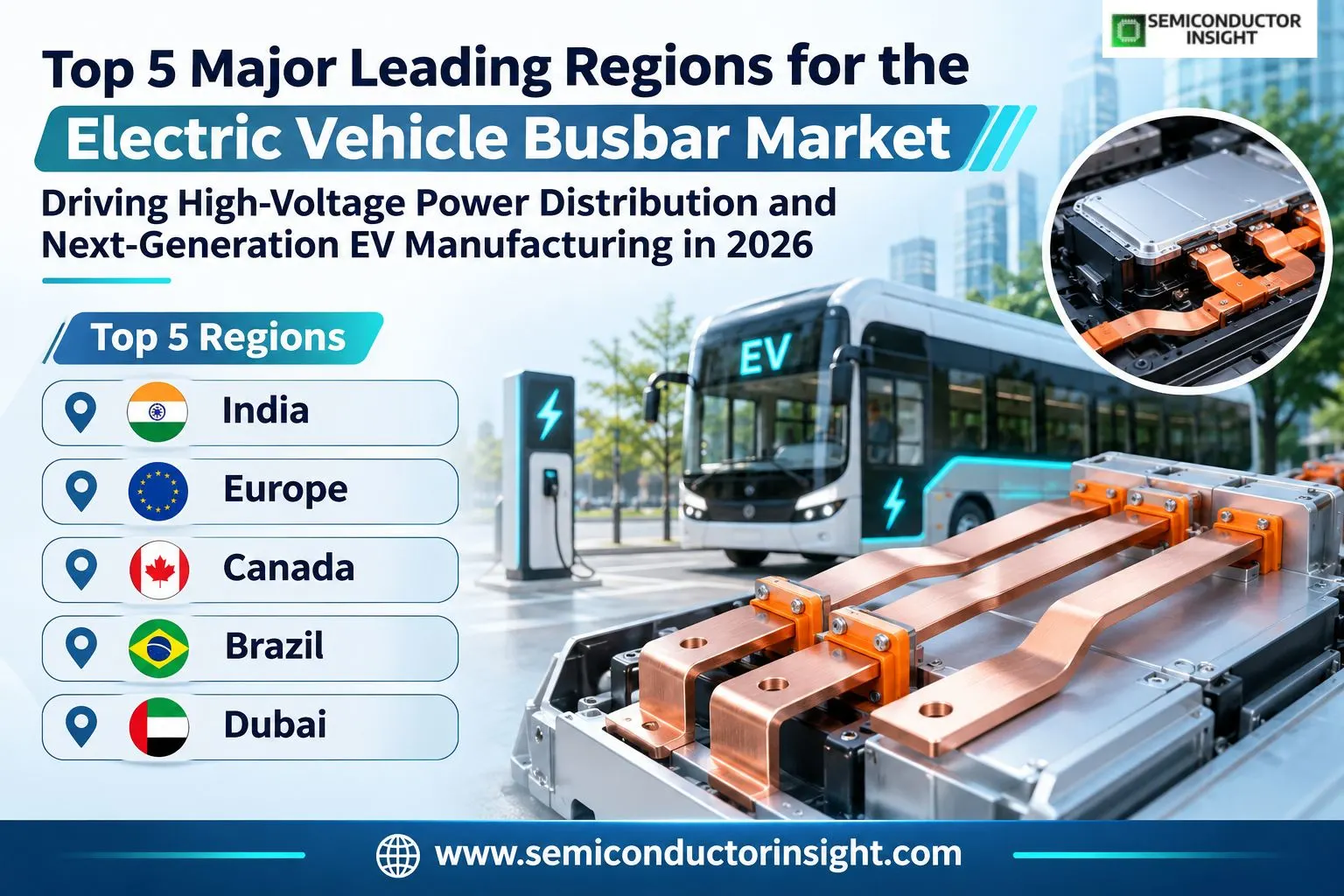
Top 5 Major Leading Regions for the Electric Vehicle Busbar Market Driving High-Voltage Power Distribution and Next-Generation EV Manufacturing in 2026
Transition towards electric mobility is creating a new level of demand for electrical components that can handle higher currents, compact battery configurations and increasingly sophisticated power-management systems.
Among these components, busbars are becoming essential to electric vehicle architecture because they provide reliable electrical connections between battery modules, power distribution units, inverters, charging systems and electric motors. As manufacturers introduce larger battery packs and faster-charging platforms, the importance of lightweight, thermally efficient and space-saving busbar assemblies is increasing.
- According to the International Energy Agency (IEA), global electric bus sales approached 70,000 units in 2025, representing 12% annual growth.
- China accounted for approximately 60% of these sales, while Europe recorded more than 12,000 electric bus sales.
- These developments are expanding opportunities for copper and aluminium busbars, laminated busbar assemblies and customised high-voltage connectors in commercial electric vehicles.
Asia Pacific Strengthens Its Position through Large-Scale Electric Vehicle Manufacturing
Asia Pacific remains the most influential region for electric vehicle busbar manufacturing, supported by China’s extensive electric bus production, battery manufacturing ecosystem and domestic demand for commercial electric vehicles. In 2025, China accounted for approximately 60% of global electric bus sales, while electric buses represented more than 60% of its total bus sales. Nearly all newly sold city buses in the country were electric. This extensive vehicle deployment creates substantial demand for battery interconnects, copper busbars, aluminium conductors and high-voltage distribution assemblies.
India is adding another important dimension to regional demand. The PM-eBus Sewa programme targets 10,000 electric buses across 169 cities, while the PM E-DRIVE initiative is supporting additional electric bus procurement. These programmes create opportunities for domestic busbar fabrication, battery-pack integration and local electrical component suppliers.
Europe Advances through Electrified Public Transport and High-Performance Components
Europe is strengthening its position through strict vehicle-emission requirements, public transport electrification and advanced automotive engineering. The IEA reported more than 12,000 electric bus sales in Europe during 2025, an increase of 28% compared with 2024. Battery-electric city buses also exceeded 55% of new city bus sales in the European Union. Germany, Norway, the Netherlands and the United Kingdom are particularly important deployment markets.
This expansion is encouraging suppliers to develop precision-engineered busbars with improved insulation, vibration resistance and thermal stability. European manufacturers are also focusing on compact laminated busbar assemblies that can support sophisticated battery management and power electronics.
North America Builds Demand Around Battery Innovation and Commercial Fleet Electrification
North America is developing opportunities through electric school buses, urban transit fleets, electric delivery vehicles and domestic battery manufacturing. The United States is particularly important because of its established automotive manufacturing infrastructure and investments in battery-pack production.
Canada is also contributing through public transport electrification and battery supply-chain development. The growing use of high-capacity battery systems is increasing the importance of copper and aluminium conductors that can maintain electrical performance under demanding operating conditions. Regional suppliers are therefore focusing on customised busbars, insulated connectors and lightweight power distribution assemblies.
Latin America Expands Its Electric Bus Ecosystem beyond Major Metropolitan Centres
Latin America is emerging as an important adoption market, particularly through public transportation electrification in Chile, Colombia, Brazil and Mexico. According to the International Council on Clean Transportation, the region had deployed 9,115 electric buses in public transport systems since 2017. By 2025, Santiago alone operated 3,849 electric buses, while São Paulo’s fleet increased to 1,095 vehicles.
These developments are creating opportunities for locally assembled battery systems, high-current busbar connections and imported electrical components. Fleet expansion in metropolitan transport networks is also increasing demand for durable electrical assemblies designed for frequent charging and intensive daily operations.
You Can Freely Surf Our Latest Updated Relevant Report Here: https://semiconductorinsight.com/report/coated-busbar-market/
Middle East & Africa Develops New Opportunities through Sustainable Transport Projects
The Middle East and Africa are progressing through government-backed clean mobility initiatives and electric public transport investments. Dubai’s Roads and Transport Authority announced the procurement of 735 buses in 2026, including 40 electric buses in its initial delivery programme. The electric model features a 434 kWh battery and a driving range of up to 280 km.
Africa is also building its electric bus ecosystem. IRENA’s 2025 publication documented deployments of 229 electric buses in Ethiopia, 200 in Egypt, 150 in Senegal and 72 in Morocco as of 2024. These early deployments offer opportunities for imported busbar systems, battery integration and regional component assembly.
The Changing Busbar Production and Integration Chain
The electric vehicle busbar ecosystem increasingly connects material processing with advanced battery engineering.
Copper and Aluminium Procurement
Conductive raw materials
↓
Precision Cutting and Forming
Stamping, bending and machining
↓
Insulation and Surface Treatment
Coating, lamination and protection
↓
Battery and Power Electronics Integration
Battery packs, inverters and distribution units
↓
Electric Vehicle Deployment
Passenger cars, buses and commercial fleets

Comments (0)