

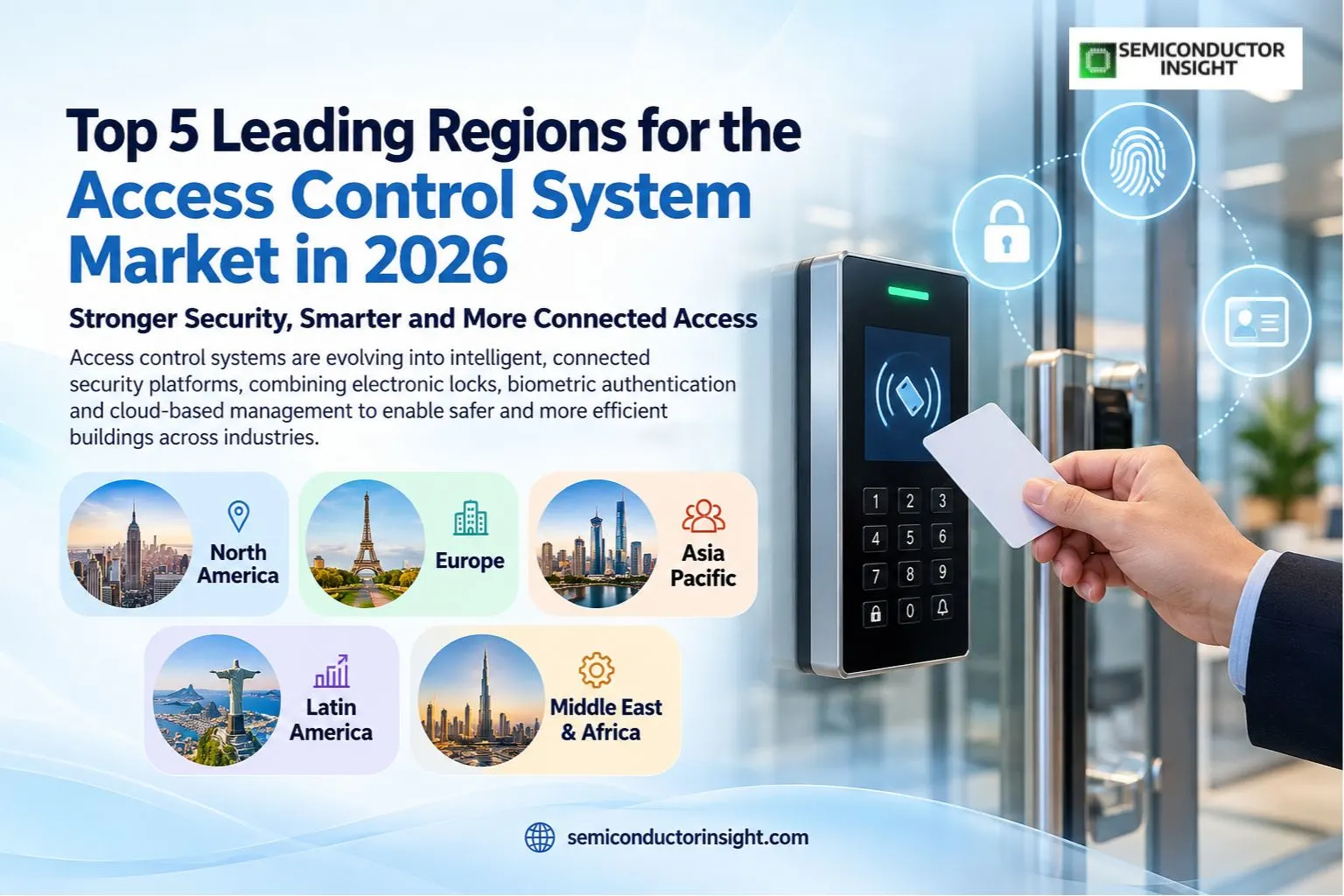
Top 5 Major Leading Regions for the Access Control System Market in 2026 as Smart Buildings Transform Physical Security
Access control systems (ACS) have evolved from basic card readers into connected security platforms that determine who can enter a building, restricted room or protected facility. Modern systems combine electronic locks, identity credentials, biometric readers, cloud-based administration and audit records.
Their growing importance reflects the need to manage physical entry alongside digital identity, particularly in offices, hospitals, industrial sites and data centres.
- The United Nations reported in its 2025 urbanisation assessment that cities were home to 45% of the world’s 8.2 billion people.
- Increasingly complex urban environments create a broad application base for controlled entry, visitor management and secure building operations, although this population statistic is not a direct measure of ACS installations.
North America Integrates Building Security with Digital Identity
- The United States and Canada offer substantial opportunities in corporate campuses, hospitals, universities, logistics facilities and data centres.
- Organisations increasingly connect door controllers with visitor databases, employee directories and security monitoring platforms, allowing permissions to be changed when employees join, move roles or leave.
- The US Cybersecurity and Infrastructure Security Agency recommends robust identity and access management practices to protect sensitive systems and physical environments.
- This is particularly relevant when access-control servers and connected door devices form part of an organisation’s wider IT infrastructure.
Europe Makes Privacy and Interoperability Central to Access Management
European deployments increasingly need to balance convenient entry with privacy protection and reliable cybersecurity. Eurostat reported that 93% of EU businesses used at least one ICT security measure in 2024, while 65% used network access control. These figures relate to business cybersecurity rather than physical door systems, but they demonstrate the region’s established attention to controlled access and information protection.
Germany, France, the Netherlands and the Nordic countries provide relevant markets for integrated office security, industrial facilities and research campuses. Systems that offer clear audit trails, carefully managed biometric data and compatibility with existing infrastructure can help organisations modernise without rebuilding every entry point.
Asia Pacific Expands Security across Dense Urban Infrastructure
Asia Pacific offers important opportunities as commercial districts, residential complexes, transport hubs and industrial campuses expand. China, India, Japan, South Korea and Singapore present different requirements, from high-volume employee authentication to restricted laboratory access and residential visitor management.
- India’s national cyber incident reporting illustrates the wider importance of digital security. The Ministry of Home Affairs reported that CERT-In recorded 2,944,248 cyber incidents in 2025, up from 2,041,360 in 2024.
- These figures cover cyber incidents generally, not access-control breaches, but they reinforce the importance of securing connected systems and their administrative accounts.
Latin America Modernises Entry Management across Commercial Facilities
Brazil and Mexico provide relevant opportunities in office buildings, manufacturing sites, healthcare facilities and distribution centres. Businesses can replace conventional keys with programmable cards, mobile credentials and centralised visitor-management systems. These technologies make it easier to revoke lost credentials and review entry records.
For organisations operating multiple locations, cloud-managed access control can reduce the need to administer permissions separately at every site. However, reliable network connectivity, local technical support and the ability to operate during outages remain important purchasing considerations.
Middle East & Africa Prioritises Secure Access for Large Developments
The Middle East’s expanding commercial, hospitality, healthcare and infrastructure projects provide opportunities for integrated access management. Saudi Arabia and the United Arab Emirates are relevant markets for connected buildings, while South Africa offers applications in corporate facilities, industry and education.
High-traffic facilities may combine turnstiles, vehicle barriers, mobile credentials and biometric verification. The most suitable configuration depends on the required security level, visitor volumes, emergency-exit arrangements and the consequences of a system outage.
Want to learn more about the report? Check out our latest updated version for free: https://semiconductorinsight.com/report/access-control-system-acs-market/
The Journey from Credential to Controlled Entry
- Identity credential
- Card, smartphone, wearable or biometric reader
- Authentication and permissions
- Checks identity, access rights and applicable rules
- Controller and locking hardware
- Authorises or denies entry
- Audit trail and monitoring
- Records events and supports security reviews
Access Control Applications at a Glance
Access control systems combine different technologies to meet the security priorities of each setting. Corporate offices use cards and mobile credentials to manage employee permissions, while hospitals rely on role-based access and restricted-area readers to protect patients and staff.
Data centres deploy multifactor authentication to safeguard critical infrastructure, and residential complexes use smart locks and visitor systems for convenient, traceable entry. Industrial facilities combine cards, biometrics, and turnstiles to enforce access restrictions in designated zones.
In 2026, the access control system market is increasingly shaped by the convergence of physical security, digital identity and connected building management. Regional requirements differ, but buyers everywhere need dependable authentication, manageable permissions, privacy-conscious design and reliable operation when networks or power supplies fail.

Comments (0)