Bluetooth Smart Garage Door Controllers Market Insights
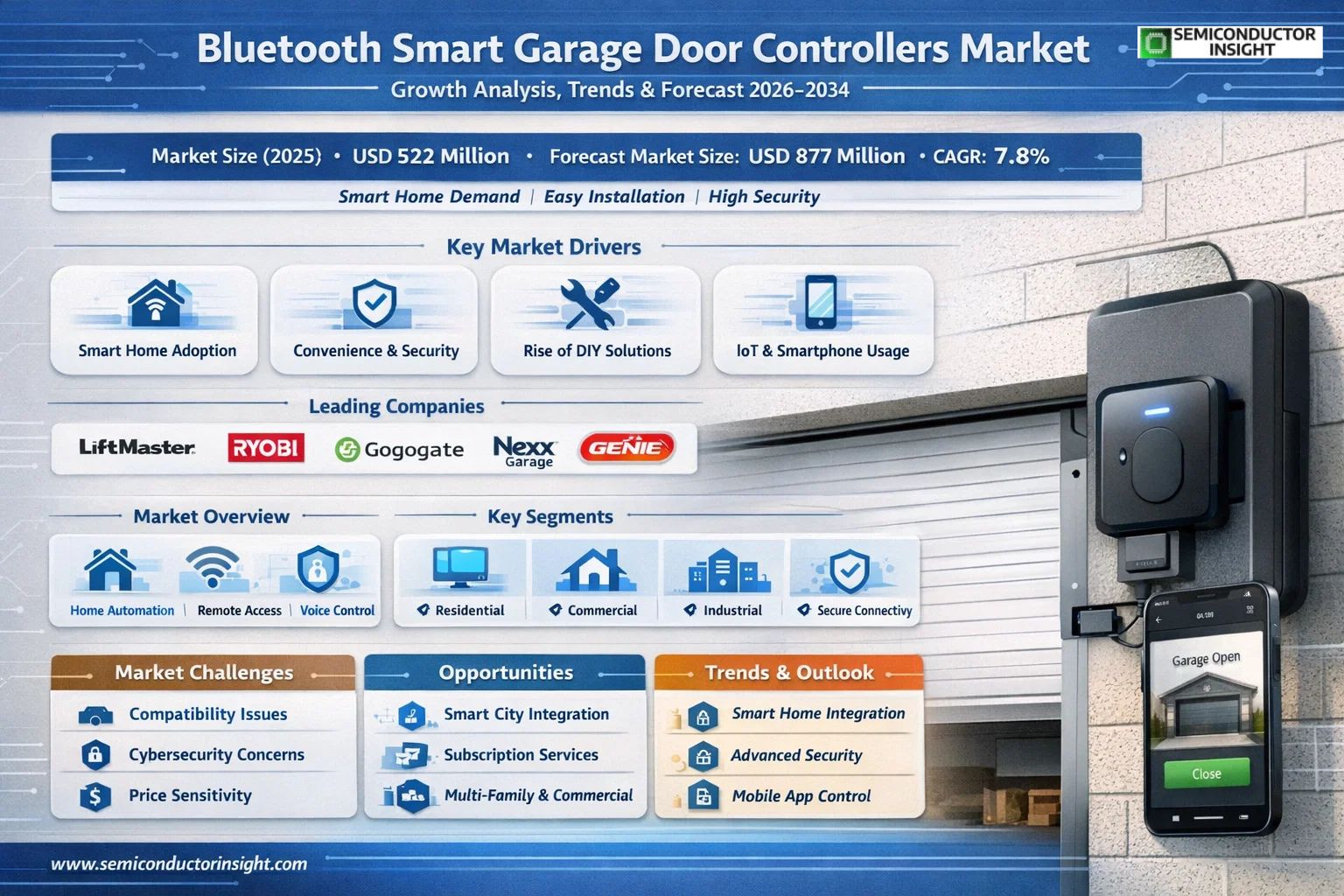
Global Bluetooth smart garage door controllers market size was valued at USD 522 million in 2025. The market is projected to grow from USD 563 million in 2026 to USD 877 million by 2034, exhibiting a CAGR of 7.8% during the forecast period.
A Bluetooth smart garage door controller is a device that uses Bluetooth technology to enable remote operation of a garage door via a smartphone or other connected device. These controllers are integral components of modern home automation systems, providing enhanced convenience and security through features like encrypted communication, remote access, and integration with broader smart home ecosystems. They function by establishing a direct wireless link with the user’s mobile device, eliminating the need for traditional remotes and offering more reliable, interference-free operation.
The market growth is primarily driven by the accelerating adoption of smart home technologies and the increasing consumer demand for convenience and security. The proliferation of smartphones with advanced Bluetooth capabilities serves as a key enabler. Furthermore, integration with voice assistants and other IoT devices creates a compelling value proposition. However, challenges such as compatibility issues with older garage door openers and concerns over cybersecurity present potential restraints. Key players like The Chamberlain Group (with its MyQ technology) and Genie Company are actively expanding their product portfolios and forming strategic partnerships to capture market share, while newer entrants focus on innovative, user-friendly solutions.
MARKET DRIVERS
Demand for Enhanced Home Security & Automation
The primary growth engine for Bluetooth Smart Garage Door Controllers market is the escalating consumer prioritization of home security. These devices transform a standard garage door into a monitored access point, offering remote operation, real-time status alerts, and integration logs. This functionality directly addresses vulnerabilities associated with traditional openers, propelling adoption among security-conscious homeowners. Concurrently, the broader smart home ecosystem’s expansion creates a natural demand pull for connected garage solutions.
Rise of DIY Smart Home Installations
Growth is significantly fueled by the consumer trend towards do-it-yourself smart home upgrades. Bluetooth Smart Garage Door Controllers are typically designed for easy, tool-free installation that avoids the need for professional technicians or complex wiring. This lowers both the upfront cost and technical barrier to entry, making smart garage access accessible to a mainstream audience. The proliferation of instructional online content further supports this DIY adoption curve.
➤ A survey of smart home device owners indicated that convenience features like remote garage door control are among the top three most-used daily smart functions, highlighting their role in habitual automation.
Technological convergence is also a key factor. Modern controllers leverage Bluetooth Low Energy (BLE) for energy-efficient, direct device-to-phone connectivity, often supplemented with Wi-Fi bridges for true remote access. This dual-communication capability ensures reliability and extends the utility of Bluetooth Smart Garage Door Controllers market offerings, catering to diverse user connectivity preferences.
MARKET CHALLENGES
Connectivity and Interoperability Hurdles
A central challenge facing Bluetooth Smart Garage Door Controllers market is ensuring consistent and reliable connectivity. The Bluetooth protocol’s inherent range limitations can cause operation failures for users at the edge of the signal area, especially in homes with dense construction materials. Furthermore, achieving seamless interoperability within broader multi-brand smart home platforms (like Amazon Alexa, Google Home, Apple HomeKit) often requires additional hardware or complex setup, creating a fragmented user experience.
Other Challenges
Consumer Security Concerns
Despite enhancing physical security, Bluetooth-connected devices introduce potential cybersecurity risks. Vulnerabilities in device firmware or mobile apps could be exploited for unauthorized access. Manufacturers in Bluetooth Smart Garage Door Controllers market must continuously invest in robust encryption and over-the-air update mechanisms to build and maintain consumer trust, which adds to R&D costs.
Market Competition and Price Sensitivity
The market is characterized by intense competition from both established OEMs and new entrants, leading to pricing pressures. While consumers seek advanced features, they also demonstrate significant price sensitivity for what is often perceived as a secondary smart home device. This environment challenges profitability and necessitates clear product differentiation beyond basic open/close functionality.
MARKET RESTRAINTS
Compatibility Issues with Legacy Systems
A significant restraint on market growth is compatibility with existing, older garage door opener systems. Many Bluetooth Smart Garage Door Controllers require specific motor types (e.g., DC motors with safety sensors) or a learn-button for programming. A substantial portion of installed openers, particularly units over 15 years old, may lack these features, necessitating a full opener replacement. This additional cost and complexity can deter the upgrade for a segment of the potential customer base.
Consumer Awareness and Perceived Value
Market penetration is restrained by a lack of consumer awareness regarding the specific capabilities and benefits of smart controllers versus traditional remotes. For many, the garage door opener is an “out of sight, out of mind” appliance until it fails. Educating the market on proactive security, convenience, and integration benefits is an ongoing marketing challenge. Without clear communication, the value proposition can be misunderstood as a luxury rather than a practical security enhancement.
MARKET OPPORTUNITIES
Integration with Smart City and Vehicle Ecosystems
A major forward-looking opportunity lies in deeper integration with connected car platforms and smart city infrastructure. Future iterations of Bluetooth Smart Garage Door Controllers could feature geofencing automation that communicates directly with a vehicle’s telematics system to open the garage upon approach. This creates a seamless experience and positions the garage as a integrated node in the broader Internet of Things (IoT) and mobility landscape.
Value-Added Services and Subscriptions
Vendors can explore recurring revenue models by developing premium software features. Opportunities include advanced access management for service providers (like cleaners or dog walkers), detailed historical access logs for security audits, or integrated video verification via partnership with camera brands. Offering these as subscription-based value-added services enhances customer lock-in and diversifies revenue streams beyond hardware sales in Bluetooth Smart Garage Door Controllers market.
Expansion in Multi-Family Housing and Commercial Segments
The application of this technology can expand beyond single-family homes. There is significant potential in the multi-family residential (apartments, condominiums) and light commercial (storage facilities, small business garages) segments. Solutions offering centralized management of multiple doors, enhanced audit trails, and temporary access codes for residents or tenants represent an untapped growth vertical with distinct requirements and higher volume potential.
Trends
Deepening Integration with Broader Smart Home Ecosystems
A dominant trend in Bluetooth Smart Garage Door Controllers market is the move beyond standalone operation towards seamless integration within broader smart home frameworks. Modern controllers no longer function in isolation; they are increasingly designed to interface with platforms like Amazon Alexa, Google Assistant, and Apple HomeKit. This enables voice-activated commands for operation. Furthermore, integration with other smart home devices, such as security cameras, lighting systems, and smart door locks, allows for the creation of automated routines. For instance, arriving home can trigger the garage door to open, the interior lights to turn on, and the home security system to disarm simultaneously, significantly enhancing user convenience and security within the residential sector.
Other Trends
Advancements in Security Protocols and Authentication
As connectivity increases, so does the focus on robust security, which is a critical purchase driver for consumers in Bluetooth Smart Garage Door Controllers market. Manufacturers are moving beyond basic pairing to implement advanced encryption standards for data transmission. Multi-factor authentication methods, including time-based one-time passwords and biometric verification through linked smartphone apps, are becoming more common. This trend addresses growing consumer concerns about unauthorized access and aligns the security posture of garage entry points with other smart home access control systems.
Shift Towards Mobile-Centric Control and Smartphone Integration
The market is showing a clear shift from dedicated PC terminals or traditional remotes to mobile-centric control interfaces. Smartphone applications serve as the primary hub for managing Bluetooth Smart Garage Door Controllers, offering features like remote status monitoring, access history logs, and temporary virtual key sharing with guests or service personnel. This trend leverages the ubiquitous nature of smartphones, reduces the need for additional hardware, and provides a more intuitive, feature-rich user experience. The development of intuitive, user-friendly apps is now a key competitive differentiator for suppliers.
Product Segmentation and Application Diversification
Bluetooth Smart Garage Door Controllers market is experiencing diversification across both product types and applications. While the residential sector remains the core application, adoption in the commercial sector is growing for managing access to corporate parking, retail storage, and multi-unit residential buildings. This expansion drives demand for controllers with enhanced durability, centralized management dashboards, and higher user capacity. Concurrently, product development continues to cater to diverse installation scenarios and user preferences, ensuring the technology remains accessible and relevant across different market segments.
COMPETITIVE LANDSCAPE
Key Industry Players
A High-Growth Market Driven by Smart Home Integration
Global Bluetooth Smart Garage Door Controllers market is characterized by a mix of established home automation leaders and specialized innovators, with The Chamberlain Group (parent of LiftMaster and Chamberlain brands) being the dominant player. Its strong brand recognition, extensive distribution network in residential and commercial sectors, and deep integration within broader smart home ecosystems solidify its leading market share. The competitive structure is moderately concentrated, with the top five companies commanding a significant portion of global revenue, yet it also features a long tail of agile startups and technology firms focusing on niche applications, enhanced security features, and direct-to-consumer sales models.
Beyond the major incumbents, the market sees vigorous activity from companies like Ryobi, leveraging its power tool ecosystem, and dedicated smart home specialists such as Gogogate and Nexx Garage, which compete on advanced features like multi-door management, camera integration, and robust app interfaces. The landscape is further diversified by hardware-focused innovators like Garadget and Shenzhen Yaoertai, which cater to cost-sensitive segments and OEM partnerships. As the market progresses towards 2034, competition is intensifying around interoperability with platforms like Amazon Alexa, Google Home, and Apple HomeKit, encryption standards, and the development of hybrid connectivity solutions that combine Bluetooth with Wi-Fi for extended remote access.
List of Key Bluetooth Smart Garage Door Controllers Companies Profiled
- The Chamberlain Group (LiftMaster/Chamberlain)
- Ryobi
- Gogogate
- Nexx Garage
- The Genie Company (Allegion)
- Garadget
- GarageDoorBuddy
- Skylinkhome
- Shenzhen Yaoertai Technology Co., Ltd.
- Garageio
- Mero
- Tailwind
- Securitron GmbH
- ITEAD
- Dessmann
Segment Analysis:
| Segment Category | Sub-Segments | Key Insights |
| By Type |
|
Mobile Terminal is the dominant platform, driven by the universal adoption of smartphones as the primary control interface for smart home devices. This segment’s ascendancy is largely due to its superior convenience, enabling users to operate the garage door from anywhere via a dedicated app. A key feature enhancing its appeal is the integration with mobile notifications and other smart home ecosystems. Furthermore, the focus on enhanced security features, such as app-based encryption and user authentication, directly addresses consumer safety concerns, making it the preferred choice for modern, connected households seeking seamless integration into their digital lives. |
| By Application |
|
Residential Sector forms the core application base, propelled by the accelerating trend of home automation and consumer demand for convenience and security. Homeowners are increasingly adopting these controllers as essential components of a comprehensive smart home setup, valuing the ability to grant secure access remotely and monitor door status. Integration capabilities with other smart devices, such as security cameras and voice assistants, create a synergistic effect that drives adoption. The residential market is further stimulated by the ease of DIY installation and the compelling value proposition of enhancing property security through encrypted, smartphone-controlled access. |
| By End User |
|
Individual Homeowners represent the most significant and dynamic end-user group. Their purchasing decisions are heavily influenced by the desire for a modern, automated lifestyle and direct control over home security. This group is highly responsive to product features that offer hassle-free installation, reliable performance without frequent maintenance, and robust data security. The trend of retrofitting existing garage doors with smart controllers, rather than complete system replacement, particularly appeals to this cost-conscious yet tech-savvy demographic, fueling consistent aftermarket demand and driving product innovation focused on compatibility and user-friendliness. |
| By Connectivity Feature |
|
Hybrid (Bluetooth + Wi-Fi) offerings are gaining rapid traction as the leading connectivity model. These products provide the foundational security and localized control of Bluetooth with the extended remote access capabilities enabled by Wi-Fi, creating a superior user experience. This segment addresses a key market need for operational flexibility,allowing control from anywhere in the world while maintaining a secure, direct connection when in proximity. The ability to seamlessly function within broader IoT ecosystems and support over-the-air updates for future features positions hybrid connectivity as a critical driver for market expansion and customer satisfaction. |
| By Sales Channel |
|
Online Retail channels are the primary growth engine for market accessibility and consumer education. The nature of the product, which benefits from detailed specification comparisons, video installation tutorials, and direct customer reviews, aligns perfectly with the online shopping journey. E-commerce platforms enable vendors to reach a global audience efficiently and offer competitive pricing. The direct-to-consumer model also allows for better brand storytelling and technical support, which are crucial for a product category where ease of installation and setup significantly influence the purchase decision. This channel’s dominance reflects a broader shift in how consumers research and buy smart home technology. |
Regional Analysis: Bluetooth Smart Garage Door Controllers Market
North America
The region’s advanced smart home infrastructure is a primary growth driver for Bluetooth Smart Garage Door Controllers market. High penetration of smartphones and ubiquitous high-speed internet facilitate reliable Bluetooth connectivity and remote operation, making these controllers a natural extension of the connected home.
Demand is heavily influenced by a security-first mindset. Homeowners seek Bluetooth Smart Garage Door Controllers for features like real-time status alerts, access history logs, and secure, encrypted connections, viewing them as critical tools for comprehensive home security systems beyond basic convenience.
The market is characterized by intense competition among established garage door OEMs and agile tech startups. This drives continuous innovation in Bluetooth Smart Garage Door Controllers market, leading to longer battery life, improved range, and enhanced integration with other smart home devices and IoT platforms.
Strong distribution through major home improvement retailers, specialized security stores, and direct online sales channels ensures high product visibility and accessibility. Professional installation services are widely available, lowering the adoption barrier for less tech-savvy consumers in the Bluetooth garage door controller segment.
Europe
The European market for Bluetooth Smart Garage Door Controllers is shaped by stringent data privacy regulations, a growing retrofit smart home segment, and architectural diversity. The General Data Protection Regulation (GDPR) compels manufacturers to prioritize robust data security and transparent data handling, which is a key purchase criterion for privacy-conscious consumers. Growth is particularly notable in Western and Northern Europe, where high living standards and a strong DIY culture support the adoption of smart home upgrades. The market faces the challenge of integrating with older garage door systems prevalent in historic residential areas, driving demand for universal and compatible Bluetooth controller solutions. Energy efficiency and sustainable design principles also influence product preferences in this region.
Asia-Pacific
Asia-Pacific represents the highest growth potential region in Bluetooth Smart Garage Door Controllers market, fueled by rapid urbanization, expanding middle-class populations, and significant investments in smart city infrastructure. Markets like China, Japan, South Korea, and Australia are at the forefront, with local manufacturers offering cost-competitive products tailored to regional preferences. The growth trajectory is closely linked to the expansion of new residential construction projects incorporating pre-installed smart home features. However, market penetration faces challenges from the popularity of alternative smart home protocols and a higher proportion of multi-family dwellings where individual garage doors are less common, segmenting the addressable market.
South America
The South American market for Bluetooth Smart Garage Door Controllers is in a developing phase, with growth concentrated in major urban centers and affluent neighborhoods in countries like Brazil and Argentina. Market dynamics are influenced by economic volatility, which affects discretionary spending on home automation. Demand is primarily driven by security concerns, leading consumers to prioritize Bluetooth Smart Garage Door Controllers with reliable alert systems and battery backup features. The market is characterized by a lower density of smart home ecosystems, making standalone, easy-to-install Bluetooth controllers a popular entry point into home automation compared to more complex wired systems.
Middle East & Africa
This region presents a nascent but opportunistic market segment, with demand clustering in high-income Gulf Cooperation Council countries and select urban areas in South Africa. The driver for Bluetooth Smart Garage Door Controllers market here is predominantly luxury residential compounds and high-end villas, where integrated smart home solutions are a standard amenity. The harsh climatic conditions, including extreme heat and dust, necessitate controllers with durable builds and wide operating temperature ranges. Growth is gradual, tied to premium real estate development projects, with broader market adoption hindered by economic disparities and varying levels of technological infrastructure development across the region.
Report Scope
This market research report provides a comprehensive analysis of the Bluetooth Smart Garage Door Controllers Market , covering the forecast period 2026–2034. It offers detailed insights into market dynamics, technological advancements, competitive landscape, and key trends shaping the industry.
Key focus areas of the report include:
- Market Overview: The report begins with an overview outlining its current market scenario, key growth indicators, and industry transformation drivers. It discusses macroeconomic factors, demand–supply balance, regulatory landscape, and the strategic role of semiconductors in powering advancements across industries such as automotive, telecommunications, consumer electronics, and industrial automation.
- Market Size & Forecast: Historical data and future projections for revenue, unit shipments, and market value across major regions and segments.
- Segmentation Analysis: Detailed breakdown by product type, technology, application, and end-user industry to identify high-growth segments and investment opportunities.
- Regional Insights: Insights into market performance across North America, Europe, Asia-Pacific, Latin America, and the Middle East & Africa, including country-level analysis where relevant.
- Competitive Landscape: Profiles of leading market participants, including their product offerings, R&D focus, manufacturing capacity, pricing strategies, and recent developments such as mergers, acquisitions, and partnerships.
- Technology Trends & Innovation: Assessment of emerging technologies, integration of AI/IoT, semiconductor design trends, fabrication techniques, and evolving industry standards.
- Market Drivers & Restraints: Evaluation of factors driving market growth along with challenges, supply chain constraints, regulatory issues, and market-entry barriers.
- Stakeholder Insights: Insights for component suppliers, OEMs, system integrators, investors, and policymakers regarding the evolving ecosystem and strategic opportunities.
Primary and secondary research methods are employed, including interviews with industry experts, data from verified sources, and real-time market intelligence to ensure the accuracy and reliability of the insights presented.
FREQUENTLY ASKED QUESTIONS:
What is the current market size of Bluetooth Smart Garage Door Controllers Market?
-> Global Bluetooth Smart Garage Door Controllers Market was valued at USD 522 million in 2025 and is projected to reach USD 877 million by 2034, growing at a CAGR of 7.8% during the forecast period.
Which key companies operate in Bluetooth Smart Garage Door Controllers Market?
-> Key players include The Chamberlain Group, Ryobi, Garageio, Gogogate, Nexx Garage, The Genie Company, Garadget, GarageDoorBuddy, Skylinkhome, and Shenzhen Yaoertai, among others.
What are the key growth drivers?
-> Key growth drivers include the popularization of smart home and IoT technology, increasing consumer demand for convenience and security, and the widespread application of smartphones and Bluetooth technology offering easy installation and higher security.
Which region dominates the market?
-> The report provides detailed market segment percentages by region for 2025, covering North America, Europe, Asia, South America, and the Middle East & Africa, with country-level analysis for major economies within these regions.
What are the emerging trends?
-> Emerging trends include integration with other smart devices (like door locks and security systems), operation via mobile apps and voice assistants, and the adoption of advanced encryption and multiple authentication mechanisms for enhanced security.

Get Sample Report PDF for Exclusive Insights
Report Sample Includes
- Table of Contents
- List of Tables & Figures
- Charts, Research Methodology, and more...
 Download Sample Report PDF