

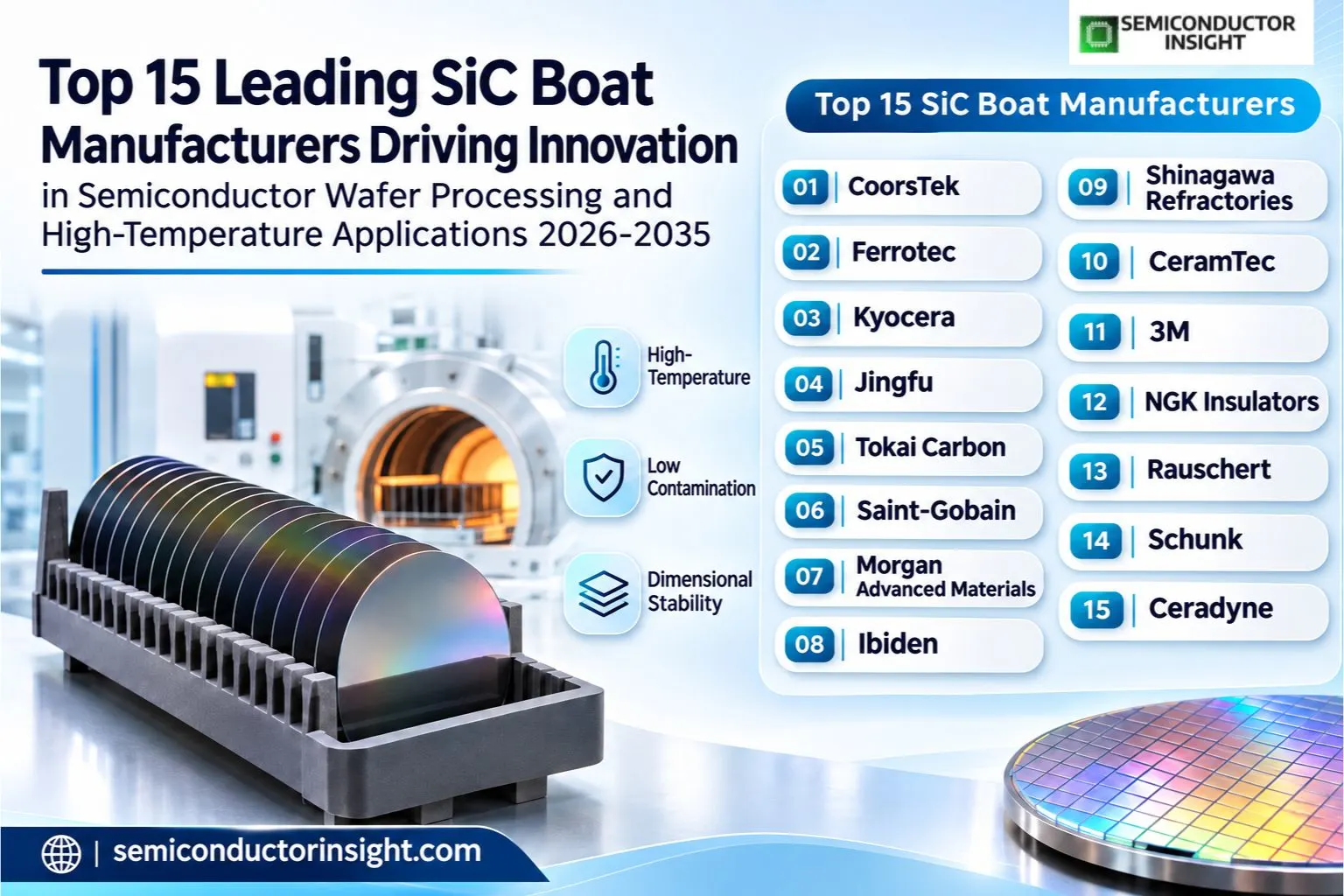
Top 15 Leading SiC Boat Manufacturers Driving Innovation in Semiconductor Wafer Processing and High-Temperature Applications 2026-2035
Silicon Carbide (SiC) Boat Market occupies an important position in semiconductor manufacturing, particularly in high-temperature wafer processing operations where dimensional stability, contamination control and thermal resistance directly influence production quality. SiC boats are precision-engineered ceramic carriers designed to hold and position multiple semiconductor wafers inside furnace systems during processes such as diffusion, oxidation, low-pressure chemical vapour deposition (LPCVD) and annealing.
- Silicon carbide boats, in contrast to traditional quartz carriers, combine mechanical durability, chemical resistance, high-temperature strength, and thermal conductivity.
- Wafer placement and manufacturing yields can be impacted by even small deformation or particle contamination, which makes these characteristics more crucial during repeated heating and cooling cycles.
- The growing complexity of semiconductor production, particularly for power devices, silicon carbide wafers, advanced memory and photovoltaic cells, is increasing the importance of specialised furnace components.
- Manufacturers are consequently focusing on reaction-bonded SiC (RSiC), sintered SiC (SSiC), and chemical vapour deposition-coated SiC and precision-machined carrier structures.
One important distinction is that SiC wafer boats used as semiconductor processing fixtures are different from SiC crystal-growth crucibles and boats used for producing silicon carbide ingots. This article focuses on wafer-processing carriers and related furnace components.
CoorsTek | Engineering High-Purity SiC Carriers for Advanced Furnace Operations
CoorsTek holds a strong position in semiconductor furnace components through its specialised portfolio of silicon carbide wafer boats, pedestals and precision-engineered carriers. Its key differentiation lies in supplying components for both horizontal and vertical furnace configurations, allowing semiconductor manufacturers to select carrier structures according to reactor design and batch-processing requirements. Its high-purity SiC technology is particularly relevant for diffusion and LPCVD applications, where maintaining wafer alignment, mechanical strength and contamination control over repeated thermal cycles is essential.
The company’s 2025 semiconductor product guide specifically identifies SiC wafer boats under its semiconductor-related product portfolio. Its TPSS silicon-impregnated silicon carbide material supports temperatures up to 1,350°C, while the company highlights reduced particle generation and certification by major furnace manufacturers. CoorsTek also supplies cantilever paddles and process tubes, giving it a broader position across the wafer-loading and furnace-handling system. This interconnected portfolio makes it particularly relevant to manufacturers seeking compatible furnace components rather than purchasing individual ceramic fixtures.
Ferrotec | Advancing CVD-SiC Technology for Precision Wafer Handling
Ferrotec differentiates itself through its chemical vapour deposition silicon carbide technology, particularly for high-purity components used in demanding semiconductor environments. Its CVD-SiC portfolio addresses equipment exposed to elevated temperatures, corrosive gases and repeated thermal processing. A notable development is its narrow-pitch film cassette boat, designed to accommodate tighter wafer spacing within high-temperature annealing equipment. This is important for manufacturers seeking to increase batch-processing capacity while maintaining controlled wafer positioning.
Ferrotec’s technical portfolio includes boat, holder and nozzle components, alongside larger SiC structures for next-generation semiconductor equipment. Its manufacturing approach uses dense CVD-SiC structures, supporting complex geometries that are difficult to produce using conventional ceramic processing alone. The company’s CVD-SiC technology has been developed over more than 30 years, according to its official product disclosures. Its ability to address both standard furnace components and specialised narrow-pitch designs makes it a significant participant in high-purity wafer-processing applications.
Kyocera | Applying Advanced Ceramic Engineering to Modular Wafer Boat Structures
Kyocera brings significant advanced ceramic expertise to semiconductor wafer carriers, with an emphasis on dimensional stability, wear resistance and serviceability. Its ceramic wafer boat portfolio is primarily based on high-purity alumina, but the company also identifies silicon carbide and sapphire as alternative material options. This material flexibility is relevant for semiconductor manufacturers that need to match carrier composition with furnace temperature, chemical exposure and wafer-contact requirements.
One particularly useful design feature is its segmented wafer boat construction. Instead of replacing an entire assembly when a particular contact section becomes worn or damaged, individual sections can be replaced using ceramic bolts. The design addresses an important manufacturing consideration: reducing equipment downtime and replacement costs in batch-processing operations. Kyocera’s semiconductor ceramics portfolio also extends into wafer-transfer equipment, deposition systems and etching components. This broader involvement gives the company an advantage in developing ceramic structures that must operate reliably alongside other precision semiconductor components.
Jingfu | Combining CVD Coating and Reaction Sintering for Low-Contamination Boats
Jiangsu Jingfu New Material Technology is developing a specialised position through its combination of reaction-sintered silicon carbide and CVD coating capabilities. Its SiC wafer boats are manufactured using high-purity SiC powder, precision machining and a CVD SiC surface layer. This approach is particularly relevant to semiconductor diffusion, oxidation and LPCVD applications, where surface impurities and particle generation can affect wafer quality.
According to its published technical specifications, the substrate impurity content is below 30 ppm, while the CVD-coated surface impurity level is below 5 ppm. The company specifies operating temperatures exceeding 1,300°C and claims a service life approximately five to ten times that of traditional quartz boats. Its manufacturing portfolio also includes furnace tubes and heat-exchanger components, enabling it to address several requirements within high-temperature processing environments. In a May 2026 technical publication, Jingfu discussed the relationship between advanced SiC ceramics, 800 V EV platforms and emerging semiconductor applications, reflecting its broader interest in next-generation SiC material development.
Kallex | Specialising in Dense Sintered SiC Boats for High-Temperature Diffusion
Kallex has developed a focused position in horizontal square silicon carbide wafer boats used in high-temperature semiconductor diffusion processes. Its principal differentiation comes from dense sintered SiC construction, which is intended to maintain mechanical integrity and minimise particle-related problems during repeated furnace operations. This makes its products relevant to wafer manufacturers that prioritise stable carrier geometry and reliable wafer positioning throughout thermal treatment.
Its published product specifications identify an operating temperature of up to 1,800°C and support for customised boat configurations. An important development in its technical history was the completion of a silicon carbide wafer boat modular-development project in 2020. The company subsequently completed a 2022 innovation project involving purification and production of SiC vacuum chuck components using grinding waste. These developments are relevant because they demonstrate attention to material recovery, precision ceramic manufacturing and component design beyond standard wafer carriers. Its modular engineering experience offers a useful differentiation in an industry where replacement time and maintenance requirements influence equipment economics.
Take a moment to check our latest report before moving forward: https://semiconductorinsight.com/report/sic-boat-market/
VeTek Semiconductor | Developing High-Slot-Count Carriers for Semiconductor Furnace Lines
VeTek Semiconductor is building its SiC boat portfolio around high-purity materials, customised carrier structures and coated wafer-handling components. One of its more distinctive products is a SiC-coated silicon carbide wafer boat featuring 165 slots. This configuration is particularly relevant to high-volume furnace processing, where increasing the number of wafers carried in a single batch can improve equipment utilisation, provided that thermal uniformity and wafer spacing remain controlled.
The company also offers recrystallised SiC boats with stated operating temperatures of 1,600°C in oxygen-containing environments and 1,700°C under reducing conditions. Its product information specifies SiC content above 99.96% and provides options for CVD SiC coating, with the coating specification reaching 99.99995% chemical purity. The portfolio covers horizontal and vertical carrier arrangements, as well as furnace paddles and other high-temperature components. Its focus on coating, material purity and high-slot-count designs makes it relevant to manufacturers seeking customised solutions for demanding diffusion and annealing processes.
Semixlab | Targeting High-Temperature Diffusion with Dense Sintered Silicon Carbide
Semixlab is positioning its SiC wafer boats around demanding semiconductor diffusion and oxidation operations. Its product range includes horizontal square wafer boats and high-purity ceramic carriers manufactured using dense sintered silicon carbide. The company’s technical specifications identify a maximum long-term operating temperature of 1,600°C and short-term operation up to 1,800°C for its high-purity boat products. These capabilities are relevant to applications where thermal deformation and chemical stability can directly affect batch-processing consistency.
Its published technical data also identifies density of at least 3.10 g/cm³ and flexural strength of at least 350 MPa for its specified ceramic boat design. The company offers both standard and customised products, with a stated supply capability of 100 units per month for one of its ceramic wafer boat models. Its delivery information specifies approximately 30-45 days after order confirmation. Beyond semiconductor processing, Semixlab identifies LED epitaxial wafer handling, photovoltaic annealing and high-temperature ceramic treatment among its application areas. This multi-application approach provides an additional customer base for its specialised SiC manufacturing capabilities.
Zirsec | Offering Multiple SiC Grades for Different Furnace Environments
Zirsec is developing its market presence through a diversified SiC wafer boat portfolio that includes reaction-bonded SiC, pressureless-sintered SiC and CVD-SiC options. The importance of this product strategy lies in the fact that semiconductor processing environments do not all require identical material properties. Different combinations of temperature, purity, wafer size and furnace atmosphere can influence whether a manufacturer selects a particular SiC grade.
Its published product range covers horizontal, vertical, round and customised wafer boats, with support for wafer diameters from 2 inches to 8 inches. A typical product configuration accommodates 25 wafers, with precision slot spacing intended to maintain consistent positioning during thermal treatment. Zirsec also advertises a one-piece minimum order quantity, samples within three to seven days and small-batch delivery in approximately seven days. These features make it relevant to equipment developers, semiconductor research facilities and smaller production lines that require customised ceramic carriers without committing to large procurement quantities.
ADCERAX | Precision-Designed SiC Boats for Semiconductor and Photovoltaic Furnaces
ADCERAX is expanding its specialised ceramic component portfolio through customised SiC wafer boats, brackets, carriers and furnace-handling structures. Its approach focuses on maintaining slot geometry, wafer spacing and structural stability during repeated heating cycles. These characteristics are particularly important for diffusion, oxidation, annealing and LPCVD operations, where changes in carrier dimensions can influence wafer alignment and process consistency.
Its AT-SIC-J1001 wafer boat uses reaction-bonded or pressureless-sintered silicon carbide, with published continuous operating-temperature specifications of approximately 1,400-1,500°C. Its technical data also identifies flexural-strength ranges of 220-290 MPa for RBSiC and 350-430 MPa for SSiC. The company supports customised configurations based on wafer diameter, furnace orientation and slot pitch, covering semiconductor wafer sizes from 100 mm to 300 mm and photovoltaic wafer formats from 156 mm to 210 mm. Its additional offering of SiC boat brackets and cantilever-related furnace components provides a broader opportunity in integrated wafer-handling assemblies.
3X Ceramic Parts | Custom-Manufactured SiC Boats for Specialised Wafer Dimensions
3X Ceramic Parts is developing its presence in the market through customised ceramic manufacturing, particularly for customers requiring specific wafer carrier geometries rather than standard catalogue configurations. Its silicon carbide ceramic wafer boat is designed for semiconductor applications involving high-temperature processing, where corrosion resistance, mechanical strength and easy cleaning are important considerations.
The company’s product information specifies temperature resistance up to approximately 1,650°C and supports custom dimensions and configurations. Its minimum order quantity is one piece, with an indicative delivery time of around 30 days. This is particularly useful for semiconductor equipment developers and specialised production facilities requiring prototypes, replacement carriers or low-volume customised components. The company’s wider manufacturing capabilities include isostatic pressing, injection moulding, dry pressing, sintering and precision machining. Its September 2026 participation announcement for the Japan International Welding Show and July 2026 participation in the Korea Advanced Ceramics Exhibition also indicate continued efforts to expand its international advanced-ceramics customer base.
FCT Tangshan | Leveraging Reaction-Sintered SiC Engineering for Furnace Components
FCT Tangshan New Material is relevant to the SiC boat landscape through its expertise in reaction-recrystallised and nitride-bonded silicon carbide products. Its technical capabilities extend across high-temperature ceramic structures, including furnace components and specialised silicon carbide assemblies. One important development in its engineering portfolio is its patent application for a high-strength SiC cantilever paddle, published in October 2020. The invention focuses on improving structural strength and the reliability of silicon infiltration in the paddle’s construction.
The significance of this development extends to wafer-processing systems because cantilever paddles are responsible for moving wafer carriers into and out of furnace chambers. The patent describes separate fixed, transition and loading sections, addressing the mechanical demands placed on long ceramic structures. FCT’s reaction-sintered SiC expertise is therefore relevant to the wider furnace-handling ecosystem, although a publicly verified 2026 launch of a new SiC boat model was not identified. Its position should be assessed through its ceramic-processing capabilities and patent-backed engineering rather than unverified production-volume claims.
Xi’an Zhongwei New Materials | An Emerging Name in Specialised High-Purity SiC Boats
Xi’an Zhongwei New Materials appears in the SiC boat supplier landscape as a specialised Chinese material manufacturer associated with high-purity silicon carbide boat products. Its relevance is connected to the growing requirement for precision ceramic carriers in semiconductor furnace operations, particularly where thermal stability, contamination management and wafer positioning are critical. These requirements become increasingly important as wafer-processing equipment moves towards higher batch capacity and tighter dimensional specifications.
However, detailed first-party technical specifications, independently verifiable production capacity and confirmed 2026 product-launch announcements were not available in the public sources reviewed for this profile. Consequently, it would be inappropriate to attribute specific wafer-slot counts, operating temperatures or customer qualifications to the company without further documentation. Its inclusion reflects its identified position among industry suppliers, while its actual competitive standing requires additional verification through product catalogues, manufacturing certifications and customer qualification records.
Zhejiang Dongxin New Material | Bringing Advanced SiC Processing and Precision Manufacturing Together
Zhejiang Dongxin New Material Technology contributes to the advanced ceramics ecosystem through its development of silicon carbide, carbon graphite, alumina and other specialised materials. Its relevance to the SiC boat industry comes from its material-processing and precision-manufacturing capabilities, particularly the development of high-performance SiC ceramics for demanding industrial environments.
The company reports a production facility covering approximately 39,870 square metres and a workforce of 460, with more than 30% allocated to research and development. Its published capabilities also include SSIC powder development and precision machining, with more than 4,000 different product designs and specifications reportedly manufactured each month. These capabilities are relevant to semiconductor-grade ceramic component development, where material consistency and machining accuracy are important. However, its publicly available portfolio places greater emphasis on advanced ceramics and mechanical sealing products than on a clearly documented standalone semiconductor SiC wafer boat range. It should therefore be viewed as a potential materials and precision-processing participant rather than an established wafer boat leader until product-specific qualifications are confirmed.
Shandong Huamei New Materials | Expanding SiC Boat Applications through Integrated Furnace Ceramics
Shandong Huamei New Materials has a relevant position in the SiC boat segment through its reaction-bonded and pressureless-sintered silicon carbide manufacturing capabilities. Its portfolio covers semiconductor wafer boats, wafer carriers, support brackets, cantilever paddles and furnace tubes. This broader range is important because semiconductor furnace operations require several coordinated ceramic components, not just the wafer-holding structure.
The company’s semiconductor application portfolio identifies SiC boats and wafer-handling components for diffusion furnaces. Its product disclosures also highlight edge-grip and slide-boat configurations designed to reduce the risk of wafer breakage during loading and unloading. The company reports more than 100 patents across its wider SiC technology portfolio, although this figure should not be interpreted as 100 patents specifically covering wafer boats. Its combination of ceramic material development and finished-component processing makes it relevant to photovoltaic and semiconductor furnace equipment manufacturers. Its wider SiC applications in new-energy manufacturing also provide opportunities to use related production capabilities across multiple industrial segments.
NKM Advanced Ceramics | Improving Wafer Carrier Purity Through CVD-SiC Surface Engineering
NKM Advanced Ceramics, associated with the Newthink brand, is developing high-purity SiC wafer boats for semiconductor thermal-processing applications. Its differentiation lies in the combination of reaction-sintered or recrystallised silicon carbide structures with CVD coating technology. This approach is relevant for reducing surface impurities and particle contamination, especially in processes involving repeated exposure to elevated temperatures and reactive gases.
The company publishes a CVD coating purity specification of up to 99.99987%, alongside semi-finished SiC purity of at least 99.9%. Its product portfolio includes horizontal boats, vertical-column boats and recrystallised SiC carriers, with one published configuration supporting operation up to 1,620°C. Its vertical-column designs are particularly relevant for increasing wafer-loading capacity within restricted furnace space. The company also describes a production and inspection process incorporating CNC machining, sintering, CVD coating and final cleaning. Its stated customer reach across more than 40 countries and regions suggests an export-oriented business model, although independent confirmation of semiconductor customer qualifications and 2026 shipment volumes remains limited.

Comments (0)