

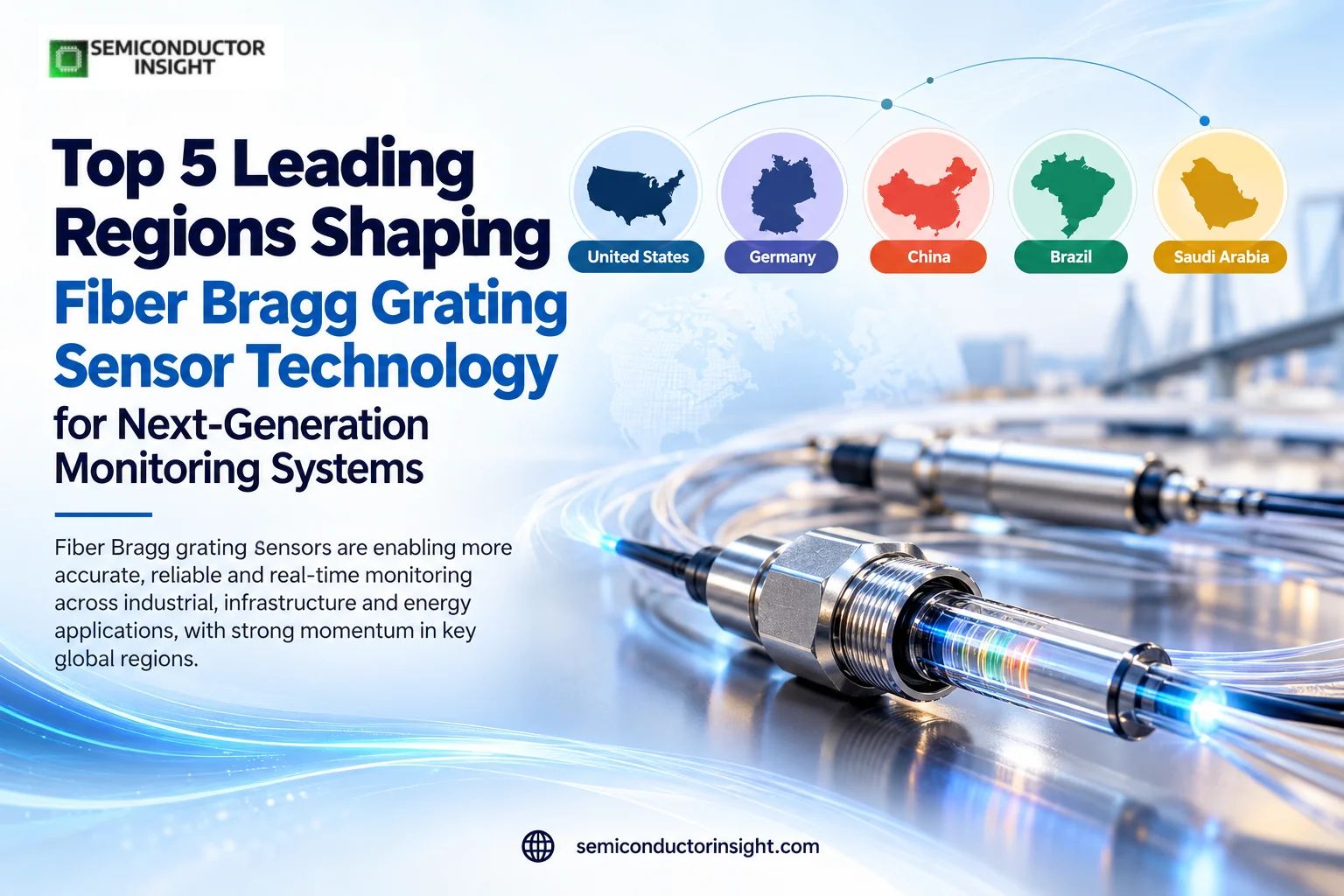
Top 5 Leading Regions Shaping Fiber Bragg Grating Sensor Technology for Next-Generation Monitoring Systems
Fiber Bragg grating (FBG) sensors are gaining attention wherever accurate, continuous measurements can help prevent equipment failure, improve structural safety and monitor human movement. By reflecting specific wavelengths of light within an optical fibre, these sensors measure changes in strain, temperature, pressure and vibration.
Their immunity to electromagnetic interference makes them particularly suitable for environments where conventional electronic sensors may be less effective. A 2025 review in Sensors examined applications spanning structural health monitoring, aerospace, biochemical measurement and environmental sensing.
North America Connects Infrastructure Safety with Advanced Engineering
North America presents important opportunities through aerospace manufacturing, energy facilities, transport infrastructure and research laboratories. The United States recorded 620,762 bridges on public roads in 2024, according to the Federal Highway Administration. Although not every bridge requires optical sensing, this extensive infrastructure illustrates the scale of potential structural-monitoring applications, from strain measurement to early detection of material deterioration.
- FBG systems are also relevant to aircraft composite structures, pipelines and industrial machinery, where multiple sensing points can share a single optical fibre.
- Their ability to operate without electrical interference is valuable around high-power equipment and sensitive instrumentation.
Europe Applies Optical Sensing to Railways and Precision Infrastructure
Europe’s engineering ecosystem supports FBG applications in railways, wind-energy installations, civil structures and industrial automation. Eurostat reported that the European Union had 201,314 kilometres of railway network in 2024, of which 57.6% was electrified. This extensive network provides potential applications for monitoring vibration, temperature and mechanical strain in railway infrastructure.
Germany, France, Italy and the Netherlands offer relevant industrial and research environments. FBG-equipped composite materials can also help aerospace manufacturers monitor structural deformation while reducing the number of conventional electrical connections required.
You Can Go Through Our Latest Updated Insights Here: https://semiconductorinsight.com/report/fiber-bragg-grating-fbg-cavity-reflectors-market/
Asia Pacific Extends Optical Monitoring Across Expanding Infrastructure
Asia Pacific stands out for its combination of large-scale infrastructure construction, electronics manufacturing and optical-fibre expertise. China operated 165,000 kilometres of railway lines by the end of 2025, including more than 50,000 kilometres of high-speed rail. Its railway system handled approximately 4.59 billion passenger trips during 2025, highlighting the scale of infrastructure that requires inspection and maintenance. These figures indicate potential application opportunities rather than measured FBG sensor demand.
Japan and South Korea contribute through advanced manufacturing and precision instrumentation, while India offers opportunities in bridges, railways, power infrastructure and industrial monitoring. Regional adoption will depend on sensor durability, interrogation equipment costs and integration with existing monitoring systems.
Latin America Finds Practical Uses in Energy and Civil Engineering
Brazil, Mexico and Chile provide relevant settings for optical sensing through mining, power generation, industrial processing and major infrastructure projects. FBG sensors can monitor deformation in concrete structures, vibration in rotating machinery and temperature changes in energy installations.
- In mining operations, optical sensing can support measurements in locations where electromagnetic interference, long cable routes or harsh environmental conditions complicate conventional instrumentation.
- Universities and engineering laboratories can also use multiplexed sensors to measure several points along a structure with fewer fibre routes.
Middle East & Africa Builds Demand around Harsh-Environment Monitoring
The Middle East offers applications in oil and gas facilities, pipelines, offshore engineering and large construction projects. Saudi Arabia and the United Arab Emirates are relevant markets for industrial monitoring, while South Africa provides opportunities in mining, energy and research.
FBG sensors can be embedded in composite structures or attached to pipelines to measure strain and temperature continuously. Radiation-tolerant FBG technology is also being studied for nuclear facilities, space systems and high-energy physics environments, where sensing reliability is essential.
How an FBG Sensor Converts Physical Changes into Data?
- Optical fibre with embedded grating
- Strain or temperature changes the reflected wavelength
- Optical interrogator measures the wavelength shift
- Software interprets measurements for monitoring and alerts

Comments (0)