

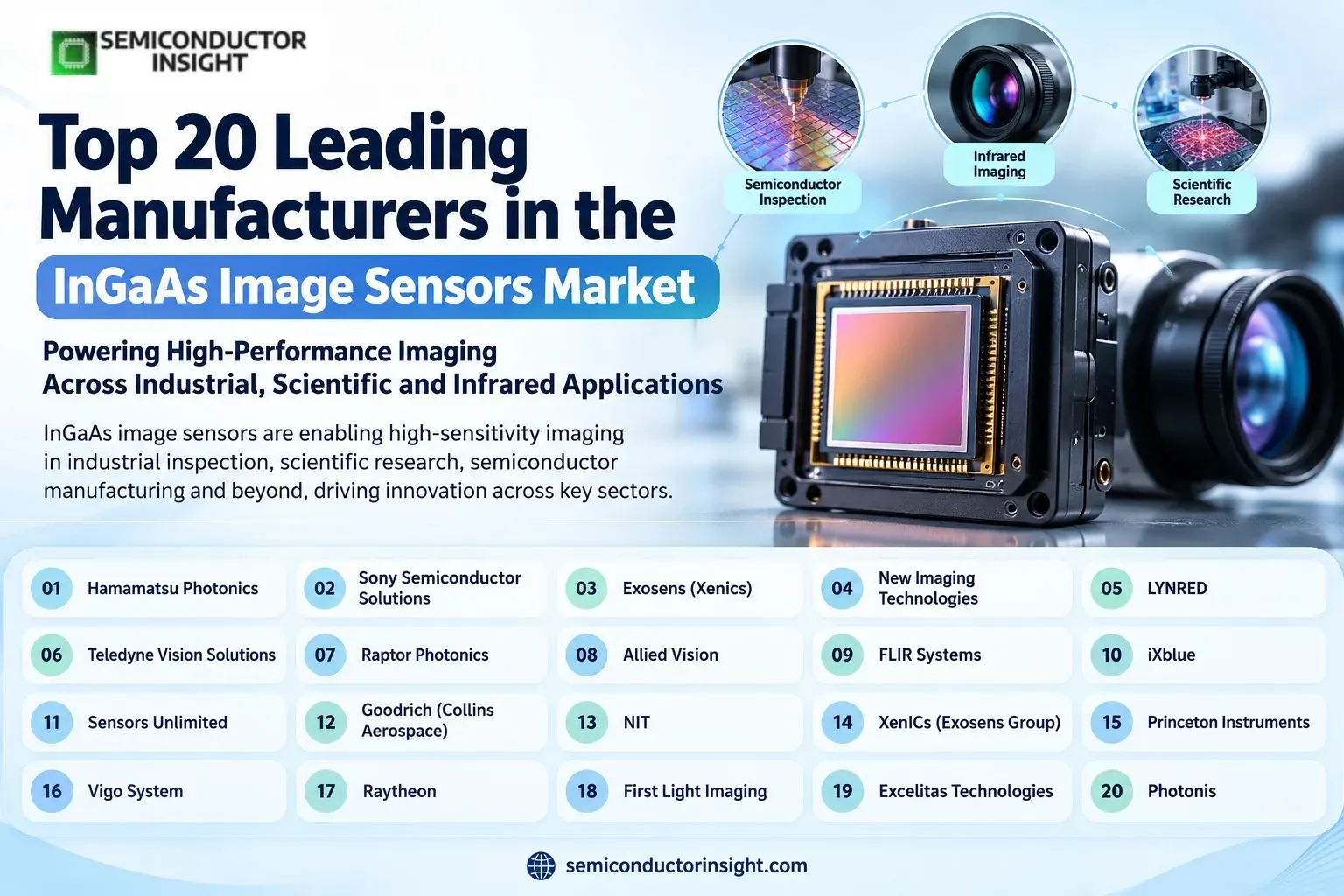
Top 20 Leading Manufacturers in the InGaAs Image Sensors Market Driving Innovation in Near-Infrared and Short-Wave Infrared Detection
InGaAs image sensors market occupies a specialised position in industrial imaging, scientific instrumentation, semiconductor manufacturing, aerospace, and defence. Indium gallium arsenide sensors detect near-infrared and short-wave infrared light that conventional visible-light cameras cannot capture effectively. Depending on the sensor design, these systems can reveal defects beneath silicon wafers, identify moisture in products, inspect opaque packaging, and detect optical signals under low-light conditions.
The market is not made up exclusively of sensor manufacturers. It includes companies producing InGaAs detector arrays, readout circuits, complete cameras, hyperspectral imaging systems, and application-specific imaging platforms. That distinction is important when evaluating competitive positioning: a sensor designer and a camera integrator can both influence adoption, but they contribute different capabilities to the finished product.
The company profiles below are organised by technological relevance and documented product capabilities, rather than verified market-share rankings. Publicly available information does not establish a reliable market-share league table for all 20 companies.
Hamamatsu Photonics – Detector Engineering for Scientific and Industrial Measurement
Hamamatsu stands out for its direct involvement in InGaAs image sensor development rather than relying solely on finished-camera integration. Its portfolio includes one-dimensional line sensors and two-dimensional area sensors built from InGaAs photodiodes combined with CMOS readout circuitry.
The company also supplies driver modules and evaluation boards, helping equipment developers move from laboratory testing toward instrument integration. Its sensors support spectroscopy, microscopy, and machine vision, where stable response and low-noise measurements are important.
Sony Semiconductor Solutions – High-Resolution Imaging across Visible and Infrared Light
Sony’s SenSWIR technology combines InGaAs photodiodes with silicon readout circuitry using copper-to-copper bonding. Its IMX992 sensor offers approximately 5.32 megapixels, while the IMX993 provides approximately 3.21 megapixels, both using 3.45 μm pixels.
These specifications are significant for industrial inspection because smaller pixels and higher resolution can help identify finer defects without requiring a large imaging system. Applications include semiconductor wafer alignment, battery-electrode inspection, food contamination detection, and photovoltaic panel testing.
Exosens (Xenics) – Bridging Detector Design and Complete SWIR Cameras
Exosens, through Xenics, is particularly relevant because it supplies both InGaAs detector solutions and complete SWIR imaging products. Its detector portfolio includes line arrays with 512, 1,024, and 2,048 pixels, alongside area arrays in 320 × 256 and 640 × 512 formats. Pixel pitches include 12.5 μm, 20 μm, and 25 μm. This variety allows system designers to balance sensitivity, resolution, and field of view across industrial inspection, scientific instrumentation, and specialised imaging applications.
New Imaging Technologies – High-Speed Sensors for Demanding Inspection Lines
New Imaging Technologies (NIT) focuses directly on SWIR InGaAs sensors and cameras. Its LiSaSWIR 2048 v2 line-scan camera provides 2,048 pixels and a full-resolution line rate exceeding 110 Hz, while the WiDy SenS 320 supports region-of-interest operation reaching 10 kHz. These capabilities are relevant to applications where moving materials must be inspected quickly, including semiconductor production, industrial sorting, and scientific imaging. NIT’s combination of camera engineering and sensor expertise makes speed, sensitivity, and integration flexibility central to its positioning.
To Know More about the Report, You Can Freely Browse Our Latest Updated Report: https://semiconductorinsight.com/report/ingaas-image-sensors-market/
LYNRED – Extended Infrared Detection for Specialist Applications
LYNRED’s InGaAs technology is relevant to machine vision, spectrometry, and compact infrared imaging systems. Its EYESENTIAL SW detector, documented in a 2026 product brochure, uses a 640 × 512 array with 10 μm pixels. This format provides a useful balance between spatial detail and system size for portable imagers and industrial instruments. The company also develops infrared detectors for space and other demanding applications, positioning it in specialist segments where detector consistency, sensitivity, and integration into customised optical systems are important procurement considerations.
Teledyne Vision Solutions – High-Throughput Inspection for Semiconductor Manufacturing
Teledyne Vision Solutions addresses applications where image capture speed is as important as image quality. Its Linea SWIR camera offers 1,024 × 1 line resolution at a maximum line rate of 40 kHz, with a 12.5 μm pixel pitch. A second model uses 512 pixels with a 25 μm pitch. This makes the portfolio relevant to continuous inspection, optical sorting, solar-cell evaluation, and semiconductor wafer analysis. Its application-testing support is also useful for customers who need to establish whether SWIR imaging can detect a specific defect before integrating equipment into production.
Raptor Photonics – High-Sensitivity Imaging for Low-Light Environments
Raptor Photonics differentiates itself through specialised camera platforms designed for scientific research, surveillance, aerospace, and industrial applications. Its Owl 2560 camera offers 2,560 × 2,048 resolution, equivalent to approximately 5.2 megapixels, with 3.45 μm pixels and frame rates up to 60 Hz at full resolution. The Owl 640 S, meanwhile, supports full-frame imaging at up to 300 Hz. These specifications serve different needs: higher pixel counts assist detailed inspection, while high frame rates support rapidly moving scenes and dynamic optical measurements.
Allied Vision – Flexible SWIR Camera Integration for Industrial Users
Allied Vision builds its SWIR portfolio around industrial camera integration, offering systems using Sony SenSWIR sensors alongside other InGaAs configurations. Its Goldeye Pro range supports resolutions up to 5.32 megapixels, while selected models offer 5GigE connectivity and a 400–1,700 nm spectral range. Other models support extended SWIR detection up to 2,200 nm. The company’s emphasis on industrial interfaces, compact housings, image correction, and temperature management makes it relevant to manufacturers who need reliable integration into established machine-vision installations rather than a detector requiring extensive custom engineering.
Sensors Unlimited – Detector-Level Expertise for Specialist Imaging
Sensors Unlimited, part of RTX’s Raytheon business, is a significant specialist in InGaAs imaging components and SWIR cameras. Its portfolio includes two-dimensional area cameras, one-dimensional line-scan cameras, and detector arrays for custom systems. The company also reports a fabrication facility exceeding 97,000 square feet, including a III-V foundry and Class 100 cleanroom environments. Its capabilities in epitaxial growth, detector fabrication, packaging, and hybridisation are particularly relevant where customers require specialised imaging components rather than standard industrial cameras.
Excelitas Technologies – Scientific Imaging With Low-Noise Performance
Excelitas expanded its scientific SWIR offering in September 2026 with the pco.edge 1.3 SWIR CLHS camera. The system combines a 1,280 × 1,024 InGaAs sensor with 10 μm pixels, a maximum full-frame rate of 148 fps, and spectral sensitivity from 300 to 1,700 nm. Its stated readout noise is below 25 electrons RMS, making the platform relevant to low-light scientific measurements and semiconductor inspection. The combination of cooling, sensitivity, and high-speed readout supports applications where weak signals must be captured without sacrificing spatial detail.
JAI – Bringing Visible and SWIR Imaging Into One Camera
JAI introduced the Wave WAA-1300-GE-TEC on June 18, 2026, combining visible and SWIR imaging in a single area-scan camera. The model offers 1.3-megapixel resolution, 5 μm pixels, a spectral response from 400 to approximately 1,700 nm, and frame rates up to 90 fps. This configuration can reduce the need to install and synchronise separate visible-light and infrared cameras. For manufacturers inspecting food, electronics, wafers, or recycled materials, combining spectral information within one imaging system can simplify equipment design and improve alignment between captured images.
SCD – InGaAs Detector Arrays Designed for System-Level Performance
SemiConductor Devices (SCD) supplies InGaAs detectors for specialised imaging systems, including surveillance, industrial inspection, and laser detection. Its Cardinal 1280 detector uses a 1,280 × 1,024 array with 10 μm pixels, while the Cardinal 640 provides 640 × 512 resolution with 15 μm pixels. SCD also incorporates functions such as asynchronous laser-pulse detection into selected readout architectures. These features can reduce the need for separate electronics in applications involving pulsed lasers or laser ranging, making detector design an important factor in overall system size, power consumption, and response speed.
First Light Imaging – Ultra-Fast SWIR Cameras for Scientific Discovery
First Light Imaging serves applications where capturing fast optical events is critical, including spectroscopy, adaptive optics, laser communications, and scientific measurement. Its C-RED 2 camera uses a 640 × 512 InGaAs sensor with 15 μm pixels and supports high-speed imaging. The product’s documented specifications include frame rates reaching 602 Hz in a full-frame global-shutter configuration. This makes it relevant to experiments involving rapidly changing light signals, although actual performance depends on camera configuration and operating conditions.
BaySpec – Deep-Cooled InGaAs Cameras for Spectroscopy
BaySpec’s Nunavut InGaAs camera family is designed for applications requiring sensitive spectral measurements across the near-infrared and SWIR bands. Depending on configuration, the cameras cover wavelength ranges extending from 900 nm to 2,500 nm and offer detector cooling to approximately −60°C, with water cooling available for lower temperatures. Its portfolio is relevant to Raman spectroscopy, fluorescence measurements, laser characterisation, and low-light analysis. By combining imaging hardware with spectrograph compatibility, BaySpec addresses users who need both spatial information and precise wavelength-dependent measurements.
Headwall Photonics – Hyperspectral Imaging for Material Identification
Headwall Photonics focuses on hyperspectral imaging, in which each image contains information across numerous wavelength bands rather than a single broadband measurement. Its SWIR 640 system covers approximately 900–2,500 nm and is offered for laboratory, field, and machine-vision use. The platform supports applications such as mineral identification, environmental monitoring, and material classification. This approach is valuable when visually similar materials have different spectral signatures, allowing inspection systems to distinguish substances that conventional RGB cameras may treat as identical.
Specim – Industrial Hyperspectral Systems for Continuous Sorting
Specim’s portfolio includes hyperspectral cameras covering visible, near-infrared, and short-wave infrared wavelengths. Its FX17 operates across 900–1,700 nm, while the GX17 covers approximately 980–1,730 nm. These systems are designed for industrial machine vision and research, including applications where materials must be classified using their spectral responses. The company’s line-scan architecture is particularly relevant to conveyor-based sorting, where material can be scanned continuously as it moves through an inspection line. Its market contribution is primarily in complete hyperspectral imaging systems rather than standalone detector fabrication.
Photonic Science – Custom Imaging for Research and Industrial Metrology
Photonic Science develops SWIR InGaAs cameras for scientific and industrial applications, including spectroscopy, astronomy, semiconductor inspection, and microscopy. Its cooled VGA camera offers 640 × 512 resolution, 15 μm pixels, and a documented full-frame rate of 174 fps. Selected operating modes can deliver substantially higher rates when the region of interest is reduced. The company also offers extended-wavelength configurations and OEM customisation, making it relevant to research laboratories and instrument developers that require specific cooling arrangements, integration formats, or long-exposure performance.
Teledyne Princeton Instruments – Low-Noise Detection for Scientific Measurements
Teledyne Princeton Instruments focuses on high-performance imaging for scientific research, industrial measurement, and OEM applications. Its product range includes InGaAs cameras alongside CCD, sCMOS, and other specialised imaging technologies. This matters because InGaAs imaging is frequently used in experiments involving weak optical signals, fluorescence, spectroscopy, and semiconductor characterisation. Rather than competing solely on pixel count, scientific camera suppliers must balance readout noise, cooling, exposure control, and measurement repeatability. These capabilities make Princeton Instruments relevant to research-led applications where reliable quantitative data is more important than a general-purpose image alone.
Photonfocus – High-Speed SWIR Inspection for Production Environments
Photonfocus’s MV3 camera series uses InGaAs sensors for industrial SWIR inspection across a stated spectral range of 900–2,600 nm. The manufacturer highlights global-shutter imaging, integrated thermoelectric cooling, and frame rates exceeding 300 fps. These characteristics are useful in applications involving fast-moving products, moisture analysis, foreign-particle detection, and chemical-composition assessment. For industrial buyers, the combination of high frame rate and SWIR sensitivity can enable inline inspection without requiring every product to stop for individual testing. Its positioning is therefore closely tied to throughput and process-control requirements.
Hinalea Imaging – Combining SWIR Data with Real-Time Classification
Hinalea Imaging differentiates itself through hyperspectral systems that combine optical capture with software-based spectral analysis. Its SWIR Pro platform covers 950–1,700 nm and offers configurations with 640 × 512 or 1,280 × 1,024 spatial resolution. The system samples 188 spectral bands and supports live classification workflows. Hinalea’s broader portfolio includes visible-to-SWIR and extended-SWIR platforms, allowing users to select a spectral range based on the material under investigation. This is particularly relevant to food quality, pharmaceutical analysis, recycling, and industrial sorting, where actionable classification is the objective rather than image acquisition alone.
What Separates the Leading Participants in 2026?
The InGaAs image sensors market is becoming more differentiated across three layers of the value chain. Detector manufacturers compete through pixel architecture, sensitivity, noise performance, spectral response, and customisation. Camera manufacturers turn those detectors into reliable systems with cooling, interfaces, image correction, and production-ready housings. Hyperspectral suppliers add spectral acquisition and classification software to identify materials and defects.
Several developments illustrate these distinct priorities in 2026: Sony’s 5.32-megapixel IMX992, JAI’s visible-plus-SWIR camera launch, Excelitas’s high-speed scientific camera, and LYNRED’s compact EYESENTIAL SW detector. Together, they show that progress is not measured by resolution alone. Industrial adoption also depends on inspection speed, spectral coverage, integration costs, and the ability to produce consistent results in real operating conditions.
For procurement teams, the most useful comparison is therefore application-specific. A semiconductor inspection line may prioritise resolution and repeatability, while a scientific laboratory may place greater emphasis on cooling and low readout noise. Material sorting may instead depend on line rate and spectral discrimination. These differences explain why the market supports specialised suppliers rather than one universal sensor design.

Comments (0)