

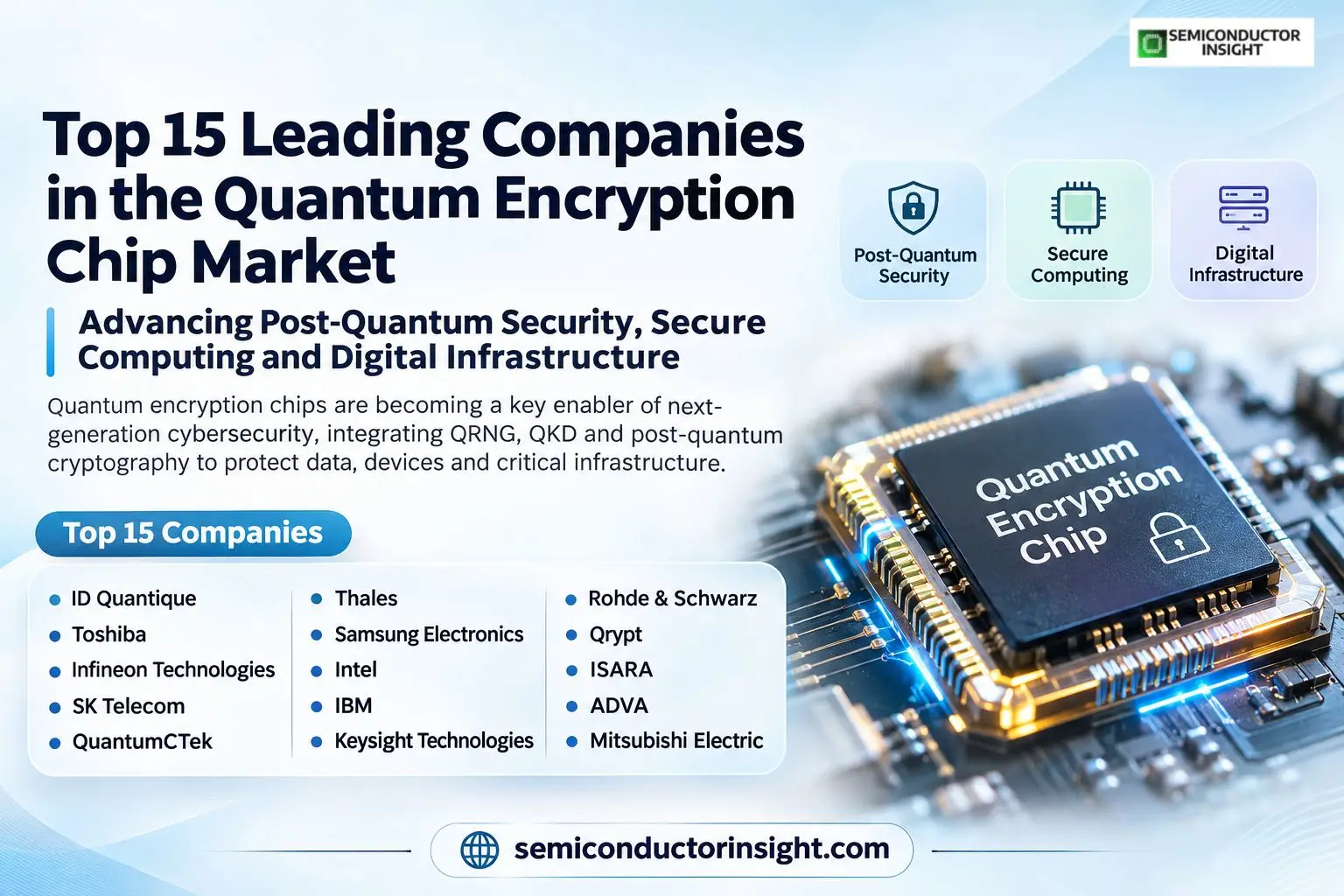
Top 15 Leading Companies in the Quantum Encryption Chip Market Advancing Post-Quantum Security, Secure Computing and Digital Infrastructure
Quantum encryption chips sit at the intersection of quantum physics, semiconductor engineering and cybersecurity. They are purpose-built hardware components that support secure key generation, quantum random-number generation, quantum key distribution (QKD), or post-quantum cryptography (PQC).
These technologies address different security problems: QKD uses quantum states to help detect interception during key exchange, while PQC uses mathematical algorithms designed to resist attacks from future quantum computers. Quantum random-number generator chips provide high-quality entropy for cryptographic systems.
ID Quantique: Quantum randomness moving into compact, certified silicon
ID Quantique has a particularly direct position in this market because its Quantis portfolio includes dedicated QRNG chips, rather than relying only on network-level quantum encryption equipment. Its IDQ20MC1 chip is a useful example of how quantum entropy is being packaged for integration into security hardware.
The 2026 Common Criteria evaluation documentation describes a chip architecture built around a CMOS image sensor, an integrated LED light source, SPI interfaces and an embedded microcontroller. The sensor’s active pixel array measures the optical noise source, while built-in voltage monitoring and health-status functions help detect abnormal operating conditions. The device is designed for PCB-level integration, including use as a random-number resource in hardware security modules.
- The wider Quantis range also gives ID Quantique reach beyond one chip format. Its product family includes six chip models, PCIe products and other integration options, with published entropy-output configurations reaching 40 Mbps and 240 Mbps in its newer PCIe offering.
- NIST entropy-source validation and automotive and space-oriented robustness claims are important because QRNG hardware must demonstrate not only randomness, but also reliable operation across different environments.
- In 2026, the company’s competitive strength is its ability to offer a defined hardware component with documented interfaces, monitoring and certification evidence for cryptographic infrastructure, connected devices and high-assurance applications.
Toshiba: Quantum key distribution expanding from fibre networks to satellite links
Toshiba’s strongest contribution is in quantum key distribution infrastructure, where specialised optical hardware creates and distributes encryption keys. Its January 2026 announcement described a compact, high-speed QKD transmitter-receiver system developed for satellite deployment. Toshiba demonstrated interoperability between the satellite-oriented system and a terrestrial fibre QKD network at Heriot-Watt University in the UK. This is an important technical step because fibre-based QKD is constrained by signal attenuation over distance, while satellite links could help extend quantum-secure communications across much larger geographic areas.
The company’s 2026 activity continued beyond laboratory development. Toshiba’s QKD news page lists an August 2026 milestone in which Quantum Corridor, Ciena and Toshiba completed a 1.6 Tb/s quantum-safe optical encryption demonstration over a live commercial network. In October 2026, Toshiba also announced its QSN Platform for delivering quantum-safe networks at scale. These developments position Toshiba as a major systems and optical-communications contributor, although its QKD equipment should not be confused with a standalone quantum encryption chip. Its relevance to the chip market lies in the optical components, control electronics and secure-network architectures required to make quantum key distribution commercially deployable.
Infineon Technologies: Bringing quantum-resistant algorithms into certified security controllers
Infineon’s importance comes from its ability to embed post-quantum cryptography into established semiconductor security products. Its portfolio spans trusted platform modules, security controllers, secure elements and microcontrollers, giving device manufacturers multiple routes to implement quantum-resistant protection. Infineon identifies three NIST-standardised algorithm families in its PQC strategy: ML-KEM for key establishment, ML-DSA for digital signatures and SLH-DSA for hash-based signatures. This is a practical approach to the market because quantum-safe protection must be implemented in the hardware that stores keys, authenticates firmware and protects device identity, not just in external network software.
A notable technical milestone is Infineon’s Common Criteria EAL6+ certification work involving a security controller with ML-KEM, alongside its SLC27 controller and cryptographic library supporting ML-KEM and ML-DSA. Its product strategy also reaches industrial and automotive platforms, where devices can remain deployed for many years and may be difficult to replace after installation. Infineon identifies secure boot, firmware verification, hardware roots of trust and field-updatable cryptography as key use cases. Its position is therefore strongest in quantum-ready semiconductor security and the transition from conventional cryptographic controllers to hardware capable of supporting post-quantum algorithms.
SK Telecom: Connecting quantum-randomness chips with telecom-scale security
SK Telecom has a distinctive place in the market because it has worked on quantum cryptography at both the chip and telecommunications-network levels. Its collaboration with ID Quantique produced a compact quantum random-number generator chip based on optical shot noise captured by a CMOS image sensor. The published chip dimensions are 5 × 5 × 2 mm, with an architecture using an LED, image sensor and ASIC. That compact form factor was designed for integration into connected devices, critical infrastructure and security equipment where board space, power consumption and resistance to environmental variation matter.
Its more recent activity demonstrates that the company is continuing to invest in quantum-secure communications. On June 9, 2026, SK Telecom announced that it had secured a Horizon Europe quantum-cryptography project involving research partners in Greece, Austria, Germany and South Korea. The three-year programme focuses on next-generation quantum cryptography and the integration of quantum and AI technologies. The development strengthens SK Telecom’s position in the wider ecosystem, although the 2026 announcement concerns collaborative quantum-cryptography research rather than a newly launched encryption chip. Its advantage is the combination of previous chip-level QRNG work, telecom deployment experience and access to international research programmes.
PQShield: Turning post-quantum cryptography research into silicon-ready security IP
PQShield’s contribution is different from that of a company selling a finished QRNG chip. It develops post-quantum cryptographic technology that can be integrated into semiconductor designs, embedded processors and secure hardware. This makes it relevant to chipmakers that want to add quantum-resistant cryptography without building every algorithm implementation and hardware architecture internally. The commercial opportunity is significant because PQC algorithms can require more memory, processing capacity and data movement than conventional public-key cryptography, creating new design requirements for constrained devices and secure elements.
For a ranking focused on quantum encryption chips, PQShield belongs in the semiconductor IP and implementation layer rather than the finished-chip category. Its technology is relevant to hardware roots of trust, secure boot, device authentication and long-life embedded systems. A useful benchmark for the sector is the NIST standardisation of ML-KEM, ML-DSA and SLH-DSA, which gives silicon developers defined algorithms to implement instead of relying on experimental cryptographic schemes. PQShield’s importance is its role in helping semiconductor manufacturers translate these standards into deployable hardware and embedded security products. A specific 2026 product-volume or chip-shipment figure was not established in the sources reviewed, so none is attributed to the company here.
Take a Quick Glance at Our In-Depth Analysis Report: https://semiconductorinsight.com/report/quantum-encryption-chip-market/
Crypto Quantique: Quantum-derived device identity at the silicon root of trust
Crypto Quantique addresses a security weakness that becomes especially important as connected devices move towards quantum-resistant cryptography: the protection and provisioning of cryptographic keys. Its QDID technology is a physically unclonable function (PUF) that derives a unique device identity from variations in quantum tunnelling current through a standard CMOS transistor’s gate oxide. Rather than storing a permanent secret key in memory, the design recreates identity material when required. This can reduce dependence on factory key injection and limit exposure associated with stored credentials.
The technology is relevant to chipmakers because QDID is offered as security IP for integration into silicon, SoCs and connected-device architectures. Crypto Quantique identifies key generation, device identification, authentication, provisioning, post-quantum cryptography and supply-chain security among its application areas. Its QuarkLink platform complements the hardware layer by automating device provisioning, onboarding and lifecycle management. This combination gives the company a role in securing large IoT deployments, where manufacturers may need to manage thousands or millions of devices without manually injecting and tracking individual secrets. Its strength is silicon-level trust, rather than a standalone QKD or QRNG encryption-chip product.
OCTATCO: Quantum randomness integrated into biometric authentication hardware
OCTATCO is relevant to this market through its EzQuant quantum fingerprint security key, developed with ID Quantique and SK Telecom. The product combines a QRNG chip with fingerprint-based authentication and FIDO2/FIDO U2F compatibility. It is designed to secure both digital sign-in and physical access, including PC login, enterprise authentication, cloud access and privileged-user environments. This is a practical example of quantum randomness being used inside an authentication product rather than only in a dedicated cryptographic appliance.
The product specifications illustrate the hardware integration involved. EzQuant lists USB Type-A and NFC interfaces, an Arm Cortex-M23 security architecture, 512 KB of flash memory and 96 KB of SRAM. Its fingerprint module is specified at 500 dpi with a 160 × 160 pixel sensing area, while the security key supports FIDO2 and FIDO U2F authentication. OCTATCO’s role should be understood as a quantum-enabled security-key and authentication solution provider, not as a manufacturer of standalone quantum encryption silicon. Its value lies in bringing a QRNG source into a compact device used for identity verification and access control.
RED Semiconductor: Secure edge-processing architecture with an adjacent quantum-security opportunity
RED Semiconductor is a less direct participant in the quantum encryption chip segment than the QRNG and QKD suppliers in this ranking. Its VISC architecture is a purpose-built processing technology based on a RISC-V CPU foundation, designed for low-power algorithm acceleration in edge devices. The company’s stated application areas include secure automotive systems, telecommunications, smart energy, healthcare devices and data-centre preprocessing. These are relevant deployment environments for future quantum-safe hardware because cryptographic operations increasingly need to run close to the device, sensor or communication endpoint.
RED’s published technical claims include up to 100× early acceleration in matrix-multiplication testing, a workload associated with AI and signal-processing operations. However, the company’s public product information reviewed for this article does not establish a dedicated QRNG chip, QKD component or NIST-standardised PQC accelerator as a commercial product. It is therefore more accurate to position RED as an emerging secure-edge semiconductor architecture company with potential relevance to quantum-ready processing, rather than to describe it as an established quantum encryption chip supplier. This distinction is important for a credible ranking and avoids overstating its current market position.
Samsung Semiconductor: Hardware-based post-quantum protection inside secure elements
Samsung Semiconductor has made a significant move towards quantum-resistant silicon with its S3SSE2A secure element. The device embeds post-quantum cryptography directly into a dedicated security chip, rather than relying entirely on a host processor or software implementation. Samsung describes a hybrid architecture that supports conventional cryptographic algorithms alongside PQC, allowing devices to maintain compatibility while transitioning to quantum-resistant protection. Its hardware implementation uses a lattice-based algorithm and is designed to protect sensitive information against physical attacks as well as future quantum threats.
A notable performance figure published by Samsung is processing up to 17 times faster than software-only solutions for the relevant PQC operations. The secure element is particularly relevant to mobile and IoT applications in which cryptographic keys and identity data need to remain isolated from the main application processor. Samsung’s 2026 CES Innovation Awards recognition also brought attention to hardware-based PQC as a product-level security feature, rather than a research-only concept. Its competitive advantage is the ability to integrate quantum-resistant cryptography into a commercial secure-element platform designed for mass-market connected devices.
STMicroelectronics: ST54M brings post-quantum cryptography into a mobile security chip
STMicroelectronics strengthened its position in quantum-ready hardware with the June 2026 introduction of the ST54M. The chip combines a near-field communication controller, an embedded secure element, embedded SIM functionality and a dedicated PQC hardware accelerator on a single die. It supports ML-KEM and ML-DSA, covering key establishment and digital signatures under the NIST post-quantum standards. This integrated approach is important for smartphones and connected consumer devices, where manufacturers need to add stronger cryptographic protection without assembling several separate security components.
The ST54M’s published specifications include up to 4.5 MB of non-volatile memory, 150 KB of RAM and output power of up to 3 W for its NFC functions. It is supplied in a compact WLCSP90 package and supports applications such as crypto wallets, secure access control, digital identity and electronic ticketing. STMicroelectronics also lists Common Criteria and EMVCo certification targets in its launch material, while its product page identifies the device as being in volume production. The combination of NFC, eSIM and PQC on one die gives ST a clear commercial angle in mobile security, particularly as device makers plan for longer-lived credentials and protection against harvest-now, decrypt-later attacks.
NXP Semiconductors: Extending quantum-safe security across automotive and industrial silicon
NXP’s approach focuses on integrating post-quantum cryptography into the hardware roots of trust used in connected vehicles, industrial systems and embedded devices. Its stated roadmap includes PQC support across processor and microcontroller families such as i.MX 94, i.MX 95, S32N, S32K5 and selected MCX devices. These platforms serve applications where secure boot, firmware updates, authentication and message signing need to remain reliable over long product lifecycles. That makes NXP relevant to the quantum encryption chip market even though its main offering is a broader semiconductor security architecture rather than a dedicated QRNG chip.
NXP’s technical strategy also addresses a major hardware-design challenge: post-quantum algorithms can require larger keys, signatures and more processing resources than conventional cryptography. The company identifies hardware roots of trust, secure enclaves and hardware security engines as mechanisms for protecting cryptographic operations. It also points to SHA-3 acceleration and additional dedicated PQC hardware for higher-security applications, including designs targeting Common Criteria EAL6-level requirements. The breadth of its automotive, industrial, mobile and IoT platforms gives NXP a route to introduce quantum-resistant capabilities across several product categories as manufacturers refresh their silicon roadmaps.
QNu Labs: India’s quantum-security hardware moving into field deployment
QNu Labs has become an important participant in India’s quantum-secure communications ecosystem through its QRNG, QKD and quantum-safe security portfolio. Its Tropos QRNG is positioned as a source of quantum randomness for cryptographic key generation, while its Armos platform provides quantum key distribution. The Indian Department of Science and Technology has reported that QNu delivered 25 QKD systems to the Indian Navy in 2024, alongside deployments of its QRNG technology to defence-related organisations. This gives the company a stronger deployment reference than a supplier whose technology remains limited to laboratory demonstrations.
Two 2026 developments add further weight to its position. In October, the Indian government announced a ₹150 crore RDI support agreement with QNu Labs for a project with a total cost of ₹300 crore, aimed at advancing an indigenous quantum-secure and sensing technology stack towards TRL-9. Earlier that month, QNu, BISAG-N and IIT Gandhinagar demonstrated a 5.56 km free-space QKD link. The trial generated secure keys at 230–260 bits per second, with a quantum bit error rate below 5%, and integrated the keys with a PQC-enabled platform. These are meaningful field metrics, although the demonstration represents a network-level QKD system rather than a standalone encryption chip.
QuintessenceLabs: Quantum entropy and key distribution for high-assurance infrastructure
QuintessenceLabs occupies an important position in the quantum-security hardware ecosystem through its qStream QRNG and qOptica QKD products. Its qStream 100 is specified to generate up to 1 Gb/s of quantum random numbers and is listed by NIST’s Cryptographic Algorithm Validation Program as a hardware random-number generator. The system is designed to provide entropy for cryptographic keys, nonces, authentication challenges and other security parameters. This focus on high-quality randomness makes the company relevant to data centres, financial institutions, government networks and organisations that need dependable key-generation infrastructure.
The company’s portfolio extends beyond a single entropy device. It includes qStream 200 for network-attached entropy distribution, qOptica 100 for continuous-variable QKD, qConnect for quantum-safe key distribution and qRand for entropy management. qConnect can support PQC-based key delivery as well as hybrid QKD/PQC arrangements, giving customers a migration path rather than forcing an immediate change to one security method. QuintessenceLabs is therefore best understood as a quantum-security hardware and infrastructure supplier, with its QRNG module providing the closest direct connection to the quantum encryption chip segment.
Quside: High-speed quantum entropy designed for embedded security
Quside is one of the more directly relevant companies in the quantum encryption chip market because it offers embedded QRNG chipsets alongside PCIe and FMC hardware modules. Its Ruby N1 QRNG security chipset is specified for 1 Gbit/s performance, while the Ruby S1 offers a 50 Mbit/s configuration. Its Garnet PCIe range covers 100 Mbit/s to 1 Gbit/s, with NIST SP 800-90B certification. These products are designed to supply high-quality randomness for cryptographic key generation, post-quantum cryptography, quantum key distribution and secure communications.
A particularly relevant 2026 development came on January 20, when Quside and Coherent demonstrated a mass-manufacturable quantum entropy source using Coherent’s vertical-cavity surface-emitting laser technology. The companies described a solution using a VCSEL manufactured on a 6-inch platform, with runtime entropy verification from a single laser source. This matters because the commercial challenge is not simply generating quantum randomness in a laboratory, but producing a reliable entropy source that can be manufactured and integrated at scale. Quside’s combination of embedded chipsets, entropy monitoring and the 2026 manufacturing demonstration gives it a strong position among specialist QRNG technology suppliers.
Quantum Dice: Verifiable quantum randomness for network and computing security
Quantum Dice differentiates itself through its DISC protocol, which continuously evaluates the quality of generated entropy at the hardware level. Its VERTEX QRNG is a PCIe-based product designed for integration into networking and computing cybersecurity equipment. The company lists throughput of up to 2.5 Gbit/s for the VERTEX platform, with a PCIe Gen 2.0 x4 interface and a full-height, half-length card format. The ability to monitor entropy continuously is commercially important because a QRNG system must provide assurance that its output remains trustworthy during operation, rather than relying only on a one-time laboratory assessment.
Quantum Dice also offers its technology in different deployment formats, including the VERTEX PCIe card, APEX rackmount server, SparQ system-on-module and quantum entropy-as-a-service. This gives customers options ranging from direct hardware integration to centralised entropy delivery. Its published API documentation supports integration through C/C++ and Python environments, with example software for Windows and Ubuntu-based systems. These details make the platform relevant to security appliance manufacturers, data-centre operators and organisations developing quantum-safe infrastructure. Quantum Dice is primarily a QRNG hardware and entropy technology supplier, rather than a manufacturer of complete QKD encryption systems.

Comments (0)