

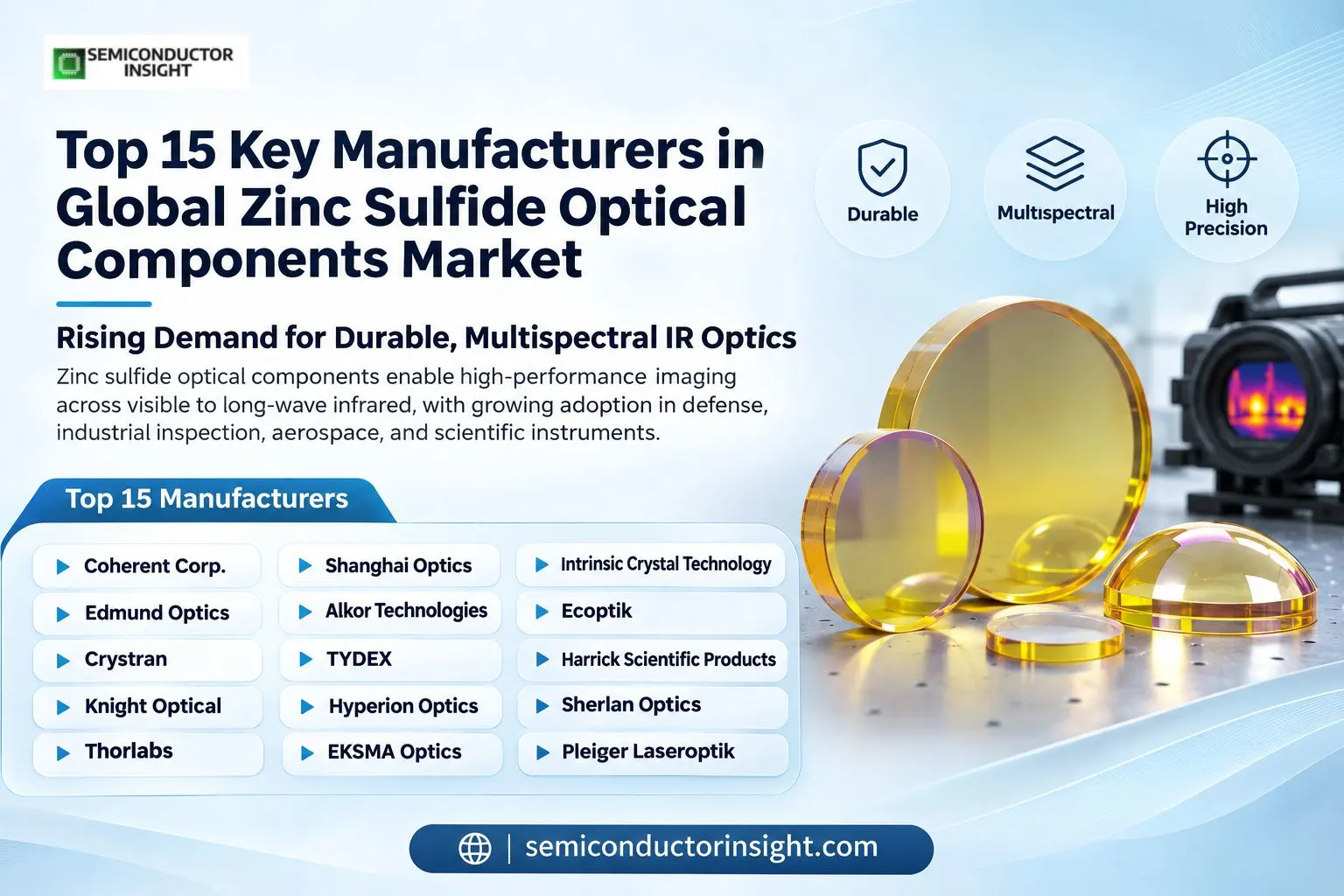
Top 15 Key Manufacturers in Global Zinc Sulfide Optical Components Market through 2026-2035: Strategic Insights and Rankings
Zinc sulfide optical components form the backbone of systems that see beyond human vision. These precision windows, lenses, prisms, and domes transmit light across visible to long-wave infrared ranges, enabling thermal imaging cameras, forward-looking infrared systems, laser rangefinders, aerospace sensors, and multi-spectral platforms that must perform under rain, dust, high-speed impact, or extreme temperatures.
The material’s combination of mechanical hardness, broad transmission from roughly 0.4 to 13.5 micrometers in multispectral grades, and resistance to environmental abrasion makes it indispensable for applications where germanium or zinc selenide alone fall short. In 2026, demand continues to rise from defense thermal systems, industrial inspection tools, and scientific instruments that require both visible alignment and infrared performance in a single optic.
Coherent Corp. stands as a primary force in large-format zinc sulfide substrates and finished optics. The company supplies ZnS material in diameters reaching 300 millimeters along with sheet stock, core-drilled blanks, edged blanks, and generated curved lens blanks designed for domes, exterior aircraft windows, and harsh-environment infrared systems.
Its chemical-vapor-deposited material delivers high fracture strength and hardness suited to rain-erosion and particulate abrasion resistance, while the multispectral grade undergoes hot isostatic pressing for water-clear transmission from the visible through 12 micrometers. In 2026 Coherent continued expanding manufacturing capacity and vertical integration from crystal growth through coating and assembly, supporting airborne and military sensor programs that demand large, durable ZnS components with optional thin-film and EMI-shielding coatings.
Edmund Optics delivers stock and custom multispectral zinc sulfide windows engineered for systems that combine visible and infrared sensors. Its TECHSPEC range covers diameters from 12.5 to 50.80 millimeters in thicknesses of 2, 3, or 4 millimeters, offered uncoated or with broadband antireflection coatings optimized for 3-12 micrometers.
These components exhibit low absorption and scatter across 0.4-12 micrometers and benefit from the material’s greater hardness and chemical resistance compared with zinc selenide. Throughout 2026 the company maintained ready availability of multiple diameter-thickness combinations while supporting custom modifications for thermal imaging and dual-band instruments that require precise surface quality of 60-40 and flatness specifications at infrared wavelengths.
Crystran specializes in both FLIR-grade and multispectral zinc sulfide for thermal-band windows and lenses. FLIR-grade material transmits from 1.0 to 13 micrometers with higher toughness for front optics exposed to harsh conditions, while the multispectral HIP-processed grade extends clear transmission from 0.37 to 13.5 micrometers with absorption coefficients as low as 0.0006 cm⁻¹ at 3.8 micrometers.
Stock windows are available in diameters such as 9.5, 12.5, 19, 25, and 25.4 millimeters with thicknesses from 1 to 5 millimeters. In current production the company continues to emphasize grain-size control for maximum strength and provides detailed refractive-index data across dozens of wavelengths to support precise system design for thermal imagers operating in the 8-14 micrometer band.
Knight Optical supplies both stock and fully custom zinc sulfide windows, lenses, meniscus elements, and blanks in FLIR and multispectral grades. Capabilities include diameters from under 5 millimeters to over 100 millimeters, form error better than λ/4 at 633 nanometers, centration under 1 arc minute, and coatings such as broadband antireflection or diamond-like carbon optimized for 1-14 micrometers. The multispectral grade supports visible-to-infrared multi-spectral systems while FLIR grade targets the 8-12 micrometer thermal band. Recent work focuses on diamond-turned aspheric surfaces and durable coatings for defense and industrial infrared optics that must maintain performance under environmental stress.
Thorlabs integrates zinc sulfide into specialized infrared optics, including ZnSe-ZnS achromatic doublets designed for the 8-12 micrometer range. These components appear in focal lengths such as 50, 75, and 100 millimeters with 25.4-millimeter diameters and 60-40 surface quality, enabling corrected imaging for thermal and CO₂-laser applications. The company maintains extensive in-house polishing and coating resources that allow rapid iteration of custom ZnS elements alongside its broader infrared catalog. In 2026 Thorlabs continued supporting laboratory and industrial users who need matched ZnS elements for beam delivery and sensing systems operating across mid- and long-wave infrared bands.
A Brief Look at Our Detailed Analysis Related Report: https://semiconductorinsight.com/report/zinc-sulfide-optical-components-market/
Shanghai Optics fabricates custom zinc sulfide windows, lenses, and assemblies for visible, mid-wave, and long-wave infrared detectors as well as laser rangefinders. The company produces multispectral-grade optics with controlled surface form and coatings tailored to specific wavebands, supporting thermal imaging and multi-spectral camera systems. Current capabilities emphasize high-precision polishing and assembly that meet the dimensional and optical tolerances required by OEM sensor integrators working with ZnS in the 0.4-12 micrometer region.
Alkor Technologies focuses on cost-effective CVD zinc sulfide planar windows, wedges, and lenses optimized primarily for the 8-12 micrometer infrared region. These components serve thermal imaging and industrial sensing applications where mechanical robustness and reliable transmission are essential. Production emphasizes consistent polycrystalline material quality suited to harsh-environment front optics.
TYDEX manufactures infrared optics including CVD zinc sulfide elements for spectroscopy, pyrometry, thermography, and protective windows on unmanned aerial vehicles. The company supplies frontal optics and sensor windows that leverage ZnS transmission and durability for outdoor and airborne thermal systems operating across relevant infrared bands.
Hyperion Optics produces zinc sulfide lenses and related components for visible cameras, mid-wave and long-wave infrared detectors, and laser rangefinders, including multispectral grades. Fabrication covers a range of diameters and surface figures that support multi-spectral imaging platforms requiring simultaneous visible and infrared performance from a single optic.
EKSMA Optics offers infrared substrates and finished components that include zinc sulfide options alongside other IR materials for laser and optical-instrument applications. Precision polishing and coating capabilities enable windows, lenses, and mirrors tailored to mid- and long-wave infrared laser systems and scientific instruments that demand low-scatter ZnS performance.
Intrinsic Crystal Technology supplies zinc sulfide optical components for infrared systems, focusing on high-purity material processing that meets the surface quality and transmission requirements of thermal imaging and multi-spectral sensing. Production supports custom sizes and coatings for specialized detector and camera assemblies.
Ecoptik fabricates precision zinc sulfide windows and lenses for infrared optical systems used in thermal radiation measurement and related instruments. Capabilities include controlled surface flatness and parallelism that ensure consistent performance across batches of components destined for scientific and industrial IR equipment.
Harrick Scientific Products provides zinc sulfide elements for spectroscopic applications, including windows and related optics that transmit in the infrared regions relevant to chemical analysis and material characterization. These components support laboratory and process instruments requiring durable, broad-band IR transmission.
Sherlan Optics manufactures custom zinc sulfide optical components for infrared imaging and sensing platforms. The company emphasizes surface quality and coating options that optimize transmission in the thermal bands while meeting mechanical requirements for field-deployed systems.
Pleiger Laseroptik produces laser-grade and infrared optics that incorporate zinc sulfide where high power handling and environmental resistance are required. Finished windows and lenses serve CO₂-laser and thermal-system applications that benefit from ZnS hardness and transmission characteristics in the long-wave infrared.

Comments (0)