

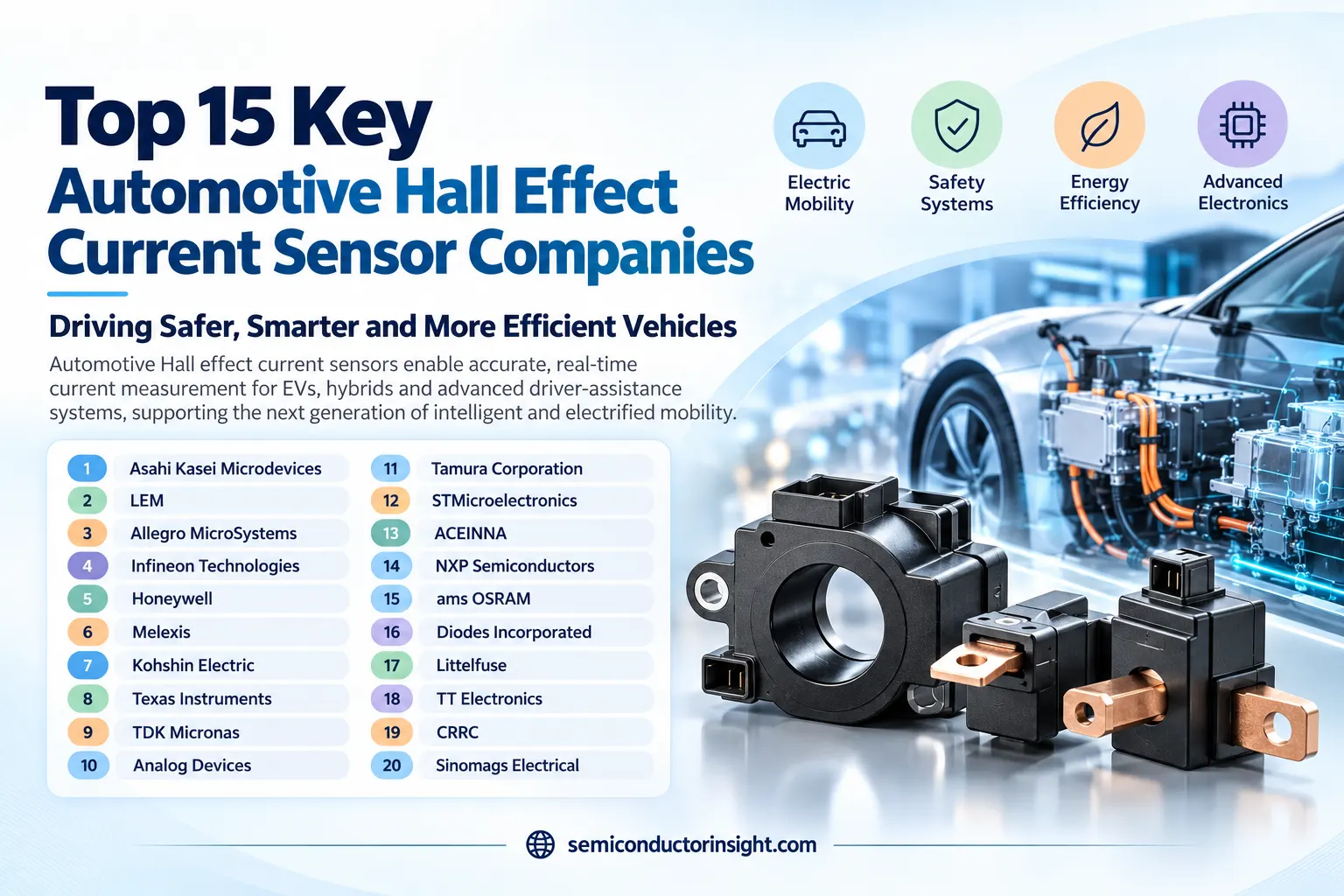
Top 15 Key Automotive Hall Effect Current Sensor Companies Powering the Transition to Electric and Hybrid Vehicle Platforms
Automotive Hall-effect current sensors measure electrical current by detecting the magnetic field generated around a conductor, delivering galvanic isolation without physical contact.
These devices sit at the heart of traction inverters, battery management systems, onboard chargers, and DC-DC converters in hybrid and battery-electric vehicles, enabling precise control of high-voltage power flows, rapid overcurrent protection, and efficient energy conversion across hundreds of amperes while surviving harsh under-hood conditions.
Asahi Kasei Microdevices
The next generation of silicon-carbide power modules, Asahi Kasei Microdevices develops coreless Hall sensing. The business finished a proof-of-concept with Silicon Austria Labs that integrates its EZ232L linear Hall IC directly into a power module for DC-DC converters and traction inverters, doing away with large magnetic cores and enabling lighter, more compact designs.
The CZ39 series, now in mass production, delivers a 100-nanosecond response time and a primary conductor resistance of just 0.3 milliohm, supporting continuous 40-ampere RMS operation at elevated temperatures while providing creepage and clearance suitable for systems above 650 volts. These sensors help OEMs shrink onboard charging systems and implement robust electronic fuses that react quickly during fault conditions.
LEM
LEM focuses on high-power traction-inverter applications with sensors engineered for extreme compactness and wide current ranges. Its HSTDR device measures only 29 mm by 21 mm by 12 mm and weighs 27 grams, offering selectable ranges from ±300 A up to ±1,500 A within the same housing while maintaining operation from –40 °C to +125 °C and withstanding vibration levels up to 10 G.
The sensor provides galvanic separation suitable for 800-volt battery architectures and delivers a global error below 3.5 percent across temperature and lifetime, allowing designers to free up space inside tightly packaged inverter enclosures without sacrificing measurement fidelity.
Allegro MicroSystems
Allegro MicroSystems continues to expand its integrated Hall-current portfolio with devices that address speed, density, and accuracy simultaneously. The ACS37200 senses bidirectional currents up to ±200 A through a 50-micro-ohm primary conductor housed in a compact PSOF-8 package that supports reinforced isolation, while the ACS37017 achieves a typical sensitivity error of 0.55 percent over temperature and lifetime with 750 kHz bandwidth and a 1-microsecond response. Factory-calibrated and AEC-Q100 Grade 0 qualified, these sensors replace discrete shunt-plus-isolation combinations, reducing board area and simplifying safety certification for traction inverters, onboard chargers, and high-voltage DC-DC converters.
Infineon Technologies
Infineon’s XENSIV TLE4973 family of coreless Hall sensors combines an internal current rail with digital diagnostics and ASIL-B support in a TISON package. Devices such as the TLE4973-R120T5 measure up to ±132 A with 1.7 percent accuracy, offer 1150-volt isolation, and include overcurrent detection plus a digital control interface for temperature and safety-status readout. Evaluation boards such as the TLE4973-MS2GO enable rapid prototyping for one-phase systems up to 25 A, while the sensors themselves target electric drivetrains, onboard battery chargers, and battery-management systems that require both analog output and programmable diagnostics.
Honeywell
Honeywell supplies robust Hall-based current transducers used in fleet-electrification and high-reliability automotive power systems. Its sensor families support a range of open- and closed-loop architectures that deliver stable performance under continuous high-current loads and wide temperature swings. These devices are frequently specified for applications requiring long-term stability and immunity to external magnetic interference, complementing the company’s broader portfolio of sensing solutions for electrified vehicle platforms.
Melexis
Melexis expanded its isolated current-sensor range in 2026 with the MLX91224 (5 V) and MLX91225 (3.3 V) platform, offering continuous measurement up to 100 A RMS across three SOIC package variants. The DE and DG packages support 50 A RMS continuous current, while the DH package reaches 100 A RMS with surge capability up to ±29 kA and working voltages up to 1640 V RMS. Developed as ISO 26262 Safety Elements out of Context with ASIL-B readiness, the devices integrate the current conductor, Hall element, signal conditioning, and isolation, delivering 400 kHz bandwidth and 2-microsecond response for traction inverters, DC-DC converters, and onboard chargers.
For a more thorough report, please contact us using our most recent report: https://semiconductorinsight.com/report/automotive-hall-effect-current-sensor-market/
Kohshin Electric
Kohshin Electric maintains a broad lineup of open-loop Hall-effect current sensors covering detection ranges from 1 A to 4000 A. The HC and HP series convert magnetic fields generated by input current into voltage outputs using Hall elements or Hall ICs, offering compact construction, low power consumption, and high overcurrent tolerance. These sensors serve industrial and automotive environments where simple, reliable non-contact measurement is required across both AC and DC waveforms.
Texas Instruments
Texas Instruments introduced the TMCS2100-Q1, the first multiaxial coreless Hall-effect current sensor designed specifically for HEV and EV traction inverters. By measuring magnetic fields in both horizontal and vertical directions and applying a proprietary algorithm, the device achieves displacement error below 1 percent at 0.4 mm movement and as low as 0.25 percent at 0.1 mm, delivering approximately twenty times greater accuracy than single-axis coreless alternatives. Production quantities became available in 2026, enabling more compact inverter designs with reduced crosstalk and torque ripple.
TDK Micronas
TDK’s Micronas division released the CUR 3020, a programmable linear Hall-effect current-sensor IC optimized for C-core concentrators. Manufactured at the company’s Freiburg facility, the device offers selectable bandwidths of 250 kHz or 500 kHz, sensitivity ranges from 4.2 to 67.4 mV/mT, and maximum sensitivity drift of 1 percent across –40 °C to 150 °C. Housed in a four-pin TO-92 package, it targets xEV traction inverters, battery-management systems, and high-power conversion modules that require low-noise, high-accuracy measurement.
Analog Devices
Analog Devices contributes precision signal-chain solutions that complement Hall-effect current sensing in automotive power systems. Its portfolio includes devices used for accurate amplification and conditioning of magnetic-sensor outputs, supporting high-resolution measurement in battery-management and inverter-control loops where low offset and temperature stability are essential.
Tamura Corporation
Tamura offers a comprehensive range of open-loop, closed-loop, and fluxgate current sensors spanning 3 A to 2500 A. Open-loop Hall-effect devices provide compact, cost-effective measurement, while closed-loop variants deliver higher accuracy and faster response for motor-control units and battery-management systems. Fluxgate sensors add ultra-high accuracy and temperature stability for onboard chargers and precision inverters, giving vehicle designers multiple technology options within a single supplier ecosystem.
STMicroelectronics
STMicroelectronics has developed X-Hall broadband current sensors fabricated in its BCD10 process and packaged in both ceramic CLCC and plastic QFN formats. Experimental evaluation of the CH10 variant in low-gain mode demonstrated an input-referred noise of 0.17 mT and a 60 dB dynamic range, with the sensors validated for phase-current monitoring and overcurrent protection inside silicon-carbide traction inverters. These efforts support higher-bandwidth sensing required by fast-switching power stages.
ACEINNA
ACEINNA specializes in high-bandwidth current sensors optimized for inverter applications. Its MCx1101 family targets demanding power-electronics environments where rapid response and accurate measurement under high di/dt conditions are critical, supporting the transition to higher-frequency switching in electric-drive systems.
NXP Semiconductors
NXP provides magnetic sensing solutions that integrate Hall-effect technology into broader automotive control architectures. Its devices contribute to current and position sensing within electrified powertrains, leveraging the company’s expertise in functional-safety and high-reliability automotive semiconductors.
ams OSRAM
ams OSRAM supplies Hall-based sensing components used in automotive current-measurement chains. The company’s magnetic-sensor technologies support precise detection in power-conversion and battery systems, aligning with the growing need for compact, isolated sensing in high-voltage vehicle architectures.
Diodes Incorporated
Diodes Incorporated offers Hall-effect current-sensor ICs suitable for automotive power-management applications. These devices provide cost-effective, board-mount solutions for monitoring currents in DC-DC converters, chargers, and auxiliary systems where space and simplicity are priorities.
Littelfuse
Littelfuse contributes current-sensing solutions that complement its broader portfolio of circuit-protection devices. Hall-effect sensors from the company support overcurrent detection and system monitoring in electrified vehicle platforms, helping integrate sensing and protection functions.
TT Electronics
TT Electronics supplies specialized current sensors for demanding automotive and industrial environments. Its Hall-effect products address applications requiring robust performance under vibration, temperature extremes, and high current levels typical of electric-vehicle power systems.
CRRC
CRRC develops Hall-effect current sensors used in electric and hybrid vehicle platforms, particularly within Chinese and broader Asian supply chains. The company’s sensors support traction and auxiliary power systems that demand reliable, high-current measurement under real-world operating conditions.
Sinomags Electrical
Sinomags Electrical focuses on magnetic current sensors for automotive and industrial power applications. Its Hall-effect devices serve high-volume electrification programs that require scalable, isolated sensing solutions for battery and inverter systems.

Comments (0)