

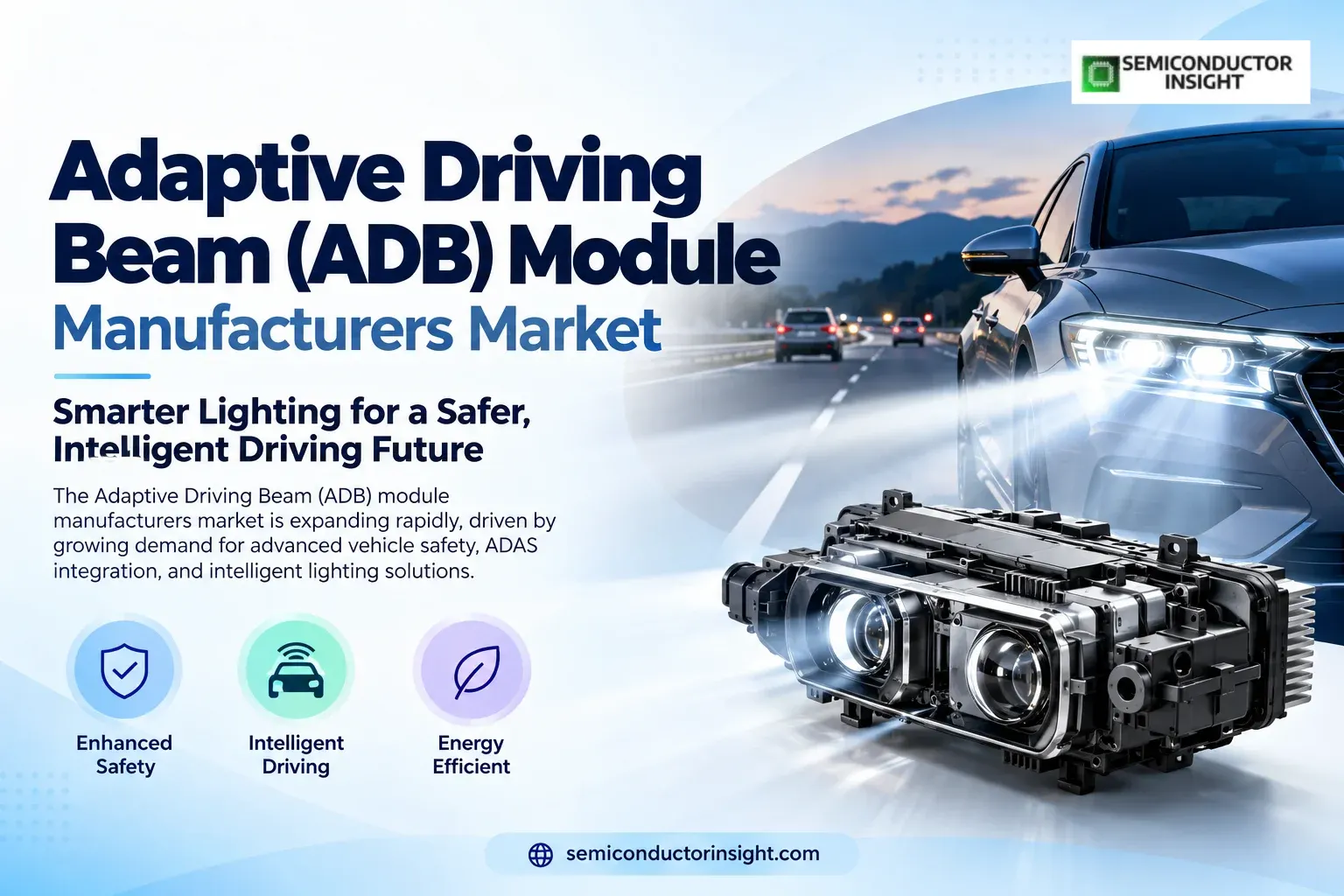
Top 10 Key Adaptive Driving Beam (ADB) Module Manufacturers Leading the Automotive Smart Lighting Market
As vehicles demand sharper nighttime vision without blinding others, Adaptive Driving Beam (ADB) modules have moved from premium options to essential safety hardware. These systems use camera-linked LED arrays or micro-pixel sources to shape high beams in real time masking oncoming traffic, highlighting pedestrians, and even projecting guidance marks on the road.
The following profiles highlight the companies driving the most advanced, production-ready ADB solutions right now, focusing on pixel density, real-world vehicle integrations, optical performance, and the latest 2025-2026 deployments that are changing how drivers experience the road after dark.
OSRAM
OSRAM stands at the center of high-resolution ADB through its EVIYOS HD25 platform, which packs 25,600 individually controllable pixels into a compact LED-IC hybrid. The second-generation version pairs with a companion ASIC and supports both precise glare-free high-beam shaping and direct road-surface projection of safety symbols. In 2025 the technology reached series production inside Marelli’s h-Digi microLED modules fitted to the NIO ET9, where the system extends maximum high-beam reach from the conventional 350-400 meters out to 500 meters and boosts low-beam ground brightness by 50 percent, stretching useful illumination from 50 meters to 70 meters at mid-to-low speeds.
The same pixel array earned its development team the German Future Award 2024 for turning headlights into digital projectors. OSRAM’s OSLON Compact series further supports matrix ADB architectures with high-luminance rectangular chips that enable ultra-slim headlamp packages as low as 10 mm high while maintaining uniform output free of dark zones. These capabilities keep the company central to the shift toward fully software-defined, region-specific light distributions that adapt instantly to traffic, weather, and road geometry.
Samsung Semiconductor
Samsung Semiconductor’s PixCell LED delivers a monolithic array of 100 addressable segments separated by silicon walls that achieve a 300:1 contrast ratio nearly three times higher than many discrete-LED alternatives. Pixel-to-pixel spacing drops to 25 µm, allowing tighter packing and a light-emitting surface only 15.4 mm by 2.7 mm. The resulting module can shrink overall headlamp volume by 30-50 percent while supporting low-beam, high-beam, and full ADB functions from a single source.
Early shipments already equipped more than 300,000 electric vehicles, and the architecture lets lamp makers tune beam patterns via software to satisfy differing regional regulations without redesigning the optical hardware. In current applications the high contrast sharply reduces glare leakage, giving drivers clearer forward vision while keeping oncoming traffic free of dazzle exactly the performance ADB systems must deliver as they expand beyond premium segments.
Take a Quick Glance at Our In-Depth Analysis Report: https://semiconductorinsight.com/report/adaptive-driving-beam-adb-module-market/
Marelli
Marelli’s h-Digi microLED modules have become a production bridge between ultra-high-resolution sources and real vehicles. Each module houses ams OSRAM’s EVIYOS HD25 array of 25,600 pixels (or the 19,200-pixel 1:3 aspect-ratio variant) and weighs only about 600 g with a compact 40 × 50 mm lens footprint. In 2025 the system entered the Chinese luxury segment on the NIO ET9, delivering dynamic bending light linked to steering angle, precise shadow zones that move with detected vehicles, and sharp road projections for car-to-X communication.
Marelli pairs the optics with its own high-definition electronic control unit and proprietary rendering algorithm, enabling functions such as town, country, motorway, and adverse-weather distributions from the same hardware. After earlier European OEM programs, the NIO application marks the first micro-LED lighting system from Marelli on a Chinese flagship, proving the platform can scale from premium to broader volume vehicles while preserving pixel-level control and energy efficiency.
Koito Manufacturing
Koito began volume production of Japan’s first high-definition ADB headlamp in May 2026, fitting a 16,000-microLED array into the new Lexus ES. The system individually switches each microLED so that the masked zone around an oncoming or preceding vehicle shrinks to the exact size of the detected object; pedestrians receive reduced intensity rather than full cutoff. Compared with earlier 12-segment ADB designs, the finer pixel grid keeps more of the roadway illuminated between vehicles and extends the driver’s useful visual range.
Additional software layers allow animated start-up sequences and future road-projection features. Koito’s earlier BladeScan ADB already demonstrated residual-image scanning that delivers the equivalent of 300 LEDs from only 12 physical sources and enables detection of roadside pedestrians at 56 meters. The new 16,000-pixel production line therefore continues a clear trajectory toward ever-tighter control of glare-free high beam while adding expressive lighting modes that enhance both safety and brand identity.
Hella GmbH & Co. KGaA
Hella’s SSL|HD matrix modules push pixel counts toward 25,000 individually addressable points per chip, supporting full software-defined light distributions, symbol projection, and lane-assist highlighting. The BiMatrix family offers a more accessible path with up to 17 matrix zones in a classic projection-lens format that still delivers selective masking and speed-adaptive patterns. Hella systems already appear on multiple European platforms (including matrix configurations with 18, 25, or 84 LEDs on models from Mercedes-Benz, Audi, and BMW) and are prepared for U.S.
ADB activation once vehicle-level certification is complete. In 2026 demonstration vehicles such as the Lincoln Navigator show continuous high-beam illumination reaching 350-500 feet while maintaining precise shadow zones. Hella’s control software can be tuned per OEM specification, allowing the same hardware to meet differing regional rules and to support over-the-air updates that refine beam behavior after the vehicle leaves the factory.
Changzhou Xingyu Automotive Lighting Systems
Xingyu supplies complete ADB headlamp systems that combine its own multi-pixel modules with external high-resolution imaging units. Production offerings include low-pixel (8-32) reflective or electronic-follow-up modules that create dark zones as narrow as 1.2 degrees, mid-range 84-100 pixel arrays for finer anti-glare control and steering-linked bending light, and integrated solutions paired with million-pixel DLP or smart modules for road projection.
On the AITO (Huawei) Wenjie M9 and M8 the company delivers 84-pixel ADB coordinated with Huawei’s imaging hardware, supporting dynamic light carpets, parking-light languages, game-mode projections, and more than ten animated welcome sequences that can be updated over the air. The same platform uses CAN-FD communication and daisy-chain architecture to refresh more than 1,000 front-and-rear signal pixels at 25 frames per second, giving designers smooth interactive lighting while the ADB core keeps the high beam active and glare-free.
Shenzhen Refond Optoelectronics
Refond’s automotive-grade ADB modules rely on chip-on-board construction with self-developed direct-plated ceramic substrates and eutectic bonding. Integrated driver ICs and laser-wall isolation achieve pixel pitches below 80 µm, eliminating side-light crosstalk and simplifying secondary optics. Available configurations span 102, 84, 48, and 24 pixels, letting manufacturers match cost and performance to different vehicle segments.
The modules automatically extinguish selected high-beam zones when oncoming or preceding traffic is detected, delivering finely graduated illumination that improves both safety and visual comfort. Because the light source and driver are combined, overall lamp cost drops while packaging remains compact enough for contemporary slim headlamp designs supporting the ongoing domestic substitution of imported ADB components in Chinese vehicle programs.
Lextar
Lextar contributes high-brightness LED arrays and matrix sources optimized for adaptive beam control. Its automotive LED packages support multi-segment ADB architectures that require precise current control and thermal stability under continuous high-beam duty cycles. Modules built around Lextar emitters appear in systems that balance lumen output with compact footprints, enabling headlamp designers to maintain optical performance while meeting increasingly strict energy budgets on electric platforms.
The company’s focus on uniform luminance and reliable long-term operation under vibration and temperature extremes keeps its components relevant for both discrete multi-LED matrices and higher-density pixel approaches entering volume production in 2026.
Lattice Power
Lattice Power specializes in GaN-based LED chips that deliver the high luminance and switching speed required for rapid pixel-level ADB modulation. Its emitters form the foundation of matrix modules that must turn individual zones on and off within milliseconds as cameras detect changing traffic.
The technology supports both mid-range pixel counts used in volume vehicles and the denser arrays needed for high-definition road projection. By concentrating on die-level performance and reliability, Lattice Power supplies the semiconductor building blocks that allow lighting-system integrators to achieve the contrast ratios and response times demanded by current ADB regulations and OEM specifications.
Wuxi Yingdixin Microelectronics Technology
Yingdixin develops the driver and control electronics that sit between camera inputs and LED pixel arrays. Its microelectronic solutions manage independent current channels for dozens to hundreds of segments, implement real-time beam-shaping algorithms, and interface with vehicle networks for over-the-air updates. In ADB modules these ICs ensure that each pixel responds accurately to object detection data, maintaining stable light output while minimizing power draw and thermal load.
As pixel densities rise and software-defined lighting expands, Yingdixin’s control silicon becomes an essential enabler for the precise, low-latency operation that distinguishes modern adaptive systems from earlier matrix designs.

Comments (0)