

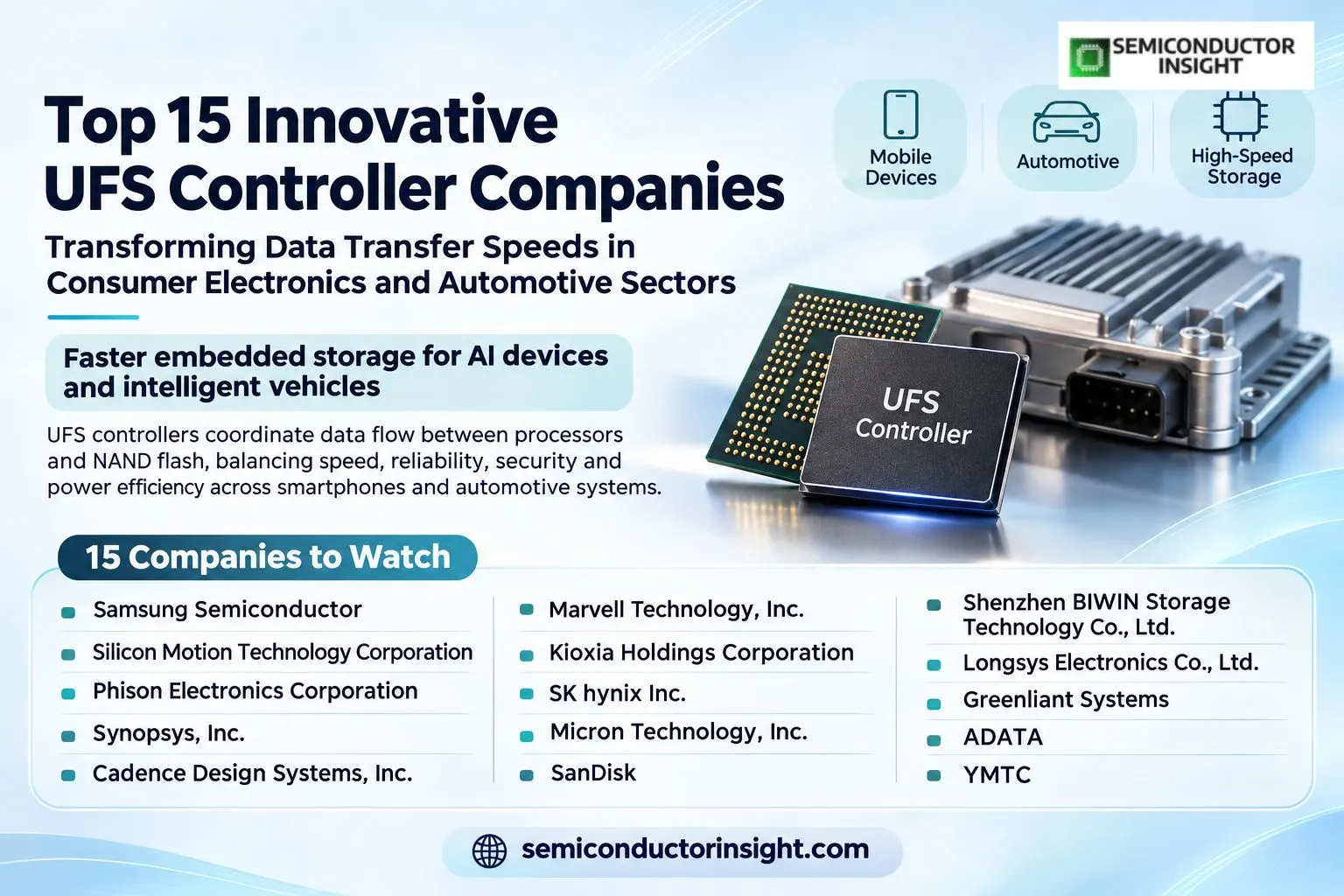
Top 15 Innovative UFS Controller Companies Transforming Data Transfer Speeds in Consumer Electronics and Automotive Sectors
UFS controller market is developing around a more demanding generation of embedded storage. A UFS controller is responsible for coordinating communication between a host processor and NAND flash memory while managing error correction, data placement, wear levelling, command queues, security and power consumption. Its design affects how quickly a smartphone launches applications, how efficiently an automotive system retrieves stored information and how reliably an embedded device handles continuous data activity.
Samsung Semiconductor – Advancing Integrated UFS 4.1 for AI Smartphones and Automotive Computing
Samsung’s strength comes from controlling several important parts of the UFS supply chain, including V-NAND, controller development, firmware and packaged embedded storage. Its UFS 4.1 portfolio reaches capacities of 256GB, 512GB and 1TB, using a compact 9 × 13 × 0.8 mm package for mobile applications.
The automotive range is particularly significant, offering up to 4,300 MB/s read performance and operating-temperature support extending from -40°C to 105°C. Its focus on AI smartphones, foldable devices, ADAS and connected infotainment makes Samsung an important integrated competitor as UFS moves beyond conventional mobile storage.
Silicon Motion Technology Corporation – Turning Merchant Controllers into an AI Storage Opportunity
Silicon Motion is one of the most directly relevant companies in this market because its business includes standalone UFS controller development. At COMPUTEX 2026, it showcased the SM2755 UFS 4.1 controller alongside its embedded eMMC portfolio, targeting mobile devices and edge AI systems. Its earlier SM2756 UFS 4.0 controller demonstrated sequential read and write performance of up to 4,300 MB/s and 4,000 MB/s, respectively.
The company’s LDPC error-correction technology, NAND compatibility and low-power firmware are important differentiators for manufacturers that want to combine NAND from different suppliers with a merchant controller rather than develop the complete storage architecture internally.
Phison Electronics Corporation – Extending UFS Controller Design into Flagship and Automotive Devices
Phison has built a substantial position in UFS controller development through its PS-series portfolio. Its PS8363 supports UFS 4.1, capacities from 256GB to 1TB and sequential read performance of up to 4,300 MB/s. Automotive versions support operating temperatures reaching 105°C and AEC Grade 2 qualification, making the controller relevant to demanding in-vehicle applications. Phison’s 2026 shareholder documentation also reported the development of UFS 4.1 controllers PS8361 and PS8363, alongside the UFS 3.1 PS8329 built on a 22nm process. The company reported 2,144 approved patents by December 2025, reflecting the importance of continued controller and firmware investment.
Synopsys, Inc. – Supplying the Host-Side IP That Makes UFS Integration Possible
Synopsys occupies a different position from companies selling finished UFS storage packages. Its DesignWare UFS Host Controller IP is intended for integration into application processors and other system-on-chip designs. The current product information lists compliance with UFSHCI v5.0 and integration with MIPI UniPro v3.0 and M-PHY v6.0 technology, supporting HS-Gear6 operation across up to two lanes.
Security features include AES-XTS inline encryption and Replay Protected Memory Block support. This combination is relevant to chip designers developing mobile and automotive processors, where the host controller must communicate reliably with external UFS memory while supporting power management and data protection.
Cadence Design Systems, Inc. – Strengthening UFS Verification before Silicon Production
Cadence contributes through verification technology rather than merchant UFS controller chips. Its UFS Verification IP helps semiconductor design teams test host controllers, UFS devices, PHYs and UniPro interfaces before committing a design to silicon. The platform supports multiple generations of the JEDEC UFS specification, including UFS 4.0, and covers command handling, task management, boot functions, security operations and error recovery.
Its verification environment also supports shared and per-logical-unit command queues. This matters because a high-speed UFS interface must be validated across normal transactions, low-power transitions and unexpected fault conditions, not simply demonstrated through peak bandwidth figures.
Marvell Technology, Inc. – An Adjacent Storage Semiconductor Player
Marvell is relevant to the broader controller and storage semiconductor landscape through its expertise in data movement, connectivity and storage processing. However, its publicly documented current portfolio does not establish a dedicated merchant UFS controller product comparable to Silicon Motion’s SM2755 or Phison’s PS8363.
It is therefore more appropriate to treat Marvell as an adjacent semiconductor participant than to describe it as a direct UFS controller supplier. For market analysis, its relevance lies in the wider controller technologies and system-level storage requirements that influence embedded computing, automotive electronics and connected devices.
Kioxia Holdings Corporation – Bringing QLC Architecture into UFS 4.1
Kioxia is an important integrated UFS manufacturer because it combines BiCS FLASH NAND with internally designed controller technology. A notable 2026 development was its sampling of QLC-based UFS 4.1 devices using eighth-generation BiCS FLASH. QLC stores four bits per cell, allowing higher storage density than conventional TLC designs.
The development is particularly relevant to mobile applications requiring greater capacity without a proportionate increase in package size. Kioxia’s wider UFS 4.1 portfolio includes 256GB, 512GB and 1TB options, while its automotive devices extend to 128GB and support applications such as ADAS, telematics and vehicle computers.
SK hynix Inc. – Combining 4D NAND with High-Capacity UFS Packages
SK hynix brings vertically integrated NAND and controller expertise to embedded UFS storage. Its UE400 UFS 4.0 product uses seventh-generation V7 4D NAND and is available in capacities from 256GB to 1TB. The company identifies performance improvements of approximately two times over its UFS 3.1 generation, reflecting the importance of NAND architecture and controller optimisation working together.
Its automotive UFS portfolio also addresses applications where storage must operate reliably under demanding temperature and usage conditions. As intelligent cockpits and advanced driver-assistance systems generate more local data, SK hynix’s combination of NAND technology and embedded controller design remains commercially relevant.
Micron Technology, Inc. – Bringing G9 NAND into Automotive and AI-Oriented UFS
Micron’s UFS strategy is increasingly connected to its G9 NAND generation and the storage demands of AI-enabled devices. Its mobile UFS 4.1 development delivers sequential read and write speeds exceeding 4,100 MB/s, with capacities extending up to 1TB. In automotive storage, Micron has introduced a G9 NAND-based UFS 4.1 solution featuring ASIL-B compliance, ASPICE certification, cybersecurity provisions and enhanced thermal protection.
These capabilities address the requirements of intelligent vehicle systems, where storage supports infotainment, software updates and data-intensive computing. Micron’s focus on firmware optimisation alongside NAND technology also shows how controller behaviour can differentiate otherwise similar embedded memory capacities.
You Can Go Through Our Latest Updated Insights Here: https://semiconductorinsight.com/report/ufs-universal-flash-storage-controller-market/
SanDisk – Carrying Forward Western Digital’s iNAND Embedded Flash Business
Western Digital’s former flash business became an independent company, SanDisk, in February 2025. This distinction is important when assessing the current UFS supplier landscape: the historical iNAND portfolio should no longer be attributed to Western Digital’s continuing HDD business.
The former Western Digital embedded flash portfolio included UFS 3.1 devices such as the iNAND MC EU551, with capacities from 128GB to 512GB, alongside other UFS generations. Its vertical integration model combined NAND, firmware, controller design and software into compact embedded products. SanDisk is therefore the more relevant company to track for continuity of this flash-storage business.
Shenzhen BIWIN Storage Technology Co., Ltd. – Moving from UFS Product Integration to Proprietary Controller Development
BIWIN’s development is notable because it is moving beyond assembling embedded memory products around externally sourced components. Its 2026 Hong Kong listing application describes eight independently designed controller chips, with six commercialised across USB, SD, eMMC, UFS and SSD products. It also reported more than 250 million units of self-designed controller chips produced by April 30, 2026. The company has commercialised UFS 4.1 products based on its own controller technology and is using hybrid TLC and QLC architectures. This vertical integration gives BIWIN greater control over firmware customisation, product differentiation and compatibility with different NAND suppliers.
Longsys Electronics Co., Ltd. – Bringing the WM7400 Controller into Automotive UFS
Longsys has been expanding its in-house controller programme through its FORESEE storage business. Its WM7400 controller supports the company’s UFS 4.1 development, with a reported sequential read speed of up to 4,350 MB/s, random write performance of 750K IOPS and capacity support reaching 2TB in its announced UFS 4.1 solution. In June 2026, Longsys also introduced an automotive UFS 4.1 product using its self-developed 5nm WM7400 controller, reporting read and write speeds of up to 4,200 MB/s and 4,000 MB/s. Its work on automotive-grade storage for ADAS and intelligent cockpits makes it an increasingly relevant emerging controller developer.
Greenliant Systems – Bringing Industrial NAND Controller Expertise to the Wider Embedded Storage Ecosystem
Greenliant’s contribution is best understood through its industrial NAND controller and embedded storage expertise rather than a confirmed current UFS controller product. Its NANDrive portfolio combines NAND flash with integrated controllers and supports interfaces including eMMC, NVMe, PATA and SATA. Selected devices range from 1GB to 512GB, with product features such as error correction, wear levelling and bad-block management. These capabilities are relevant to industrial computing, transportation, medical equipment and networking systems, where long operating life and data integrity matter more than headline interface speed. Greenliant is an adjacent embedded-storage participant, not a directly verified UFS controller leader.
ADATA – Extending UFS 3.1 into Industrial and High-Performance Embedded Applications
ADATA has a clearly documented UFS 3.1 product range through its embedded storage portfolio. Its AEU3 series covers 128GB, 256GB and 512GB capacities, using 3D TLC NAND in a 153-ball BGA package. The devices support sequential read speeds of up to 2,254 MB/s and write speeds of up to 1,971 MB/s, alongside LDPC error correction, bad-block management, garbage collection and TRIM. The inclusion of temperature-event notifications, power-off notifications and device-life-span reporting is particularly relevant to embedded equipment. ADATA’s positioning spans smartphones, tablets, industrial controllers, networking equipment and surveillance systems.
YMTC – Building Embedded UFS around Xtacking NAND Technology
YMTC is an important participant in China’s embedded flash supply chain through its Xtacking NAND architecture and UFS products. Its UC260 UFS 2.2 device is available in 128GB, 256GB and 512GB capacities, with sequential read and write speeds of up to 1,050 MB/s and 950 MB/s. It also supports Write-Booster+ and HPB 2.0+ features, which help improve storage responsiveness. YMTC’s use of a single flash interface channel is designed to reduce power consumption, with the company reporting a 30% reduction for the UC260 architecture. Its product strategy is relevant to smartphones, tablets and other intelligent devices seeking compact, cost-conscious embedded storage.
What These Company Developments Reveal About UFS Controller Competition?
The strongest competitive shift is towards controller differentiation rather than interface speed alone. UFS 4.1 products are now appearing across merchant-controller suppliers, vertically integrated NAND manufacturers and specialist storage companies. At the same time, automotive qualification, QLC support, firmware-level optimisation and low-power operation are becoming important purchasing considerations.
For semiconductor suppliers, the opportunity is no longer limited to supplying a controller that meets a particular JEDEC specification. It increasingly involves delivering a validated storage subsystem that combines NAND compatibility, error correction, security, thermal management and predictable performance across the full device lifecycle.

Comments (0)