

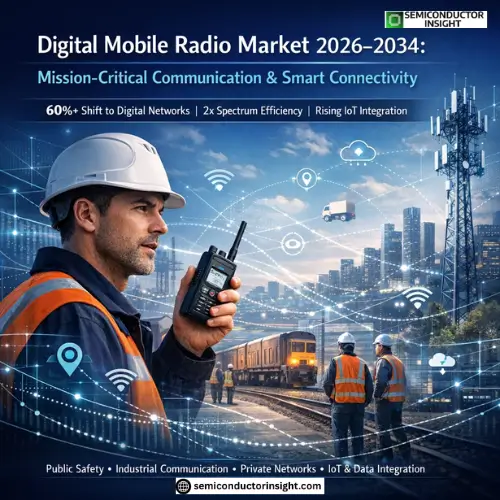
Top Digital Mobile Radio (DMR) Market Trends Reshaping Industrial and Public Safety Networks
Digital Mobile Radio (DMR) Market is quietly becoming a cornerstone of mission-critical communication across industries where reliability is non-negotiable. Unlike traditional analog systems, DMR technology offers enhanced spectrum efficiency, better voice clarity, and integrated data capabilities features that are increasingly essential in today’s connected operations.
Globally, more than 60% of industrial communication networks are now transitioning toward digital formats, with DMR leading adoption in sectors like utilities, transportation, and manufacturing. Its ability to operate in challenging environments with minimal infrastructure dependency makes it particularly valuable in regions where cellular coverage remains inconsistent.
Where DMR Is Making the Biggest Impact?
One of the strongest growth pockets for Digital Mobile Radio (DMR) Market lies in public safety and emergency response systems. Police, fire services, and disaster management teams rely on DMR for uninterrupted communication, especially during large-scale emergencies.
For example, during recent flood response operations in parts of Southeast Asia, DMR systems supported over 70% of field communication traffic, ensuring coordination between rescue teams even when conventional networks were down.
In the transportation sector, rail and metro networks are increasingly deploying DMR to manage operations. A single urban rail system can support thousands of connected radios, enabling real-time communication between drivers, control rooms, and maintenance teams.
Spectrum Efficiency Is Becoming a Strategic Advantage
A defining feature of DMR technology is its two-slot Time Division Multiple Access (TDMA) capability. This effectively doubles channel capacity without requiring additional spectrum a critical advantage as spectrum availability becomes more constrained globally.
In practical terms, organizations using DMR can achieve up to 2x communication capacity within the same bandwidth compared to analog systems. This is particularly beneficial for large enterprises managing fleets of devices, where communication density directly impacts operational efficiency.
You can freely browse our most recent updated relevant report to learn more about it before scrolling further:
https://semiconductorinsight.com/report/hand-portable-digital-mobile-radio-market/
Integration with Data and IoT Systems Is Unlocking New Value
- Digital Mobile Radio (DMR) Market is no longer limited to voice communication. Modern DMR systems now support text messaging, GPS tracking, telemetry, and IoT integration, making them a hybrid communication solution.
- Industries such as oil & gas and mining are leveraging DMR-enabled sensors to monitor equipment and worker safety.
- In some deployments, over 40% of DMR network usage is now attributed to data transmission rather than voice alone.
- A notable instance is smart utility grids, where DMR networks are used to connect field devices across vast geographies. These systems enable faster fault detection and response, reducing downtime significantly.
Private Networks Are Driving Enterprise Adoption
As enterprises seek greater control over communication infrastructure, private DMR networks are gaining traction. Unlike public cellular networks, DMR systems offer dedicated, secure, and interference-free communication channels.
Large manufacturing facilities, for instance, often deploy DMR networks to manage operations across multiple units. A single plant may operate hundreds to over 1,000 radio endpoints, ensuring seamless coordination across departments.
This shift toward private communication ecosystems aligns with broader Industry 4.0 trends, where reliability, latency, and security are critical parameters.
Hardware Innovation Is Enhancing User Experience
Device manufacturers are continuously improving DMR radios with features such as rugged designs, extended battery life, and enhanced audio processing. Modern devices can operate for over 12-16 hours on a single charge, making them suitable for long operational shifts.
Additionally, advancements in noise cancellation technology have improved voice clarity in high-noise environments like construction sites and factories, where traditional communication tools often fail.
Interoperability Is Expanding Deployment Flexibility
- One of the key strengths of Digital Mobile Radio (DMR) Market is its adherence to open standards.
- This allows interoperability between devices from multiple vendors, reducing vendor lock-in and enabling flexible network expansion.
- Organizations can scale their communication systems incrementally, adding new devices or upgrading infrastructure without complete overhauls.
- In large-scale deployments, this flexibility can reduce transition complexity by 30% or more.
Recent deployments across smart cities and industrial corridors highlight the growing relevance of DMR. For instance, several urban infrastructure projects have integrated DMR systems to manage utilities, traffic coordination, and emergency services under a unified communication framework.
In logistics hubs, where coordination across warehouses, transport fleets, and security teams is critical, DMR networks are handling thousands of daily communication exchanges, ensuring operational continuity.

Comments (0)