

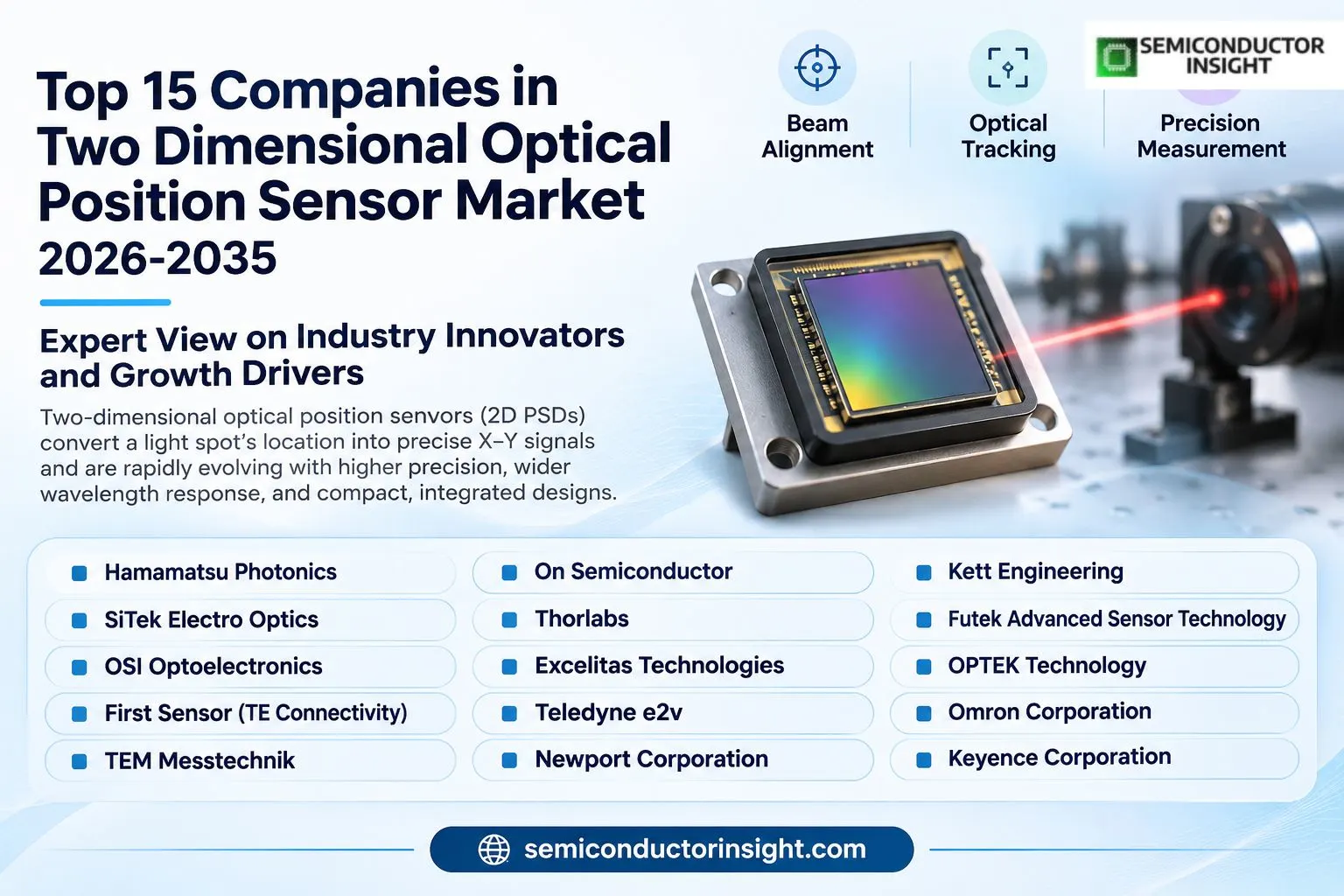
Top 15 Companies in Two Dimensional Optical Position Sensor Market 2026-2035: Expert View on Industry Innovators and Growth Drivers
Two-dimensional optical position sensors convert the location of a light spot into electrical signals that identify its position along two perpendicular axes. A key technology in this category is the position-sensitive detector (PSD), which can provide continuous position information without dividing the sensing surface into individual pixels. These sensors are used in laser-beam alignment, optical tracking, displacement measurement, precision positioning, machine calibration, and laboratory instrumentation.
An important distinction matters when evaluating this market: a company that manufactures a two-dimensional PSD is not automatically equivalent to a company that supplies a complete optical measurement system or distributes PSD components.
The ranking below therefore gives priority to companies with identifiable two-axis PSD products, followed by specialist optical detector suppliers and companies whose products address closely related optical-position measurement requirements. Where direct PSD participation is not established, I identify that distinction rather than presenting an adjacent supplier as a confirmed PSD manufacturer.
Hamamatsu Photonics – Setting the benchmark for commercial two-dimensional PSDs
Hamamatsu Photonics has one of the clearest positions in this market through its dedicated two-dimensional PSD portfolio. Its products are designed to deliver continuous X–Y position information rather than pixel-based measurements, making them suitable for laser alignment, optical tracking, displacement monitoring, and pointing applications. The company’s S2044 detector has a 4.7 × 4.7 mm photosensitive area, a typical rise time of 0.3 μs, and a spectral response from 340 to 1,060 nm.
A particularly relevant 2026 development is Hamamatsu’s expanded surface-mount PSD offering. Its S15534 and S15535 devices use glass-epoxy packaging and support lead-free reflow soldering. The two models provide active areas of 4 × 4 mm and 9 × 9 mm, respectively, with typical position resolutions of 0.7 μm and 1.5 μm. This packaging direction is important for equipment manufacturers seeking to integrate optical position sensing into smaller electronic assemblies rather than relying exclusively on separately mounted detector components.
SiTek Electro Optics – A specialist portfolio built around lateral-effect detection
SiTek Electro Optics is a specialist supplier whose product identity is closely connected to lateral-effect position sensing. Its two-dimensional PSD range is available in several active-area formats, including 2 × 2 mm, 4 × 4 mm, 10 × 10 mm, 20 × 20 mm, and 45 × 45 mm. This range allows system designers to select detectors for compact optical assemblies as well as larger beam-position measurement arrangements. SiTek’s portfolio also includes one-dimensional detectors, PSD arrays, and supporting electronics.
The company’s relevance extends beyond the detector chip itself. Its PSD technology is offered through specialist distribution and signal-processing channels, including SiTek-compatible evaluation electronics. The availability of different detector sizes and customized configurations is useful in applications where optical spot dimensions, measurement travel, and installation geometry vary substantially. Although a distinct 2026 product launch was not verified, its multi-format PSD range remains an important reference point in the specialist supplier landscape.
OSI Optoelectronics – Extending two-axis detection into visible and short-wave infrared
OSI Optoelectronics strengthened its position in February 2026 with the launch of its APX-VNG0031PSD two-dimensional extended-visible InGaAs detector series and the companion E-VNG0031PSD analog modules. The devices feature a 2 mm-diameter active area, a spectral response spanning 400–1,700 nm, and a specified position-detection error of 20 μm. This broad wavelength coverage is particularly relevant where conventional silicon PSDs do not provide the required response at longer near-infrared wavelengths.
The accompanying module integrates transimpedance amplifiers and offers a 5 MHz cutoff frequency, SMA input/output connections, and optical mounting compatibility. OSI identifies applications including optical-axis alignment, free-space communication, range finding, beam stabilization, and target tracking. The 2026 launch is a meaningful product-level development because it brings both the detector and its signal-conditioning electronics into the same purchasing discussion.
First Sensor – Established dual-axis silicon detector capability
First Sensor has a documented position-sensitive diode range based on silicon PIN detector technology. Its listed DL100-7 dual-axis devices use a 10 × 10 mm active area, equivalent to 100 mm², and are offered in three package formats: CERpin, CERsmdG, and LCC10. The company also lists an evaluation-board option, giving system developers a route to assess the detector before incorporating it into a larger optical measurement design.
An important corporate distinction is that First Sensor is now part of TE Connectivity. Its PSD product documentation remains accessible under the First Sensor name, while TE’s broader sensor portfolio covers industrial, medical, and mobility applications. This makes First Sensor a relevant established product-line participant, although a new 2026 two-dimensional PSD launch was not identified in the reviewed sources.
TEM Messtechnik – Turning beam position into multi-axis optical feedback
TEM Messtechnik occupies a specialist position in optical alignment and active beam stabilization. Its product range includes a PSD 2D detector for measuring horizontal and vertical beam displacement, as well as PSD 4D configurations that combine position and angular information. This is particularly relevant to laser laboratories and precision optical systems where a beam’s lateral movement and angular drift must be distinguished rather than treated as one measurement.
The company’s Aligna documentation specifies a standard position-detector area of 9 × 9 mm, with alternative detector areas of 2 × 2 mm and 12 × 12 mm also available. Its 4D detector configurations are designed to measure four quantities—X, Y, and two angular directions—with reported resolution specifications reaching below 10 nm and below 10 nrad in the high-precision version. These capabilities place TEM closer to a complete optical positioning-system supplier than a component-only PSD manufacturer.
OTRON Electronic Technology – Offering integrated two-dimensional PSD components
OTRON Electronic Technology has a dedicated two-dimensional PSD portfolio that includes tetra-lateral and lateral-effect detector designs. Its PSD100-IC uses a single resistive layer for one- and two-dimensional measurements, with a common cathode and four anodes for two-axis position detection. The manufacturer’s documentation identifies tool alignment, angular measurement, automatic range finding, levelling, and three-dimensional vision as relevant applications.
The company’s PSD100-SPB5 takes the product concept further by combining a two-dimensional PSD with a low-noise amplifier. It provides both analogue X–Y outputs and digital position information, with an RS-422 serial connection for communication with a PC. This combination can reduce the amount of external signal-conditioning work required by equipment developers. OTRON’s documented product range makes it a relevant additional supplier, although a separate 2026 launch announcement was not established in the sources reviewed.
Take a Quick Glance at Our In-Depth Analysis Report: https://semiconductorinsight.com/report/two-dimensional-optical-position-sensor-market-size/
Newport – Bringing two-axis PSDs into ready-to-use beam measurement systems
Newport is relevant because it offers complete beam-position measurement products rather than only standalone detector components. Its CONEX-PSD series provides X–Y laser-beam position information and integrates the detector with a controller and USB-based computer interface. The portfolio includes a silicon-based 9 × 9 mm detector operating across 320–1,100 nm and a germanium-based 10 × 10 mm version covering the near-infrared range.
The CONEX-PSD system supports 12-bit measurement resolution and reports position sensitivity of 1.5 μm for the silicon model under specified operating conditions. Newport also provides software and LabVIEW documentation, making the product relevant to laboratory automation and beam-stabilization installations. Its importance lies in simplifying integration: users can acquire position data without independently designing the complete detector-amplifier-controller chain.
LASER COMPONENTS – Connecting PSD detectors with signal-processing electronics
LASER COMPONENTS plays a commercially important role by connecting specialist PSD manufacturers with equipment builders that need detectors, evaluation electronics, and technical support. Its portfolio explicitly covers two-dimensional silicon PSDs, integrated signal-processing PSDs, PSD arrays, and evaluation electronics. The company also distributes products from SiTek Electro Optics, broadening access to detector formats and supporting components.
One differentiating product is the SPC-PSD, which combines a SiTek detector with four individual transimpedance preamplifiers—two for each measurement axis—along with sum and difference amplifiers. The circuit is mounted on a 20.5 × 20.5 mm ceramic substrate and has an average 3 dB bandwidth of approximately 400 Hz. This type of ready-to-use signal-processing arrangement is valuable because PSD performance depends not only on the photosensitive element but also on stable current measurement and signal conditioning.
iC-Haus – Integrating position detection and signal conditioning on one chip
iC-Haus is relevant to the broader optical position-sensing ecosystem through its iC-OD optical position-sensitive detector. The device integrates a position-sensitive photodiode with a low-noise current amplifier and includes filtering to suppress constant and low-frequency background light. The documented photodiode dimensions are 2.6 × 0.88 mm for the iC-OD and 8.4 × 0.88 mm for the longer iC-ODL version.
However, the product is not evidence of a current two-dimensional PSD portfolio. The iC-Haus distributor page identifies the iC-OD series as approaching end of life and advises against using it in new designs. Its relevance is therefore mainly in integrated, one-dimensional optical position detection and legacy motion or proximity sensor architectures—not as a direct competitor to manufacturers of two-axis lateral-effect PSDs.
Micro-Epsilon – Raising the performance bar for optical displacement measurement
Adjacent optical measurement supplier
Micro-Epsilon is an important adjacent participant because its laser triangulation, confocal, and optical displacement instruments address many of the same precision measurement environments in which PSDs are used. Its optoNCDT 5500 received a significant performance upgrade in 2026, reaching a measurement rate of up to 150 kHz across the full measuring range. The updated system also reports repeatability below 8 nm and ambient-light resistance up to 200,000 lux.
The company’s October 2026 confocal-chromatic line sensor development adds another relevant example. The CLI8500 series combines confocal measurement with line-profile capture, with specified Z-axis resolution of 0.2 μm and X-axis resolution of 2.7 μm. These are not two-dimensional PSD products, but they demonstrate how optical measurement suppliers are responding to demand for faster inspection and more detailed position and surface data in semiconductor, electronics, and battery production.
Renishaw – Advancing multi-degree-of-freedom optical positioning
Renishaw is relevant through optical encoder and laser interferometer technologies used in precision machine positioning. In March 2026, the company announced a true-absolute multi-degree-of-freedom encoder system built around its RXMA30 1.5D scale and RESOLUTE readheads. The system can measure motion in up to six degrees of freedom, with dedicated scale tracks supporting direct X- and Y-axis measurement.
Another significant 2026 development was its RLE interferometric laser encoder family, comprising three systems—RLE100, RLE200, and RLE300—aimed at advanced semiconductor manufacturing motion control. These products do not use the same measurement principle as a conventional two-dimensional PSD, but they compete for precision-positioning requirements in machine tools, semiconductor equipment, and high-end metrology.
KEYENCE – Expanding two-dimensional optical inspection beyond spot detection
KEYENCE participates in the wider optical positioning market through laser profilers and non-contact displacement measurement systems. Its LJ-G5000 series captures a laser-line profile to measure height, width, and positional differences. The system can perform up to eight measurements simultaneously, allowing inspection equipment to assess multiple geometric characteristics during a single measurement cycle.
The distinction is important: KEYENCE’s 2D laser profiler uses a two-dimensional CMOS-based receiving system to reconstruct a surface profile, not a lateral-effect PSD that directly outputs a continuous light-spot coordinate. Nevertheless, the technology addresses overlapping industrial requirements, including alignment checks, dimensional inspection, part positioning, and defect detection. This makes KEYENCE a relevant adjacent competitor in the broader market for optical position measurement solutions.
OMRON – Retaining relevance through PSD-based displacement sensing
OMRON has a documented connection with position-sensitive detector technology through its optical displacement sensing portfolio. Its Z4D-A01 micro-displacement sensor uses a PSD-based optical measurement principle, with documentation describing detection of movement as small as 10 μm. OMRON’s technical guidance also explains that some optical triangulation displacement sensors use a one-dimensional PSD, while other models use CCD or CMOS receiving elements.
This provides a legitimate connection to PSD technology, but it does not establish OMRON as a manufacturer of standalone two-dimensional PSD chips. Its competitive relevance is stronger in integrated industrial displacement sensing, where the sensor, emitter, optical path, and signal processing are packaged for a specific measurement task. For market profiling, it should therefore be included as an adjacent optical sensing company rather than a confirmed direct 2D PSD supplier.
Panasonic Industry – Serving the wider optical displacement and automation market
Panasonic Industry has a broad measurement-sensor portfolio that includes laser displacement, reflective, through-beam, and digital displacement technologies. Its industrial measurement catalogue includes the HG-T through-beam digital displacement sensor family and the HL-G2 laser displacement range. These solutions address non-contact measurement and automated positioning tasks in manufacturing environments.
The company’s relevance comes from its participation in the industrial measurement ecosystem rather than a verified two-dimensional PSD product line. Its sensor platforms can serve applications such as component positioning, dimensional checks, and automated inspection, but the available product documentation does not establish direct participation in standalone two-axis lateral-effect PSD manufacturing. It is best positioned as an adjacent supplier when assessing the broader market’s industrial customer base.
Gentec-EO – Providing an alternative route for laser beam tracking
Gentec-EO is relevant because its laser-position measurement systems provide an alternative approach to tracking and aligning optical beams. The company’s QUAD detector family uses four-channel quadrant detection and includes 9 mm and 20 mm square detector formats. Its QUAD-E and QUAD-P product families address pulsed and continuous-wave laser measurement requirements, respectively.
Its QUAD-4Track system uses the four detector outputs to calculate X–Y beam displacement, with PC-based acquisition and software support. The system is designed for beam tracking, alignment, and pointing-stability measurements, with operation extending from ultraviolet to far-infrared and terahertz wavelengths depending on the detector configuration. Quadrant detectors are not the same as continuous-output lateral-effect PSDs, but they compete in several beam-position monitoring applications.

Comments (0)