

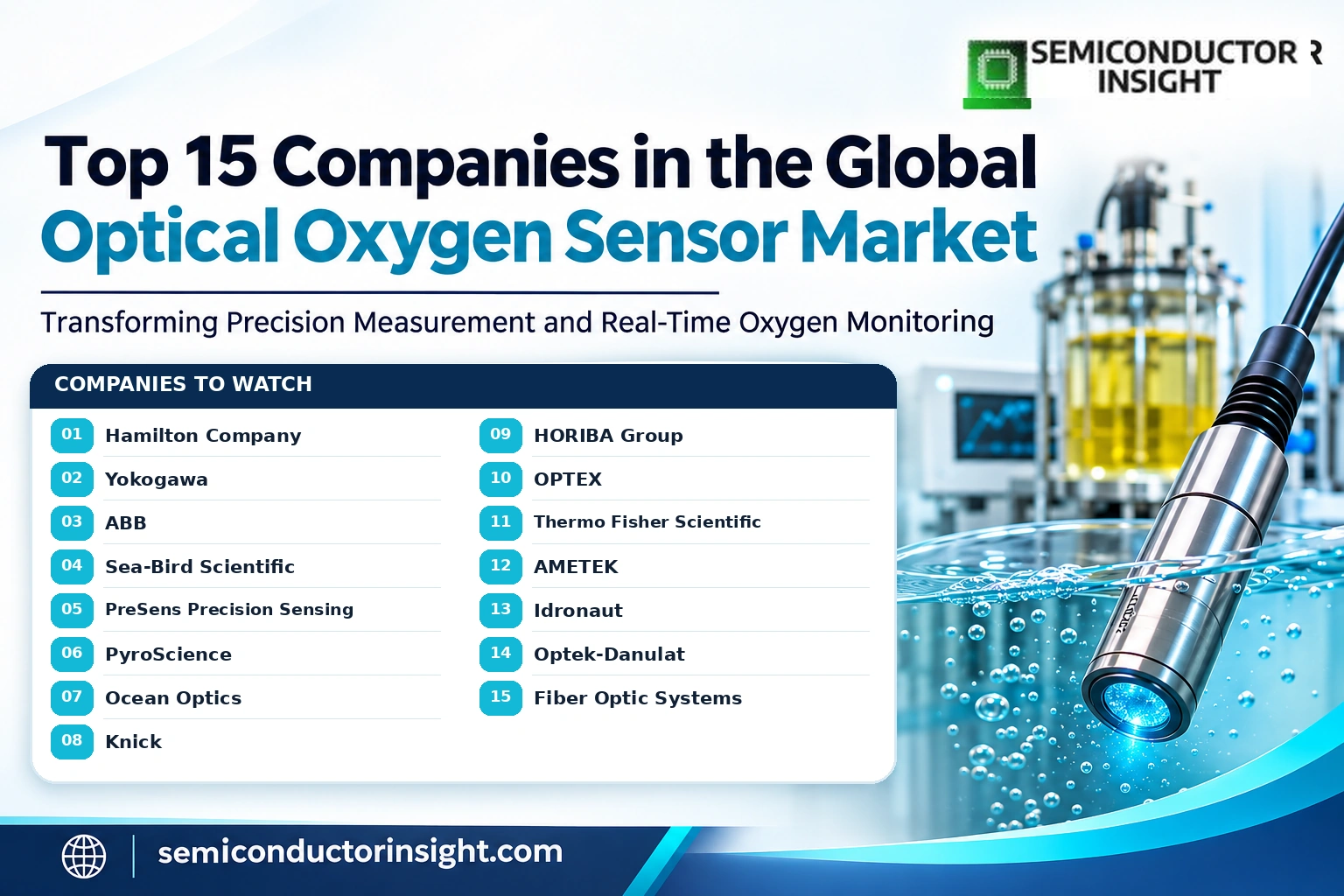
Top 15 Companies in the Global Optical Oxygen Sensor Market Transforming Precision Measurement and Real-Time Oxygen Monitoring
Optical oxygen sensors measure oxygen through changes in fluorescence or luminescence rather than consuming oxygen during measurement. This makes them particularly useful in applications where stable readings, low maintenance and minimal disturbance to the sample are important. Their reach extends from pharmaceutical fermentation vessels and wastewater plants to aquaculture systems, laboratory experiments and deep-ocean monitoring.
Hamilton Company – Setting the benchmark for biopharmaceutical oxygen monitoring
Hamilton has a particularly strong position in optical dissolved oxygen measurement through its VisiFerm range, designed for bioreactors and hygienic process environments. These sensors use a luminophore-based measurement method, in which oxygen changes the light emitted by the sensing layer. Unlike conventional electrochemical probes, the optical approach avoids electrolyte-related maintenance and is well suited to long fermentation cycles.
- A key product development was the next-generation VisiFerm platform, which Hamilton introduced with 50% higher robustness and an 80% reduction in calibration frequency compared with the earlier generation.
- Its portfolio includes RS485-ECS, mA, DO Arc and DO ECS configurations, with communication options such as Modbus RTU, 4-20 mA and HART 7.0 depending on the model.
- These features make Hamilton relevant to biopharmaceutical production, where reliable oxygen monitoring is essential for maintaining repeatable cell-culture conditions.
Yokogawa – Bringing optical oxygen measurement into continuous water treatment
Yokogawa stands out through its DO71 and DO72 optical dissolved oxygen sensors, developed for wastewater treatment, aquaculture, industrial utilities and steam-water analysis. The range includes wide-measurement and trace-oxygen configurations, allowing operators to select a sensor according to the oxygen concentration and process conditions.
The DO71 covers 0-22.5 mg/L, while the DO72 trace model measures 0-2 mg/L. Both offer a response time of up to 90 seconds for 90% response and operate across a temperature range of 0-50°C. Their digital communication and compatibility with Yokogawa’s FLXA402 analyzer support integration into automated plants. A particularly useful detail is the oxygen exchange cap’s stated five-year storage stability when kept in dark, dry conditions at 20°C. This helps simplify spare-parts planning for water-treatment operators.
ABB – Supporting long-duration dissolved oxygen monitoring
ABB’s ADS420 optical dissolved oxygen sensor is designed for applications where continuous monitoring and reduced maintenance are important. Its luminescence-quenching method uses blue LED excitation and measures the resulting red-light response to determine oxygen concentration. This eliminates the oxygen consumption associated with conventional electrochemical measurement.
ABB identifies municipal and industrial wastewater treatment, food and beverage processing, aquaculture and environmental monitoring among the target applications. The company’s published product documentation specifies continuous operation for up to 24 months while maintaining calibration, supported by diagnostics that indicate when maintenance is required. This makes the ADS420 particularly relevant to facilities that need stable measurements without frequent sensor intervention.
Sea-Bird Scientific – Extending optical oxygen sensing into deep-ocean research
Sea-Bird Scientific occupies a specialist position in oceanographic oxygen measurement through its SBE 63 optical dissolved oxygen sensor. Unlike sensors primarily designed for factory pipelines or laboratory vessels, the SBE 63 is engineered for CTD systems, moorings and autonomous ocean platforms. Its role is important in studying hypoxia, ocean circulation and changes in marine ecosystems.
The SBE 63 offers 1 Hz sampling, a resolution of 0.2 µmol/kg and housing options rated to either 600 metres or 7,000 metres. Each sensor is individually calibrated, with a stated accuracy of the larger of ±3 µmol/kg or ±2%. It can also be integrated with Sea-Bird MicroCAT and Argo float CTD systems. This combination of depth capability, calibration and platform compatibility gives the company a strong niche in long-term ocean observation.
PreSens Precision Sensing – Advancing trace oxygen analysis and non-invasive measurement
PreSens is an important specialist in optical oxygen measurement for laboratories, bioprocess development and packaging research. Its product portfolio includes oxygen meters, sensor spots, dipping probes and flow-through cells. The ability to measure oxygen without directly inserting a conventional probe into a sample is particularly useful for closed containers, microfluidic systems and experiments where contamination must be avoided.
The OXY-1 SMA trace system supports sensor types with detection limits down to 1 ppb dissolved oxygen, depending on the sensor used. The compact meter weighs approximately 128 grams, measures around 101 × 35 × 30 mm, and operates through a USB connection. PreSens also supports temperature, pressure and salinity compensation, with software that can control multiple measurement devices. These features make it relevant to emerging bioprocess applications, including cell-culture monitoring and cultivated-food research.
PyroScience – Building a broad portfolio of fiber-optic oxygen probes
PyroScience differentiates itself through the variety of optical sensor formats available for oxygen measurement. Its portfolio covers robust probes, microsensors, sensor spots and underwater configurations, making it relevant to laboratory research, environmental testing, respirometry and industrial monitoring.
The OXROB10 probe is a useful example: its stainless-steel body is 10 cm long and 3 mm in diameter, and it can measure oxygen in both gases and liquids without consuming oxygen at the sensing point. Its OXSP5 range provides eight sensor spots, each 5 mm in diameter, for contactless measurement through transparent container walls. Published specifications for underwater models also identify response times below 3 seconds for selected probes and a minimum lifetime of up to 2 million data points for certain sensor types. This breadth of formats gives PyroScience a strong position in specialist measurement applications.
Ocean Optics – Connecting optical spectroscopy with oxygen measurement
Ocean Optics brings a photonics and fiber-optic instrumentation approach to oxygen sensing through its NeoFox platform. The system is designed for biological samples, headspace gases, industrial slurries, cosmetics, food products and natural-water measurements. Its non-invasive measurement capability is useful where the sample’s chemical composition must remain unchanged during testing.
The NeoFox system operates across a wavelength range of 200-1,000 nm, with optical decay resolution of approximately 0.5-1.0 nanoseconds, depending on the optical configuration. Its electronics measure approximately 108 × 64 × 38 mm and weigh around 640 grams. The system supports FOSPOR and HIOXY sensing chemistries and can operate across electronics temperatures of −30°C to 60°C. This makes Ocean Optics particularly relevant to research laboratories and application developers that need to build customized oxygen measurement setups.
Knick – Addressing trace oxygen measurement in demanding hygienic processes
Knick has developed a focused optical oxygen offering through its SE740 sensor, intended for food, pharmaceutical, fermentation and process applications. Its product range is notable for multiple insertion lengths, allowing integration into different vessel and pipeline configurations. The published SE740 range includes 120 mm, 215 mm, 325 mm and 425 mm versions.
The sensor measures dissolved oxygen from 4 ppb to 25 ppm and partial pressure from 0.1 to 600 mbar. It is designed for process pressures from −1 to 12 bar and oxygen-measurement temperatures up to 85°C, with steam sterilization possible up to 140°C. Knick’s 2026 product documentation includes a June 2026 EU declaration of conformity for the SE740 range. Its combination of trace measurement, hygienic materials and process integration makes it relevant to high-purity and pharmaceutical manufacturing.
HORIBA Group – Making optical oxygen measurement practical for wastewater facilities
HORIBA’s optical dissolved oxygen offering is built around the HD-200FL field-installation meter and its DO-2000 probe. The system is designed for aeration tanks, municipal wastewater plants and industrial wastewater facilities, where sensor fouling and maintenance can affect measurement reliability.
The HD-200FL measures dissolved oxygen across 0-20 mg/L, with a stated 90% response time of approximately 30 seconds. Its replaceable sensor cap includes memory that automatically identifies membrane-specific coefficients, reducing the need for manual configuration after replacement. The system can also use a float-type holder, where the movement of the water supports a self-cleaning effect. These features make HORIBA relevant to wastewater operators looking to improve aeration control and reduce routine sensor servicing.
OPTEX – Targeting robust oxygen monitoring in aquaculture and water treatment
OPTEX has a clearly documented optical dissolved oxygen product in its DOS-20 series. The sensor is designed for water-quality applications, including aquaculture and biological wastewater treatment. Its construction and measurement approach are intended to provide stable readings without relying on water-flow changes to maintain measurement performance.
The DOS-20 measures dissolved oxygen, temperature, saturation and oxygen partial pressure. Its published measurement range extends to 50 mg/L, with a 90% response time of less than 45 seconds and a 95% response time below 60 seconds under the stated test conditions. The probe has an IP68 protection rating, a standard 10-metre cable and an underwater rating of up to 200 metres. OPTEX also identifies a guide replacement interval of approximately one year for the sensor cap. Its documented shrimp-farm application in Thailand demonstrates the practical role of optical oxygen measurement in aquaculture operations.
Thermo Fisher Scientific – Serving field testing and laboratory water analysis
Thermo Fisher Scientific participates in optical oxygen measurement through its Thermo Scientific Orion RDO range. These rugged dissolved oxygen probes use luminescence-based optical technology and are designed to reduce the maintenance associated with membranes, fill solutions and conventional electrochemical electrodes. Their use across laboratory and field testing gives the company a practical position in water-quality analysis.
The Orion RDO probes cover 0-20 mg/L dissolved oxygen and 0-200% saturation, with cable configurations ranging from 3 to 10 metres. The replacement RDO cap has a specified 365-day service-life tracking period, monitored through an integrated sensor clock. The product documentation also lists ASTM D888, Standard Methods 4500-O G or H, and ISO 17289 compliance. This combination is relevant to environmental laboratories, water testing teams and field operators who need standardized measurements.
You can freely browse our most recent updated report to learn more about it before scrolling further: https://semiconductorinsight.com/report/optical-oxygen-sensor-market/
AMETEK – Extending optical oxygen analysis into industrial gas and liquid streams
AMETEK’s contribution is more specialized than conventional dissolved oxygen probes. Through its OXYvisor optical oxygen analyzer and Barben optical sensor technology, the company targets demanding process environments such as natural gas pipelines, gas processing, biomethane production and selected liquid applications. The measurement principle uses oxygen-sensitive luminophores whose fluorescence is quenched in the presence of oxygen.
The OXYvisor is designed for trace-to-percentage oxygen measurement and supports remote configuration through Modbus RS485. Its industrial enclosure carries IP66 and NEMA 4X protection, with hazardous-area approvals for selected installation environments. Published Barben documentation identifies detection limits of approximately 0.5 ppm for gas-phase oxygen and 1 ppb for dissolved oxygen in liquids. This gives AMETEK a distinctive position in industrial process monitoring, especially where oxygen contamination can affect product quality, corrosion or plant safety.
Idronaut – Engineering optical oxygen sensing for high-pressure oceanographic systems
Idronaut’s optical oxygen sensor is aimed at marine research and demanding underwater measurement rather than routine industrial process control. Its dynamic fluorescence-quenching design uses a fluorescent sensing layer and optical fibre to transmit excitation and measurement signals. The company also offers optical oxygen sensing as part of its wider oceanographic instrumentation portfolio.
A notable engineering feature is its high-pressure Blue Cap configuration, designed for operation up to 700 bar. Published specifications include a measuring range of 0-500% oxygen saturation, equivalent to up to 44 mg/L, and response times of approximately 3 seconds with the standard membrane or 1 second with the fast membrane. The sensor support uses titanium and a compact optical arrangement. These characteristics make Idronaut relevant to deep-water profiling and specialized oceanographic deployments, where pressure resistance and rapid response are important.
Optek-Danulat – An adjacent optical process-measurement participant
Optek-Danulat is relevant to the broader optical process-measurement ecosystem, particularly inline optical analysis used in industrial production. However, its publicly available product information reviewed for this profile does not establish a dedicated optical dissolved oxygen sensor comparable to Hamilton’s VisiFerm, Yokogawa’s DO71/DO72 or ABB’s ADS420.
That distinction matters when assessing its position in this particular market. Optical concentration and process-monitoring instruments should not automatically be classified as optical oxygen sensors simply because they use optical measurement principles. Optek-Danulat may be relevant to adjacent process analytics and plant integration, but a dedicated oxygen product, its specifications and a current oxygen-specific commercial application should be confirmed before describing it as a leading direct supplier.
Fiber Optic Systems – A name requiring product-level verification
Fiber-optic technology is central to many optical oxygen measurement systems, as it carries excitation light to the sensing layer and returns the fluorescence signal to the detector. This architecture supports remote sensing, compact probes and measurements in enclosed or difficult-to-access environments. It is particularly useful in laboratory research, environmental monitoring and specialized industrial applications.
However, the supplied name Fiber Optic Systems does not identify a clearly verifiable manufacturer or a specific optical oxygen sensor product in the public documentation reviewed. Without a confirmed company identity, product model, technical datasheet or current application reference, it would be misleading to attribute oxygen-sensing capabilities or market leadership to this name. It should remain on the company watchlist until the exact business entity and product portfolio are confirmed.

Comments (0)