

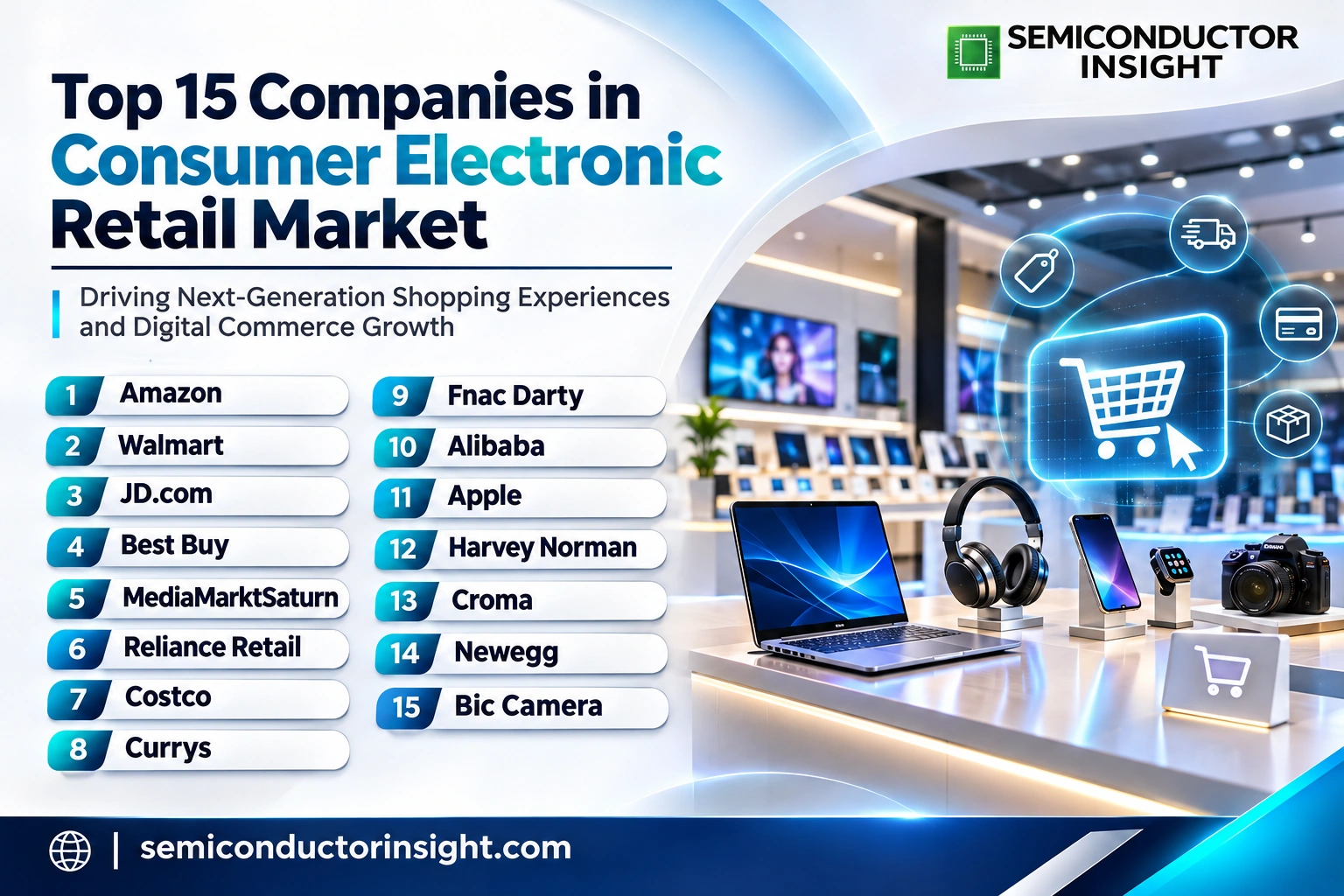
Top 15 Companies in Consumer Electronic Retail Market Driving Next-Generation Shopping Experiences and Digital Commerce Growth
Consumer electronics retailer market covers businesses that sell technology products to individuals and households through physical stores, e-commerce platforms, mobile applications and omnichannel networks.
Its product range spans smartphones, televisions, laptops, tablets, gaming systems, cameras, audio equipment, home appliances, smart-home devices and accessories. The market also increasingly includes services such as device financing, trade-ins, repairs, installation, warranties, subscriptions and refurbished-product sales.
Amazon – Turning Product Discovery into a High-Speed Electronics Shopping Ecosystem
Amazon holds a leading position in online consumer electronics retail through its extensive product catalogue, third-party seller network, recommendation systems and fulfilment infrastructure. Its electronics offering spans smartphones, laptops, televisions, gaming consoles, smart-home devices, accessories and computer components. The company’s strength lies in bringing products from established brands and smaller technology sellers onto one platform, allowing customers to compare specifications, prices, reviews and delivery options within a single shopping journey.
– Its 2025 annual report recorded US$269.3 billion in online-store sales, while third-party seller services generated US$172.2 billion.
– These figures cover wider product categories rather than electronics alone, but they demonstrate the commercial scale of the platform supporting electronics transactions.
– Amazon’s 2026 interim filings also showed continued growth in online-store activity. Its retail advantage increasingly comes from combining marketplace assortment with fulfilment speed, product recommendations and connected services such as Alexa and Prime.
Walmart – Making Consumer Technology Accessible Through Store-Based Fulfilment
Walmart’s consumer electronics position is supported by its ability to combine competitive pricing with an extensive physical retail network. Televisions, smartphones, computers, printers, gaming products and home appliances are sold alongside everyday merchandise, giving customers the convenience of purchasing technology during routine shopping trips. This broad customer reach is particularly important for mainstream electronics, where price, availability and convenient collection can influence purchase decisions.
Walmart’s FY2026 annual report identified 4,611 Walmart U.S. stores, with substantially all stores supporting same-day pickup and delivery. Its omnichannel infrastructure enables customers to order electronics online and collect them locally or receive them through delivery services. The company is also investing in AI-powered retail solutions and digital operations. For electronics brands, Walmart’s value lies in its ability to connect national-scale product distribution with local inventory, especially during seasonal demand periods and major device launches.
JD.com – Competing Through Electronics Expertise and Delivery Infrastructure
JD.com is one of the most influential electronics-focused retail platforms in China. Its position is built around direct product sales, authorised brand relationships, logistics infrastructure and a strong presence in smartphones, computers, home appliances and digital devices. The company has traditionally differentiated itself through product authenticity, inventory management and delivery reliability important considerations for customers purchasing higher-value electronics.
Its 2025 results reported RMB 605.1 billion in electronics and home-appliance revenue, making this one of the largest product categories in its retail business. The company also operates an extensive logistics network that supports warehousing, fulfilment and last-mile delivery. In 2026, JD’s electronics retail model remains particularly relevant as consumers increasingly expect rapid delivery, reliable product warranties and professional installation for larger appliances. Its integrated logistics capabilities help it compete beyond price alone.
Best Buy – Converting Product Expertise Into a Retail Advantage
Best Buy remains a major specialist consumer electronics retailer in North America because it combines product sales with consultation, installation, technical support and repair. Its stores allow customers to compare televisions, computers, mobile devices, home theatre systems and appliances before making a purchase. This is particularly valuable for products where compatibility, configuration and installation influence the buying decision.
Best Buy reported US$41.7 billion in fiscal 2026 revenue and operated more than 1,000 retail stores across North America. Its service proposition extends through Geek Squad, which supports device setup, troubleshooting, repairs and technical assistance. The retailer also participates in trade-in and recycling programmes, creating additional customer touchpoints after the initial sale. As consumers upgrade computers and home entertainment equipment, Best Buy’s ability to connect product advice with post-purchase support remains a key differentiator.
MediaMarktSaturn – Building Europe’s Omnichannel Technology Destination
MediaMarktSaturn has a substantial position in European consumer electronics retail through its MediaMarkt, MediaWorld and Saturn formats. Its assortment covers smartphones, laptops, gaming hardware, televisions, photography equipment, audio systems and household appliances. The retailer’s large-format stores provide product demonstration and comparison opportunities, while its online platform supports home delivery, store collection and access to a broader catalogue.
CECONOMY’s October 2026 trading statement described a network of more than 1,000 stores across 11 countries. Its strategic direction places increasing emphasis on services and solutions, marketplace activity and retail media. The group aims for these growth areas to contribute more than half of gross profit by FY2028–29. This shift is significant: the retailer is seeking to earn more from installation, repair, protection and digital marketplace services rather than relying exclusively on the margin from physical electronics products.
Reliance Retail – Expanding India’s Electronics Shopping and Service Network
Reliance Retail has built a strong consumer electronics position through Reliance Digital, MyJio Stores and its wider distribution ecosystem. Its electronics business covers smartphones, laptops, televisions, refrigerators, washing machines, audio equipment, accessories and smart-home products. The combination of physical outlets and digital commerce gives the company access to customers across metropolitan areas as well as smaller Indian cities.
Its FY2025–26 disclosures identify Reliance Digital and MyJio Stores as key consumer electronics formats, supported by resQ, a multi-product, multi-brand service network. Reliance Retail’s wider network reached 20,169 stores as of June 30, 2026, although this figure includes all retail formats and should not be interpreted as electronics-store count. The company also operates a large distribution ecosystem through JioMart Digital and local merchant partnerships. In a market where installation, warranty support and product financing influence electronics purchases, this connected retail-and-service model is particularly important.
Costco – Using Membership Retail to Compete in High-Value Electronics
Costco has a distinctive consumer electronics strategy built around membership warehouses, limited product selection, competitive pricing and high-volume inventory movement. Its electronics assortment includes televisions, laptops, desktop computers, tablets, smartphones, cameras, accessories and major appliances. Rather than matching every specialist retailer’s catalogue depth, Costco focuses on selected products and promotional offers that appeal to members seeking value on larger purchases.
At August 30, 2026, Costco operated 939 warehouses worldwide and maintained e-commerce sites in eight markets, including the United States, Canada, the United Kingdom, Japan and Australia. Its 2026 annual filing also identifies a 90-day return policy for certain electronic products, alongside technical support and extended-warranty options. This combination of product selection, member pricing and purchase protection gives Costco a strong proposition in televisions, computers and household technology.
Currys – Making Repairs, Installation and Financing Part of Electronics Retail
Currys has developed a strong position in the United Kingdom and Nordic consumer technology markets by connecting electronics sales with services that continue after the purchase. Its product categories include computing, mobile phones, televisions, gaming, audio equipment and major domestic appliances. The retailer’s model places considerable importance on expert advice, delivery, installation, repair and flexible payment options.
Its FY2025–26 annual report identified 691 stores across six countries. The group also reported 6.4 million Order & Collect units during the year, up 19% year on year, and 11.6 million active repair plans. Its recurring service revenue reached £648 million in the UK and Ireland and £225 million in the Nordics. These figures demonstrate why Currys is more than a conventional electronics shop: repair plans, installation and financing help maintain customer relationships beyond individual product transactions.
A Brief Look at Our Detailed Analysis Related Report: https://semiconductorinsight.com/report/global-optoelectronic-components-market/
Fnac Darty – Combining Electronics Retail with Repair and Circular Services
Fnac Darty is an influential European retailer with a product mix covering consumer electronics, computing, mobile devices, home appliances, books and cultural products. Its retail strategy is supported by specialist advice, physical stores, online ordering and services that help customers maintain products for longer. This is especially relevant in categories such as laptops, televisions and household appliances, where installation, repair and warranty support can influence retailer selection.
In its 2025 annual results published in February 2026, Fnac Darty reported group revenue of €10.33 billion. Its online business increased by nearly 6%, while Click & Collect represented close to 50% of online activity. The integration of Italian retailer Unieuro also strengthened its European footprint. The company’s strategic direction places emphasis on repair, product durability and services, reflecting the growing importance of circular retail models in the European electronics market.
Alibaba – Extending Electronics Choice through Taobao and Tmall
Alibaba plays a major role in China’s online electronics retail ecosystem through Taobao and Tmall. The platforms connect consumers with established electronics brands, authorised distributors and third-party merchants selling smartphones, tablets, computers, smart-home devices, cameras and appliances. Tmall is particularly relevant for brand-led retail, while Taobao supports a wider range of merchants and product offerings.
Alibaba’s FY2026 annual report identifies Taobao and Tmall within its China E-commerce Group, alongside other commerce businesses. The company’s wider strategy increasingly connects e-commerce with AI capabilities and digital infrastructure. For electronics merchants, this ecosystem offers access to product discovery, promotional campaigns, consumer data and digital marketing tools. Its influence is particularly visible during major shopping festivals, where product launches, livestream demonstrations and platform-wide promotions can rapidly increase consumer attention around new devices.
Apple – Turning Brand-Owned Retail into an Experience and Support Channel
Apple occupies a distinctive position in consumer electronics retail because its stores combine product sales with demonstrations, education, personal setup and technical support. The retail experience covers iPhone, Mac, iPad, Apple Watch, AirPods and accessories, allowing customers to explore connected devices before purchasing. The company’s stores also provide product collection, trade-in assistance and support through the Genius Bar.
Apple operates more than 500 retail locations globally, according to current retail coverage. Its retail model is particularly relevant in premium electronics, where customers often consider device compatibility, software services and ecosystem integration before choosing a product. The company’s 2026 environmental reporting also includes retail operations within its wider materials and emissions disclosures. Its retail advantage comes from controlling much of the customer journey from product discovery and purchase to device support and future upgrades rather than competing through multi-brand assortment.
Harvey Norman – Connecting Electronics with Home Technology and Large-Format Retail
Harvey Norman has a strong position in Australia and selected international markets through its large-format stores and franchise-led retail model. Its consumer technology offering includes computers, televisions, audio systems, mobile devices, cameras and accessories, alongside furniture, bedding and household appliances. This broader home-focused assortment creates opportunities to sell electronics as part of a connected household purchase.
Its FY2026 disclosures describe an operating footprint across eight countries, comprising 195 franchised complexes in Australia and 123 company-operated stores across seven overseas markets. The retailer has also highlighted investment in digital transformation and technology infrastructure. Its large-format stores are useful for products that customers prefer to compare physically, particularly televisions, computers and home entertainment systems. Harvey Norman’s ability to combine electronics with furniture and appliances helps it attract customers undertaking wider home upgrades.
Croma – Building India’s Specialist Electronics Retail Experience
Croma, operated by Infiniti Retail within the Tata Group, is a major specialist electronics retailer in India. Its product assortment covers smartphones, laptops, televisions, cameras, gaming equipment, audio products, kitchen appliances and smart-home devices. The retailer differentiates itself through product demonstrations, expert assistance, own-label products and after-sales support, making it relevant to consumers who want guidance before purchasing technology.
Croma’s corporate profile lists more than 25,000 products across 547 brands, supported by 515 Croma stores and 15 TRiBE stores across 171 major Indian cities. Its own-label portfolio includes more than 400 products. The company also offers ZipCare protection and maintenance services, while its express-delivery model uses nearby stores to fulfil eligible orders placed before 4 p.m. These capabilities demonstrate how Croma is combining specialist retail with local fulfilment and post-purchase services.
Newegg – Serving the PC Builder, Gaming and Technology Enthusiast Community
Newegg has a specialised position in online electronics retail, particularly among PC builders, gamers, IT professionals and technology enthusiasts. Its assortment includes graphics cards, processors, motherboards, memory, storage drives, monitors, gaming peripherals, networking equipment and complete computer systems. This technical depth differentiates it from general marketplaces where product specifications and compatibility information may be less central to the shopping experience.
Newegg’s 2025 annual report disclosed approximately 4.6 million SKUs across 1,550 categories, supported by more than 5,100 marketplace sellers. It served customers in 19 countries and regions through its platforms. The company also highlighted demand associated with NVIDIA GeForce RTX 50 Series and AMD Radeon 9000 Series launches during 2025. In 2026, its relevance continues through specialist component discovery, product bundling and support for customers assembling or upgrading high-performance computers.
Bic Camera – Combining Specialist Electronics Retail with Japan’s Omnichannel Shopping Culture
Bic Camera is a major Japanese electronics retailer with a broad assortment spanning cameras, computers, mobile phones, televisions, audio products, gaming equipment and household appliances. Its stores are known for offering extensive product comparisons and a wide range of accessories, while its online channel gives customers another route to research and purchase technology. The company also benefits from a wider group structure that includes Kojima and Sofmap.
Its FY2026 results reported consolidated sales of approximately ¥974.5 billion for the year ended August 2025? This figure relates to FY2025, while the company’s FY2026 non-consolidated results reported net sales of approximately ¥508.9 billion. Its FY2026 disclosures also highlighted group-wide customer-card registrations reaching 97 million cumulatively as of August 31, 2026. The retailer’s focus on customer membership, product replacement demand and buyback services gives it a meaningful role in Japan’s electronics retail landscape.

Comments (0)