

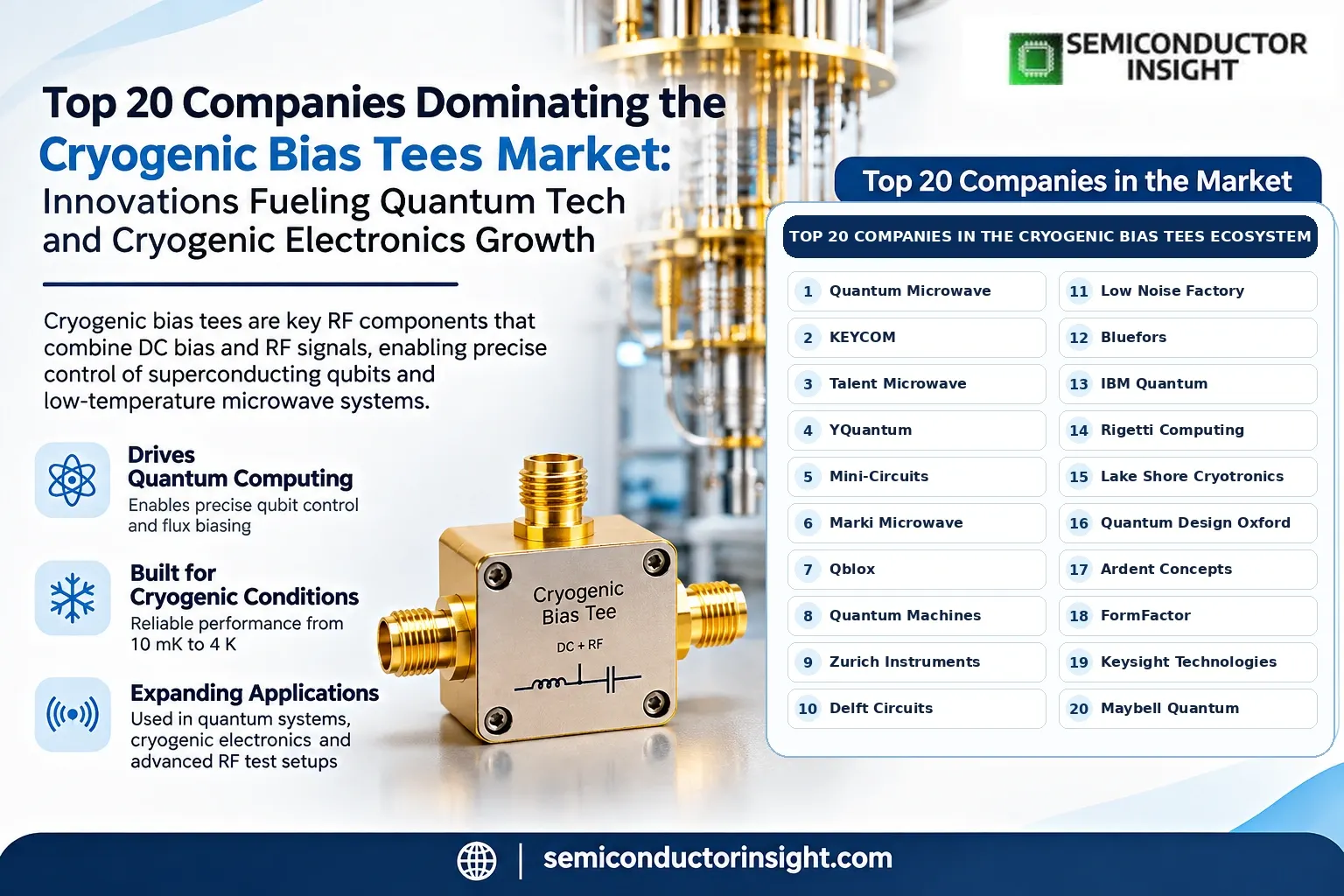
Top 20 Companies Dominating the Cryogenic Bias Tees Market: Innovations Fueling Quantum Tech and Cryogenic Electronics Growth
Cryogenic Bias Tees Market occupies a specialised position within the quantum computing and low-temperature microwave electronics industry. Cryogenic bias tees are three-port RF components that combine direct-current (DC) bias signals with radio-frequency (RF) signals through a common output while keeping the two signal paths appropriately isolated.
They are particularly important in superconducting quantum computers, where qubits require precisely controlled microwave pulses and DC or low-frequency flux-bias signals inside dilution refrigerators operating at temperatures close to absolute zero.
Quantum Microwave: Millikelvin-Compatible Bias Tee Designs Are Setting a Higher Performance Benchmark
Quantum Microwave has a particularly strong position in the dedicated cryogenic bias tee segment because its product catalogue includes components explicitly designed for dilution refrigerator applications. Its QMC-CRYOTEE series includes multiple frequency configurations, including 3 MHz-10 GHz, 200 MHz-18 GHz and DC-50 GHz product offerings. The QMC-CRYOTEE-S0.218SMA model supports operation down to 10 mK, with typical insertion loss of 0.25 dB between 200 MHz and 12 GHz and 1 dB across the wider 200 MHz-18 GHz range.
Its maximum specified DC current is 225 mA, making it relevant to applications requiring simultaneous RF delivery and controlled electrical biasing. Another important product is the QMC-CRYOTEE-0010, which combines a DC path extending to 500 kHz with an RF path from 3 MHz to 10 GHz. The use of oxygen-free high-conductivity copper housings and gold plating is particularly relevant for reducing thermal and contact-related problems. Its catalogue also includes thermalised terminations and specialised connector configurations, allowing researchers to build more complete cryogenic microwave measurement assemblies.
KEYCOM: Multiple Cryogenic Frequency Configurations Are Supporting Superconducting Device Research
KEYCOM has a specialised position in cryogenic microwave engineering through its BYT01 bias tee family, which includes both conventional and low-temperature configurations. Its published cryogenic models cover four RF frequency combinations: 2 kHz-4 GHz, 30 kHz-10 GHz, 100 kHz-20 GHz and 20 MHz-18 GHz. This range allows researchers to select components according to the operating frequency and DC-bias requirements of different superconducting devices. Its 20 MHz-18 GHz configuration supports a maximum DC current of 1 A, while the lower-frequency models have different current and voltage specifications.
KEYCOM also develops cryogenic low-noise amplifiers, superconducting cables, filters and microwave interconnects. This broader portfolio is valuable because bias tees are rarely installed independently; they operate as part of a larger signal-delivery chain involving attenuation, filtering, amplification and thermal anchoring. An important technical distinction is that KEYCOM states its routine low-temperature testing is generally conducted at liquid-nitrogen temperature. Buyers requiring operation at 10 mK should therefore request specific qualification evidence rather than assume every cryogenic-rated model has been validated at dilution refrigerator base temperature.
Talent Microwave: High-Current Cryogenic Biasing Is Expanding Its Quantum Hardware Applications
Talent Microwave is gaining relevance through its dedicated quantum computing cryogenic device portfolio, which includes bias tees, circulators, isolators, attenuators, low-pass filters, DC blocks, coaxial cables and non-magnetic adapters. Its TLBT-100K18G-18-SS-Cryo model operates from 100 kHz to 18 GHz and provides 35 dB isolation, with a maximum DC bias voltage of 18 V and current capacity of 700 mA. The corresponding 50 V model offers an alternative configuration for applications with different voltage requirements. Another model, TLBT-3M10G-50-SS-Cryo, covers 3 MHz-10 GHz and supports 50 V DC operation.
These specifications are important for experimental systems where biasing conditions vary across superconducting devices and microwave measurement configurations. Talent’s wider offering of cryogenic fixed attenuators, parametric amplifiers and high-density wiring solutions also creates opportunities to supply multiple components within a single refrigerator installation. Its product-level specification transparency is particularly useful for engineers comparing isolation, current handling and connector requirements before integrating components into low-temperature systems.
YQuantum: Twelve-Channel Cryogenic Flux BiasT Arrays Are Addressing the Wiring Density Problem
YQuantum is an important specialist in flux-bias control for superconducting quantum processors. Its Cryo Flux BiasT Array, model YQ-CBT12-1G, combines 12 cryogenic bias tee circuits in one high-density assembly. The system operates across a 10 kHz-1 GHz RF range and is designed for temperatures from 10 mK to 4 K. Its gold-plated oxygen-free copper housing and compatibility with Bluefors twisted-pair DC wiring through Micro-D connections address two important engineering requirements: efficient thermal integration and compact signal routing.
Each channel has a specified maximum DC input current of ±25 mA, with RF pulse amplitude ratings of ±20 V. This 12-channel arrangement is particularly relevant for flux-tunable superconducting qubits, where precise control of qubit frequencies requires low-noise DC and fast control signals. YQuantum also offers the room-temperature YQ-BT-2G, which covers 10 kHz-2 GHz and incorporates a 10 Hz low-pass DC path with 60 dB suppression up to 1 GHz. These products demonstrate how the company is addressing both room-temperature control electronics and specialised cryogenic flux-bias requirements.
Mini-Circuits: Custom RF Assemblies and Cryogenic-Compatible Components Are Supporting Quantum Laboratory Expansion
Mini-Circuits is an important participant in the wider cryogenic bias tee supply chain because it combines conventional microwave components with application-specific engineering for quantum computing. Its quantum computing portfolio covers attenuators, filters, directional couplers, DC blocks, bias tees, non-magnetic RF cables and custom signal-routing assemblies. One relevant product is its ZFBT-4R2GW+ bias tee, which has a 0.1-4.2 GHz operating range. However, its general component temperature rating should not be confused with guaranteed millikelvin qualification. Mini-Circuits reports that research institutions have successfully used selected components at temperatures below 30 mK, leading to custom brass-housed low-pass filters after standard stainless-steel housings showed performance degradation. Its quantum engineering work also includes multi-channel signal generator assemblies supporting up to 16 independent channels, with frequency coverage extending from 10 MHz to 15 GHz in the described configuration. These capabilities make the company relevant to research laboratories that need customised RF infrastructure rather than isolated standard catalogue components.
Want to learn more about the report? Check out our latest updated version for free: https://semiconductorinsight.com/report/cryogenic-bias-tees-market/
Marki Microwave: Broadband Bias Tee Engineering Is Creating Opportunities for High-Frequency Quantum Applications
Marki Microwave is relevant to the cryogenic bias tee ecosystem through its extensive range of precision RF and microwave bias tees, particularly for applications requiring low insertion loss and wide frequency coverage. Its connectorized catalogue includes 29 listed bias tee and DC-block product configurations, with frequency coverage extending to 65 GHz. Models such as BT-0065 and BTN-0065 are particularly relevant to high-frequency microwave signal-routing applications.
The company also offers high-power bias tees supporting different DC voltage and current requirements, alongside compact surface-mount designs. These characteristics are useful when designing microwave signal paths for superconducting devices, although it’s general catalogue specifications should not be interpreted as confirmation of millikelvin operation. Its relevance lies in providing high-performance RF/DC combining technology that can be evaluated for specialised low-temperature applications after appropriate cryogenic qualification.
Qblox: Multi-Channel Quantum Control Is Increasing the Need for Integrated Cryogenic Biasing
Qblox is becoming an important contributor to the quantum hardware infrastructure supporting superconducting qubit control. Its modular Cluster architecture combines qubit control, readout, DC bias and measurement functions, addressing the growing complexity of quantum processor signal management. Its QRC module provides six independent signal-generation outputs covering 100 MHz-10 GHz, together with two input channels for readout. The module incorporates 14-bit digital-to-analogue and analogue-to-digital conversion, with sampling rates of 5 GSa/s.
Its architecture also supports multiple carrier frequencies per output channel, making it useful for frequency-multiplexed quantum experiments. Qblox’s separate DC Cluster and source-measurement modules are relevant to low-frequency bias control, which must be coordinated with microwave signal delivery through cryogenic components. As quantum systems expand, the company’s integrated control architecture increases the importance of compact, reliable bias tees and low-noise interconnects between room-temperature electronics and dilution refrigerators.
Quantum Machines: High-Density Hybrid Controllers Are Changing How Qubit Bias Signals Are Managed
Quantum Machines is an important technology provider because its control systems address the coordination of microwave pulses, DC signals and real-time feedback required by superconducting quantum processors. Its OPX1000 platform supports up to 64 analogue outputs and 16 analogue inputs, with up to eight microwave or low-frequency front-end modules in one chassis. Its microwave front-end modules generate signals up to 10.5 GHz, while its low-frequency modules support DC-750 MHz operation.
The latter is particularly relevant to flux-tunable qubits, where precise voltage control is necessary alongside microwave excitation. The system also incorporates high-speed pulse processing, distortion compensation and crosstalk minimisation. Quantum Machines further lists cryogenic control systems and sample-holder solutions within its wider product ecosystem. Although it does not compete directly with dedicated bias tee manufacturers across every component category, its growing channel density and integrated control architecture create demand for high-performance RF/DC signal-conditioning products.
Zurich Instruments: Sub-Microsecond Feedback and Microwave Readout Are Raising Cryogenic Signal Requirements
Zurich Instruments has established a specialised role in superconducting quantum control through its SHFQC+ 8.5 GHz Qubit Controller. The instrument integrates microwave generation, readout and feedback capabilities, supporting control of up to six superconducting qubits through six signal-generator channels and one quantum-analyser channel. Its 1 GHz instantaneous analysis bandwidth and 14-bit, 4 GSa/s analogue-to-digital conversion provide the measurement precision needed for advanced qubit experiments.
One of its important specifications is 350 ns internal feedback latency, which supports fast conditional operations and error-correction experiments. These requirements have direct implications for cryogenic signal-delivery components because insertion loss, phase stability and unwanted signal coupling can influence readout accuracy. Zurich Instruments’ role is therefore particularly relevant to the equipment ecosystem surrounding cryogenic bias tees, especially in laboratories building synchronised microwave control and measurement systems.
Delft Circuits: High-Density Cri/oFlex Interconnects Are Reducing Cryostat Wiring Complexity
Delft Circuits is an important specialist in cryogenic wiring, particularly through its Cri/oFlex technology for superconducting quantum processors. Its approach replaces multiple conventional coaxial connections with compact, flexible cryogenic interconnect structures that can integrate several signal paths within a single assembly. This is particularly relevant because every additional cable inside a dilution refrigerator creates thermal loading, consumes installation space and introduces another possible mechanical connection point. Its Cri/oFlex platform integrates attenuators, low-pass filters and infrared filters directly into flexible wiring assemblies.
The company also uses superconducting niobium-titanium flex wiring to reduce heat conduction between temperature stages. Its applications include coupler and flux-bias connections, microwave drive signals and qubit readout. These capabilities make Delft Circuits particularly relevant to the development of high-density biasing architectures, where individual bias tees must be considered alongside the overall thermal and electrical performance of the wiring system.
Low Noise Factory: Cryogenic Amplifier Qualification Is Improving the Reliability of Quantum Readout Chains
Low Noise Factory plays an important supporting role in cryogenic microwave electronics through its specialised low-noise amplifier technology. In superconducting quantum computers, readout signals emerging from qubits are extremely weak, making low-noise amplification essential before signals reach room-temperature measurement equipment. The company states that its cryogenic amplifiers are tested at 4 K before delivery. Its qualification approach also includes repeated cooling experiments, with selected sample amplifiers undergoing up to 100 cycles towards near-absolute-zero temperatures. This is particularly relevant because thermal cycling can affect semiconductor devices, electrical contacts and mechanical packaging.
Although its principal products are amplifiers rather than bias tees, its position in the cryogenic signal chain makes it an important complementary supplier. As quantum processors move towards larger readout channel counts, demand for reliable combinations of bias tees, filters, circulators and low-noise amplifiers is likely to become increasingly important.
Bluefors: The 4,000-Line Cryogenic Wiring Architecture Is Expanding the Scale of Quantum Hardware
Bluefors is one of the most important infrastructure companies in the cryogenic bias tee ecosystem because its dilution refrigerators and wiring platforms provide the operating environment in which these components are installed. Its KIDE Cryogenic Platform is designed for systems exceeding 1,000 qubits and offers more than 4,000 high-density RF wiring lines. The architecture includes over 40 available ports, including 24 line-of-sight side-loading ports, and a base-temperature flange with 1.6 square metres of surface area.
It also provides three cooling units with expected cooling power exceeding 3,000 µW at 100 mK. An important 2026 development came on March 3, when Bluefors announced its Modular Cryogenic Platform for scaling quantum infrastructure. On September 9, the company also published research examining the physical limits of densely packed microwave wiring in superconducting quantum processors. These developments are particularly relevant because larger cryostats require more compact biasing, filtering and signal-combining components without compromising thermal stability.
IBM Quantum: Modular Cryogenic Architecture Is Creating New Requirements for High-Density Bias Components
IBM Quantum is a major demand-side influence on the cryogenic bias tee industry because its superconducting processors require extensive microwave and DC signal-routing infrastructure. Its August 19, 2026 announcement concerning modular cryogenic systems marked an important development in the engineering of larger quantum computers. IBM successfully connected and cooled two cryogenic modules, with the combined architecture reaching temperatures below 15 mK. Each module’s vacuum enclosure provides up to 12 times more wiring space than the company’s most widely used earlier quantum systems.
IBM’s roadmap also includes L-couplers for connecting quantum processors across modules, with its 2027 plans targeting systems with at least 1,000 programmable qubits. In its November 2026 technical update, IBM described cryogenic wiring requirements of approximately 0.96 miles of trace length per cryostat bay, with future Nighthawk configurations requiring substantially more. Such developments highlight the importance of compact bias tees, low-loss connectors and reliable RF/DC interconnects. IBM is not a commercial bias tee manufacturer, but its architecture represents an important source of advanced component demand.
Rigetti Computing: Chiplet-Based Superconducting Processors Are Increasing Demand for Precise Cryogenic Signal Distribution
Rigetti Computing is an important technology developer within the cryogenic bias tee ecosystem because its superconducting quantum processors depend on precisely controlled microwave and DC signal paths. Its Cepheus-1-108Q system, made commercially available in April 2026, incorporates 12 interconnected chiplets, each containing nine qubits. In its November 10, 2026 third-quarter update, Rigetti reported 99.5% median two-qubit gate fidelity on the 108-qubit system, based on internal testing, with gate speeds of approximately 60 nanoseconds. The company also disclosed a September 2026 agreement with the US Department of Commerce for up to $100 million in research and development support.
Three important programme areas include miniaturised readout electronics, expanded cryogenic capacity and fabrication of high-connectivity chip architectures. These developments are significant for bias tee suppliers because chiplet-based processors require more sophisticated signal distribution and lower-noise bias control. Rigetti is a quantum processor developer rather than a merchant bias tee manufacturer, but it’s hardware roadmap provides a strong indication of the component requirements emerging in larger superconducting systems.
Lake Shore Cryotronics: Precision Temperature Control Is Supporting Stable Cryogenic Biasing Environments
Lake Shore Cryotronics is an important supporting supplier because reliable temperature measurement and control are essential for evaluating cryogenic microwave components. Its technologies include cryogenic thermometry, temperature controllers, magnetic measurement systems and low-temperature electrical characterisation equipment. An important 2026 development came on June 18, when the company announced that it would showcase its Model 346 temperature controller and M81-SSM source-measure system at international cryogenic and quantum technology events.
The Model 346 supports temperature control from 300 mK to 1,500 K and incorporates four 100 W heater outputs, providing a combined 400 W heating capacity. These specifications are particularly useful for laboratory environments requiring controlled cooldown, warm-up and repeatable temperature measurements. For bias tee manufacturers, such infrastructure is relevant when verifying insertion loss, isolation, DC current handling and performance changes across different cryogenic temperature stages. Lake Shore’s contribution is therefore centred on measurement reliability and temperature stability rather than direct production of commercial cryogenic bias tees.
Quantum Design Oxford: Modular Dilution Refrigerators Are Creating Opportunities for Integrated Cryogenic Wiring
Quantum Design Oxford is relevant to the cryogenic bias tee market through its Proteox family of dilution refrigerators and its expanding integration of high-density signal-delivery infrastructure. On September 25, 2026, the company announced a collaboration with Ardent Concepts to integrate the latter’s Cryogenic Wiring System with Proteox platforms. The arrangement combines cryogenic thermal management, modular refrigerator architecture and higher-density interconnect technology. This is an important development because quantum processors require increasing numbers of electrical connections without allowing excessive heat to enter the coldest refrigerator stages. The integrated platform is intended to improve wiring configuration, system serviceability and scalability. Its relevance to bias tee suppliers is particularly strong in installations where DC biasing and microwave control must be coordinated within limited cryostat space. Rather than developing a standalone bias tee product family, Quantum Design Oxford is strengthening the infrastructure into which specialised RF/DC components can be integrated.
Ardent Concepts: High-Density Cryogenic Wiring Is Addressing the Interconnection Bottleneck
Ardent Concepts is an important additional participant because its high-performance interconnect technology directly addresses one of the major limitations of scaling superconducting quantum computers: the increasing number of connections between room-temperature electronics and cryogenic processors. Its Cryogenic Wiring System became particularly relevant following the September 25, 2026 collaboration with Quantum Design Oxford. The integrated solution is designed for Proteox dilution refrigerators and focuses on configurable, high-density wiring with improved serviceability. The development reflects a broader industry shift from assembling individual coaxial cables and connectors towards modular interconnect platforms. This has implications for cryogenic bias tees because high-density wiring systems need suitable RF/DC interfaces, compact mounting configurations and controlled thermal conduction. Ardent’s role is therefore complementary to manufacturers such as Quantum Microwave, KEYCOM and Talent Microwave, whose components can be considered within wider cryogenic wiring architectures.
FormFactor: Wafer-Level Cryogenic Testing Is Bringing Quantum Component Validation Closer to Manufacturing
FormFactor has an important role in the supporting ecosystem because it enables researchers and semiconductor manufacturers to characterise superconducting devices before they are installed in complete quantum computing systems. Its HPD IQ3000 cryogenic wafer probing platform supports 150 mm, 200 mm and 300 mm substrates in a 4 K environment. The system accommodates up to 56 RF coaxial connections operating up to 18 GHz and as many as 520 DC lines. It also supports a 25-wafer cassette capacity in its fully automated configuration, helping researchers move towards higher-throughput device characterisation. Another relevant capability is its Flatiron dilution refrigerator platform for millikelvin research. These technologies are useful for evaluating superconducting circuits, cryogenic electronics and device-level signal performance. For cryogenic bias tee manufacturers, access to reliable RF and DC measurement infrastructure helps support component qualification, signal-path validation and repeatability testing. FormFactor is therefore a specialist test-equipment provider rather than a direct bias tee competitor.
Keysight Technologies: Sixteen-Gigahertz Quantum Control Platforms Are Supporting Advanced RF Signal Validation
Keysight Technologies is relevant to the cryogenic bias tee ecosystem through its quantum control and microwave measurement technologies. Its Quantum Control System combines direct digital conversion, microwave signal generation, acquisition and full-stack software for quantum device characterisation. The platform supports signal operation from DC to 16 GHz and incorporates synchronised timing and control capabilities. These specifications are important when testing bias tee performance across multiple microwave frequencies, particularly where signal phase, insertion loss and isolation must be evaluated under controlled conditions. Keysight’s wider instrumentation portfolio also includes network analysers, signal generators and semiconductor measurement equipment, which can support characterisation of RF/DC components before integration into cryogenic systems. Its collaboration with FormFactor provides additional relevance through cryogenic probe stations and quantum device measurement configurations. Keysight’s position is therefore strongest in signal generation, validation and test infrastructure rather than dedicated cryogenic bias tee manufacturing.
Maybell Quantum: Distributed Cryogenic Cooling Is Opening a New Direction for Quantum Infrastructure
Maybell Quantum is an emerging participant in the cryogenic infrastructure ecosystem through its ColdCloud platform, announced on March 12, 2026. The architecture is designed to distribute cryogenic cooling power across independent quantum hardware nodes rather than relying entirely on conventional standalone dilution refrigerator configurations. The company describes more than 10 times the energy efficiency of legacy systems, cooldown times measured in hours rather than days and modular operation for large quantum installations. Its nodes can be configured to operate below 10 mK for superconducting qubit applications. This approach is relevant to the cryogenic bias tee industry because distributed cooling architectures may require new arrangements for RF signal distribution, DC bias delivery and thermal anchoring. As independent cryogenic nodes become more modular, suppliers may need to develop smaller, configurable and easily replaceable signal-conditioning assemblies. Maybell does not currently represent a direct commercial bias tee supplier, but its cooling architecture highlights another important direction in the development of next-generation cryogenic quantum infrastructure.

Comments (0)