Cryogenic Bias Tees Market Insights
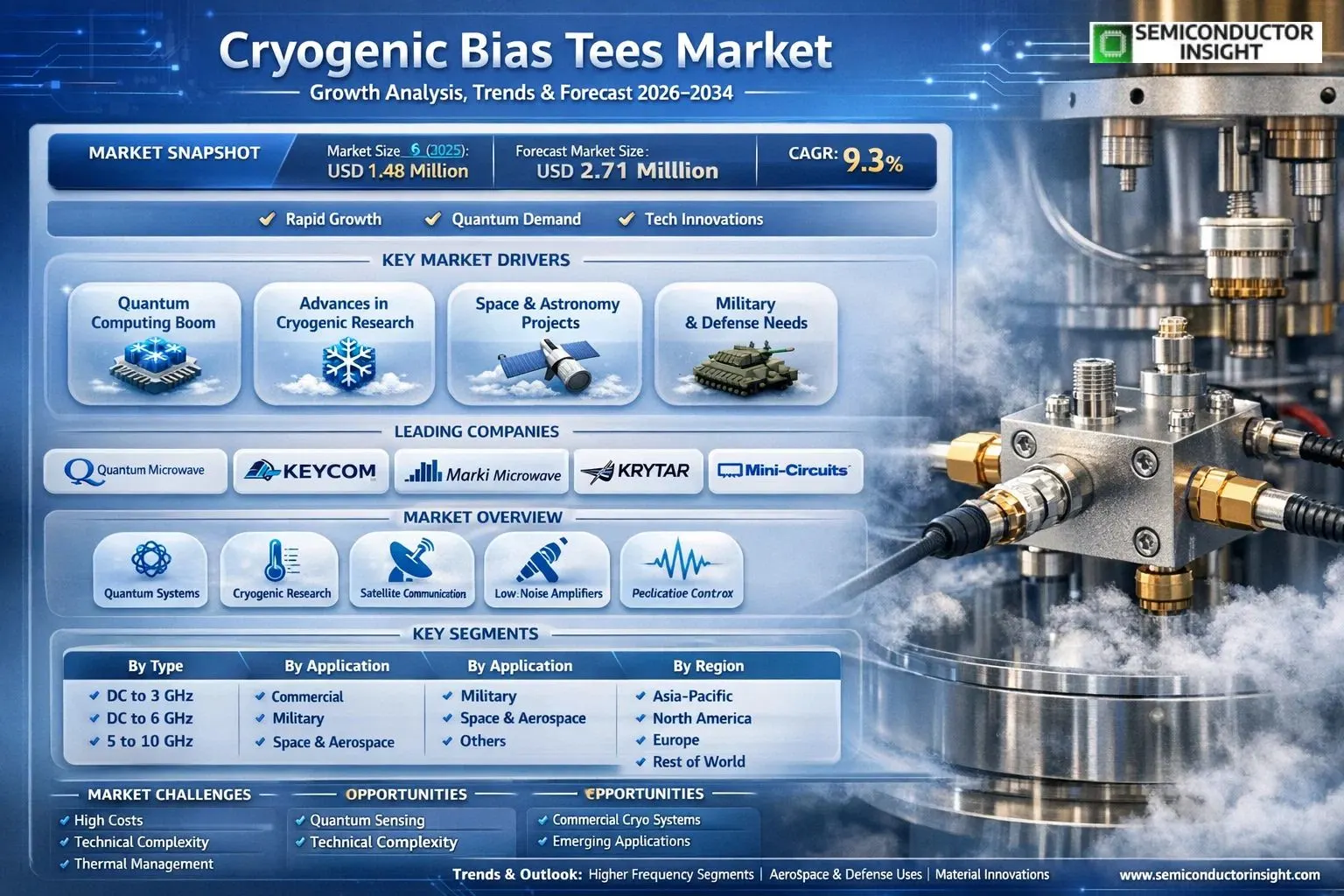
Global Cryogenic Bias Tees market size was valued at USD 1.48 million in 2025. The market is projected to grow from USD 1.62 million in 2026 to USD 2.71 million by 2034, exhibiting a CAGR of 9.3% during the forecast period.
Cryogenic bias tees are specialized passive radio frequency (RF) components designed to operate at extremely low temperatures, often near absolute zero. These devices are essential for combining a DC bias current with an RF signal path without interference, a function critical in low-noise applications like quantum computing research, cryogenic amplifiers, and advanced astronomical receivers. Their construction utilizes materials and designs that maintain performance and structural integrity in harsh thermal environments.
The market is experiencing robust growth primarily driven by the rapid global expansion of quantum computing initiatives and substantial investments in space and astronomy infrastructure. For instance, the U.S. National Quantum Initiative, backed by over USD 1.2 billion in federal funding, has significantly accelerated the demand for cryogenic electronic components. Furthermore, the increasing deployment of ultra-sensitive cryogenic systems in projects like the Square Kilometre Array (SKA) telescope is a major growth driver. Key players such as Quantum Microwave and KEYCOM Corp. are expanding their product portfolios to meet the stringent performance requirements of these advanced research applications, focusing on innovations that offer lower insertion loss and higher isolation at millikelvin temperatures.
MARKET DRIVERS
Growing Demand in Quantum Computing Applications
Cryogenic Bias Tees Market is experiencing robust growth driven primarily by the expanding quantum computing sector. These components are essential for enabling precise signal routing and biasing in qubit control and readout systems operating at millikelvin temperatures. As quantum computing research accelerates and moves toward commercialization, the need for high-performance cryogenic microwave components like bias tees has surged significantly.
Advancements in Low-Temperature Research
Increased investment in low-temperature physics and materials science research is another key driver. Cryogenic bias tees are critical in experiments involving superconductivity, spintronics, and quantum dot devices, where maintaining signal integrity at cryogenic temperatures is paramount. National laboratories and academic institutions worldwide are scaling up their cryogenic research capabilities, directly fueling market demand.
➤ The global quantum computing market is projected to grow at a CAGR of over 25% in the next five years, creating substantial downstream demand for specialized cryogenic components like bias tees.
Furthermore, the ongoing miniaturization and integration of cryogenic systems necessitate compact, reliable, and high-performance bias tees. Manufacturers are responding with innovations that offer lower thermal load, improved bandwidth, and enhanced reliability, meeting the stringent requirements of next-generation cryogenic applications.
MARKET CHALLENGES
Technical Complexity and Fabrication Hurdles
Cryogenic Bias Tees Market faces significant challenges related to the technical complexity of designing and manufacturing components that operate reliably at extreme temperatures. Achieving minimal insertion loss, high isolation, and stable performance across a broad frequency range from DC to over 40 GHz in cryogenic environments requires advanced materials and precise engineering, increasing production costs and limiting scalability.
Other Challenges
Thermal Management and Reliability
Maintaining performance stability during thermal cycling between room temperature and cryogenic levels poses a major challenge. Repeated cycling can induce mechanical stress, leading to performance degradation or failure. Ensuring long-term reliability under such conditions requires robust design and specialized materials, adding to the overall cost and complexity.
MARKET RESTRAINTS
High Cost of Cryogenic Testing and Validation
One of the primary restraints for Cryogenic Bias Tees Market is the high cost associated with testing and validation. Characterizing component performance at cryogenic temperatures requires specialized equipment such as dilution refrigerators and cryogenic probes, which are expensive to acquire and operate. This elevates the overall development cost and can slow down product iteration and time-to-market.
Limited Standardization
The lack of universal standards for cryogenic high-frequency components like bias tees can restrain market growth. Different research and commercial applications often have unique requirements, leading to fragmented demand and customized solutions. This absence of standardization complicates mass production, limits economies of scale, and can hinder wider adoption across diverse applications.
MARKET OPPORTUNITIES
Expansion in Quantum Sensing and Metrology
Beyond quantum computing, Cryogenic Bias Tees Market finds significant growth opportunities in quantum sensing and metrology applications. Ultra-sensitive detectors, such as superconducting nanowire single-photon detectors (SNSPDs) and atomic force microscopes operating at cryogenic temperatures, require precise bias tees for optimal performance. This diversifying application base presents a substantial avenue for market expansion.
Rise of Commercial Cryogenic Ecosystems
The emergence of turnkey cryogenic systems and commercial service providers in the quantum technology space creates a ripe opportunity. As companies offer more accessible cryogenic platforms, the demand for reliable, off-the-shelf components like cryogenic bias tees is expected to grow. Manufacturers that can provide standardized, high-performance products compatible with these systems are well-positioned to capture this emerging market segment.
Cryogenic Bias Tees Market Trends
Growing Demand in Quantum Computing Applications
global Cryogenic Bias Tees market is experiencing significant growth driven by increasing adoption in quantum computing systems. These specialized components are critical for maintaining signal integrity in ultra-low temperature environments required for quantum bit operation. Research institutions and commercial quantum computer manufacturers are the primary adopters, requiring high-frequency performance with minimal signal loss at cryogenic temperatures below 4 Kelvin.
Other Trends
Expansion in Aerospace and Defense Applications
Cryogenic bias tees are finding increased utilization in aerospace and defense systems where reliability under extreme temperature conditions is paramount. These components are essential for satellite communication systems, radar installations, and other mission-critical applications requiring stable performance across wide temperature ranges from cryogenic to elevated operational temperatures.
Technological Advancements in Materials Science
Manufacturers are developing innovative materials and designs to enhance performance characteristics. Advanced substrate materials with improved thermal conductivity properties are being implemented to better manage heat dissipation in cryogenic environments. These developments are enabling higher frequency operation while maintaining impedance matching and reducing insertion losses, particularly in the DC to 6 GHz and 5 to 10 GHz segments.
Regional Market Development Patterns
North America maintains a significant market share due to substantial investments in quantum computing research and defense applications. The Asia-Pacific region is demonstrating rapid growth, particularly in China and Japan, where government initiatives in quantum technology and telecommunications infrastructure are driving increased adoption of cryogenic electronic components.
Supply Chain and Manufacturing Evolution
The market is characterized by specialized manufacturing processes requiring precise environmental controls and testing methodologies. Key manufacturers are implementing automated production techniques to maintain consistency in performance specifications while addressing challenges related to thermal cycling reliability and material compatibility at cryogenic temperatures.
Standardization and Compliance Requirements
Increasing emphasis on industry standards for cryogenic electronic components is influencing market development. Manufacturers are focusing on compliance with international performance specifications while developing products that meet the rigorous reliability requirements of both commercial and military applications operating in extreme temperature environments.
COMPETITIVE LANDSCAPE
Key Industry Players
Strategic Positioning of Leading Cryogenic Bias Tees Manufacturers
global Cryogenic Bias Tees market exhibits a moderately consolidated competitive structure, with Quantum Microwave and KEYCOM identified as two of the prominent global manufacturers. These leading players have established strong market positions through their expertise in developing high-performance components for cryogenic applications, primarily serving research laboratories, quantum computing developers, and advanced communication systems manufacturers. The market is characterized by high technical barriers to entry, requiring specialized knowledge in microwave engineering and cryogenics, which consolidates the position of established players.
Beyond the top-tier manufacturers, the market includes several specialized companies and research institutions that focus on niche applications or custom solutions. These players often compete on the basis of specific frequency range expertise, ultra-low noise performance, or custom design capabilities for unique experimental setups. The competitive dynamics are further influenced by collaborations between academic research institutions and commercial manufacturers to develop next-generation cryogenic components for emerging technologies like quantum information processing.
List of Key Cryogenic Bias Tees Companies Profiled
- Quantum Microwave
- KEYCOM Corporation
- Marki Microwave
- Pasternack Enterprises
- Krytar, Inc.
- EM Research, Inc.
- Mini-Circuits
- Renaissance Electronics Corporation
- Narda Microwave-East
- SAGE Millimeter, Inc.
- Ducommun Incorporated
- Anatech Electronics, Inc.
- MECA Electronics, Inc.
- RF Lambda Corporation
- Nexyn Corporation
Segment Analysis:
| Segment Category | Sub-Segments | Key Insights |
| By Type |
|
DC to 3 GHz is the leading segment, valued for its broad compatibility with standard quantum microwave setups and low-noise requirements in cryogenic environments.
|
| By Application |
|
Commercial emerges as the frontrunner, propelled by surging demand in quantum computing and sensing technologies within private sector innovations.
|
| By End User |
|
Research Institutions command the lead position, serving as the primary hub for advancing cryogenic electronics in quantum physics.
|
| By Connector Type |
|
SMA Connectors dominate as the preferred choice, offering unmatched versatility and compatibility in cryogenic test setups.
|
| By Cryogenic Platform |
|
Dilution Refrigerators lead the segment, integral to environments achieving millikelvin temperatures for quantum experiments.
|
Regional Analysis: Cryogenic Bias Tees Market
North America
Robust R&D investments in quantum technologies and aerospace applications fuel demand for cryogenic bias tees in North America. Focus on reducing insertion loss at milliKelvin temperatures supports advancements in sensitive RF signal processing.
Prominent firms leverage expertise in cryogenic engineering to deliver high-reliability bias tees, dominating through superior material selection and thermal management innovations tailored for quantum and microwave applications.
Developments in low-loss superconducting materials and compact designs enhance performance, enabling seamless integration into dilution refrigerators and cryogenic probe stations prevalent in regional labs.
Expansion into hybrid quantum-classical systems and defense communications offers growth avenues, with strategies centered on scalable production and ecosystem collaborations.
Europe
Europe exhibits steady growth in Cryogenic Bias Tees Market, supported by strong public funding for fundamental physics research and European Space Agency initiatives. Countries like Germany and the UK lead with expertise in superconducting technologies, driving demand for bias tees in particle accelerators and radio astronomy projects. Market dynamics emphasize precision engineering and regulatory compliance, fostering a competitive landscape of specialized suppliers. Collaborative EU-wide programs accelerate innovation in cryogenic RF infrastructure, with focus on energy-efficient designs for large-scale facilities. Business strategies prioritize internationalization and joint ventures to meet rising needs in quantum sensing and secure communications, positioning Europe as a key innovator despite supply chain dependencies.
Asia-Pacific
Asia-Pacific emerges as a dynamic region in Cryogenic Bias Tees Market, propelled by rapid semiconductor and electronics manufacturing expansion. Japan and South Korea spearhead adoption through investments in advanced materials research, catering to telecommunications and quantum computing prototypes. China’s growing quantum ambitions intensify competition, with localized production enhancing accessibility. Market trends highlight cost-effective scaling and integration into high-frequency test systems, supported by government-backed tech parks. Strategies focus on vertical integration and export-oriented growth, navigating challenges like material import reliance to capture expanding end-user bases in emerging quantum hubs.
South America
South America represents an nascent stage in Cryogenic Bias Tees Market, with potential driven by burgeoning aerospace and research collaborations. Brazil’s space program and university-led superconductivity studies spark initial demand for specialized RF components. Limited local manufacturing underscores reliance on imports, yet regional dynamics favor partnerships with global leaders for technology transfer. Growth hinges on educational investments and niche applications in environmental monitoring, with business approaches emphasizing affordability and customization to stimulate adoption amid infrastructural constraints.
Middle East & Africa
The Middle East & Africa region shows selective interest in Cryogenic Bias Tees Market, centered on oil & gas exploration and emerging satellite technologies. UAE and South Africa’s research facilities drive modest uptake for cryogenic signal processing in harsh environments. Market evolution relies on international collaborations and skill development, with strategies targeting defense and telecom upgrades. Opportunities lie in diversified applications beyond traditional sectors, though challenges like extreme climates necessitate robust, adaptable designs to foster gradual market penetration.
Report Scope
This market research report provides a comprehensive analysis of the Cryogenic Bias Tees Market , covering the forecast period 2026–2034. It offers detailed insights into market dynamics, technological advancements, competitive landscape, and key trends shaping the industry.
Key focus areas of the report include:
- Market Overview: The report begins with an overview outlining its current market scenario, key growth indicators, and industry transformation drivers. It discusses macroeconomic factors, demand–supply balance, regulatory landscape, and the strategic role of cryogenic bias tees in powering advancements across industries such as quantum computing, telecommunications, scientific research, and defense.
- Market Size & Forecast: Historical data and future projections for revenue, unit shipments, and market value across major regions and segments.
- Segmentation Analysis: Detailed breakdown by product type, technology, application, and end-user industry to identify high-growth segments and investment opportunities.
- Regional Insights: Insights into market performance across North America, Europe, Asia-Pacific, Latin America, and the Middle East & Africa, including country-level analysis where relevant.
- Competitive Landscape: Profiles of leading market participants, including their product offerings, R&D focus, manufacturing capacity, pricing strategies, and recent developments such as mergers, acquisitions, and partnerships.
- Technology Trends & Innovation: Assessment of emerging technologies, integration of AI/IoT, semiconductor design trends, fabrication techniques, and evolving industry standards.
- Market Drivers & Restraints: Evaluation of factors driving market growth along with challenges, supply chain constraints, regulatory issues, and market-entry barriers.
- Stakeholder Insights: Insights for component suppliers, OEMs, system integrators, investors, and policymakers regarding the evolving ecosystem and strategic opportunities.
Primary and secondary research methods are employed, including interviews with industry experts, data from verified sources, and real-time market intelligence to ensure the accuracy and reliability of the insights presented.
FREQUENTLY ASKED QUESTIONS:
What is the current market size of Cryogenic Bias Tees Market?
-> Cryogenic Bias Tees Market was valued at USD 1.48 million in 2025 and is expected to reach USD 2.71 million by 2034, at a CAGR of 9.3% during the forecast period.
Which key companies operate in Cryogenic Bias Tees Market?
-> Key players include Quantum Microwave, KEYCOM, among others.
What are the key growth drivers?
-> Key growth drivers include demand in quantum microwave applications, military uses, commercial sectors, and industry trends in cryogenic RF components.
Which region dominates the market?
-> North America leads with significant U.S. market presence, while Asia shows strong potential with China highlighted.
What are the emerging trends?
-> Emerging trends include higher frequency segments like DC to 10 GHz, advancements in low-temperature performance, and expansions in commercial and military applications.

Get Sample Report PDF for Exclusive Insights
Report Sample Includes
- Table of Contents
- List of Tables & Figures
- Charts, Research Methodology, and more...
 Download Sample Report PDF